There is a particular kind of household knowledge that lives entirely in one person’s head — which way the water valve turns, what the dog eats, which noises the furnace makes on purpose. It works beautifully right up until that person is on a plane, in a hospital, or standing in the dark trying to remember where the flashlight went.
This is that knowledge, on paper, stuck where somebody can read it. Eight forms you print, fill in with a pen, and post on the fridge, in a binder, and in the house-sitter’s hand — inside a 63-page set that also gives you the cards, the guides, and a worked example of every form. No app, no spreadsheet, nothing to log into.
What makes this different from a stack of blank printables
Most home-binder printables hand you pretty forms and wish you luck. That is the easy half. The hard half is knowing that “basement” is not where your water shutoff is, that “peanut allergy” does not tell a babysitter what to do, and that the alarm code should never go on a page taped to the fridge.
Every page comes shown filled in. A complete worked example for an invented household — all eight pages, answered in full, including a hand-drawn shutoff map with nine numbered shutoffs. Ten minutes with it and you will never stare at a blank line wondering how much detail is enough.
The shutoffs are actually located for you. A 14-system guide covering the main water valve, the curb stop, fixture stops, the gas meter, the main breaker, the water heater, the furnace service switch, the sump pump, the sewer cleanout and a well pump. For each: where it hides, how to recognize it, which way it turns, what tool it takes, and the caution that matters — including the one everybody gets wrong, which is that if you shut the gas off at the meter you must not turn it back on yourself.
The cards are already imposed. Eight wallet cards to a sheet at credit-card size and four half-page fridge cards, cut marks in place. Print on card stock, cut, done.
And there is a method, not just paper. What never belongs on a posted page and where each of those things goes instead, a weak-versus-strong phrasing table for every kind of field, and a placement guide telling you which page goes on the fridge, which is handed to a person, and which stays in the binder and nowhere else.
The eight print-and-fill forms
- Emergency Contacts — with 911, Poison Control and 988 already printed on (US numbers; the page has blank fields for your own country’s equivalents)
- Shutoff & Breaker Location Map — sketch the plan, number every shutoff
- “If I’m Away” House-Sitter Sheet — the daily rhythm, and what is not normal
- Pet-Care Card — the dose, the amount and the time, written for a stranger
- Medical & Allergy Info Card — the reaction, not just the allergen
- Family Meeting-Place Card — three places, agreed in advance
- Home-Systems Quick Reference — the filter size you look up twice a year
- Utilities & Service Providers — who supplies the house, and who fixes it
The one rule the whole pack is built on
Record where things are and how the home runs — never the passwords or the codes.
Every page here is meant to be visible: stuck to a fridge, handed to a sitter, read by a neighbor, picked up by a firefighter. So it asks where the water shutoff is and what the cat eats, and it never asks for an alarm code, a Wi-Fi password, a full account number, or a PIN. That is exactly what makes it safe to post — and it is why the pack tells you where each of those things belongs instead.
Why paper, and not an app
A page on the fridge needs no battery, no signal, no subscription, and no explanation. A neighbor can read it without being added to an account. A twelve-year-old can read it. It will not vanish when a company changes direction, and it does not stop working because a payment lapsed.
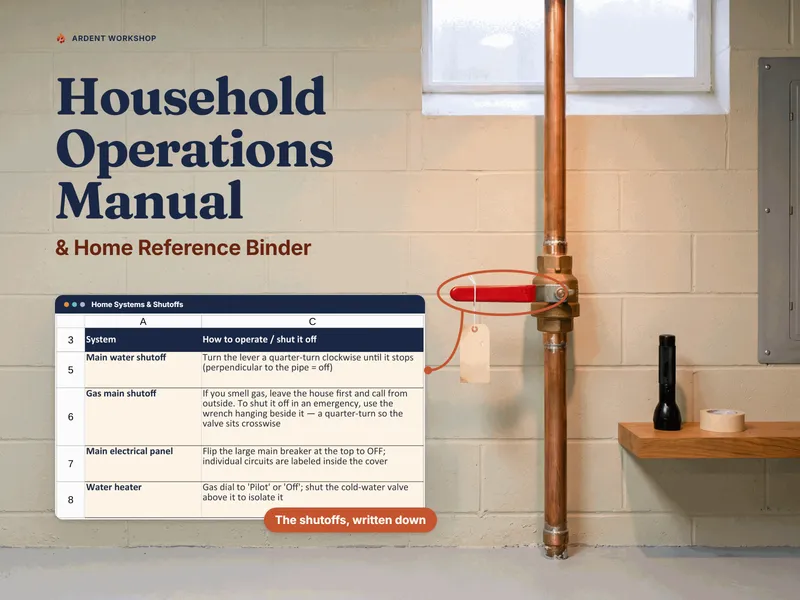
That is the whole idea behind Ardent Workshop: things you own outright, sitting between a blank sheet of paper and a rented app. This pack is the emergency-and-handoff half of running a home. If you also want the routine half written down — every utility and account, the maintenance schedule, the running reference — the Household Operations Manual & Home Reference Binder is that, in a workbook. Neither contains the other; they sit side by side.
Printing it
US Letter or A4 — the two files you actually print each come in both editions, laid out for the sheet rather than scaled to it. Single-sided, at 100% (Actual size) — not “fit to page”, which moves the cut marks on the card sheets. Grayscale is fine for the fill-in pages if you are saving ink. Card stock is worth it for the cards. If you laminate, fill the page in first.
Not professional advice
This is a household reference pack — your own information, organized and posted. It is not professional emergency, medical, plumbing, gas, electrical, insurance, or legal advice, and it does not replace your utility company, a licensed trade, your doctor, or the instructions of local officials. The shutoff guide is general orientation for finding and labeling the valves in your own home; if something is seized, corroded, or unfamiliar, leave it alone and ask someone qualified. In any emergency involving gas, fire, or an electrical hazard, get everyone out first and call from outside.
Want a taste first? Two pages of this pack are free and ungated: the Home Shutoff & Breaker Location Map — the standout page, and it comes shown filled in — and the “If I’m Away” House-Sitter Sheet. Neither costs anything and neither asks for an email.