What it actually is
A proof of loss is a sworn statement of your claim. Typically it identifies the policy and the claim, the date and cause of the loss, who else has an interest in the property (your mortgage servicer, usually), and — the part that matters — the amount you are claiming, often with a schedule of damaged property attached. Follow the required form for signatures and any oath or notarization; these are not interchangeable requirements.
Because it is sworn, it is not a form to fill in casually. Two rules follow from that: never sign a blank one, and never sign a figure you have not worked out yourself. If your insurer sends a partially completed proof of loss with their number already on it, you are entitled to check that number before you sign.
The deadline, and where yours comes from
Find the proof-of-loss provision in your policy and any request from the insurer. Record the event that starts the clock, the due date, what must be submitted and where. Do not infer a homeowners-policy deadline from a flood-insurance rule, or assume a letter overrides the policy.
For a specific federal example, the NFIP Standard Flood Insurance Policy dwelling form generally requires a signed and sworn proof of loss within 60 days after the loss. Applicable FEMA waivers or extensions can change the requirement. This is not a rule for every private flood policy.
Ask the insurer to identify any applicable waiver or extension in writing. An extension request is not itself approval, and an adjuster's involvement does not automatically satisfy the policyholder's filing obligations.
What goes on the schedule
The attached schedule of damaged property is where a proof of loss is won or lost, because it is where the amount comes from. For contents that means a room-by-room inventory: what the item was, how old it was, what it would cost to replace, and what it was worth at the moment it was destroyed — the Disaster-Recovery Claims & Rebuild Binder estimates depreciated values from category and age. Those estimates help organize questions; the policy and claim evidence determine the applicable valuation, not the workbook alone.
Count by category rather than by memory — "14 work shirts", not "clothes". Whole-household categories like clothing, linens, kitchenware and tools are the easiest to summarize away in one line, and so the easiest to underclaim.
Proof of loss is not the same as proof of purchase
The names are similar and the confusion is common. The proof of loss is the sworn statement of the claim. Proof of an individual item — a receipt, a pre-loss photograph, a bank record, a serial plate — is the evidence behind a line on the schedule. Ask what supporting records the insurer requires. A description, model number or comparable listing may help, but is not guaranteed to establish ownership, condition or value by itself.
Additional damage and supplemental requests
Report additional damage or an omitted or misidentified item promptly and ask what supplemental documents are required. The NFIP claims checklist expressly discusses requesting additional payment when damage, estimate details or repair costs warrant it. Review the policy's deadlines and any settlement or release before assuming either that supplementation is barred or that it preserves all other rights.
An honest word
This page is general explanation — not insurance, legal, tax, or public-adjusting advice, and no guarantee of any result. Ardent Workshop is not affiliated with, endorsed by, or connected to FEMA, the Small Business Administration, any insurance company, or any government agency. What your policy requires, when it is due, and what you are owed are set by that policy, by your state, and by the letters your insurer sends you. If a deadline is close or has passed, call your insurer today: a passed date is a reason to pick up the phone rather than to stop, and seek advice on the applicable rights and deadlines if the response is unclear or disputed. Your state insurance department takes claim-handling complaints for free.
Related tools and concepts
New to this? Start with the free After-the-Disaster First Steps Checklist — the first week in order, including the figures to find on your declarations page.
Then read what an insurance adjuster does, and the step-by-step tutorial on documenting a home insurance claim. If you are deciding where to keep the record, compare an owned claims binder against a hosted claims app. The tools for disaster recovery hub has the rest.
Templates that implement this
Tools for the claim behind the proof of loss
2 templates
Work out what every damaged item was actually worth, log every deadline the claim creates, and keep the correspondence trail — in one owned file.
- $23.95 Spreadsheet

Disaster-Recovery Claims & Rebuild Binder — Loss Inventory, Living Expenses, Claim Deadlines & Adjuster Log (Excel + Google Sheets)
A post-disaster insurance claim organizer for Excel & Sheets — work out each item's cash value, compute claimable living expenses, track every deadline.
Life AdminView details - $21.95 Spreadsheet
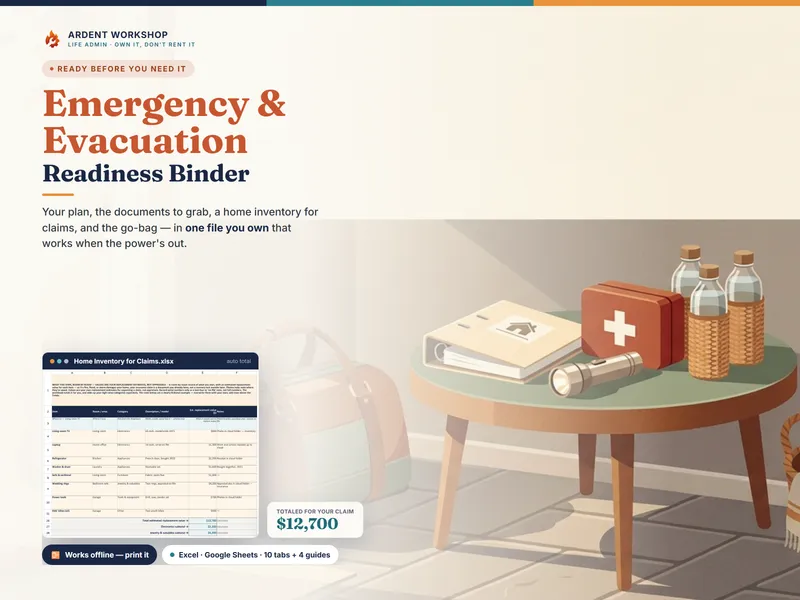
Emergency & Evacuation Readiness Binder — Family Plan, Document Grab-List, Home Inventory & Go-Bag (Excel + Google Sheets)
An emergency & evacuation readiness binder for Excel & Google Sheets — your plan, documents to grab, home inventory & go-bag in one file you own.
Life AdminView details