The three kinds, and who pays each one
An insurance adjuster is the person who investigates a property claim, inspects the damage, and works out what the insurer will pay. There are three kinds, and the difference that matters is who is paying them.
- Staff (company) adjuster. An employee of your insurer. They inspect, write an estimate, and have authority up to a limit set internally.
- Independent adjuster. A contractor working the claim on the insurer's behalf. After a large declared disaster, carriers bring in catastrophe teams, so this is who many households actually meet — and it is why the person handling your claim may be reassigned partway through, or rotate out of the area entirely.
- Public adjuster. Works for you, not the insurer, and is paid a percentage of the settlement. Licensed and regulated by the state in most of the country — though a handful of states do not license or permit public adjusters at all, so check yours. Their fee is negotiable, and many states cap it after a declared disaster.
There is a fourth person you may meet who is not an adjuster at all: a contractor offering to "handle the claim for you." In many states, negotiating a claim on your behalf requires a public adjuster's license. Ask.
What an adjuster actually does
They inspect the property, scope the damage, and write a line-by-line estimate from a pricing database, applying your policy's terms — the limits, the deductible, any sub-limits, and whether contents are covered at replacement cost or actual cash value. The output is a number, and that number comes from a document you are entitled to see.
Ask for the estimate, and for the depreciation applied to it. That single request changes the whole dynamic of a disagreement. It turns "this feels too low" into "line 41 was depreciated at a rate I would like to understand" — and only one of those two is a conversation anyone can act on.
Working with one, practically
- Get a direct number and a name every single time. After a large event you may well speak to a different person almost every call.
- Log every contact the day it happens — date, name, reference number, what was agreed. "On the 14th, this adjuster confirmed the supplement was opened, reference 0147-S" is worth a great deal; "someone told me it was approved" is worth nothing.
- Follow important calls with an email summarizing what was said. It costs a minute and turns a conversation into a record.
- Do not start permanent repairs before the inspection. Temporary work to stop further damage is expected and normally reimbursable; permanent repairs can cost you the evidence.
- Bring your own numbers. An adjuster is scoping a property they have seen once. You have the photographs, the inventory, and the ages of your own possessions.
Should you hire a public adjuster?
For a large, complex, or stalled claim it can be worth the percentage; for a straightforward one it may not be. What is true either way: in most states they are licensed and regulated, the fee is negotiable, and the ones who knock on your door in the first week are not the ones to judge the profession by. If you are considering it, being organized makes you a better client — an itemized inventory and a complete correspondence log are exactly what they would otherwise build for you, on your percentage. Your state insurance department can tell you whether public adjusters are licensed where you live, and how they are regulated.
When the number does not match the damage
Most disputes are not bad faith. They are a scope somebody wrote down differently, a price list that lags a market where every roofer in the county is booked, or damage nobody could see on the day. Four things to do, in order:
- Ask for a re-inspection in writing, and send what supports it.
- Ask whether your policy contains an appraisal clause — a process for disputes about the amount of a loss rather than whether it is covered.
- Name the specific line items you disagree with, rather than the total.
- Remember your state insurance department takes claim-handling complaints for free — and while the claim is still live, not after you have closed it.
An honest word
This page is general explanation — not insurance, legal, tax, or public-adjusting advice, and no guarantee of any result. Ardent Workshop is not affiliated with, endorsed by, or connected to FEMA, the Small Business Administration, any insurance company, or any government agency. Titles, licensing, and fee rules vary by state, and what you are owed is set by your policy and the letters your insurer sends you.
Related tools and concepts
New to this? Start with the free After-the-Disaster First Steps Checklist — the first week in order, no signup.
Then read what a proof of loss is before you sign one, and the step-by-step tutorial on documenting a home insurance claim. If you are weighing where to keep the record, compare an owned claims binder against a hosted claims app. The full Disaster-Recovery Claims & Rebuild Binder keeps the claim, the losses, the deadlines and the correspondence in one owned file, and the tools for disaster recovery hub has more.
Templates that implement this
Tools for working with an adjuster
2 templates
Come to every call with the dates, the documents, and your own figures — one owned file for the claim, the losses, and the correspondence trail.
- $23.95 Spreadsheet

Disaster-Recovery Claims & Rebuild Binder — Loss Inventory, Living Expenses, Claim Deadlines & Adjuster Log (Excel + Google Sheets)
A post-disaster insurance claim organizer for Excel & Sheets — work out each item's cash value, compute claimable living expenses, track every deadline.
Life AdminView details - $21.95 Spreadsheet
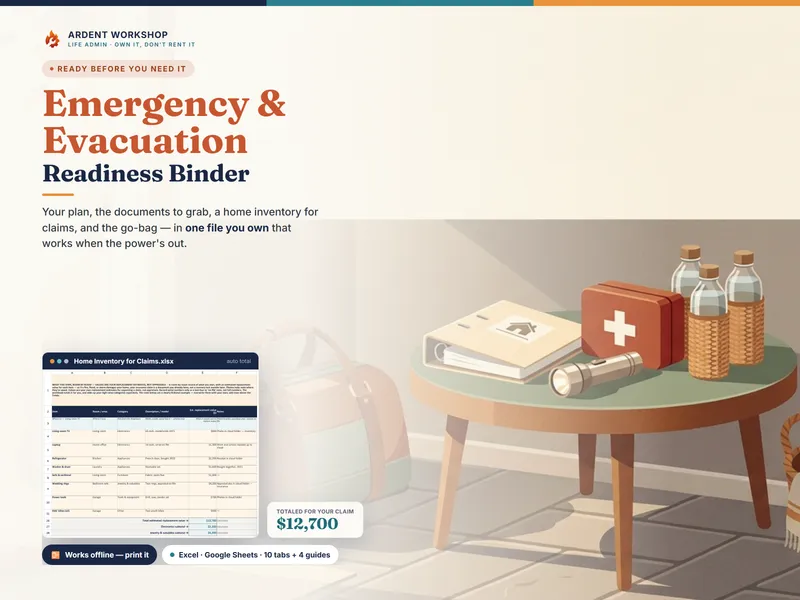
Emergency & Evacuation Readiness Binder — Family Plan, Document Grab-List, Home Inventory & Go-Bag (Excel + Google Sheets)
An emergency & evacuation readiness binder for Excel & Google Sheets — your plan, documents to grab, home inventory & go-bag in one file you own.
Life AdminView details