OJT vs. classroom (related) instruction
Most structured programs pair two kinds of learning. On-the-job training is the hands-on work, done at the bench or on the line under a mentor. Related instruction — often called Related Technical Instruction, or RTI — is the classroom or online theory that runs alongside it: shop math, print reading, electrical theory, safety. A registered apprenticeship typically requires a set number of both: thousands of OJT hours across the trade's work processes, plus a yearly block of RTI hours. The record has to cover both halves; a program that logs its on-the-job hours perfectly but loses track of the classroom hours still fails the review.
Why OJT is counted in hours by competency
"Two thousand hours" on its own proves little. What a sponsor or registration agency wants is hours tied to skill: so many hours on lockout/tagout, so many on bearings and couplings, so many on motor controls — each one a competency, or work process, the trainee had to master. Logging OJT hours against the competency they built turns a raw total into evidence of what was trained, and lets a program see how close a trainee is to the required hours on each skill, not just overall.
The sign-off is what makes an hour count
An auditor rarely doubts that hours were worked — they doubt the hours were verified. That's what a sign-off is: a named mentor or supervisor attesting, on a date, that the work was done to standard. A block of OJT hours with a sign-off is defensible evidence; the same hours with nobody's name behind them are just numbers. Good OJT records capture the sign-off at two levels — on the hours as they're logged, and on the whole competency once the trainee is judged competent in it.
How OJT hours are documented
- Define the competencies. List the work processes the role requires, each with a target number of OJT hours — usually straight from the program's or trade's standards.
- Log the hours as they happen. One entry per block of time, tied to a competency and the mentor who trained it — by the day, the week, or the pay period.
- Sign it off. Have a mentor or supervisor verify the hours and record who signed and when, while the work is fresh.
- Roll it up. Total hours per competency against the required target, and track which competencies are signed off — so you always know how close each trainee is to done.
Common mistakes documenting OJT
- Logging hours with no competency. A total with no skill attached can't answer the question an audit asks — what was trained.
- Chasing sign-offs months later. The hardest signature to get is the one you ask for after the supervisor has forgotten the job. Sign off as you go.
- Forgetting the classroom. Related instruction hours are part of the requirement; a program that only tracks OJT is only half-documented.
Related concepts and templates
On-the-job training is the core of a registered apprenticeship, and it's a form of the verified-skill tracking a skills matrix captures. To log one trainee's OJT hours for free, the free single-apprentice hours log is an ungated taste; the full Apprenticeship / OJT Training-Hours Logbook adds competency progress, sign-offs, the RTI hours, and a completion-readiness dashboard for a whole program. For when to keep it in a workbook versus a platform, see apprenticeship hours spreadsheet vs. apprenticeship-management software, and the templates for HR & team leads hub for the rest of the toolset.
Logged hours also decide what an apprentice may be put on unsupervised, which is a question the logbook alone cannot answer. The Crew Safety & Training-Compliance Kit joins the hours with the skill level, the certification and the talk attendance, and returns one verdict per person per station. The Assignment Gate Starter is a free ten-row version of that join.
Templates that implement this
Templates that document on-the-job training
2 templates
Log OJT hours against the competency each built, capture the mentor and supervisor sign-off, and roll it up against required totals — audit-ready evidence, not a folder of timesheets.
- $24.95 Spreadsheet

Apprenticeship & OJT Training-Hours Logbook — Hours, Competencies & Sign-Offs for Excel & Google Sheets
An apprenticeship & OJT training-hours logbook for Excel & Google Sheets: log hours by competency, capture sign-offs, and track completion readiness.
Team & TalentView details - $29.95 Spreadsheet
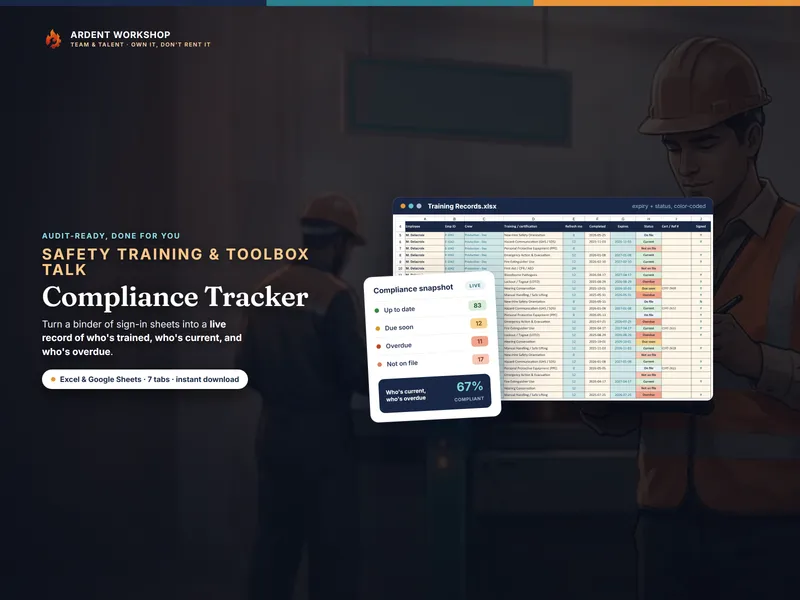
Safety-Training & Toolbox-Talk Compliance Tracker — Excel & Google Sheets
A safety-training & toolbox-talk tracker for Excel & Google Sheets — automatic refresher expiry, color-coded status, and audit-ready compliance dashboard.
Team & TalentView details