The parts of a registered apprenticeship
- On-the-job training (OJT). Paid, supervised work under a mentor, planned around the trade's competencies — usually a large number of required hours over several years.
- Related instruction (RTI). Classroom or online theory that runs alongside the work — commonly a required block of hours per year.
- A structured wage progression. Apprentices earn a rising percentage of the journeyworker wage as they gain skill.
- A sponsor. The employer or partnership responsible for the program, the mentorship, and the records.
- A recognized credential. On completion, a certificate the industry recognizes nationally.
Time-based, competency-based, or hybrid
Programs define completion in one of three ways. A time-based program sets a required number of OJT hours per work process. A competency-based program cares that each competency is demonstrated, however long it takes. Most modern programs are a hybrid: enough hours and a demonstrated, signed-off competency. Whichever model a program uses, the record has to show it — hours logged, competencies signed off, and the classroom hours complete.
What a sponsor has to document
Registration comes with a documentation duty. A sponsor generally has to be able to show, for each apprentice: the OJT hours logged against each work process, who verified them and when, the related-instruction hours completed, and the competencies signed off — the paper trail that proves the training standards were met. When most of that lives on loose timesheets and in one supervisor's memory, it falls apart under review. A structured record — every hour tied to a competency, every competency to a sign-off — is what makes a completion package defensible.
Registered apprenticeship vs. an informal apprenticeship or internship
The word "apprenticeship" gets used loosely. An informal apprenticeship or an internship may involve real on-the-job learning, but without registration, published standards, a required hour-and-competency framework, or a recognized credential at the end. A registered apprenticeship is the formal version: it answers to an agency's standards, and the documentation is part of the deal. The record-keeping described here applies to any structured OJT program, but it's a registered program that most needs it.
Related concepts and templates
A registered apprenticeship is built on on-the-job training, and tracking who is competent in what is a form of the skills matrix idea. To log one apprentice's hours for free, the free single-apprentice hours log is an ungated starting point; the full Apprenticeship / OJT Training-Hours Logbook documents hours, sign-offs, RTI, and completion readiness for a whole program. See the templates for HR & team leads hub for the rest of the toolset.
This is a general explanation, not legal or registration advice. Ardent Workshop is not affiliated with or endorsed by the U.S. Department of Labor, any state apprenticeship agency, or any Registered Apprenticeship program. Requirements vary by trade, agency, and state — confirm yours against your own standards.
Templates that implement this
Templates that document an apprenticeship
2 templates
Track OJT hours by competency, capture mentor and supervisor sign-offs, log the related instruction, and see each apprentice's completion readiness — the evidence a sponsor's review asks for.
- $24.95 Spreadsheet
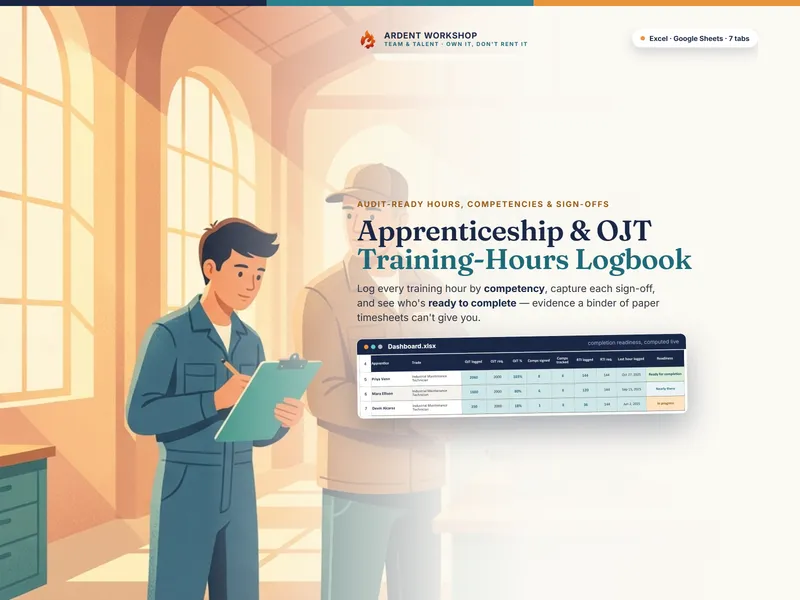
Apprenticeship & OJT Training-Hours Logbook — Hours, Competencies & Sign-Offs for Excel & Google Sheets
An apprenticeship & OJT training-hours logbook for Excel & Google Sheets: log hours by competency, capture sign-offs, and track completion readiness.
Team & TalentView details - $19.95 Spreadsheet

Training & ILUO Skills Matrix — Coverage & Key-Person Risk (Excel + Google Sheets)
An ILUO skills matrix for Excel & Google Sheets — track each operator's level on every task, see coverage at a glance, and flag key-person risk.
Team & TalentView details