What the four levels mean
The power of ILUO is the line it draws between "can do it with help" and "can do it alone." Coverage only starts on the far side of that line.
- I — In training. Learning the task under direct instruction. Cannot work it without a trainer alongside. The starting line, not coverage.
- L — Limited. Can do the task with supervision, or can do part of it unaided. Not yet signed off to work alone — so still not coverage.
- U — Unsupervised. Fully competent. Works the task alone, to standard, with no supervision. This is the first step that counts as coverage.
- O — Operator. Fully competent and able to train and sign off others. Counts as coverage and as your training capacity.
A blank cell means "not assessed" — treat it as a gap, not a quiet pass. The conventional symbols are quarter-filled circles: in training, limited, unsupervised, operator.
ILUO matrix vs. a numeric skills matrix
A skills matrix usually scores proficiency on a 0–5 number scale. An ILUO matrix is a skills matrix with a particular, opinionated four-step scale built for operational coverage rather than fine-grained skill. The win is shared meaning: "Unsupervised" has one agreed definition — can run the task alone to standard — so coverage isn't a judgment call. ILUO is a common vocabulary in manufacturing, food production, labs, and other quality-managed environments, where "who is signed off for this task" is a question with audit consequences.
What an ILUO matrix surfaces
- Coverage. For each task, how many people are at Unsupervised or Operator — the ones who can run it alone.
- Single points of failure. A task only one person can run. The day they're off sick, on holiday, or gone, the task goes with them.
- Training capacity. Only an Operator can sign others off, so the count of Operators on a task is how fast its bench can grow. A task with coverage but no Operator can be run today but not taught.
- Cross-training priorities. Every single point of failure on a critical task is the next training job, in priority order.
- Audit evidence. A dated, reviewed board shows that competence is defined, assessed, and kept current.
How to build one
- List the tasks, not the job titles — one row per task someone is either signed off for or not.
- List the people down the side, with shift or area if it helps.
- Assess each cell against evidence, not impression. The test is simple: could they do this right now, alone, to standard?
- Be strict about the Unsupervised line. A board that overstates coverage hides the very risk it was built to show.
- Count coverage per task, flag the single points of failure, and cross-train them in criticality order.
- Date it and review it on a regular rhythm — quarterly is common. A matrix is only true on the day it was filled in.
For a fuller walkthrough on a production line, follow the step-by-step how to build an ILUO skills matrix tutorial.
Common mistakes
- Rounding people up. Marking someone Unsupervised because they're nearly there. When in doubt, mark the lower level.
- Counting Limited as coverage. If they still need help, the line still stops when the qualified person is away.
- Tracking proficiency you don't need. ILUO is about operational coverage; don't let it sprawl into a performance score.
- Letting it go stale. Last year's board describes a team that no longer exists.
Try it free, or get the full board
The fastest way to understand ILUO is to fill one in. The free ILUO starter board lets you try the icon system on a small grid, and the Training & ILUO Skills Matrix adds the coverage counts, key-person-risk flags, and audit log for a whole team. See also ILUO matrix vs. LMS training records and the templates for HR & team leads hub.
A level says what someone can do. It does not say whether they are allowed to do it today — that also depends on whether their certification is current and whether their toolbox-talk attendance has kept up. The Crew Safety & Training-Compliance Kit joins all of those into a single verdict per person per station, and the Assignment Gate Starter is a free ten-row version of that join.
Templates that implement this
Templates that build an ILUO matrix
2 templates
A ready-made ILUO board with the four-level icon system, per-task coverage counts, and key-person-risk flags — pre-loaded with a worked example you overwrite with your team.
- $19.95 Spreadsheet

Training & ILUO Skills Matrix — Coverage & Key-Person Risk (Excel + Google Sheets)
An ILUO skills matrix for Excel & Google Sheets — track each operator's level on every task, see coverage at a glance, and flag key-person risk.
Team & TalentView details - $24.95 Spreadsheet
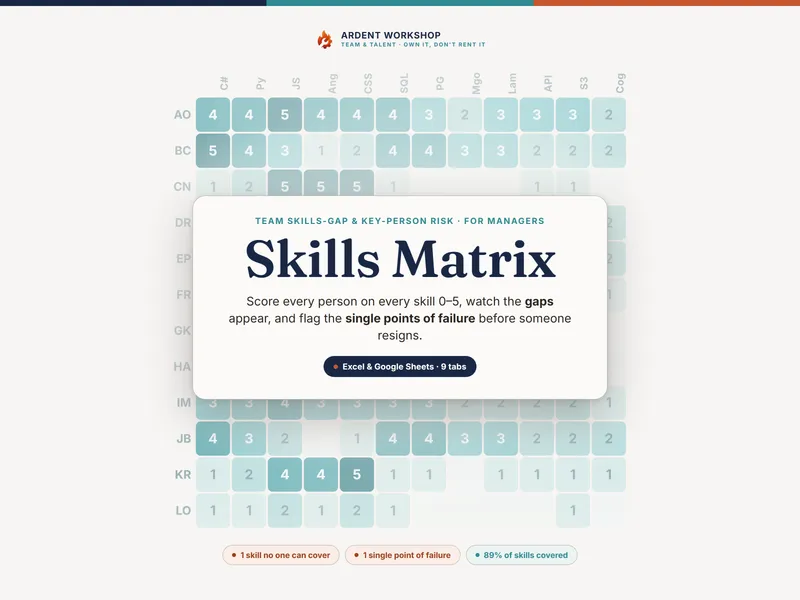
Skills Matrix Template - Team Skills Gap Analysis & Key-Person Risk (Excel & Google Sheets)
A 9-tab skills matrix for Excel & Google Sheets: score your team 0-5, find the skills gaps, and flag single points of failure before someone resigns.
Team & TalentView details