How many apprenticeship hours your trade requires is set in three places, not one: a federal floor of at least 2,000 hours for the entire term, your own registered program standards, and your state licensing board — 8,000 hours for a journey-level electrician in both Texas and Washington. Those three numbers do not have to agree. Here is how that plays out.
An apprentice three years in asks how many hours they still need. You say 8,000, because that is the number everyone in the trade says. They ask how many they have. You open a folder of timesheets, add up some payroll exports, and give them a number you would not want to defend in front of an auditor.
Then it gets worse. They finish the program. They apply for a journey-level license. The licensing board sends the application back, because the hours you certified are not the hours the board counts.
The problem is not your arithmetic. It is that “how many apprenticeship hours does my trade require” has no single answer — and almost everyone asking it assumes it does.
Why apprenticeship hours have no single number
The hours requirement for an apprentice is not one number set by one body. It is three separate requirements, set by three different authorities, that stack — and they do not have to agree with each other.
| Layer | Who sets it | What it governs | What happens if you miss it |
|---|---|---|---|
| Federal floor | US Department of Labor, 29 CFR part 29 | Whether an occupation is apprenticeable at all, and the minimum term a time-based program may set | Your program cannot be registered |
| Program standards | Your program sponsor, approved by your Registration Agency | The actual term your apprentices must complete | Your apprentice does not complete |
| State licensure | A state licensing board | Whether that person can work unsupervised in the trade | Your apprentice completes and still cannot get licensed |
Most of the confusion in this subject comes from someone quoting a number from one layer and applying it to another. “2,000 hours” is a federal floor. “8,000 hours” is usually a licensing requirement. “Four years” is a program term. They are answers to three different questions.
That also explains the record-keeping problem sitting underneath it. A running total of hours answers the first question and only the first question. The other two ask which hours, doing what, supervised by whom — and a column of weekly totals cannot answer that after the fact. That is the gap the Apprenticeship and OJT Training-Hours Logbook is built to close: every hour logged against the competency it built, with the mentor and supervisor recorded on the entry. But the structure matters more than the tool, so here is the whole picture either way.
Layer 1: the federal floor is 2,000 hours — for the entire term
The federal minimum for a time-based registered apprenticeship is at least 2,000 hours of on-the-job learning across the whole program, not per year. The rule is 29 CFR 29.5(b)(2) (opens in new tab), which lets a sponsor measure the term three ways:
The term of apprenticeship, which for an individual apprentice may be measured either through the completion of the industry standard for on-the-job learning (at least 2,000 hours) (time-based approach), the attainment of competency (competency-based approach), or a blend of the time-based and competency-based approaches (hybrid approach).
The “per year” misreading is common enough that the Department of Labor’s Office of Apprenticeship put it in writing in Circular 2026-01 on Registered Apprenticeship training approaches (opens in new tab), issued 9 March 2026:
The minimum of 2,000 hours of on-the-job learning required in the time-based approach applies to the entire term of the apprenticeship program and is not a minimum number of hours per calendar year. A program can distribute the required hours of on-the-job learning across multiple years based on the nature of the occupation and the needs of the employer and apprentices.
There is a second 2,000-hour figure that gets mixed in with this one, and it is not a requirement on your apprentices at all. The circular’s own footnote is blunt about it: the 2,000-hour standard in 29 CFR 29.4(c) (opens in new tab) “is solely for the purpose of defining an apprenticeable occupation” — it is the test for whether an occupation is eligible for registration in the first place.
Related instruction is recommended, not required
The classroom side has its own number, and it is softer than it is usually treated as being. 29 CFR 29.5(b)(4) (opens in new tab) reads:
Provision for organized, related instruction in technical subjects related to the occupation. A minimum of 144 hours for each year of apprenticeship is recommended.
Recommended. The 2026 circular restates the point — “the regulation recommends, but does not require, a minimum of 144 hours of related instruction for each year of apprenticeship” — and confirms the hours can be sequenced to suit the work:
Related instruction may be front-loaded, segmented, or delivered concurrently with the on-the-job learning. In practice, a program may propose more than 144 hours of related instruction in the first year, with less than 144 hours in later years of a program’s overall term, and still meet the recommended 144 hours of related instruction per year of the apprenticeship.
Sponsors are not confined to clock hours in counting it, either. The circular allows related instruction to be quantified “utilizing clock hours, credit hours, contact hours, or alternative, commonly recognized measures of time,” and time spent on out-of-class work can count.
The practical consequence: related-instruction hours need their own running record, kept separately from on-the-job hours, because they are measured against a separate target on a separate schedule.
Layer 2: your program standards set the number that actually binds
The number your apprentices must actually hit is the one in your registered program’s standards — the work process schedule your Registration Agency approved. The federal floor tells you the minimum that number is allowed to be. It does not tell you what yours is.
Which of the three approaches your program uses changes what “hours” even means:
| Approach | How the term is measured | What you have to evidence |
|---|---|---|
| Time-based | Completion of at least 2,000 hours of on-the-job learning, described in a work process schedule | Hours, tied to the specific work processes in the schedule |
| Competency-based | Successful demonstration of acquired skills and knowledge, verified by the sponsor | Assessment results per competency, plus an on-the-job learning component |
| Hybrid | A specified minimum number of hours and demonstrated competencies | Both — hours and sign-offs, against the same work process schedule |
Note what is true in all three rows: even a competency-based program still has an on-the-job component. The circular is explicit that programs using that approach “must still require apprentices to complete an on-the-job learning component of Registered Apprenticeship.” Competency-based does not mean hours stop mattering. It means hours stop being the finish line.
Four old rules that stopped being rules in March 2026
Circular 2026-01 rescinded and replaced Circular 2016-01, and several of the numbers people still quote came from the older document. If your program standards were written before March 2026, these four are worth a look:
-
The 12-month minimum for competency-based programs is gone. The old guidance carried a table asserting that an apprentice must be registered for twelve calendar months. The Office of Apprenticeship rescinded it because “the regulation does not impose a specific amount of time an apprentice must be registered in a program utilizing a competency-based approach.”
-
The 25% cap on adjusting a term is gone. Time-based and hybrid terms could previously be adjusted up or down by no more than 25% of the industry standard. That cap “does not have a basis in the regulation.” A Registration Agency may still treat 25% as “a helpful, non-binding guideline,” but it is no longer a ceiling.
-
The six-month and 1,000-hour minimum before a certificate of completion is gone. The old rule required an apprentice to have worked under the sponsor for at least six months, and at least 1,000 hours in a time-based or hybrid program, before completing. Rescinded, because “the regulation does not impose these limitations.”
-
The 50% ceiling on credit for prior work experience is gone. The old guidance “asserted that the maximum allowable credit for prior work experience is 50 percent of training.” The Office of Apprenticeship rescinded it because “the regulation does not impose this limitation on the granting of advanced standing” — so an experienced hire can be granted more than half the term, provided your written advanced-standing policy supports it and you keep the documentation behind the decision.
The through-line in all four is the same: the federal rules got less prescriptive about hours, and correspondingly more interested in whether you can evidence progress. Which brings us to the part that is easy to miss. 29 CFR 29.5(b)(6) (opens in new tab) requires “Periodic review and evaluation of the apprentice’s performance on the job and in related instruction; and the maintenance of appropriate progress records,” and the 2026 circular confirms that requirement applies under all three approaches. Fewer fixed hour thresholds does not mean lighter paperwork. It means the paperwork is the thing being checked.
Layer 3: state licensure is a different number, and it does not have to match
Completing a Registered Apprenticeship and getting a state license are two separate achievements with two separate hour requirements. Your Registration Agency issues a certificate of completion. A state licensing board issues a license. Those are different bodies applying different rules, as the two examples below show, and an apprentice can satisfy one without satisfying the other.
Two real examples, both for the same job title in the same trade, make the point better than any general statement can.
Texas: 8,000 hours to be licensed, 7,000 to sit the exam
The Texas Department of Licensing and Regulation’s requirements for a journeyman electrician license (opens in new tab) put the threshold at 8,000 hours, with a deliberate gap between testing and licensure:
To apply for a Journeyman Electrician license, you must have completed at least 7,000 hours of on-the-job training under the supervision of a Master Electrician licensed in Texas. Submitting at least 7,000 hours of on-the-job training will simply allow you to take the examination before reaching the full 8,000 hours required for licensure.
Note who has to vouch for those hours. TDLR requires verification “from each Master Electrician who supervised you,” documented and signed on an Experience Verification Form, one form per supervisor. If an apprentice worked under four masters over four years, that is four forms — and the person whose signature you need may have left the company two years ago.
Washington: 8,000 hours, but only 4,000 of them can be the easy kind
Washington sets the same headline number and then constrains its composition. For the general journey level (01) electrician exam (opens in new tab), Labor and Industries requires:
For a 01 journey level exam– 8,000 hours, no more than 4,000 of which can be worked in 4,000 hour specialties. For a 4,000 hour specialty exam– 4,000 hours in that specialty.
Plus 96 hours of basic classroom instruction for the (01) exam, or 48 hours for a 4,000-hour specialty. There are 14 specialty categories, and the supervision rule is not the same across them: trainees in the six 4,000-hour specialties must be supervised “a minimum of 75% of the time,” while trainees in the eight 2,000-hour specialties must be “supervised 100% of the time until they pass examination.”
This is the detail that breaks total-only records. An apprentice with 8,000 hours of residential work in Washington does not have 8,000 qualifying hours toward an (01) certificate. They have 4,000 that count and 4,000 that do not, and the only way to know which is which is a record that captured what kind of work each block of hours was, at the time it happened.
Washington also draws a distinction in vocabulary worth borrowing, because it is a distinction about status rather than skill. On its electrical apprenticeship requirements (opens in new tab) page, Labor and Industries writes:
Electrical trainees are often referred to as “apprentices.” However, an apprentice is a trainee who is enrolled in a registered apprenticeship program.
That is not pedantry there. The same page records that Washington moved (01) certification to an apprenticeship-only model effective 1 July 2023 — “a new law changes Washington’s approach to journey level (01) electrician certification to an apprenticeship-only model” — with a transition window for trainees who already had 3,000 hours that closed on 1 July 2026. After that date, the main route to the (01) exam is completing a registered apprenticeship program; L&I lists the remaining routes — an equivalent out-of-state program, an out-of-state journey-level certificate, and military or out-of-state experience — under the exceptions on the same page.
How many apprenticeship hours each trade typically requires
You will find per-trade hour figures quoted widely, and the most commonly cited source behind them is the Bureau of Labor Statistics Occupational Outlook Handbook, which describes what is typical — a genuinely different claim from what is required. Here is what it actually says, trade by trade, as of its 27 August 2026 revision.
| Trade | Typical program length | Hours the Handbook states |
|---|---|---|
| Electricians | 4 or 5 years | 2,000 hours paid on-the-job training per year |
| Plumbers, pipefitters, steamfitters | 4 or 5 years | 2,000 hours paid on-the-job training per year |
| Ironworkers | 3 or 4 years | “at least 144 hours of related technical instruction and 2,000 hours of paid on-the-job training” per year |
| Sheet metal workers | 4 or 5 years | Not stated |
| Boilermakers | “typically last 4 years” | Not stated |
| Elevator and escalator installers | 4 years | “a predetermined number of hours” |
| Carpenters | Not stated | “a predetermined number of hours” |
| HVAC and refrigeration technicians | “usually lasts several years” | Not stated |
Every row above is linked to its own Handbook entry in the sources at the end of this post.
Multiply the top rows out and you get the familiar 8,000-to-10,000 range — that arithmetic is ours, not the BLS’s. It is a fair description of the norm for those trades.
But look at the bottom half of the table, because that is the real answer to the question in the title. For five of these eight trades the federal government’s own reference publication declines to give a number at all — three say nothing about hours, and two say only that apprentices must complete “a predetermined number” of them. The carpentry entry is the clearest about why: apprentices “must complete a predetermined number of hours of technical training and paid on-the-job training,” and “apprenticeship program requirements differ based on the type of program and by region.” That is the BLS saying, in its own words, that there is no national table — which is exactly the position you are in, one level down, when a licensing board asks you to certify hours.
So the honest answer to “how many hours does my trade require” is that the typical program runs three to five years at roughly 2,000 hours a year, and that number is not the one that will be checked.
Your actual number takes three lookups
You need all three. Any one of them on its own will give you a number that is right for one audience and wrong for another.
- Your program’s registered standards. The work process schedule is the binding document. If you sponsor the program, this is a file you already own. If you are a training agent for someone else’s program, ask the sponsor for the current version.
- Your Registration Agency. Either the DOL Office of Apprenticeship or a recognized State Apprenticeship Agency, depending on your state — the state office directory (opens in new tab) will tell you which one covers you. They approve the term and they review the records.
- Your state licensing board, separately. This is the lookup people skip, and it is the one that produces the nasty surprise years later. Ask specifically whether the hours carry composition requirements, who is allowed to certify them, and on what form.
The apprenticeship hours record that satisfies all three layers
Every constraint above is really a constraint on your records rather than on your hours. Read back through them and an hour has to carry four facts to be defensible everywhere:
- What work process or competency it built. Required by the work process schedule under every approach, and the only way to answer Washington-style composition rules.
- Who supervised it. Texas needs a named master electrician per block of hours. Washington needs supervision percentages. Neither can be reconstructed from payroll.
- When it happened. Sign-offs collected years later are the ones most at risk, because the supervisor whose signature you need may have moved on — and Texas wants a separate form from every master electrician who supervised the apprentice.
- Whether it is on-the-job training or related instruction. Two separate targets, measured against two separate recommendations. Merging them loses both.
A weekly total in a spreadsheet carries exactly one of those four. That is the whole problem, and it is why the fix is structural rather than a matter of being more diligent with the same format.
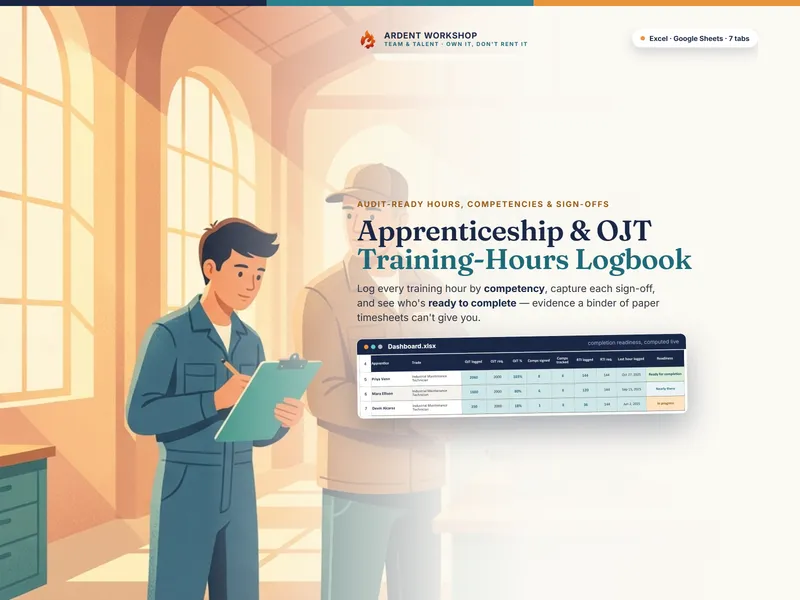
For the mechanics of building that record — the competency framework, the sign-off capture, the completion-readiness read — there is a full walkthrough on how to track apprenticeship OJT hours for an audit. The Apprenticeship and OJT Training-Hours Logbook is that same structure as an owned Excel and Google Sheets workbook: hours logged against competencies, mentor and supervisor sign-offs on each entry, related instruction tracked alongside, and a dashboard that reads each apprentice as ready for completion, nearly there, or in progress. One file you keep, rather than a per-seat subscription to a system that holds your compliance record — that trade-off is worked through in full in apprenticeship hours spreadsheet vs. apprenticeship-management software. If you are documenting one apprentice rather than a cohort, there is also a free single-apprentice hours log that carries the same structure.
It is the same principle behind how to track employee training and certifications before one quietly expires, and behind how to identify skills gaps on your team: the record has to be built to answer the question you will eventually be asked, not the question that was convenient to log.
Common questions about apprenticeship hours
Is the 2,000-hour minimum per year or for the whole apprenticeship?
For the whole term. This is a common misreading of the rule — common enough that the Office of Apprenticeship addressed it directly in March 2026. A program can spread those hours across as many years as the occupation warrants, and the electrician and plumber programs the BLS describes run four or five years, which is far more than 2,000 hours in total.
Do I have to provide 144 hours of related instruction every year?
No. The regulation recommends it; it does not require it. The wording in 29 CFR 29.5(b)(4) is that a minimum of 144 hours for each year of apprenticeship is recommended. Registration Agencies assess your instructional content and total workload against that recommendation, and the hours can be front-loaded or segmented across the term.
Can an apprentice finish early?
Under a competency-based or hybrid program, yes — that is what those approaches are for. A hybrid program’s range of hours “gives the apprentice the opportunity to accelerate completion of the term of apprenticeship” on demonstrated competency. Under a purely time-based program, the hours in the standards are the hours. Separately, advanced standing for prior experience can reduce what remains under any approach, provided your policy for granting it is written down and applied uniformly to every apprentice.
If my apprentice completes the program, are they licensed?
Not automatically, and not in every trade or state. A certificate of completion comes from your Registration Agency. A journey-level license comes from a state licensing board, which is usually a different body with its own hour count, its own paperwork, and its own exam. Check both before an apprentice is close to finishing, not after.
What happens if my hour records are just totals?
You will pass some reviews and fail others. A total is enough to answer the question of how many hours, and that is all some programs will ever be asked. It cannot answer which competencies those hours built, who supervised them, or what proportion was commercial rather than residential — and those are the questions that decide a license application in states like Washington and Texas.
The takeaway: find all three numbers before you need them
There is no national apprenticeship hours table, and looking for one is what causes the trouble. The federal rules set a floor of at least 2,000 hours across the whole term and recommend 144 hours of related instruction a year. Your registered program standards set the number your apprentices actually have to hit. Your state licensing board sets a third number, on its own form, certified by its own list of people.
Find all three before an apprentice needs them, and keep hours in a form that can answer all three: what the hour built, who signed it, when, and which kind of hour it was. The programs that get caught out are rarely the ones that logged too few hours. They are the ones that logged the hours as a single number.
Sources
- 29 CFR 29.5, Standards of apprenticeship (opens in new tab) — US Department of Labor, Employment and Training Administration
- Office of Apprenticeship Circular 2026-01, Registered Apprenticeship Training Approaches (opens in new tab) — issued 9 March 2026
- Apply for a New Journeyman Electrician License (opens in new tab) — Texas Department of Licensing and Regulation
- Electrician licensing, exams and education (opens in new tab) — Washington State Department of Labor and Industries
- Electrical apprenticeship requirements (opens in new tab) — Washington State Department of Labor and Industries
- Electricians, Occupational Outlook Handbook (opens in new tab) — US Bureau of Labor Statistics
- Plumbers, Pipefitters, and Steamfitters, Occupational Outlook Handbook (opens in new tab) — US Bureau of Labor Statistics
- Ironworkers, Occupational Outlook Handbook (opens in new tab) — US Bureau of Labor Statistics
- Sheet Metal Workers, Occupational Outlook Handbook (opens in new tab) — US Bureau of Labor Statistics
- Boilermakers, Occupational Outlook Handbook (opens in new tab) — US Bureau of Labor Statistics
- Elevator and Escalator Installers and Repairers, Occupational Outlook Handbook (opens in new tab) — US Bureau of Labor Statistics
- Carpenters, Occupational Outlook Handbook (opens in new tab) — US Bureau of Labor Statistics
- Heating, Air Conditioning, and Refrigeration Mechanics and Installers, Occupational Outlook Handbook (opens in new tab) — US Bureau of Labor Statistics
- State Offices of Apprenticeship directory (opens in new tab) — Apprenticeship.gov