Cross-training vs. a skills matrix vs. a coverage plan
Three terms travel together and get muddled. They're really three steps of one job:
- A skills matrix records who can do what — people down one side, tasks across the top, a level in every cell. It's the picture.
- Coverage is what you read off that picture: how many people can run each task alone. One person is a single point of failure; two or more is cover.
- Cross-training is the action you take to raise coverage where it's thin — training a second person up on the tasks that need it.
So a cross-training matrix is a skills matrix pointed at a decision: not just "who can do what," but "where are we short, and what do we do about it."
Why cross-training matters
- Resilience. When two people can run a task, one being away is an inconvenience, not a stoppage. That's the whole return.
- It kills key-person risk. A task only one person can do is a bus factor of one — the work leaves when they do. Cross-training raises the bus factor deliberately.
- Flexibility. People who can move between tasks make a line easier to balance and a rota easier to fill.
- Fairer progression and engagement. A visible plan shows everyone what the next sign-off is and what it takes — and a broader job is a less boring one.
How to plan cross-training
Guessing at it — "let's train Sam on packing sometime" — is how it never happens. A grid turns it into a short, ordered plan:
- Assess honestly. Score each person on each task. A common scale is ILUO: In training, Limited, Unsupervised, Operator — where "Unsupervised" is the first level that counts as coverage, and "Operator" is someone who can also train.
- Set a coverage target per task. How many people you want able to run it — two as a baseline (no single point of failure), three or more for tasks that run across shifts.
- Find the gaps. Compare actual coverage against the target. Every task below target is a cross-training job; the high-criticality ones come first.
- Pair a trainer with a trainee. For each gap, pick an Operator to teach and the person closest to the line to bring up — and note the special case where there's no trainer yet, so you grow one first.
- Schedule it and track it. A pairing with a date and a status gets done; one that lives in your head doesn't.
Common mistakes
- Rounding people up. Marking someone "can cover" when they still need help hides the very risk the plan was built to show. When in doubt, mark the lower level.
- Training breadth with no target. Without a target you can't tell "enough" from "not enough." The target is what turns effort into a finish line.
- Ignoring training capacity. A task with coverage but no Operator can be run today but not taught — so the bench can only shrink. Grow a trainer before it's the last one.
- Letting the grid go stale. Coverage is only true on the day it was assessed. A quick, regular review keeps it worth trusting.
Related templates and concepts
Cross-training sits on top of a skills matrix and directly attacks key-person risk — the bus factor. Where to go next:
- Try it free. The Coverage Checker is an ungated, no-signup tool that flags your single points of failure.
- Plan the whole team. The Cross-Training & Coverage Planner sets a target for every task, shows the gap, and suggests the pairings to close it.
- Compare the options. See how a matrix stacks up against workforce scheduling software.
- See the rest of the toolset. The templates for HR & team leads hub collects the skills matrices, gap analysis, and more.
Templates that implement this
Templates that plan cross-training
3 templates
Set a coverage target per task, see the gap against it, and get a suggested trainer-and-trainee pairing for each gap — in one owned spreadsheet.
- $24.95 Spreadsheet
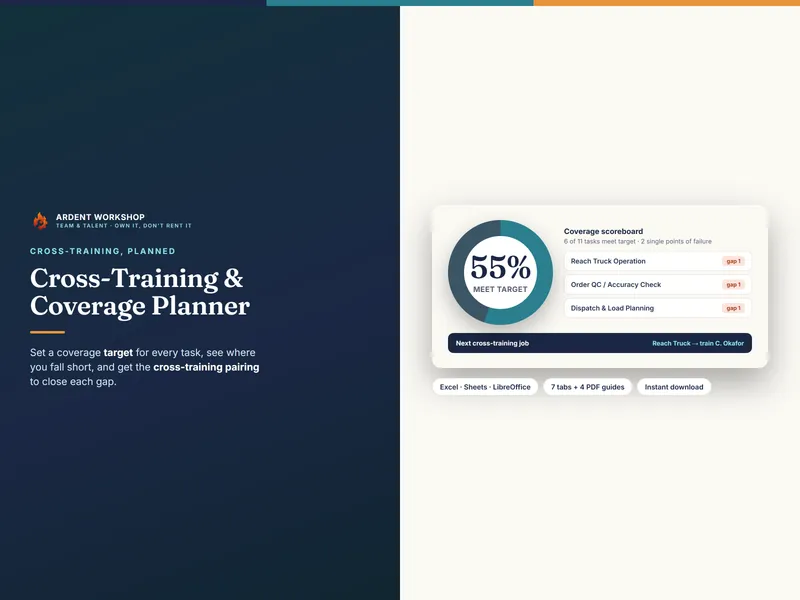
Cross-Training & Coverage Planner — Skills Coverage & Cross-Training Matrix (Excel + Google Sheets)
A cross-training and coverage planner for Excel & Google Sheets — set a coverage target per task, see the gaps, and get the pairings to close them.
Team & TalentView details - $19.95 Spreadsheet
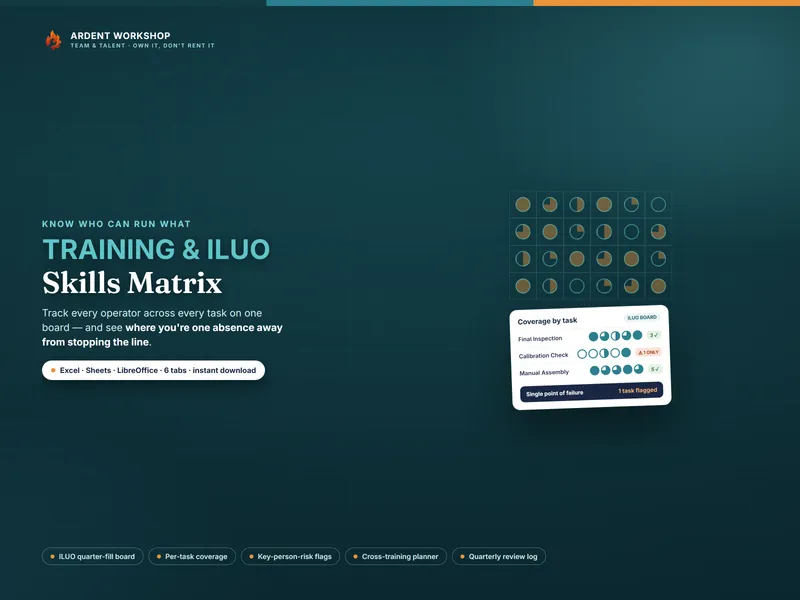
Training & ILUO Skills Matrix — Coverage & Key-Person Risk (Excel + Google Sheets)
An ILUO skills matrix for Excel & Google Sheets — track each operator's level on every task, see coverage at a glance, and flag key-person risk.
Team & TalentView details - $24.95 Spreadsheet
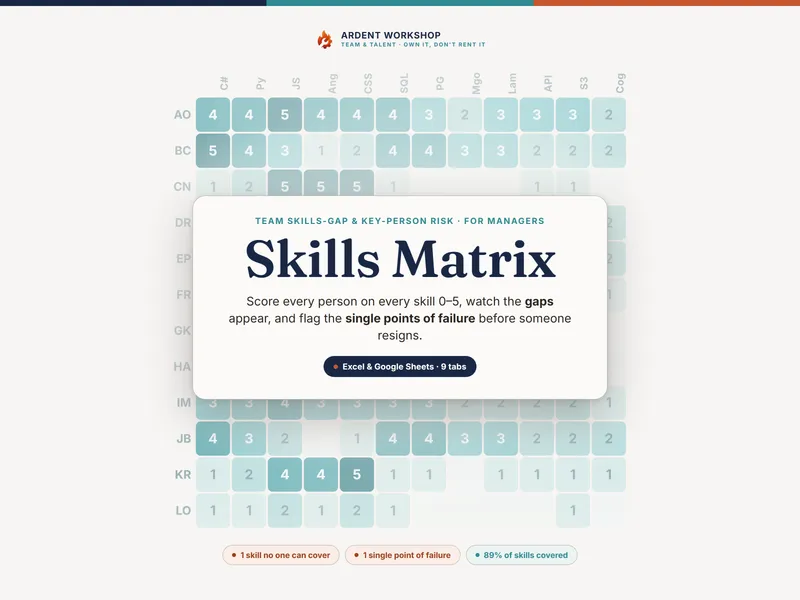
Skills Matrix Template - Team Skills Gap Analysis & Key-Person Risk (Excel & Google Sheets)
A 9-tab skills matrix for Excel & Google Sheets: score your team 0-5, find the skills gaps, and flag single points of failure before someone resigns.
Team & TalentView details