Hiring your first help is the scariest math a maker ever does. You know you’re drowning — you’re packing orders at midnight, ignoring messages for days, and turning down work you’d love to take. But payroll feels like a cliff. So most makers stay solo far longer than they should. In fact, about 82% of U.S. small businesses have no employees at all (opens in new tab) (SBA Office of Advocacy) — the leap from “just me” to “me plus one” is the line most operations never cross.
Here’s the reframe that makes it less scary: you’re not hiring a person, you’re hiring a role — and every role has one skill that actually matters. Get that one skill right and the hire pays for itself. Optimize for the wrong skill (usually “they’re as talented as me”) and you’ll spend more time managing them than you saved.
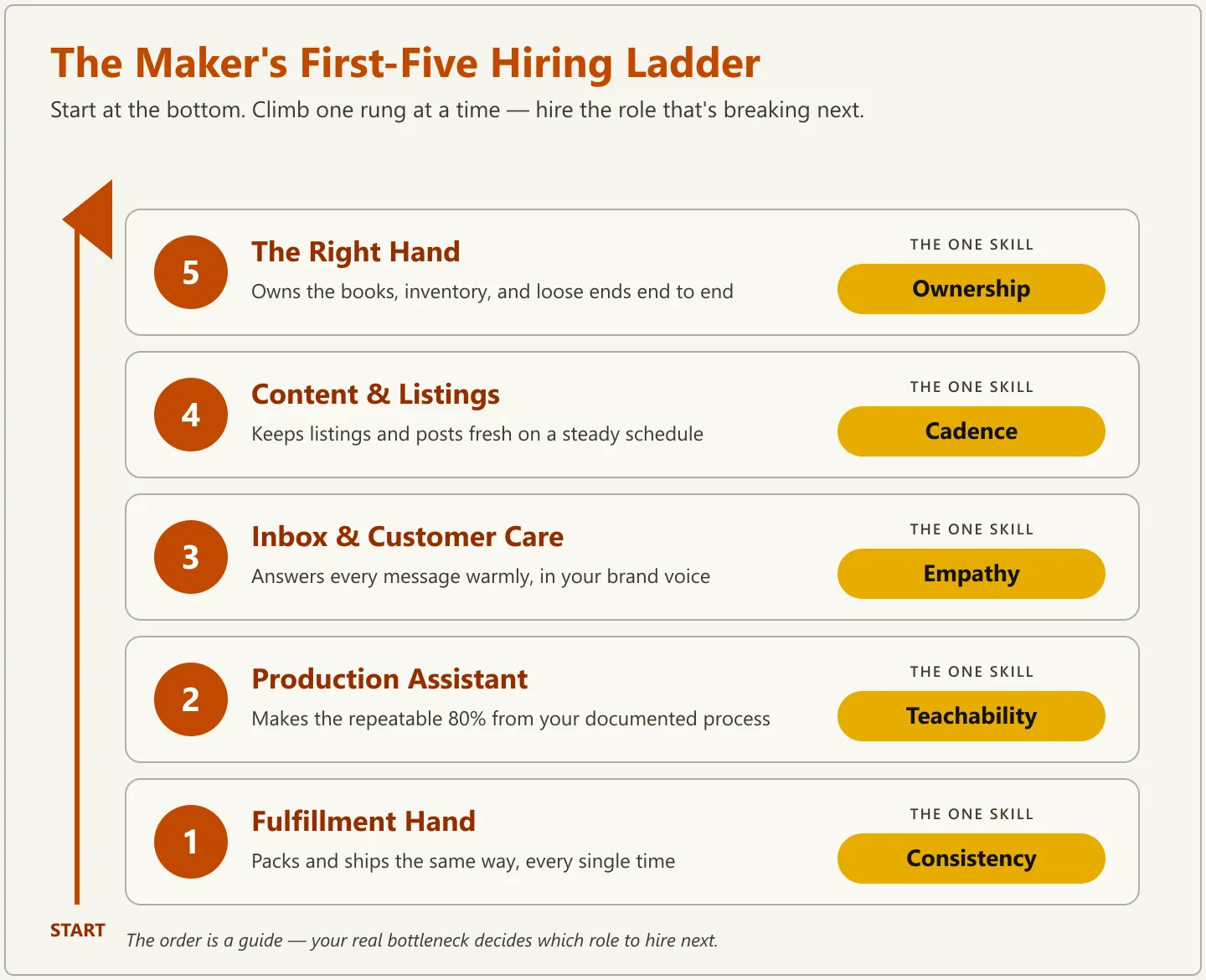
This is a field guide to the first five roles a growing maker hires, roughly in the order they show up, with the single skill each one has to bring to the table. In order, those roles are the Fulfillment Hand (skill: consistency), the Production Assistant (teachability), the Inbox & Customer Care Lead (empathy), the Content & Listings Person (cadence), and finally your Right Hand (ownership). Think of it less as an org chart and more as a hiring ladder you climb one rung at a time.
How to read this list
A few ground rules before the roles:
- Order matters, but it’s not rigid. Most makers hire in something close to this sequence, but your bottleneck decides your next hire — not this list. Hire for the thing that’s actually breaking.
- “Role” doesn’t mean “full-time employee.” Your first few roles are usually part-time help, a contractor, or a few hours a week. The role is the job to be done; the arrangement is up to you.
- The one skill beats the résumé. For each role below, there’s a skill people think they need to hire for and the skill that actually makes the hire work. They’re rarely the same.
Here’s the whole ladder at a glance:
| # | The role | Hire them when… | The one skill that matters | What it frees up for you |
|---|---|---|---|---|
| 1 | Fulfillment Hand | Shipping is your bottleneck, not making | Consistency (same steps, every time) | Late nights packing and labeling |
| 2 | Production Assistant | Demand outruns your two hands | Teachability (follows your process) | Capacity to make more |
| 3 | Inbox & Customer Care | You dread opening your messages | Calm empathy in writing | Emotional load and reputation risk |
| 4 | Content & Listings | Your listings and posts have gone stale | Cadence (publishes reliably) | The “I’ll post tomorrow” guilt |
| 5 | The Right Hand | You’re the bottleneck for every decision | Ownership (closes every loop) | The ability to step away at all |
Role 1: The Fulfillment Hand
The one skill: consistency. This is the person who packs, labels, and ships — the same way, every single time. Your first hire is almost never another maker. It’s someone who takes the most repetitive, lowest-skill, highest-volume work off your plate so your hands are free for the work only you can do.
Makers resist this hire because packing “isn’t a real job” and they feel silly paying someone for it. That’s exactly backwards. Every hour you spend cutting tissue paper and printing labels is an hour you’re not making the product that funds the business. The Fulfillment Hand is cheap to hire, easy to train, and buys back the hours that hurt the most.
- Hire them when: you’re regularly packing after everyone else has gone to bed, or shipping — not making — is what’s capping your order volume.
- The skill people wrongly hire for: speed, or “someone who really loves the product.” You don’t need a superfan. You need someone who will do step 7 the same way on order #300 as they did on order #3.
- The trap: hiring a fellow maker who secretly wants to design, not pack. They’ll get bored, cut corners, and quietly redesign your packing process without telling you.
Underrated move: write your packing process down before you hand it over. A one-page “how we pack an order” checklist turns a two-week training slog into a two-hour one — and it’s the first entry in what eventually becomes your whole operations playbook.
Role 2: The Production Assistant
The one skill: teachability. This is your maker’s helper — the person who does the 80% of production that’s repeatable so you can focus on the 20% that needs your hands and your judgment. And the skill that matters is not raw craft talent. It’s the willingness to make it your way, from a documented process, without improvising.
This is the hire that scales your actual output, and it’s also the one makers get most emotionally tangled up in. You’ve spent years developing your craft; handing any of it to someone else feels like handing over your identity. But you can’t clone yourself, and you can’t sell what you can’t make enough of.
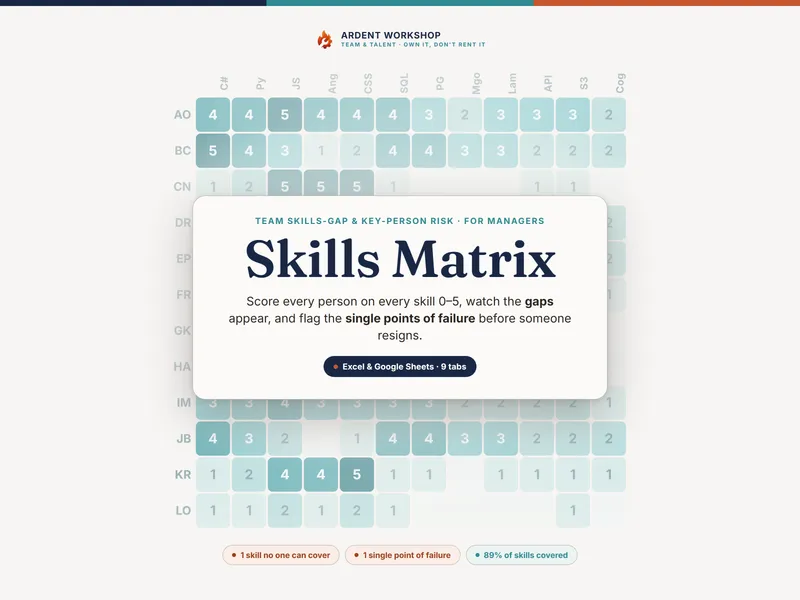
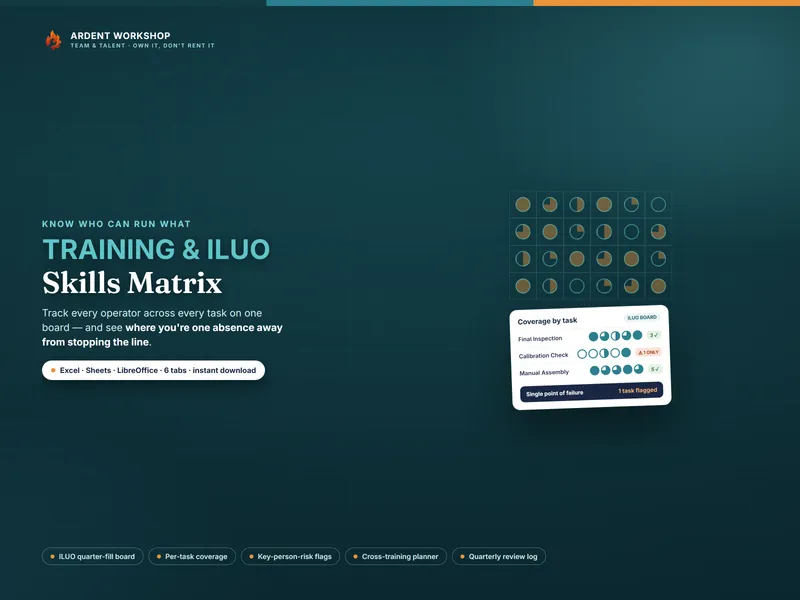
The unlock here is documentation. You cannot delegate a skill that lives only in your head. Before this hire pays off, you need to have mapped what steps make up your product and who can do which of them to what standard — the core of a simple skills matrix. Then you need a way to bring a beginner up to competence on each step, which is exactly what a training and ILUO matrix is built to do: it tracks each person from “in training” to “expert” on every task, so you know precisely what your assistant can be trusted with today.
- Hire them when: demand is outrunning your two hands and you’re turning away orders you’d happily take.
- The skill people wrongly hire for: someone “as good as me.” A near-peer often wants to run their own line, tweak your methods, or leave to compete. You want someone who’s genuinely great at following a great process.
- The trap: hiring before you’ve written anything down. If training means “watch me and absorb it by osmosis,” you’ll spend three months teaching and still be the only one who can do it right.
If you’re not sure the numbers support a production hire yet, onboarding your first employee when you’ve always worked solo walks through the same first-employee leap in more detail.
Role 3: The Inbox & Customer Care Lead
The one skill: calm empathy in writing. Somewhere around your third hire, the volume of messages, reviews, custom-order questions, and “where’s my package?” emails becomes its own full-time job — and it’s the one quietly eroding your sanity. The person who takes it over needs one thing above all: the ability to stay warm and human under pressure, in your voice.
Customer care is where your brand actually lives for most buyers. A calm, kind reply to an anxious customer turns a potential one-star review into a loyal repeat buyer. A defensive or rushed reply does the opposite. This is emotional labor, and offloading it is often the single biggest relief a solo maker feels.
- Hire them when: you dread opening your inbox, your response times are slipping, or a negative review sat unanswered for days because you couldn’t face it.
- The skill people wrongly hire for: sales aggressiveness. You’re not hiring a closer. You’re hiring someone whose default setting is “let me help you,” even when the customer is wrong.
- The trap: handing over your voice with no guardrails. Give this person a short library of tone examples and canned responses for the common situations, then let them improvise within those lines. Voice without guardrails drifts; scripts without warmth sound like a robot.
Editorial aside: this is the role where “hire for attitude, train for skill” is most literally true. You can teach someone your return policy in an afternoon. You cannot teach someone to be a genuinely patient human being.
Role 4: The Content & Listings Person
The one skill: cadence. Photos, product listings, and social posts are the top of your funnel, and they decay the moment you get too busy making to maintain them. The person who owns this needs to publish reliably — a steady drumbeat of decent content — far more than they need to occasionally produce a viral hit.
Makers get seduced by the promise of the “growth hacker” who’ll make them famous. Ignore that. Consistency compounds; virality is a lottery ticket. A shop that lists a new product every week and posts three times a week will quietly outgrow the one waiting for its big moment. The whole game here is showing up on schedule.
- Hire them when: your listings have gone stale, your best photos are two years old, or you can’t remember the last time you posted — and your traffic is drifting down because of it.
- The skill people wrongly hire for: a huge personal following or “going viral.” Their audience isn’t your audience, and virality doesn’t transfer. Reliability does.
- The trap: measuring this hire by any single post. Judge them on the calendar staying full and the quality bar staying steady over a quarter — not on whether one reel popped off.
Role 5: The Right Hand
The one skill: ownership. Eventually you hit the ceiling that isn’t about making, packing, or posting — it’s that you are the single point of failure for every decision, every number, and every loose end. The Right Hand is the person who owns systems end to end: the books, the inventory counts, the vendor emails, the schedule. They don’t wait to be told; they close loops.
This is your future number two, and it’s the most important hire on the ladder — which is why it usually comes last. You can only hand off ownership once there’s something built to own. Hire this role too early and there’s nothing for them to run; too late and you’ve already burned out being the bottleneck.
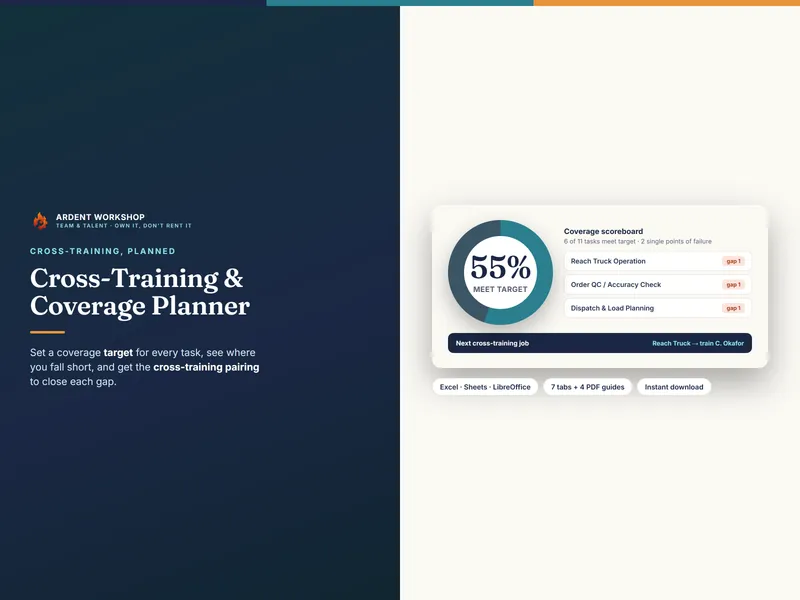
The Right Hand is also how you finally defuse your own bus factor — the risk that the whole operation stops the day you can’t work. A second person who genuinely knows how the business runs is worth more than any single process document. To get there deliberately, map which critical tasks only you can do today and deliberately cross-train a backup for each; a cross-training and coverage planner makes that gap visible instead of terrifying.
- Hire them when: you can’t take a single day off without the business stalling, and you couldn’t tell someone last month’s real profit without a scramble.
- The skill people wrongly hire for: a fancy title or years of “management.” Ownership isn’t seniority. It’s the person who, handed a messy problem, quietly solves it and tells you it’s done.
- The trap: never actually letting go. If every decision still routes through you, you’ve hired an expensive assistant, not a right hand. The point is to make yourself removable.
Where to start
If you’re on rung zero, here’s the honest sequence: hire the role that’s breaking, not the role that sounds exciting. (Before you fill any of them, settle whether the person is an employee or a contractor — that choice shapes how you can schedule and train them.) For almost every maker, that’s the Fulfillment Hand first — it’s the cheapest hire, the easiest to train, and it buys back the hours that make you resent your own business.
Then climb deliberately. Notice that four of the five roles depend on the same underlying thing: a written-down way of doing the work. You can’t delegate what only exists in your head. Whether it’s a packing checklist, a production process, a tone library, or a content calendar, the businesses that hire well are the ones that documented well first. Keeping all of that — your processes, your product costs, your inventory, and your order flow — in one connected system rather than a pile of separate files is what turns “me plus a helper” into an actual team. A tool like the Craft Business Manager is built to be that single connected file, and figuring out what to hand off first is the natural next step once you have someone to hand it to.
The five roles, one more time: Fulfillment Hand, Production Assistant, Inbox & Customer Care, Content & Listings, and the Right Hand. Consistency, teachability, empathy, cadence, ownership. Hire for those five skills in that order, and you’ll build a team that runs the operation with you — instead of a payroll cost that just needs more managing.
And when your business outgrows a spreadsheet — when the inventory, orders, and production tracking your team relies on need to live somewhere more powerful — Ardent Seller (opens in new tab) is the next step.