Where the term comes from
The bus factor (also called the “truck factor” or “lottery factor”) originated as software-engineering slang, where it described how many developers would have to vanish before a codebase became unmaintainable. The idea travels well beyond code: any team, business, or process has a bus factor, and it's almost always lower than people assume.
A bus factor of one is a single point of failure
The number that matters most is one. A bus factor of one means exactly one person can do something the business depends on — the only signatory on the account, the only one who understands the legacy system, the only one the key client trusts. That person being out for a month, or leaving, doesn't slow the work down; it stops it. A single point of failure on a business-critical seat is the most dangerous combination there is.
Where a low bus factor hides
The riskiest single points of failure are the quiet ones — they rarely show up on an org chart. Walk the actual work and the real dependencies, and look for:
- Knowledge. The one person who understands how a system, spreadsheet, or process really works.
- Relationships. The make-or-break client, supplier, or partner who trusts one specific person.
- Access. The only person who holds the passwords, the keys, or the signing authority.
- Skills. A specialized task only one person on the team is trained to do.
How to raise your bus factor
Raising the bus factor is rarely an emergency and rarely expensive — it just has to be deliberate:
- Cross-train a named backup. Have a second person actually do the work, not just watch — a backup isn't real until it's been used.
- Write the knowledge down. Get the how-to, the contacts, and the access out of one person's head and into a shared, written form.
- Develop a successor. For a critical seat, grow someone toward readiness over time — that's succession planning.
- Spread access. No single signatory, no single key-holder, no password that lives with one person.
The point isn't to make anyone less valuable — it's that nobody should have to be the only one who can do something, or be unable to take a holiday without the work stopping.
Measuring it across a business
You don't need a formula — you need a list. Go role by role and ask, for each: if this person were out for a month starting tomorrow, what would actually stop, and who else could do it? Score how critical the role is and how covered it is, and the seats with a bus factor of one on something that matters rise to the top. A skills matrix does this for tasks on a team; a key-person-risk register does it for whole roles.
Related templates and concepts
The bus factor is the measure behind succession planning and key-person risk. To find your single points of failure for free, the key-person risk checklist flags them for one team with no signup; the full Succession-Planning & Key-Person-Risk Workbook scores every critical role and tracks the successors who would raise your bus factor. Weighing build-versus-buy? See succession planning template vs talent management software, and the templates for HR & team leads hub for more.
Templates that implement this
Templates that map your bus factor
2 templates
Score each critical role's coverage, flag the seats only one person can fill, and plan the cover that raises your bus factor — in a workbook you own.
- $29.95 Spreadsheet
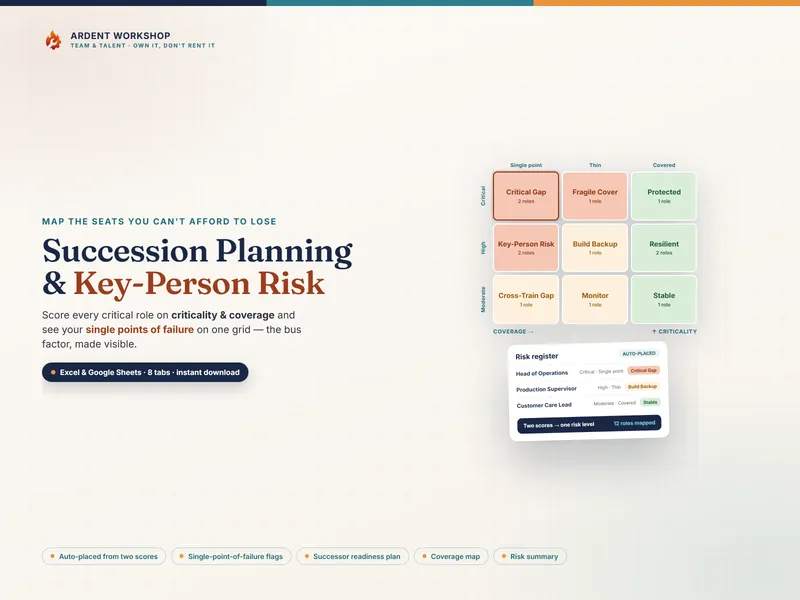
Succession-Planning & Key-Person-Risk Workbook for Excel & Google Sheets
A succession-planning & key-person-risk workbook for Excel & Google Sheets — score criticality and coverage to map your single points of failure.
Team & TalentView details - $24.95 Spreadsheet
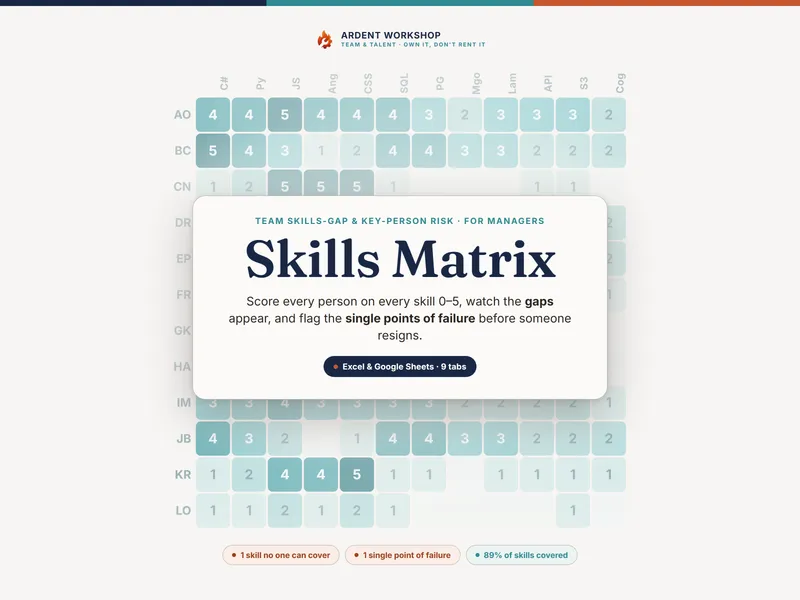
Skills Matrix Template - Team Skills Gap Analysis & Key-Person Risk (Excel & Google Sheets)
A 9-tab skills matrix for Excel & Google Sheets: score your team 0-5, find the skills gaps, and flag single points of failure before someone resigns.
Team & TalentView details