What an SOP actually contains
Formats vary, but a usable procedure answers seven questions and stops. If a section does not answer one of them, it is padding.
- Purpose. What the procedure protects, written as a consequence rather than an activity. "So every candle in a batch has the same fill weight and the same burn" is a purpose; "to describe the candle pouring process" is a title with extra words.
- Trigger. The event that starts it — an order arrives, a machine is switched on, stock drops below a level. A procedure with no trigger is a set of instructions waiting for somebody who already knows they should be reading it.
- Owner. Not the only person who does the task; the person responsible for the document being right when the work changes.
- Inputs. Materials, tools, settings, files and safety equipment to have to hand before step one. Stopping halfway to fetch something is where half-finished work comes from.
- Steps. One action per step, in order, starting with a verb, with a real number wherever a number exists.
- The quality check. What must be true for the result to be acceptable, and what happens to work that fails.
- Version. A number, a date, and what changed — so the printed copy taped to the wall can identify itself.
SOP, work instruction, policy, checklist — the differences
These four words get used interchangeably and they are not the same document.
- A policy says what the organization will and will not do, and usually has to be approved. It rarely contains steps.
- An SOP describes how a repeated task is performed end to end — the flow, the decisions, the handoffs.
- A work instruction sits underneath an SOP and covers one physical task in detail, usually with photographs, for the technique a paragraph cannot carry.
- A checklist is a memory aid for a task somebody already knows how to do. It confirms; it does not teach.
A small shop typically ends up with roughly twice as many SOPs as work instructions, and more checklists than either.
How long an SOP should be
One page. If it will not fit, count the steps: more than about fifteen and you are describing two procedures that happen to run consecutively. Split them, and let the first end by naming the second.
A four-page procedure is not more thorough than a one-page one. It is a procedure nobody reads, which is worse than having none — because you will believe it is being followed.
The rule that does most of the work: numbers, not adjectives
Most first attempts fail the same way. They describe the task instead of instructing it. "Ensure the material is prepared appropriately prior to assembly" is a sentence about a step; it is not a step. (The full method — five rules, an action-verb list, and how to test a draft — is in how to write an SOP for a small business.)
Any time a step says "until it looks right," "a small amount," "warm," "snug," "a while," or "a good bead," there is a number hiding behind it that you know and the reader does not. Find it and write it down:
- "Heat the wax" becomes "set the melter to 185 °F."
- "Let it cool a bit" becomes "let it cool to 135 °F, checking with the probe, not by eye."
- "Stir well" becomes "stir slowly for 2 full minutes by the clock."
- "Make sure they look right" becomes "fill within 1/4 inch of the scored line."
Those figures are from an invented candle shop and are illustrative — the point is the shape, not the settings, and they are not a recommendation for any real equipment or material.
Where there genuinely is no number — and sometimes there is not — name what to compare against instead: the reference piece, the line on the jig, the sound the machine makes when it is right.
Which procedures to write first
Nobody writes thirty. The useful test is: what would a competent stranger need in order to keep this running for a week without you? For a small production shop that is usually the same ten, and none of them are interesting:
- Opening the shop
- Closing the shop
- Making your best-selling item
- Checking work before it leaves
- Packing an order for shipment
- Picking and staging an order
- Answering a customer message
- Handling a damaged or lost shipment
- Checking in a delivery
- What to do if someone is hurt
In our estimate that is roughly twenty minutes apiece to write, plus ten to have somebody else test each one — call it an evening or two rather than a project. The procedures people want to write, by contrast, are usually the ones that would survive their absence perfectly well.
Common mistakes
- Writing it alone at a desk. The steps you leave out are exactly the ones you perform without noticing. Write it while doing the task, with the page beside you.
- Leaving out the quality check. Steps say what to do; only the check says whether the result is acceptable. Without it, the trainee's version of "finished" becomes the shop's.
- Never testing it. Hand the draft to somebody else, answer no questions, and watch. Every question they have to ask is a missing step.
- Filing it where the work is not. A procedure in an office folder is read once, on day one. A procedure on the wall beside the bench is read whenever there is doubt.
- Writing once and never revising. Change the page the day the work changes, not at the next review. A page reviewed once a year is, by the arithmetic alone, half a year out of date on the day you read it.
- Not recording who was told. A revision nobody was told about did not happen — the people doing the work carry on doing the old thing, and now the paperwork blames them for it.
Are SOPs required?
For most small shops, no — writing procedures is a management choice, not a legal one. But regulated activities frequently do impose documented procedures or records of their own (food safety, licensed trades, certain certifications, some insurance policies), and a few certification schemes are built almost entirely around them. Where a regulator, an equipment manufacturer's manual, an insurer, or a certification scheme sets a requirement, that requirement is the procedure, and anything you write sits underneath it rather than replacing it. Find out what applies to your trade in your area before a procedure goes on a wall. Nothing here is safety, legal, employment, or compliance advice.
Start with one page
The free one-page SOP template is the form above, fillable, plus the same page shown filled in for a worked example — no signup. When you want to know which procedures to write rather than only how, the Shop SOP & Work-Instruction Template Pack opens with a register naming thirty-six of them, grouped by area, with ten starred as the ones to write first — so the list is a menu, not an assignment.
Related templates and concepts
An SOP is the method; a work instruction is the technique underneath it, and a training matrix tracks who is signed off on each. Compare the approaches at SOP binder vs. process app, walk the method in how to write an SOP for a small business, or see the whole toolset on the templates for makers hub.
Templates that implement this
Templates that write the procedure for you
4 templates
A one-page SOP form, a photo-slot work instruction, checklists, and a register naming the procedures a small shop actually runs on.
- $19.95 Mix
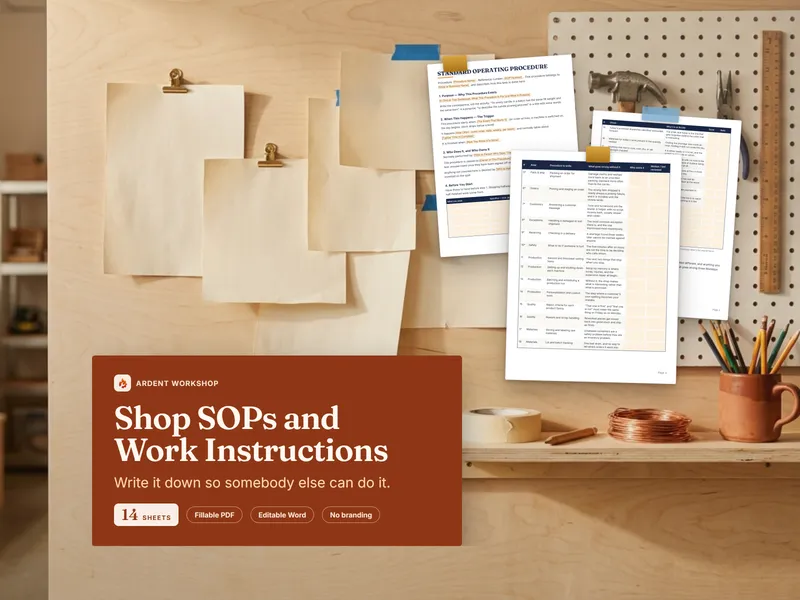
Shop SOP & Work-Instruction Template Pack — 14 Fillable Procedure Sheets for a Small Production Shop: SOP, Work Instruction, Opening & Closing Checklists, Reject Criteria, Packing Standard, Training Sign-Off
Fourteen fillable sheets for writing down how your shop runs — SOPs, work instructions, checklists, reject criteria and a training record, in PDF and Word.
Operator OSView details - $24.95 Spreadsheet
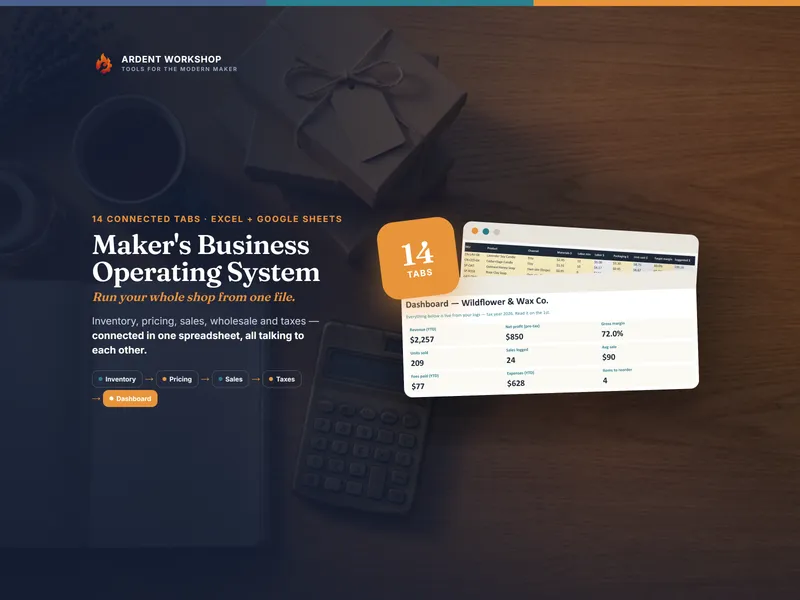
Maker's Business Operating System (Excel + Google Sheets)
One connected spreadsheet — Excel plus a ready-made Google Sheets copy — running your handmade business inventory, pricing, sales, wholesale and taxes.
Operator OSView details - $19.95 Spreadsheet

Training & ILUO Skills Matrix — Coverage & Key-Person Risk (Excel + Google Sheets)
An ILUO skills matrix for Excel & Google Sheets — track each operator's level on every task, see coverage at a glance, and flag key-person risk.
Team & TalentView details - $29.95 Spreadsheet
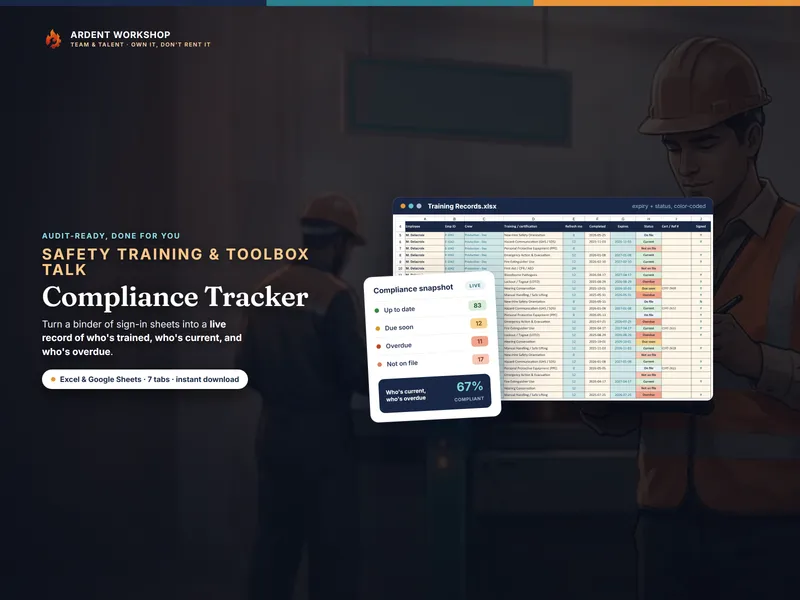
Safety-Training & Toolbox-Talk Compliance Tracker — Excel & Google Sheets
A safety-training & toolbox-talk tracker for Excel & Google Sheets — automatic refresher expiry, color-coded status, and audit-ready compliance dashboard.
Team & TalentView details