There is a specific week in the life of a small shop when this becomes urgent. Someone is starting on Monday. Or an order has to go out while you are ill. Or you have explained the same task for the fourth time and got a slightly different result each way.
Then you sit down to write your first procedure, type a heading, stare at it, and conclude you are not the kind of person who does this.
You are. Nobody handed you the shape.
This pack is that shape, fourteen times over — and the part that actually stops people is not the form but the list: which procedures to write, in what order, and what to put in them. These are general templates for documenting your own procedures, not safety, legal, or compliance advice — see the fine print at the foot of this page.
Why blank SOP templates don’t get filled in
The hard part was never the headings. A free template gives you an empty Purpose / Scope / Steps skeleton and leaves you exactly where you started: which procedures should I write, in what order, and what is a step supposed to look like?
This pack answers all three before you type anything.
The procedures are already named. Sheet 01 is a register of thirty-six procedures a small production shop actually runs on — opening, closing, making your best seller, checking work before it leaves, packing an order, picking and staging, answering a customer message, handling a damaged shipment, checking in a delivery, what to do if someone is hurt, and twenty-six more — each with one line on what goes wrong without it. Ten of them carry a star: those are the ten to write before anyone else works a shift here, and together they are about five hours of work.
Half the content is already written. Twelve defect families with their usual causes. Eight packing fragility classes with the protection method for each. Fourteen shop exceptions with a suggested first move. Forty-four opening and closing checks, each with a line on why it is on the list. Sixteen things that quietly stop when the owner does. You are editing real shop content, not inventing it from nothing.
And the method is taught. Section 04 of the guide is five rules for writing a step somebody else can follow, with a curated action-verb list and the rule that does most of the work: any time a step says “until it looks right,” there is a number hiding behind it that you know and the reader does not. Find it and write it.
The question every template dodges: how much detail is enough?
The pack answers it by showing you. One complete procedure — pouring an 8 oz container candle at an invented shop — is reproduced filled in, with the owner’s own words marked in amber and the template’s own words left in navy. Twelve numbered steps, a materials table, a quality check with real tolerances, and a what-to-do-when-it-goes-wrong table.
Read step 7. It does not say “stir well.” It says stir slowly for two full minutes by the clock, and the column beside it says what happens if you do not. Every number on that page replaced an adjective somebody had been using instead.
The fourteen sheets
The system. SOP Master Index & Register · Standard Operating Procedure (one page) · Work Instruction with Photo Slots · Equipment & Machine Setup Card · Procedure Revision & Review Log
The day. Opening Checklist · Closing Checklist · Quality Standard & Reject Criteria Sheet · Packing & Shipping Standard · Receiving & Incoming Inspection Standard
A second pair of hands. Exception & Escalation Sheet · Training & Sign-Off Record · Cover & Handover Sheet · New Helper’s First Week
Plus three reference documents: a 39-page Start Here guide with a full page on every sheet, a 51-situation router, and a 28-question “What Breaks When You Are Not There” self-audit.
What breaks when you are not there
A small shop’s real fragility is not its finances or its equipment. It is the set of things that only work because one particular person is standing there.
The audit asks about them one at a time. Could someone else open the shop and know what “ready” looks like? Make your best-selling item to the same standard? Pack and ship an order the way you would? Tell an acceptable piece from an unacceptable one? Decide a refund? Every answer that is not a clean yes is a single point of failure, and the last column names the sheet in this pack that closes it.
Do it once now. Do it again in six months. The change is the point.
Two formats, no branding
Every sheet ships twice. The fillable PDF is genuinely fillable — click a highlighted blank and type, including inside the tables: every blank cell in the register, the reject criteria, the packing classes and the training record is its own typeable field. The editable Word file lets you rewrite any wording, add or remove sections, add rows, or drop the whole thing into Google Docs, and it carries the curated reference rows across as real tables.
None of them carries any branding. They become your shop’s own documents the moment you fill them in.
Own it, don’t rent it
This is a file you buy once and keep. No subscription, no account, no process app that gets discontinued out from under you, and nothing that stops working the month you decide to cut costs. Fill it in, print it, post it on the wall, and revise it for as long as your shop exists.
Start free with the one-page SOP template — ungated, no signup, and pre-filled with a worked example so you can see the shape before you write a word.
Where it leads
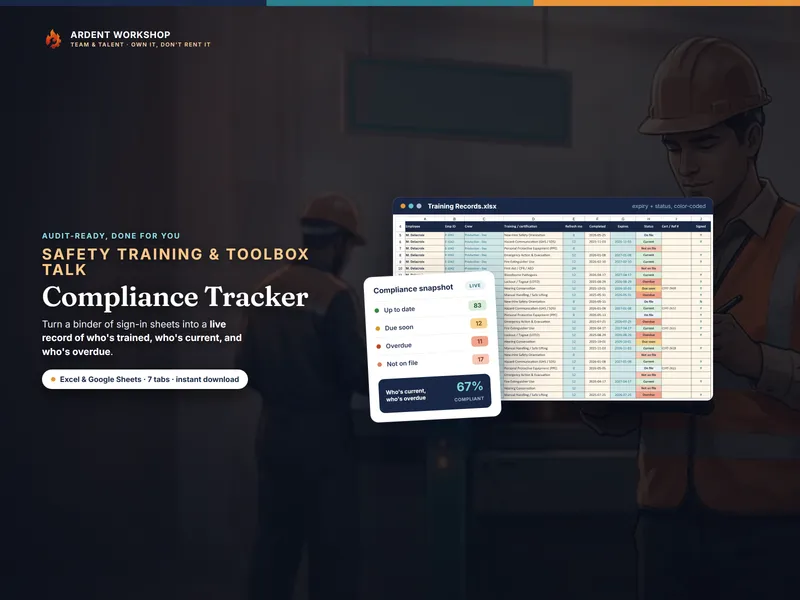
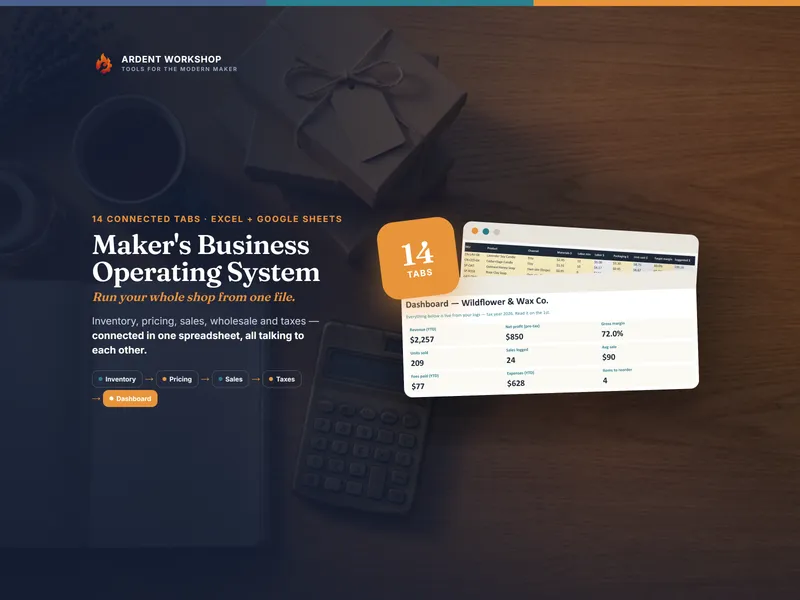
A binder of procedures answers how the shop runs. It does not hold the numbers. When you want those, the Maker’s Business Operating System covers materials, costing and orders; the Training / ILUO Matrix takes over when the sign-off record outgrows one page per person; and the Safety-Training & Toolbox-Talk Compliance Tracker handles training that has dates and expiries attached.
And when the shop outgrows a binder entirely, Ardent Seller (opens in new tab) is our software for makers and small production shops — inventory, manufacturing, and sales in one place. Its free Small-Batch Production Planning Playbook (opens in new tab) and Maker Business OS Starter (opens in new tab) plan and track production; this pack documents how the work is done. They do different jobs, and most shops want both.
The fine print
These are general templates and general guidance for writing down your own procedures. They are not safety advice, not legal or employment advice, not regulatory compliance advice, and not a quality management system or certification of any kind. Where an equipment manufacturer’s manual, a regulator or licensing scheme, your insurer or landlord, or an employment or marketplace rule says something different from a sheet in this pack, that requirement wins and the sheet is what changes. Find out what applies to your trade in your area before a procedure goes on a wall and is followed by somebody who trusts it. Section 02 of the guide sets the boundary out in full, and names what the pack deliberately does not cover.