The two questions that stop people
Ask a shop owner why they have not written their procedures down and you get one of two answers, both of them fair.
The first is “where would I even start?” — there are forty things the shop does, they all feel load-bearing, and no ordering suggests itself. The second is “I wrote one and it was useless” — a page of sentences that describe the task without instructing it, which the one person who read it never needed and the one person who needed it could not follow.
Both are structure problems, not effort problems. This guide fixes the first with a shortlist and the second with five rules.
Which procedures to write first
The useful test is not importance. It is absence:
What would a competent stranger need in order to keep this shop running for a week without you?
Not run it well. Not grow it. Keep it running. Answered honestly, that question produces almost the same ten procedures in almost every small production shop:
- Opening the shop — whoever arrives first has to know what “ready” looks like, and which slow equipment to switch on before anything else.
- Closing the shop — the expensive one. Everything that damages a building or a night’s work happens between the last job and the door.
- Making your best seller — the procedure most likely to exist only in your head, and the one whose absence stops revenue.
- Checking work before it leaves — without a written standard, “good enough” drifts, and eventually the customer sets it.
- Packing an order — the most delegated task in any shop, and the one whose failures arrive months later as refunds and reviews.
- Picking and staging an order — the wrong item shipped is nearly always a picking failure, and it is invisible until the review lands.
- Answering a customer message — tone and turnaround are the brand; somebody with no template invents both, slower and colder.
- Handling a damaged or lost shipment — the commonest exception there is, and the one improvised most expensively.
- Checking in a delivery — two minutes at the door, and a shortage found three weeks later cannot be claimed against anyone.
- What to do if someone is hurt — the five minutes after an injury are not the time to be working out who calls whom.
Notice what is not on that list: nothing clever, nothing strategic, nothing you would put on a website. The procedures people want to write — the brand voice, the product development process, the five-year plan — are the ones that would survive your absence perfectly well, because nothing depends on them this week.
In our estimate that is roughly twenty minutes apiece to write, plus ten to have somebody else test each one — call it an evening or two rather than a project, and much smaller than the year most people spend intending to get around to it.
And write each one while you do the task, not afterward at a desk. Take the page to the bench and fill it in as you work. The steps you leave out at a desk are precisely the ones you perform without noticing: reaching for the tool that is always in the same place, the half-turn you give the jig, the glance at the edge before you commit. Those are the steps a new person needs most, and they are invisible from a chair.
What one page has to contain
| Section | What it answers | The mistake |
|---|---|---|
| Purpose | What this protects, as a consequence | "To describe the pouring process" is a title with extra words |
| Trigger | The event that starts it | Leaving it out — the page then waits for somebody who already knows to read it |
| Owner | Who keeps the document right | Naming everyone, which means nobody reviews it |
| Before you start | Materials, tools, settings, safety gear | Discovering a missing item halfway, which is where half-finished work comes from |
| The steps | One action each, in order, with numbers | Describing the task instead of instructing it |
| The quality check | What must be true, and what happens to work that fails — rework, sell as a second, scrap, or set aside for the owner | Omitting it — the trainee's idea of "finished" then becomes the shop's |
| Version | Number, date, what changed | An undated printout taped to a wall that cannot identify itself |
One page is the target. If it will not fit, count the steps: more than about fifteen and you are describing two procedures that happen to run consecutively. Split them, and let the first one end by naming the second. A four-page procedure is not more thorough than a one-page one — it is a procedure nobody reads, which is worse than none, because you will believe it is being followed.
The rule that does most of the work
Most first drafts fail the same way. “Ensure the material is prepared appropriately prior to assembly” is a sentence about a step. It is not a step.
The fix is mechanical: any time a step contains an adjective where a number belongs, find the number. You know it; the reader does not.
| Written vaguely | Written so a stranger can follow it |
|---|---|
| Heat the wax | Weigh 1,600 g of wax into the melter and set it to 185 °F |
| Let it cool a bit | Let the wax cool to 135 °F, checking with the probe, not by eye |
| Add fragrance | Weigh 128 g of fragrance oil — 8% of 1,600 g |
| Stir well | Stir slowly for 2 full minutes by the clock |
| Make sure they look right | Fill within 1/4 inch of the scored line; wick centered within 1/8 inch |
Those figures are from an invented candle shop and are illustrative — the point is the shape, not the settings, and they are not a recommendation for any real equipment or material. Where there genuinely is no number, name what to compare against instead: the reference piece, the line on the jig, the sound the machine makes when it is right.
Four more rules go with it. One action per step — if a step joins two verbs with and, it is two steps and the middle one gets skipped. Start with a verb — an instruction, not a description. Say what it looks like when it is right every few steps, so a person can recover when reality differs slightly from the page, which it always does. And have somebody else run the task from your draft, answering no questions, because every question they have to ask is a missing step.
When the words are the wrong tool
If you catch yourself writing “like this,” or “about so far,” or “you’ll know it when you see it,” stop and take a photograph. Those three phrases are the reliable signal that the task is visual and the paragraph is losing.
That is what a work instruction is for: one physical task, a photograph at each step, and — the line that does the teaching — what it looks like when it is wrong. Photograph the step rather than the finished item, shoot from the worker’s viewpoint rather than the trainer’s, and photograph the wrong way too. A right-and-wrong pair for the step everybody gets wrong is worth more than four more correct photographs.
Most shops need more procedures than work instructions — but the work instructions save the most training time, because each one replaces a demonstration you would otherwise repeat.
Four habits that keep the binder true
Almost every shop that writes procedures writes them once. Six months later the binder is a historical document: the shop has moved, the pages have not, and the first person to notice concludes the binder is not to be trusted — a conclusion that spreads and does not reverse.
- Put them where the work happens. Not in an office folder, and not only in a cloud drive. Whatever is reachable in ten seconds is what gets consulted.
- Change the page the day the work changes. Not at the next review, even if the change is scribbled on the printed copy in pen and typed up on Friday. The annual review is a safety net, not the mechanism — a page reviewed once a year is, by the arithmetic alone, half a year out of date on the day you read it.
- Let anyone say a page is wrong. Give them a pen and permission to mark the printed copy. A binder covered in annotations is a binder in use; a pristine one is decoration.
- Record what changed, and who was told. That last column is the only one that connects a document change to a behavior change.
Where this stops being enough
Written procedures are a management choice, not a legal requirement, for most small shops. But regulated activities frequently impose documented procedures or records of their own — food safety, licensed trades, some certifications, some insurance policies — and where a regulator, an equipment manufacturer’s manual, an insurer, or a certification scheme sets a requirement, that requirement is the procedure. Anything you write sits underneath it rather than replacing it. Find out what applies to your trade in your area before a page goes on a wall and is followed by somebody who trusts it. Nothing here is safety, legal, employment, or compliance advice.
Start with one page
The free one-page SOP template is the seven-section form above, fillable, plus the same page shown filled in for a worked example and the five rules in full — no signup.
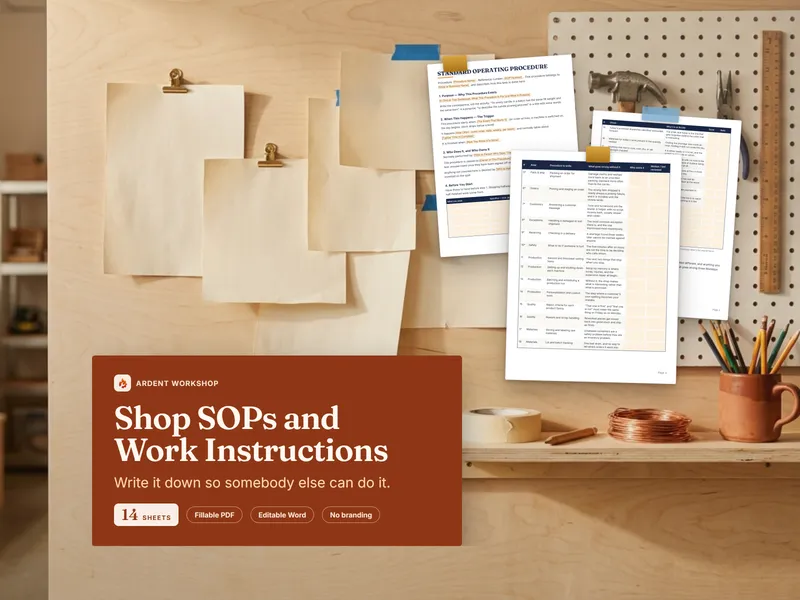
When the question becomes which procedures to write rather than only how, the Shop SOP & Work-Instruction Template Pack opens with a register naming thirty-six of them in the order worth writing, ten of them starred, and adds the thirteen sheets that go around them — the photo-slot work instruction, opening and closing checklists, reject criteria, a packing standard, an exception sheet, and a training sign-off record. If you are weighing that against software, SOP binder vs. process app sets out where each one wins.