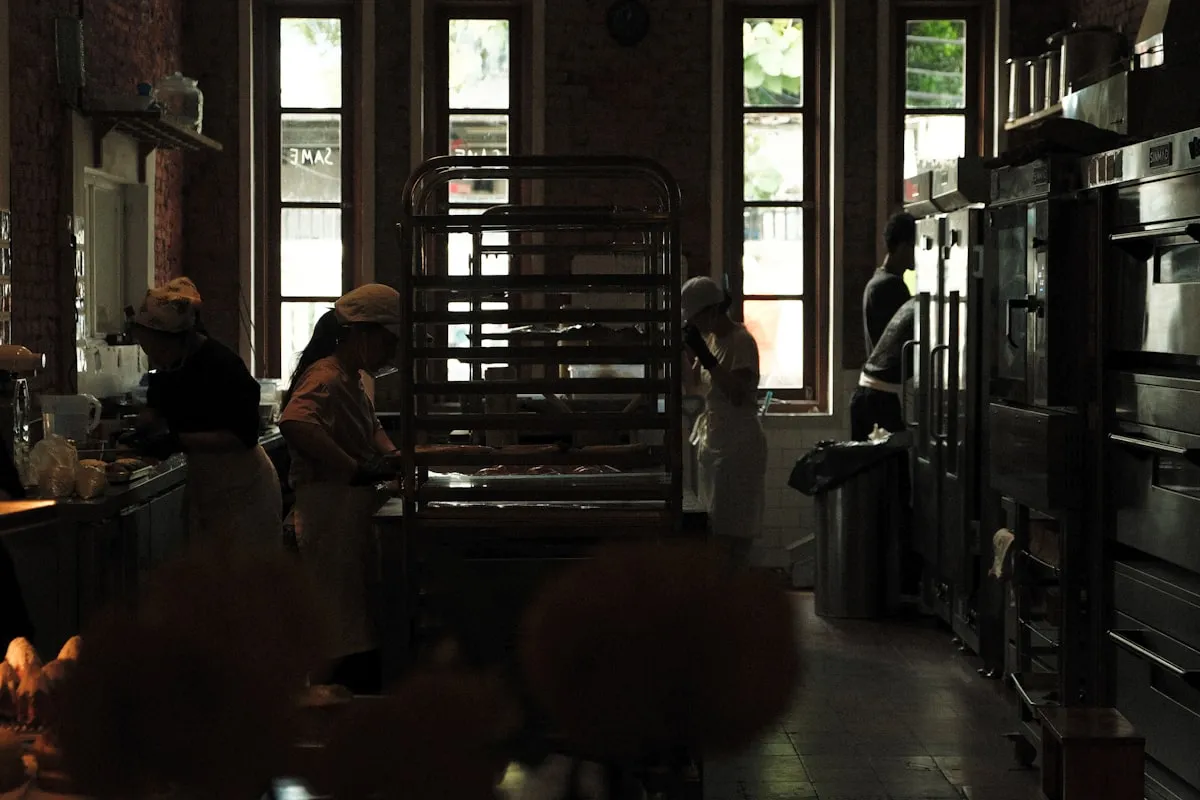
Work instruction vs. SOP
They answer different questions, and a shop generally needs more SOPs than work instructions.
- An SOP covers a repeated task end to end: what triggers it, who owns it, the steps, the quality check, what to do when it goes wrong. It is about the flow.
- A work instruction covers one physical operation inside that flow, at the level of the hands: how the jig is clamped, which way the grain runs, how the piping bag is held, what a correct bead of glue looks like, where the label sits on the box.
In practice a small shop ends up with roughly twice as many procedures as work instructions — but the work instructions save the most training time, because each one replaces a demonstration you would otherwise have to repeat.
What a work instruction contains
- What a correct result looks like, in one sentence, plus who does the task, roughly how long it takes, and what it needs.
- The hazards and the protective equipment for this specific task.
- The steps, each with a photograph — one instruction per image, so the eye can find its place again after looking away.
- What it looks like when it is wrong, per step. This is the line most people leave out and the one that does the teaching.
- A right-and-wrong pair for the one step everybody gets wrong, photographed both ways.
- The feel of it — the sound a machine makes when it is right, the resistance under a blade, how tacky is tacky enough. A camera cannot carry these; plain words can.
- The date the photographs were taken, because that is what makes the sheet expire.
How to photograph the steps
The photographs are the expensive part, and four habits decide whether they teach anything:
- Photograph the step, not the finished item. A picture of a perfect result teaches nobody how to get there. A picture of the hand position at the moment that matters teaches it in one glance.
- Shoot from the worker's viewpoint, not the trainer's. Over the shoulder of the person doing it, so the image matches what they will be looking at.
- Photograph the wrong way too. A right-and-wrong pair for the step people get wrong is worth more than four more correct photos.
- Take them while somebody else does the task. You will photograph the steps they hesitate at — which are exactly the steps that need photographs.
Write the caption before you take the photograph. If you cannot say in one line what the image is meant to show, the image will not show it.
The failure mode: photographs that go stale
Change the jig, the packaging, or the machine, and every photograph of it is now instructing somebody to do the old thing — with more authority than text, because a photograph looks like evidence. So a work instruction needs two things a text procedure does not: the date the photographs were taken printed on the sheet, and a line saying what would make them wrong.
Keep the original image files somewhere named after the instruction rather than in a camera roll. The day you revise the sheet, you will want the shots you did not use.
When you cannot photograph it
Some things cannot be photographed — a customer's property, a licensed component, a food process where a camera has no business being. A drawing works, and a bad drawing works better than a good paragraph. Trace over a printed photograph if you have to.
Printing and protecting the sheet
A work instruction lives where the work happens, which means heat, dust, water and hands. Print it, sleeve or laminate it, and hang it at the station. A sheet that curls off the wall within a month was not worth making, and the same goes for one that lives in a folder in the office where it will be read exactly once.
The boundary
Writing a work instruction is a way of recording how you do a task. Nothing here is safety, legal, or compliance advice. Where an equipment manufacturer's manual, a regulator or licensing scheme, your insurer, or a food-safety or certification requirement says something different from what you photograph and write, that requirement wins and the sheet is what changes.
Related templates and concepts
A work instruction is the technique layer under an SOP, and an ILUO training matrix is how a shop records who is signed off on each one. The free one-page SOP template is the procedure it sits under, and the Shop SOP & Work-Instruction Template Pack carries the photo-slot sheet itself. For the method behind both, see how to write an SOP for a small business; for the whole toolset, the templates for makers hub.
Templates that implement this
Templates for hands-on tasks
4 templates
A photo-slot work instruction sheet, the one-page SOP it sits under, and the records that track who is signed off on each.
- $19.95 Mix
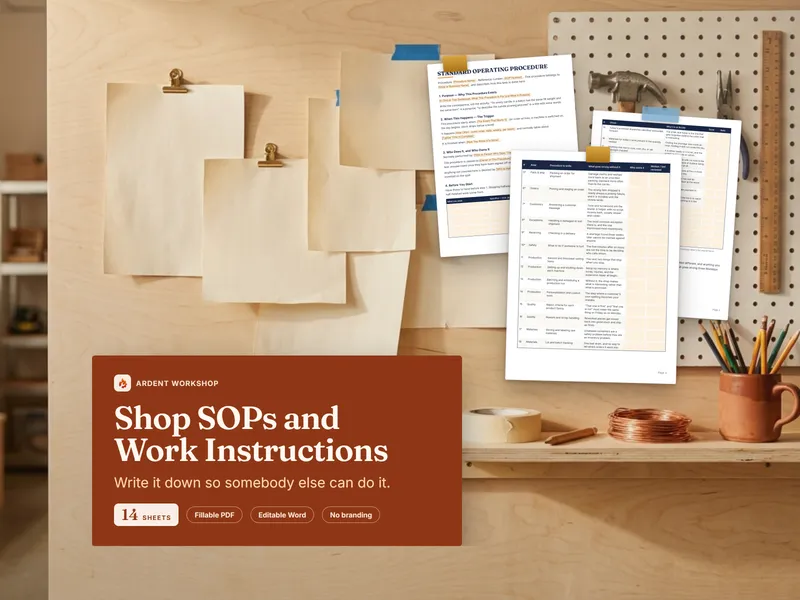
Shop SOP & Work-Instruction Template Pack — 14 Fillable Procedure Sheets for a Small Production Shop: SOP, Work Instruction, Opening & Closing Checklists, Reject Criteria, Packing Standard, Training Sign-Off
Fourteen fillable sheets for writing down how your shop runs — SOPs, work instructions, checklists, reject criteria and a training record, in PDF and Word.
Operator OSView details - $19.95 Spreadsheet

Training & ILUO Skills Matrix — Coverage & Key-Person Risk (Excel + Google Sheets)
An ILUO skills matrix for Excel & Google Sheets — track each operator's level on every task, see coverage at a glance, and flag key-person risk.
Team & TalentView details - $24.95 Spreadsheet

Apprenticeship & OJT Training-Hours Logbook — Hours, Competencies & Sign-Offs for Excel & Google Sheets
An apprenticeship & OJT training-hours logbook for Excel & Google Sheets: log hours by competency, capture sign-offs, and track completion readiness.
Team & TalentView details - $24.95 Spreadsheet

Maker's Business Operating System (Excel + Google Sheets)
One connected spreadsheet — Excel plus a ready-made Google Sheets copy — running your handmade business inventory, pricing, sales, wholesale and taxes.
Operator OSView details