What goes in a household operations manual
A good household operations manual covers the areas a home actually needs when someone has to step in — whether for a weekend away, a hospital stay, or a new owner learning an unfamiliar house:
- A home summary — the one page a house-sitter or a partner needs first: the address, how to get in, where the shutoffs and breaker panel are, trash day, and who to call first.
- Home systems & shutoffs — where the water, gas, and electrical shutoffs are, plus the water heater, furnace, and sump pump, with plain steps anyone could follow.
- Utilities & services — electric, gas, water, trash, and internet: the provider, an account reference, where the login lives, and the number to call.
- A maintenance schedule — HVAC filters, smoke-detector batteries, gutters, the water heater — each with how often it's due and when it was last done.
- Emergency contacts — utility emergency lines, a trusted neighbor, poison control, the insurer, and the plumber you'd actually call.
- An "if I'm away" handoff — daily must-dos, pets, plants, trash, the mail, the alarm, and what to do if something goes wrong.
- Home inventory, trusted vendors, and documents — what you own, who you trust for repairs, and where the important papers are kept.
The one rule that keeps it safe to keep
A reference like this is only worth keeping if it's safe to keep — and a home manual gets photographed, emailed to a sitter, and left on a counter. The rule that makes it safe runs through every page: record where things live and how the home runs — never the passwords, alarm or gate codes, or full account numbers. Write down which utility, the account reference, and where the login lives ("in our password manager"). Don't write the password. Note that the alarm has a code and who knows it — not the code itself. Kept on the safe side of that line, the manual is a map to the house, not a key to it: invaluable to the person who should have it, far less dangerous if it's ever seen by someone who shouldn't.
The actual credentials and codes belong in a dedicated password manager, which is built to encrypt them and share them safely. The manual's job is to record that those things exist and who has emergency access.
Household operations manual vs home reference binder
The two terms describe the same thing from slightly different angles. "Household operations manual" emphasizes the how — the running instructions, the shutoff steps, the if-I'm-away routine. "Home reference binder" emphasizes the where — the single place all the facts are filed. In practice one document serves both: a reference you can hand someone that also tells them how to keep the house going.
Who needs one
It earns its keep for more people than you'd expect. Homeowners who are the only one who knows where the shutoff is. Renters who want their own record of the fuse box and the landlord's number. New homeowners learning an unfamiliar house. Families with a house-sitter, a dog-walker, or a grandparent covering a weekend. Anyone who's ever stood in a flooding basement not knowing which valve stops the water. If the home currently runs on one person's memory, that person is a single point of failure — and this is how you remove it.
How to start without overwhelm
- Start with the home summary — the one page a sitter needs: entry, shutoffs, trash day, who to call. Half a binder is already worth having if it's this page.
- Walk the house and mark the shutoffs — find the water main, the gas valve, and the breaker panel, and write down where each is and how to use it. Do this before you ever need it.
- Add utilities and emergency contacts next — the providers and the numbers, not the passwords.
- Fill the maintenance schedule from what you remember, then update it as you go.
- Tell one or two people the manual exists and where it lives. A manual no one can find helps no one.
Not sure where to begin? The free "If I'm Away" house-sitter sheet is the single most useful page — one printable handoff you can fill out today and leave on the counter before your next trip.
Paper or digital?
Both work, and many households keep both. A printed page lives on the fridge or by the door for a sitter; a digital version — a spreadsheet you own — lives on your drive or a trusted cloud account, easy to update and share with a partner. The advantage of a workbook you own over a hosted home-management app is ownership: the file can't be locked behind a lapsed payment or vanish if a service shuts down, your home's details aren't sitting on someone else's server, and you decide who can see it. That's the case laid out in household binder vs home management app.
Related templates and guides
A household operations manual pairs naturally with a home inventory (what you own, room by room) and a life-admin binder (where the household's documents and accounts live). This is a record-organizing approach — not legal, insurance, or safety advice, and no substitute for a licensed plumber, electrician, or your utility's emergency line.
Templates that implement this
Build your household operations manual
3 templates
A workbook that organizes how your home runs — utilities, shutoffs, maintenance, contacts, inventory, vendors, and the if-I'm-away handoff — in a file you own.
- $24.95 Spreadsheet
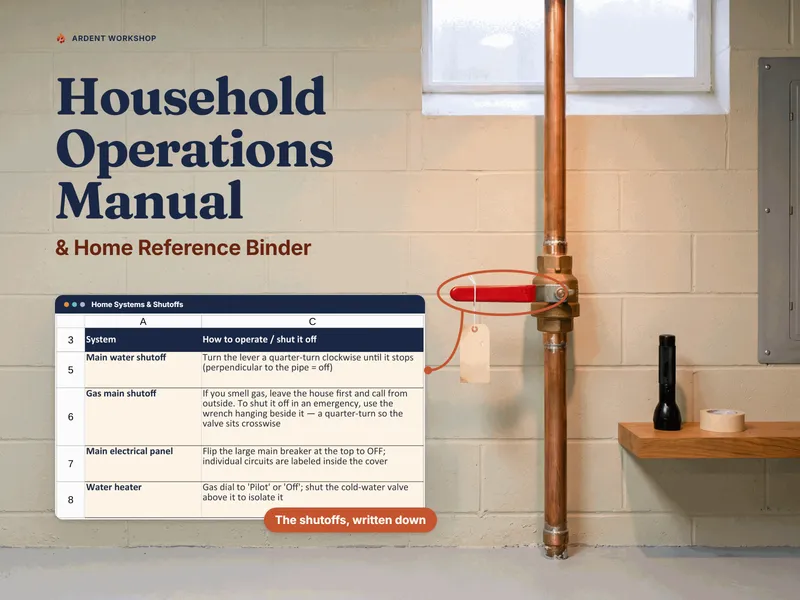
Household Operations Manual & Home Reference Binder — Utilities, Shutoffs, Maintenance, Emergency Contacts & House-Sitter Info (Excel, Google Sheets & Word)
Household operations manual for Excel, Google Sheets & Word: shutoffs, a maintenance schedule that computes what's due, and a house-sitter packet.
Life AdminView details - $14.95 Excel
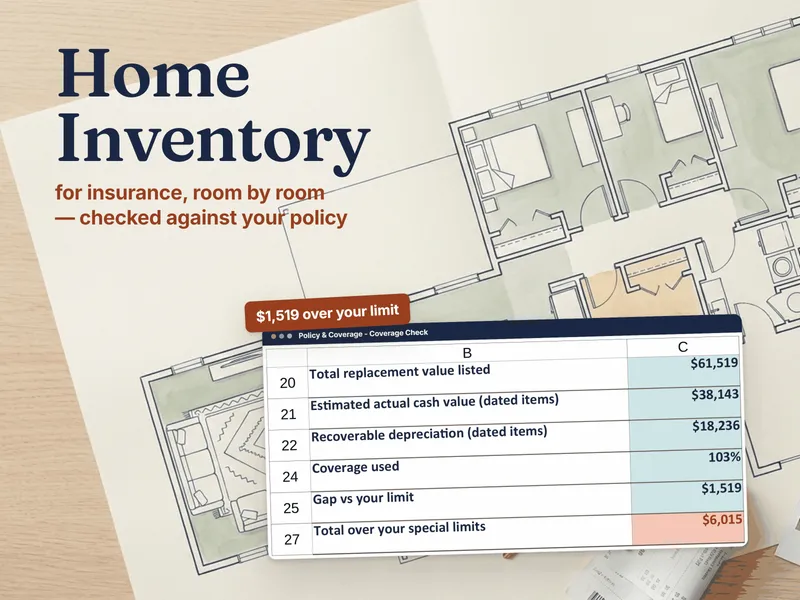
Home Inventory Spreadsheet for Excel — Room-by-Room Insurance Inventory with Proof Score, Coverage Check, Estimated ACV & Claim Worksheet
Excel home inventory for insurance: log what you own room by room, score your proof, check it against your policy limit and build a claim schedule.
Life AdminView details - $29.95 Spreadsheet
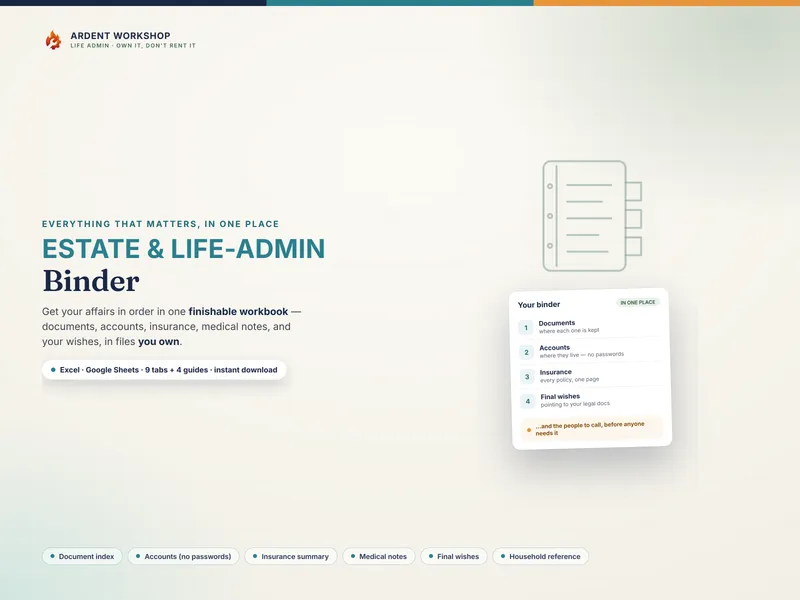
Estate & Life-Admin Binder — Important Documents, Accounts, Insurance & Final Wishes Organizer (Excel + Google Sheets)
An estate & life-admin binder for Excel & Google Sheets — organize important documents, accounts, insurance, and final wishes in one file you own.
Life AdminView details