What goes in a life-admin binder
A good life-admin binder covers the areas a household actually needs when someone has to step in — whether for an afternoon, a hospital stay, or for good:
- Important documents — birth certificates, the deed, titles, the will — and exactly where each is kept.
- Accounts — each bank, card, loan, utility, and subscription, with where it's accessed and who to contact.
- Insurance — every policy on one page: type, insurer, what it covers, and the renewal.
- Key people — family, the executor, the attorney, the doctor, the neighbor with a key.
- Medical information — allergies, conditions, current medications, and providers.
- Final wishes — where your legal documents are and what you'd want, pointing to the documents that make it official.
- Household reference — shut-offs, utilities, routines, and pets, so the house keeps running.
The one rule that keeps it safe to keep
A binder like this is only worth keeping if it's safe to keep. The rule that makes it safe runs through every page: record where things live and who to call — never the passwords, PINs, or full account numbers. Write down which bank, the last four digits, and where the login lives ("in our password manager"). Don't write down the password itself. Kept on the safe side of that line, the binder is a map, not a key — useful to the person who should find it, far less dangerous if it's ever seen by someone who shouldn't.
The actual credentials belong in a dedicated password manager, which is built to encrypt them and hand them over safely. The binder's job is to record that the password manager exists and who has emergency access to it.
Paper or digital?
Both work, and many households keep both. A printed binder lives in a home safe or a fireproof box, with the originals of the irreplaceable documents. A digital version — a spreadsheet you own — lives on an encrypted drive or a trusted cloud account. The advantage of a workbook you own over a subscription app is ownership: the file can't be locked behind a lapsed payment or vanish if a service shuts down, and you decide who can see it.
How to start without overwhelm
- Start with the document index — walk the house and write down where each important document already is. You're recording locations, not gathering a pile.
- Then the accounts — list the institutions, not the credentials. This is the page that can save a grieving family weeks of detective work.
- Add insurance and contacts next; save final wishes for a quiet evening.
- Tell one or two trusted people the binder exists, where it is, and how to open it. A binder no one can find helps no one.
- Walk it once a year, updating what changed.
Not sure where to begin? The free "What Documents Do I Need?" checklist is a self-scoring list of what to locate first. Want the rest of the household's records organized too? The Life Admin Bundle includes the Estate & Life-Admin Binder and eleven more household-records products, plus a Command Center: you mark each record's status, and it scores readiness by group and names the next ten records to fill in.
Life-admin binder vs estate binder
The two terms overlap heavily. A life-admin binder is the broader, in-life version — it keeps a household running and organized day to day, not only at the end of life. An "estate binder" usually emphasizes what an executor needs to settle someone's affairs. In practice the same workbook serves both: organize once, and it's ready whether someone needs to step in for a week or for good.
Related templates and guides
A life-admin binder pairs naturally with a home inventory (what you own, room by room) and the rest of the caregiver templates hub. This is a record-organizing approach — not legal, medical, or financial advice, and not a substitute for a will or a professional.
Templates that implement this
Build your life-admin binder
4 templates
A workbook that organizes where everything lives — documents, accounts, insurance, medical notes, and wishes — plus the trackers that go alongside it.
- $29.95 Spreadsheet
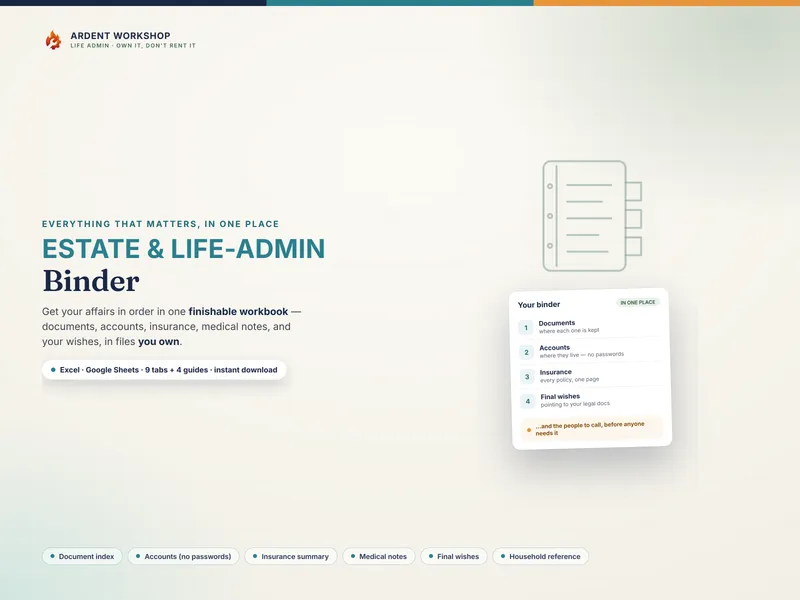
Estate & Life-Admin Binder — Important Documents, Accounts, Insurance & Final Wishes Organizer (Excel + Google Sheets)
An estate & life-admin binder for Excel & Google Sheets — organize important documents, accounts, insurance, and final wishes in one file you own.
Life AdminView details - $79.00 Bundle
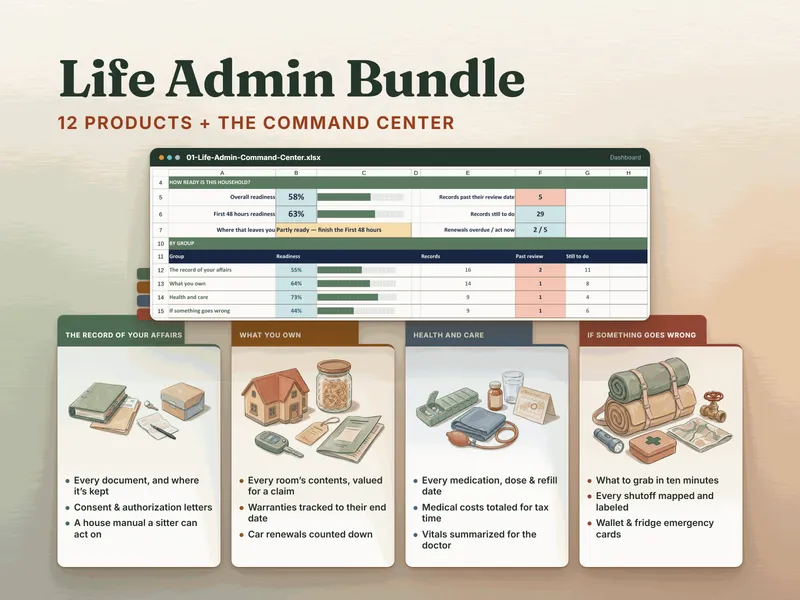
The Life Admin Bundle — 12 Household Records Products + a Readiness Command Center (Excel + Google Sheets + PDF)
Twelve Life Admin products in one bundle, plus a Command Center that scores how ready your household records are and names the next ten to fill in.
Life AdminView details - $14.95 Excel
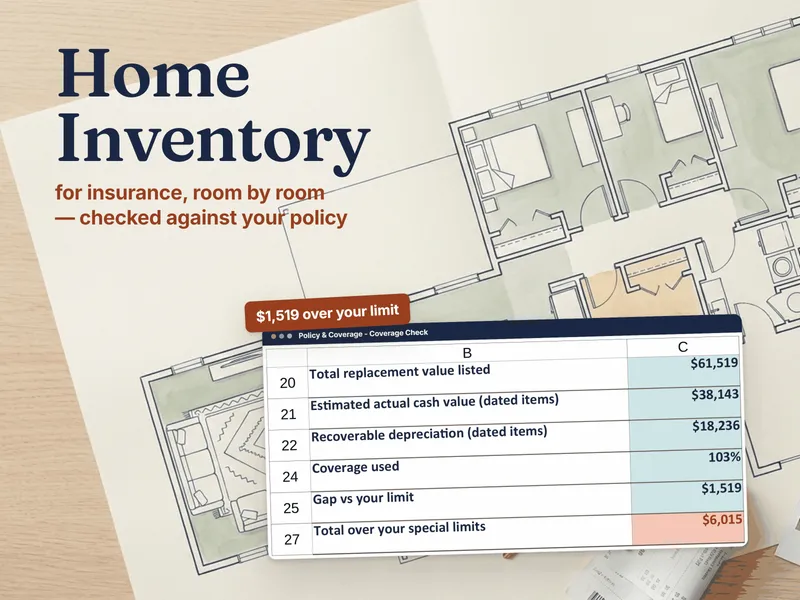
Home Inventory Spreadsheet for Excel — Room-by-Room Insurance Inventory with Proof Score, Coverage Check, Estimated ACV & Claim Worksheet
Excel home inventory for insurance: log what you own room by room, score your proof, check it against your policy limit and build a claim schedule.
Life AdminView details - $14.95 Spreadsheet
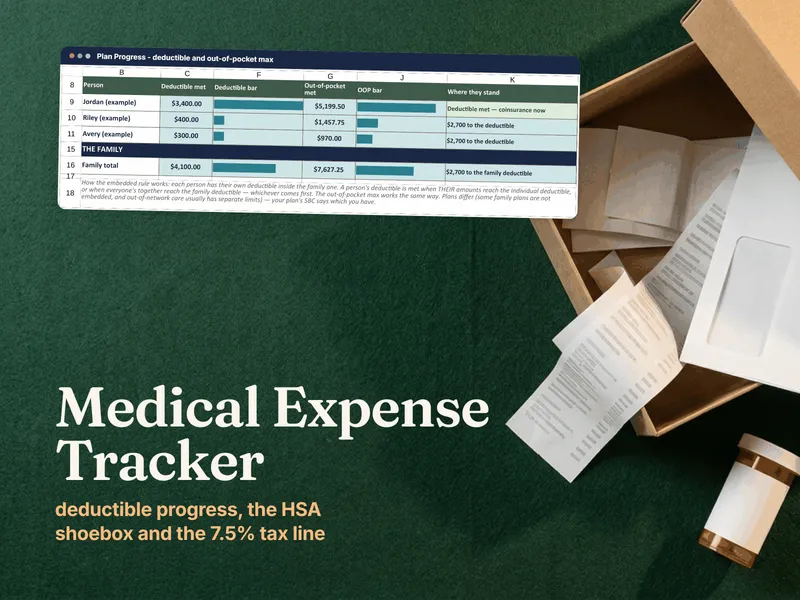
Medical Expense Tracker for Excel & Google Sheets — Deductible Progress, HSA Shoebox, FSA Deadline & the 7.5% Tax Line
Medical expense tracker for Excel and Google Sheets: log every bill from the EOB, see each person's deductible progress, the HSA shoebox and the 7.5% tax line.
Life AdminView details