There’s a drawer. You know the one. It has three years of warranty cards, a car title you’re pretty sure is in there, a passport that may or may not be expired, and a letter from your insurance company you opened, read for four seconds, and set down “to deal with later.”
Later never came. Later never comes. Because “later” isn’t a time — it’s a place you send things to avoid them.
Here’s the reframe that changes everything: the reason life admin feels impossible isn’t that you’re disorganized or lazy. It’s that you’re treating scheduled maintenance like an emergency. You wait until the passport is expired two weeks before a trip, until the warranty lapsed last month, until the insurance form needed to be back yesterday. Every one of those is the same small task — just handled at the worst possible moment, at the highest possible cost.
The fix isn’t more discipline. It’s a standing appointment. Call it a Life Admin Day.
What Is a Life Admin Day?
A life admin day is a recurring, time-boxed session — about 90 minutes, once a month — where you handle the small, non-urgent household and personal-record tasks that would otherwise pile up into a crisis. Renewals, filing, updating records, canceling what you don’t use, checking what’s about to expire.
The key word is recurring. A one-time “get organized” weekend is a New Year’s resolution — it feels great and lasts until February. A life admin day is maintenance. It’s the oil change, not the engine rebuild. You don’t do it because something is wrong; you do it so nothing goes wrong. That single shift — from reactive to scheduled — is the whole idea.
If you already run a two-minute weekly review for your task list, this is the household equivalent, dialed up to a monthly cadence for the slower-moving stuff that doesn’t need weekly attention but absolutely can’t be ignored for a year.
Why Life Admin Feels Impossible
Most household paperwork is not urgent — right up until it becomes an emergency. That’s the trap. A task with no deadline gets no attention, so it silently drifts toward the one moment it does have a deadline: the trip, the claim, the audit, the move. And by then it’s expensive.
Think about a passport. Renewing it is a boring, 20-minute errand at any point in the decade an adult passport stays valid. But the U.S. State Department lists routine passport processing at 4–6 weeks (opens in new tab), and that’s before mailing time on both ends — realistically 8–10 weeks door to door. Handle it on a quiet Sunday and it costs you 20 minutes. Handle it two weeks before a wedding abroad and it costs you an expedite fee, a stress spiral, and possibly the trip.
Nothing about the task changed. Only when you did it changed. Life admin is cheap and boring when it’s scheduled, and expensive and stressful when it’s summoned.
There’s a quieter cost, too. Unhandled admin doesn’t just wait — it can walk off with your money. State governments are currently holding upwards of $70 billion in unclaimed property (opens in new tab) — forgotten deposits, old paychecks, insurance payouts, refunds. NAUPA, the association of state unclaimed-property administrators, estimates that about 1 in 7 people (opens in new tab) are owed some of it. That’s not a fringe problem. That’s the direct, dollar-denominated cost of everyone’s “I’ll deal with it later” drawer, summed across the country.
Scheduled vs. Emergency: What the Same Task Costs
The clearest way to see the reframe is to put the two versions of the same task side by side. The task is identical. The timing is everything.
| The task | Handled on a Life Admin Day | Handled as an emergency |
|---|---|---|
| Passport renewal | 20 minutes, standard fee | Expedite fee, rush stress, or a missed trip |
| Home inventory for a claim | A folder of photos and receipts, ready | Reconstructing from memory while the loss is still raw |
| Warranty registration | Filed the week you bought it | A hopeful “I think it was still under warranty?” — and it wasn’t |
| Canceling an unused subscription | Caught at the next renewal | 11 months of charges you never noticed |
| Updating a beneficiary or record | Five minutes, done calmly | A legal or financial mess someone else inherits |
Read down the right-hand column and you’ll notice something: none of those emergencies are dramatic. There’s no fire. It’s just the compounding, low-grade tax you pay for handling predictable things unpredictably. A life admin day is how you stop paying it.
The Five Passes of a Life Admin Day
You don’t need to do everything every month. A life admin day works because it’s the same short set of passes each time — a checklist you run top to bottom, spending a few minutes on each. Most months, most passes are quick. That’s the point: you’re skimming for the one thing that’s about to matter, not overhauling your life.
- The paper pass. Deal with the physical and digital inbox. Open the mail you’ve been avoiding, act on anything with a date, and shred or file the rest. The goal is zero mystery envelopes.
- The renewals pass. Scan the next 60–90 days for anything that expires or auto-renews: registrations, licenses, memberships, warranties, insurance, that passport. Anything with a countdown gets checked now, not when the countdown hits zero.
- The records pass. Update the documents Future You (or your family) will need in a hurry. Add the new appliance to your home inventory, log the receipt, note the model number. A running home inventory spreadsheet turns the worst day — a fire, a flood, a break-in — into a file you already have instead of a memory test you’ll fail.
- The money-admin pass. Not budgeting — admin. Cancel what you don’t use, catch the free trial before it converts, verify the auto-pays. A subscription tracker makes the “wait, I’m still paying for that?” moment happen on your terms instead of on your bank statement.
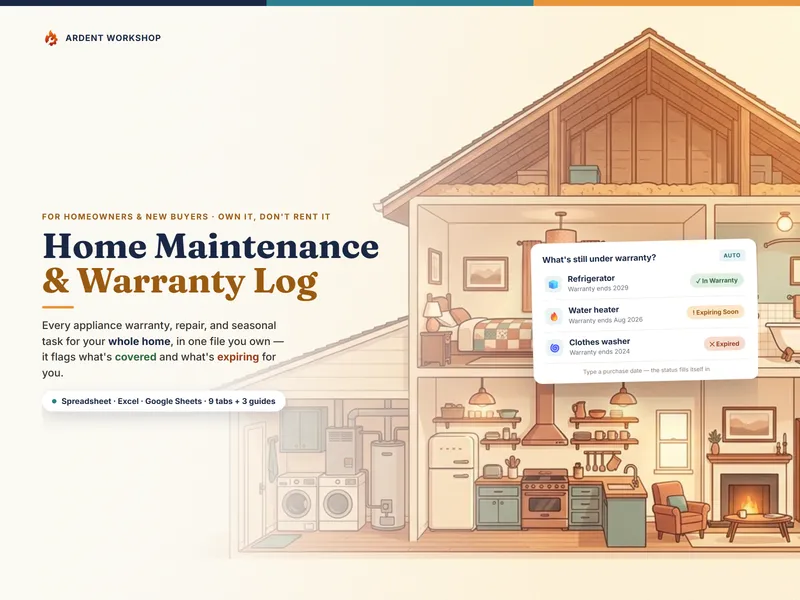
- The maintenance pass. For homeowners especially, the house is on an invisible schedule whether you look at it or not. Log the filter change, the serviced furnace, the warranty window, the thing that’s making a noise. A home maintenance and warranty log keeps a small repair from graduating into a big one.
Five passes. Ninety minutes. Once a month. That’s the entire system.
How to Run Your First Life Admin Day
Your first one takes longer than 90 minutes, because you’re clearing a backlog, not just maintaining. Budget a half-day, expect it to feel a little unpleasant, and know that every session after this one is dramatically shorter. Here’s the sequence:
- Pick the recurring slot and defend it. First Sunday of the month, second Saturday morning — whatever you’ll actually keep. Put it on the calendar as a repeating event. An appointment you can see is one you’ll keep; a vague intention is one you won’t.
- Gather everything into one place. The drawer, the pile, the folder of screenshots, the browser tabs. You can’t triage what’s scattered. One surface, everything on it.
- Sort into the five passes, not into “important” and “unimportant.” Everything is important-ish, which is exactly why the pile grew. The passes give you a decision for each item instead of a judgment call.
- Run the passes in order and time-box hard. Set a timer. The goal of session one is momentum and a system, not perfection. You are allowed to leave the garage door remote’s manual for next month.
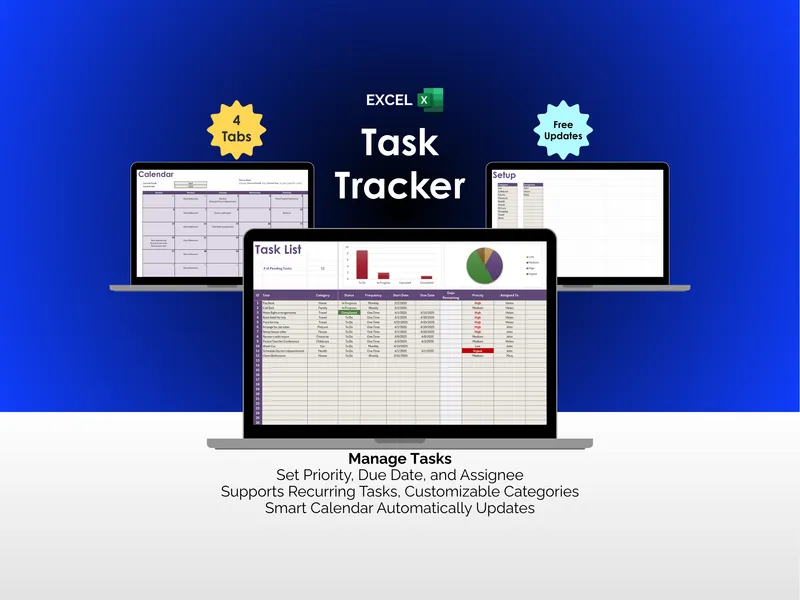
- Capture the recurring tasks so they resurface. The whole thing collapses if it lives in your head. Drop the repeating items — “check registrations in October,” “furnace service before winter” — into a task tracker so next month’s list builds itself.
By your third session, the paper pass is ten minutes and the renewals pass is a scan. The backlog is gone, and you’re just maintaining. That’s the version worth protecting.
Own the System, Don’t Rent It
Here’s the part the productivity-app industry won’t tell you: the tasks on a life admin day don’t need a monthly subscription to manage. They need a home. A place your records, renewals, and reference details live — one you keep, not one that locks your data behind a paywall the day you stop paying.
That’s the difference between renting and owning. A pile of loose sheets is free, but it’s infinite DIY work and it fails you exactly when you need it. A generic app rents you structure by the month and holds your information hostage. A connected set of workbooks you own sits in between: real structure, no monthly bill, and it’s yours for good.
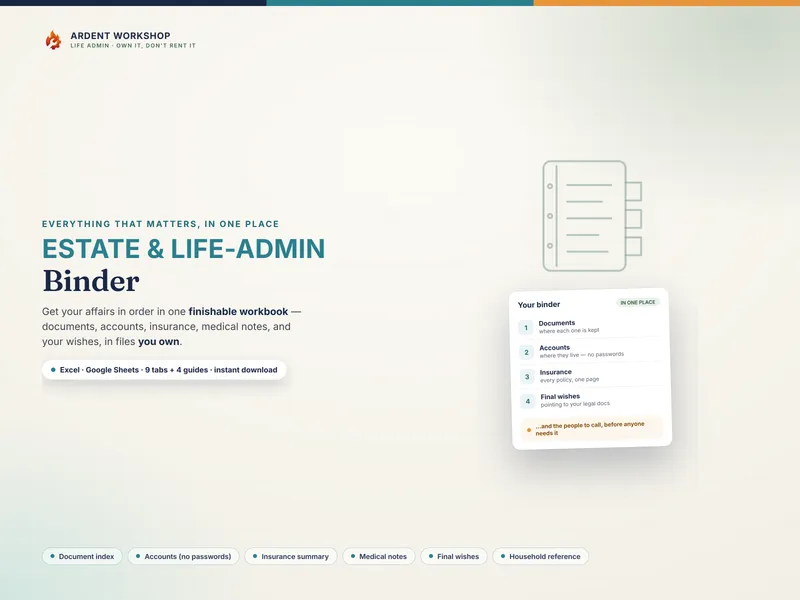
A master file gives your life admin day a permanent destination instead of a fresh scramble each time. The Estate & Life Admin Binder holds the records, accounts, and final wishes your passes turn up; the everyday side — appliances, service dates, house details — lives just as well in a Household Operations Manual. Build it one pass at a time, and the family emergency binder you’ve been meaning to create finally exists.
The takeaway is simple: you can’t eliminate life admin, but you can decide when it happens. Ninety boring minutes a month, on your calendar, on your terms — or a series of small, expensive emergencies, on the world’s. Pick the boring Sunday. Future You is counting on it.