Nobody hands you a maintenance manual at closing. You get a key, a stack of paperwork, and a house that is quietly already on a schedule — one you can’t see and didn’t agree to. The furnace has a service interval. The gutters have a clock. The water heater is aging whether you think about it or not.
A home maintenance calendar is a season-by-season schedule of the small upkeep tasks that keep a house healthy — so the work happens on a predictable rhythm instead of as a string of expensive surprises. This is that calendar, built for someone in their first year of ownership who has never had to think about any of this before.
The problem isn’t that maintenance is hard. Most of it is fifteen minutes and a ladder. The problem is that nothing reminds you, and the bill for forgetting doesn’t arrive for months — long after you’d forgotten there was anything to remember. That’s how a $15 filter turns into a $5,000 furnace, and a free afternoon on the gutters turns into a foundation repair.
Why “I’ll deal with it when it breaks” is the expensive plan
Here’s the uncomfortable math: deferred maintenance doesn’t disappear. It compounds. The tasks that cost nothing or almost nothing this season are the exact ones that, skipped long enough, become four- and five-figure repairs.
A few real numbers, so this isn’t abstract:
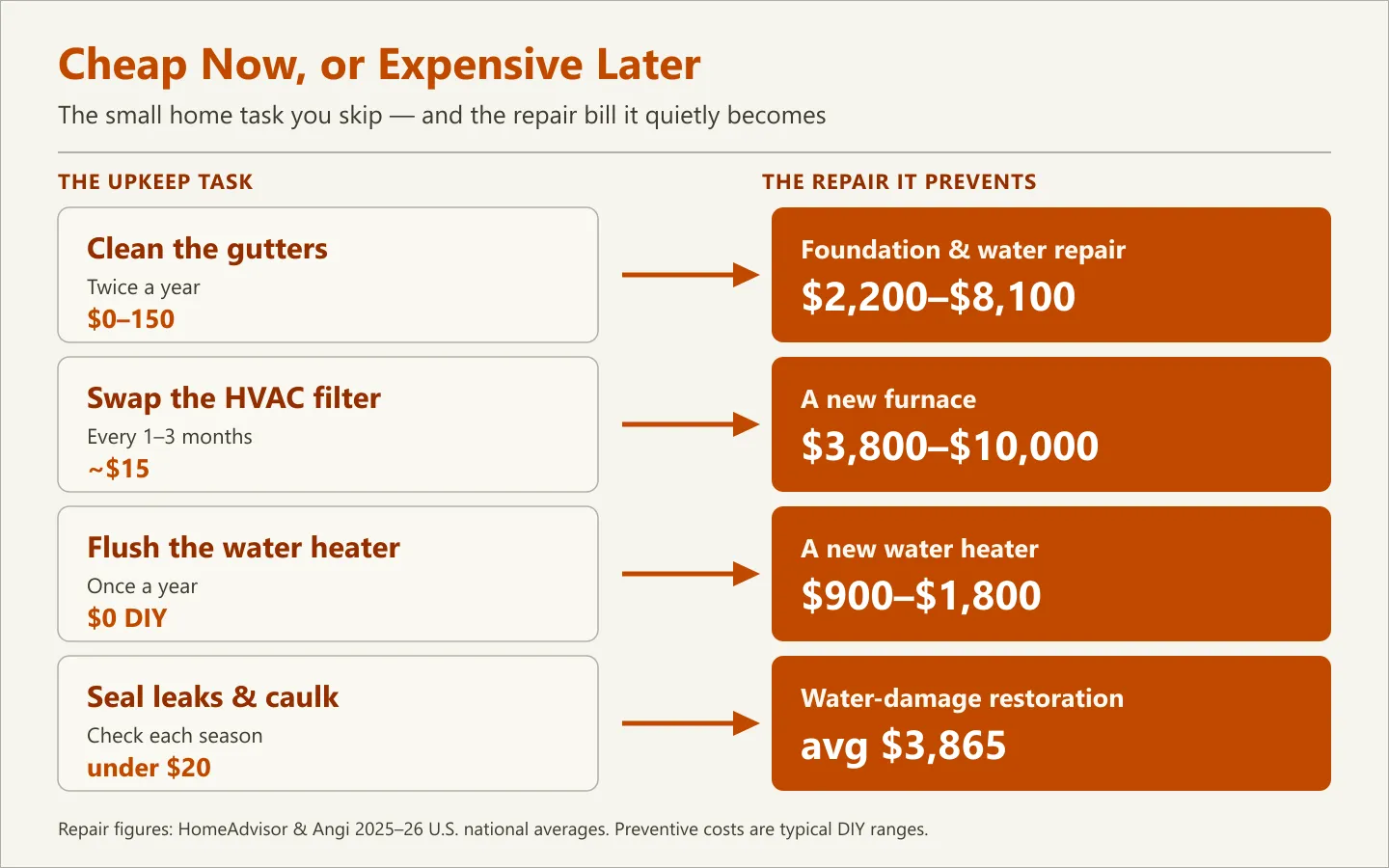
- Water damage restoration averages $3,865, and runs from about $1,383 to $6,378 depending on how far it spread (HomeAdvisor’s water-damage cost data (opens in new tab)). Much of it traces back to gutters nobody cleaned and small leaks nobody sealed.
- Foundation repair averages $5,176, with most homeowners paying between $2,225 and $8,135 (HomeAdvisor’s foundation-repair costs (opens in new tab)). Water pooling against the house — often from clogged gutters — is a leading cause.
- Replacing a gas furnace runs $3,800 to $10,000, and a full HVAC system averages around $7,500 (Angi’s HVAC replacement pricing (opens in new tab)). Skipping filter changes and annual service shortens a system’s life and strains it toward early failure.
- Replacing a standard tank water heater typically runs $900 to $1,800, averaging about $1,340 — more for a tankless unit (Angi’s water-heater replacement costs (opens in new tab)). A yearly flush you can do yourself for free is one of the cheapest ways to buy extra years out of one.
None of these are freak accidents. They’re the predictable end state of small tasks left undone — cleaning the gutters ($0–150), swapping an HVAC filter (~$15), flushing the water heater (free if you do it yourself), or resealing caulk (under $20). The whole point of a calendar is to intercept the expensive repairs upstream, while the fix is still one of those cheap chores.
A common rule of thumb is to set aside roughly 1% of your home’s value each year for maintenance and repairs — so about $3,500 a year on a $350,000 house, and more if the home is older. Whether or not you hit that number, the framing is right: upkeep is a line item, not a series of emergencies. A calendar is how you spend it deliberately instead of panicking.
Spring home maintenance: undo what winter did
Spring maintenance is about checking the house for damage the cold left behind and getting the exterior ready for rain. Winter is hard on a home — freeze-thaw cycles, ice, and heavy weather all leave marks you want to catch before spring storms find them.
- Clean the gutters and check the downspouts. Winter fills them with debris; spring rain overflows the clog straight down your foundation. Do this twice a year — spring and fall — and it’s the single highest-value hour you’ll spend on the house.
- Walk the roof line from the ground. Look for lifted, cracked, or missing shingles and any sagging. Binoculars are fine — you don’t need to climb up.
- Inspect the foundation and exterior for cracks. Small gaps that let water in now become big problems later. Note anything wider than a pencil.
- Service the air conditioner before the first heat wave, and replace the HVAC filter if you haven’t lately.
- Test the sump pump (if you have one) by pouring water into the pit and confirming it kicks on. You want to learn it’s dead in April, not during a June flood.
- Reseal exterior caulk around windows and doors where it’s cracked or peeling.
Summer home maintenance: exteriors and systems
Summer maintenance focuses on the outside of the house and the systems working hardest in the heat. The weather is cooperating, so this is the season for the jobs that need dry conditions and a full day.
- Inspect and clean the deck or patio, and reseal wood if water no longer beads on it.
- Check exterior paint and siding for peeling, rot, or gaps where pests get in.
- Clean the dryer vent — lint buildup is both an efficiency drain and a genuine fire risk.
- Flush the water heater to clear sediment. It’s a free, once-a-year task that protects one of the more expensive appliances in the house.
- Change the HVAC filter again — during heavy-use months, every one to three months is the right cadence.
- Trim trees and shrubs back from the roof, siding, and power lines.
Fall home maintenance: get ready for the cold
Fall maintenance is the most important season of the year — it’s your last chance to prepare the house before heating season and freezing weather arrive. Skipped fall tasks are the ones that turn into a no-heat call on the coldest night or a burst pipe in January.
- Service the furnace before you need it, and put in a fresh filter. A pre-season tune-up is a fraction of the cost of an emergency repair once it’s failed.
- Clean the gutters again after the leaves come down — the second of your two annual passes.
- Seal gaps and drafts around windows, doors, and where pipes enter the house. Cheap weatherstripping here shows up on your heating bill all winter.
- Disconnect and drain garden hoses, and shut off water to exterior spigots so they don’t freeze and split.
- Have the chimney inspected and swept if you have a wood-burning fireplace.
- Test smoke and carbon monoxide detectors and replace the batteries — heating season is exactly when CO risk rises.
Winter home maintenance: watch and protect
Winter maintenance is less about projects and more about monitoring the house through its hardest season. Most of the heavy lifting happened in fall; now you’re watching for trouble and keeping small problems from becoming disasters. (This section assumes a cold-winter climate — if you’re somewhere that never freezes, skip the ice-and-pipe tasks.)
- Watch for ice dams on the roof after snow, and keep an eye on any interior water stains.
- Know where your main water shutoff is — before a pipe bursts, not during. If you don’t know where it is, finding it is the most important thing you’ll do all winter.
- Keep interior temperatures steady and let faucets drip during deep freezes to prevent frozen pipes.
- Change the HVAC filter on the same monthly-ish rhythm.
- Reverse ceiling fans to clockwise to push warm air back down.
The quick-reference calendar
If you skim one thing, skim this. Each season’s non-negotiables, in one place:
| Season | Do this first | Why it matters |
|---|---|---|
| Spring | Clean gutters, test sump pump, service A/C | Catch winter damage; prep for rain |
| Summer | Flush water heater, clean dryer vent, reseal deck | Protect systems; dry-weather jobs |
| Fall | Service furnace, clean gutters, seal drafts | Last chance before heating season |
| Winter | Locate main shutoff, watch for ice dams, prevent frozen pipes | Monitor and protect through the freeze |
And the tasks that don’t belong to any one season — the background rhythm underneath the calendar:
- HVAC filter: every 1–3 months, year-round.
- Smoke and CO detectors: test monthly, replace batteries at least yearly, replace units per the manufacturer’s date.
- Water heater flush: once a year.
- Deep clean of one “hidden” system (dryer vent, refrigerator coils, range hood filter) each quarter.
How to actually keep a calendar (instead of a pile of good intentions)
Here’s the honest failure mode: you read a list like this, feel briefly organized, and forget all of it by the next season. The tasks aren’t hard. Remembering them, on time, every year, is the entire challenge — and a printout on the fridge doesn’t survive contact with real life.
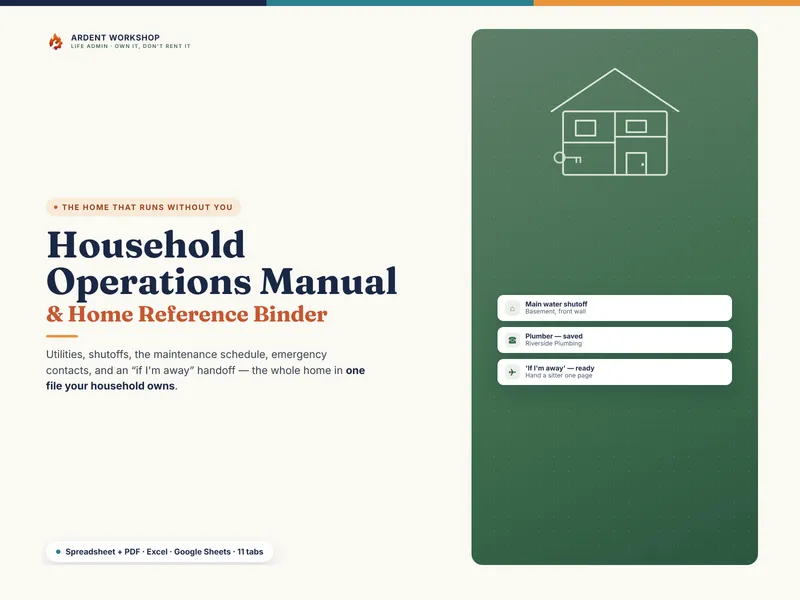
The fix is a system you own and actually open — one file where the schedule lives next to the record of what you’ve already done, so “when did I last flush the water heater?” has an answer. That’s precisely what the Household Operations Manual & Home Reference Binder is built around: a maintenance schedule that keeps the whole home on a rhythm — HVAC filters, gutters, smoke-detector batteries, the water heater — each with how often it’s due and when it was last done, alongside where your shutoffs and breakers are and who to call first. It’s the difference between a house you react to and a house you run.
Two companions make it more useful, not less:
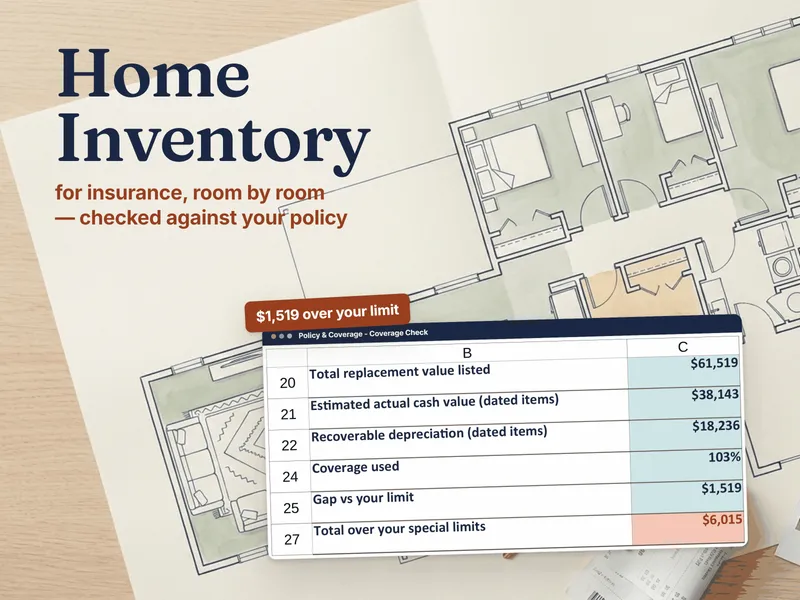
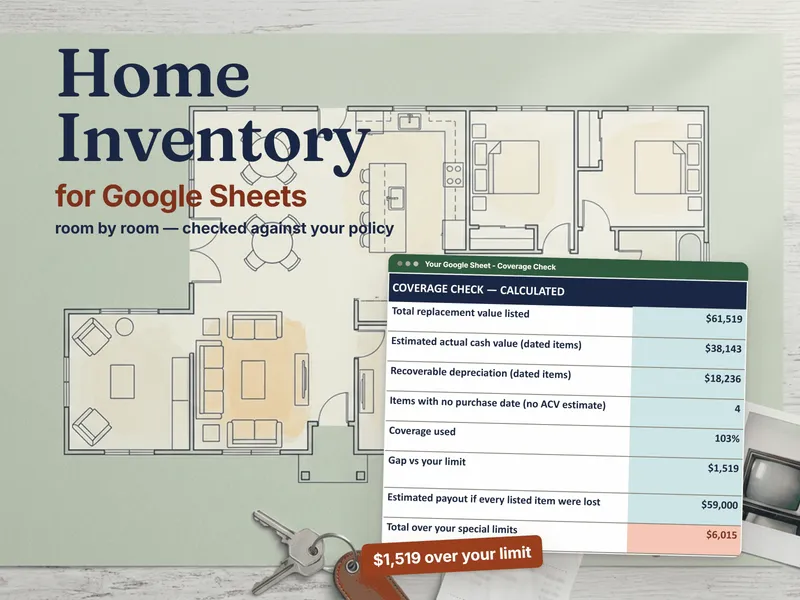
- Pair it with a Home Inventory Spreadsheet (also in Google Sheets) so that if the worst maintenance surprise still gets through, your insurance claim is a lookup instead of a memory test. If you’re new to this, here’s why every home needs one.
- Keep the paperwork that outlives any single repair — warranties, the deed, service records — in one place. A Family Emergency Binder covers the household records that sit right next to your maintenance log.
The reason these live in a spreadsheet you keep, rather than an app you rent, is simple: your house will outlast any subscription, and a maintenance history is only useful if you still have it in ten years. Own the record.
The takeaway
A house doesn’t fail randomly — it fails on a schedule, and a maintenance calendar is just that schedule written down before the bills come due. You don’t need to do everything at once. Start with the three “do this first” tasks for whatever season you’re in right now, then let the rhythm carry you. The gutters cleaned this weekend are the foundation you don’t repair next year. That’s the whole trade, and it’s the best one in homeownership.