Somewhere in your house there is a drawer, a box, or a shelf of banker’s boxes in the garage, and inside it is a phone bill from 2011.
You know it’s there. You’ve known for years. You don’t keep it because you need it — you keep it because opening the box means making four hundred small decisions, and every one of them carries the same quiet fear: what if this is the one they ask for?
Almost every household document falls on one of five shelves: shred it today, keep it 1 year, keep it at least 3 years, keep it as long as you own the thing it describes, or keep it forever.
Here’s the part most people never realize about the pile: which shelf a document lands on is almost never your decision. Nearly every document in the house is already on a countdown clock that somebody else started — a tax agency, a lender, a statute, a warranty period. The clocks are public, they’re specific, and once you know which one applies to a piece of paper, keeping it becomes a two-second call instead of a two-hour one. The two shelves nobody else sets — shred-today and the one-year pile — are the ones that come off the stack fastest.
Here’s where those clocks are.
How long should you keep documents? The short answer
Four of the five shelves map onto a clock — some legal, some practical. The fifth has no clock at all. The Federal Trade Commission’s guidance on which documents to keep and which to shred (opens in new tab) uses exactly these categories:
| Shelf (how long to keep) | What belongs there | Why that long |
|---|---|---|
| Shred today | ATM receipts, credit and insurance offers, cleared checks you wrote (after 14 days), old credit reports, prescription information for medicines you no longer take, expired warranties, expired credit cards and IDs | No clock at all. These have no remaining life, and they carry personal or financial information |
| 1 year | Bank statements, pay stubs, undisputed medical bills, credit card and utility bills, your records of deposited checks | Your own reconciliation cycle — you need them long enough to catch an error |
| At least 3 years | Income tax returns, tax-related documents (canceled checks, receipts, W-2s, 1099s), records related to selling a home | The IRS period of limitations for assessing tax or paying a refund |
| While you own it | Vehicle titles, home deeds, mortgage and auto loan documents, home improvement receipts, leases and rental agreements, receipts and warranties for major appliances, insurance policies and the declarations pages of expired ones | The life of the asset — the clock doesn’t start until you sell or replace it |
| Forever (lock it up) | Birth or adoption papers, Social Security cards, valid passports and citizenship papers, marriage licenses and divorce decrees, military records, wills and powers of attorney, death certificates, vital health records | Replacement cost — these are hard or impossible to reissue |
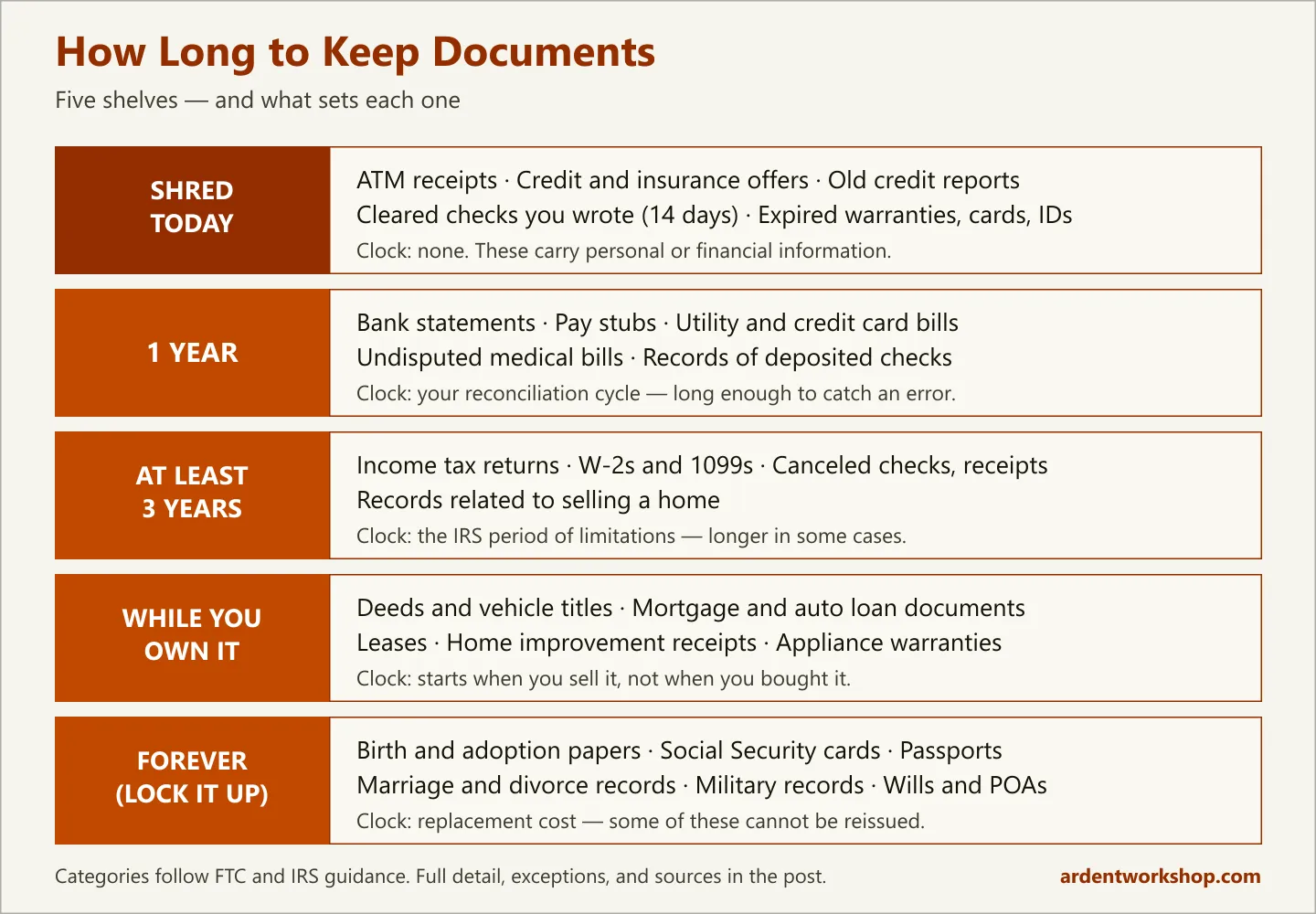
That’s the whole system. The rest of this post is the reasoning behind each shelf — because knowing why a clock runs three years is what lets you handle the document the chart doesn’t list.
Why three years is the number that matters
Three years is the default because that’s the IRS period of limitations — the window in which you can amend a return to claim a credit or refund, and the window in which the IRS can assess additional tax.
The IRS’s own guidance on how long you should keep tax records (opens in new tab) sets the baseline plainly: keep records for 3 years if none of the longer situations apply to you. If you file a claim for a credit or refund after filing your return, the rule shifts to 3 years from the date you filed your original return or 2 years from the date you paid the tax, whichever is later.
That’s why the three-year shelf holds more than the return itself. A return without its supporting documents — the W-2s, 1099s, canceled checks, and receipts behind every number on it — is not a defensible record. It’s a summary of a case you can no longer make.
Practical translation: in 2026, a 2022 return filed on time in April 2023 has passed its ordinary window. A 2023 return has not.
When three years becomes six — or never
Three years is the floor, not the ceiling. The IRS guidance on how long to keep records (opens in new tab) lists four situations that extend it, and the first two are worth knowing by heart:
- 6 years if you don’t report income you should have reported and it’s more than 25% of the gross income shown on your return. Note what triggers this: not fraud, not intent — just a large enough omission. A forgotten brokerage account or an unreported side income year can quietly put a return on a six-year clock without you ever deciding to put it there.
- 7 years if you file a claim for a loss from worthless securities or a bad debt deduction.
- Indefinitely if you don’t file a return at all.
- Indefinitely if you file a fraudulent return.
There’s also a separate track most households forget: if you pay a household employee — a nanny, a housekeeper, a part-time assistant — enough to owe employment taxes, the same IRS guidance (opens in new tab) says to keep employment tax records for at least 4 years after the tax becomes due or is paid, whichever is later.
The useful takeaway is a habit rather than a rule. When you close out a tax year, ask one question: is there anything unusual in this year? Unreported income, a large loss claim, a first year with household help, a year you filed late. If yes, that year’s box gets a longer date on the lid than the one next to it.
What to keep while you own it
Some documents have no calendar clock at all. Their clock starts the day you sell, and this is one of the most expensive misunderstandings in the whole drawer.
The IRS instruction on property records (opens in new tab) is to generally keep them until the period of limitations expires for the year in which you dispose of the property. A deed you’ve held for 18 years is not an 18-year-old document for retention purposes. It’s a document whose three-year window hasn’t opened yet.
The same logic covers leases, vehicle titles, and loan documents. They aren’t old. They’re open.
Why home improvement receipts are the ones worth keeping
Home improvement receipts are the ones people throw away, and here’s the money behind them. When you sell a main home, the IRS lets you exclude up to $250,000 of gain from your income — up to $500,000 on a joint return (opens in new tab) — the Section 121 exclusion — provided you meet the ownership and use tests, which generally require owning and living in the home for at least 2 of the previous 5 years (24 months). Gain above that exclusion is taxable, and gain is measured against your adjusted basis.
Improvements raise your basis. IRS Publication 523 (opens in new tab) defines them as work that adds to the home’s value, prolongs its useful life, or adapts it to new uses, and the qualifying list is long: additions, a new roof, new siding, kitchen modernization, heating and air conditioning systems, water heaters, septic systems, driveways, fences, landscaping, built-in appliances.
Every one of those receipts is a number that lowers your taxable gain — but only if you can produce it decades later. In a market where a long-held home clears the exclusion, a shoebox of contractor invoices is not clutter. It’s the difference between two tax bills.
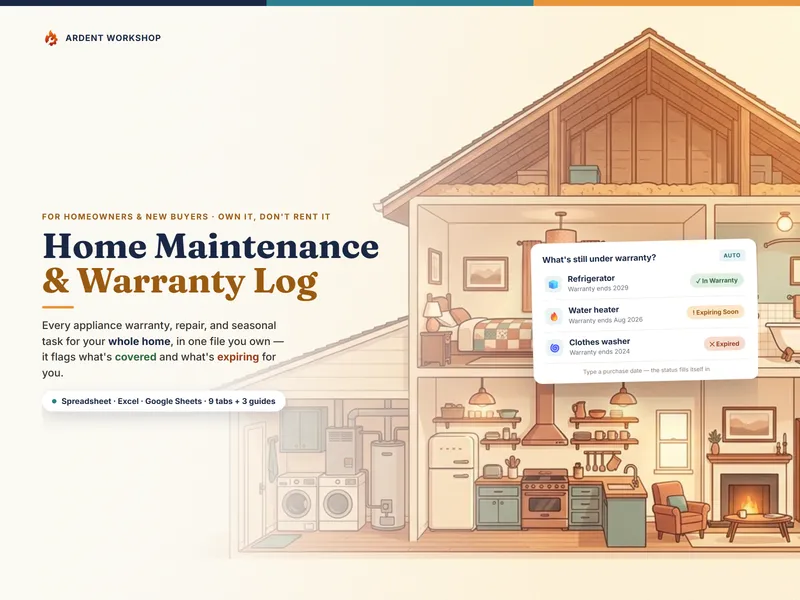
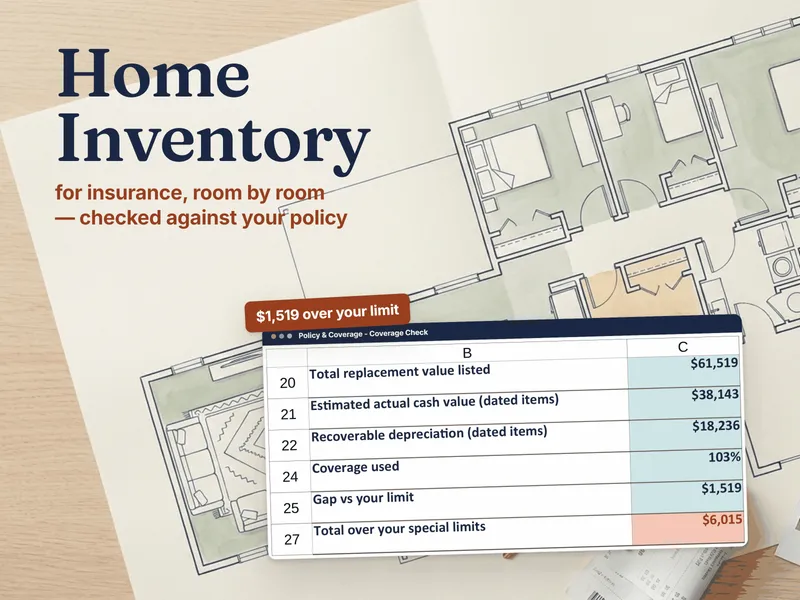
If you’d like these records to survive the decades, a running log beats a shoebox: the Home Maintenance & Warranty Log keeps contractors, service costs, and warranty windows in one place, and a Home Inventory records the receipts and serial numbers for the appliances that sit here. Keep the improvement invoices themselves — the ones that raise your basis — filed with the deed.
How long to keep insurance policies
Keep every insurance policy while it is in force, and keep the declarations page of expired policies far longer than feels reasonable — for liability coverage, indefinitely. This is the shelf people get wrong in the other direction: the common instinct is to shred last year’s policy the moment the new one arrives, and for liability coverage that is the one document you may need most.
The reason is the trigger. Household liability coverage is generally written on an occurrence form, and the Texas Department of Insurance states the rule plainly: occurrence policies “cover claims arising from injury or damage occurring while the policy is in force, regardless of when the claim is first made” (opens in new tab). What decides coverage is the date of the incident, not the date somebody files. An injury on your property in 2020 that becomes a lawsuit in 2027 is answered by the 2020 policy — a policy that expired six years earlier and is not old paper at all.
That is why the Nonprofit Risk Management Center’s guidance on how long to keep expired insurance policies (opens in new tab) recommends retaining occurrence-based policies permanently, and warns against relying on a broker’s files, which are commonly kept only six or seven years. You are the party with the longest interest in your own coverage history.
The practical version: shred the marketing pack and the expired wallet cards, keep the declarations page and any endorsements for every term, and keep them as PDFs so “permanently” costs you nothing but a folder. Claims-made policies — more common in professional liability than in household coverage — are triggered by the reporting date instead and do not carry the same tail. If you want the whole set indexed rather than merely stored, how to organize your insurance policies covers the one-page index that makes a claim call short.
How long to keep bank statements and pay stubs
The one-year pile — bank statements, pay stubs, utility and credit card bills, your records of deposited checks, undisputed medical bills — exists so you can catch an error while catching it still does something. After a year, a utility bill is a receipt for a problem nobody is going to reopen.
Two exceptions are worth carving out:
-
W-2s belong with your tax records, not the one-year pile — and there’s a reason beyond taxes. Federal law puts a hard limit on how long Social Security’s record of your earnings stays open to correction. The statute defines that “time limitation” as a period of three years, three months, and fifteen days (42 U.S.C. §405(c)(1)(B) (opens in new tab)) after the year the wages were paid, after which the agency’s earnings record is generally treated as conclusive, with narrow exceptions. Your W-2 is the evidence that closes the gap if the record is wrong — and your Social Security benefit is computed from that record. Check your earnings statement each year while the window is open.
-
A disputed medical bill is not a one-year document — and on Medicare, neither is the receipt behind a Summary Notice. The FTC’s one-year shelf specifies undisputed medical bills — and the qualifier does real work: an open dispute keeps every related record live, including the itemized bill, the explanation of benefits, and your notes on every call. If you’re carrying one of those, keep the whole file until it’s resolved and a year past, and read our walkthrough on how to dispute a medical bill before you pay it.
The same applies on Original Medicare. The Medicare Summary Notice arrives at least twice a year (opens in new tab), and the instruction worth acting on is the second one on Medicare’s what-to-do list: “Keep your receipts and bills, and compare them to your MSN…” That comparison is the whole point of holding the receipts — and a Medical Expense Tracker makes the year’s bills reconcilable at a glance instead of a bag of paper.
What to keep forever (and lock up)
The forever shelf isn’t defined by a legal clock. It’s defined by replacement cost — how painful it is to get a new one, measured in weeks and agency phone calls rather than dollars.
Per the FTC’s keep-or-shred guidance (opens in new tab), that shelf holds: birth certificates or adoption papers, Social Security cards, valid passports and citizenship or residency papers, marriage licenses and divorce decrees, military records, wills, living wills, powers of attorney, retirement and pension plan documents, death certificates of family members, and vital health records — especially any that predate electronic health records, because those exist nowhere else.
Two rules for this shelf:
- It leaves the drawer. These do not live in the same box as your electric bills.
- Somebody else has to be able to reach them. A perfectly organized forever shelf that only one person can find fails at exactly the moment it’s needed. That’s the same problem as a digital estate plan — the account nobody can access might as well not exist.
What you can shred today
You can do this pass tonight, without deciding anything. The FTC’s shred list (opens in new tab) is unambiguous:
- ATM receipts
- Offers of credit or insurance
- Cleared checks, after 14 days (the ones you wrote — not your records of checks you deposited)
- Credit reports
- Prescription information for medicines you no longer take
- Expired warranties
- Expired credit cards, driver’s licenses, and other forms of identification
Shred rather than bin — every item on that list carries personal or financial information: an account number, a prescription history, an ID number, or at minimum your name and address. If you don’t own a shredder, the FTC’s advice is to look for a community shred day. And if you can access a bank or tax document electronically, the FTC suggests considering shredding the paper copy; the bank’s archive is a better filing cabinet than your garage.
Where to store the documents you keep — and who needs access
A retention schedule is only half a system. The other half is storage that survives the event you’re keeping the documents for.
Ready.gov’s financial-preparedness guidance (opens in new tab) — home of the Emergency Financial First Aid Kit, a joint publication from Operation HOPE and FEMA — makes the practical version of the point: store important documents in a safe deposit box, on an external drive, or in the cloud, so they’re reachable during a disaster. Losing the house shouldn’t also mean losing the deed to it. In practice that’s three tiers:
- Fireproof and waterproof at home — the forever shelf and anything you’d need in the first 48 hours.
- A second copy off-site — a safe deposit box or encrypted cloud storage, both of which come with access control. A trusted relative works too, but hand it over as a sealed envelope labeled only with your name — not loose copies of everyone’s ID.
- One page that says where everything is — the index. Categories, locations, and who’s authorized to reach each one. Store the index itself on the forever shelf, not on the fridge: it’s the one page that unlocks all the others.
That last one is the piece almost nobody builds, and it’s the piece that makes the other two work. This is the shape of an owned system rather than a rented one: no subscription decides whether your family can find your documents, and no app going out of business takes the index with it. If you’d rather not design that structure from scratch, the Estate & Life Admin Binder is exactly this index built out — every category, where the original lives, and who can reach it — and the Household Operations Manual covers the running-the-house half of the same drawer.
How to sort a decade of paper in one afternoon
Don’t sort chronologically and don’t sort by hoping. Make five passes, each with one job:
- The shred pass. Go through everything once, pulling only the no-remaining-life items from the shred list above. No decisions, just volume. This is usually the pass that removes the most paper, and it’s the only one that asks nothing of you.
- The forever pass. Pull every vital record. It leaves the room and goes somewhere protected today, not eventually.
- The tax pass. Group returns and supporting documents by filing year. Check each year against the limitation periods above — and flag any year that’s unusual for a longer hold.
- The ownership pass. Titles, deeds, loans, leases, improvement receipts, appliance warranties. File these by asset, not by year, because that’s how you’ll look for them: you won’t think “2019,” you’ll think “the roof.”
- The index pass. Write the one page. Where each category lives, and who can get to it.
Everything left over after five passes is, almost by definition, the 2011 phone bill.
Start with the shred pass tonight. It’s the only one that requires nothing from you but a bag.
Sources and methodology
Retention periods change when the underlying rules do. The IRS limitation periods, the FTC keep-and-shred categories, the Section 121 home-sale exclusion amounts, and the occurrence-form definition cited above were each checked against the primary sources listed below in August 2026; Publication 523 was the 2025 edition at that time. Verify any figure against the source before acting on it.
- Protecting your personal information: Which documents to keep and which to shred (opens in new tab) — Federal Trade Commission
- How long should I keep records? (opens in new tab) — Internal Revenue Service
- Topic no. 701, Sale of your home (opens in new tab) — Internal Revenue Service
- Publication 523, Selling Your Home (opens in new tab) — Internal Revenue Service
- 42 U.S.C. §405(c)(1)(B), definition of the time limitation on earnings records (opens in new tab) — Cornell Legal Information Institute
- Medicare Summary Notice (MSN) (opens in new tab) — Medicare.gov
- Commercial general liability insurance, on occurrence and claims-made forms (opens in new tab) — Texas Department of Insurance
- How long should you keep out-dated (expired) insurance policies? (opens in new tab) — Nonprofit Risk Management Center
- Financial Preparedness and the Emergency Financial First Aid Kit (opens in new tab) — Ready.gov (FEMA)