What goes in an entry
The exact fields vary, but a decision journal that can teach you anything carries six things, all recorded before the outcome is known:
- The decision. One line, in plain words, describing what you are actually going to do.
- The options you turned down. Including "do nothing" and "wait," if those were genuinely on the table. It is the easiest field to leave blank and the one most worth having — a year on you remember choosing, but not what you chose against.
- Your reasoning, in your own voice. Untidied. If part of the reason is that you were tired of the subject, that belongs in the entry too.
- A confidence number. How likely you think your prediction is to come true — not how much you like the choice.
- A prediction that could be wrong. A claim, a threshold or a number, and a date.
- A review date. When the result will actually be knowable, which is usually later than you'd like.
Why the prediction has to be falsifiable
"I think this will work out" cannot be scored, so it can never be wrong, so it can never teach you anything. Compare two versions of the same entry:
- Unscorable: "The kitchen renovation will go fine."
- Scorable: "Done for under $14,000 and finished within ten weeks."
The second isn't more accurate — it's more falsifiable, which is a different and better property. It can catch you out. That's the point, and it's why a good journal keeps a separate verdict for entries that fail the test: not right, not wrong, but too vague to score. Each one is a decision you spent and got no information back from.
Judging the decision separately from the outcome
A decision journal is built on a distinction that's easy to state and hard to live by: a good decision and a good outcome are not the same thing. Judging a decision by how it turned out — outcome bias — is the habit the journal exists to interrupt. You control the process; the world controls the result, and over a small number of decisions luck is louder than skill. That gives four real combinations, and two of them are the ones that quietly teach the wrong lesson:
- Sound process, good outcome. Earned. Note what you did — it's a repeatable method, not a streak.
- Sound process, bad outcome. Bad luck. The danger here is over-learning: abandoning a good method because of one bad result feels exactly like wisdom at the time.
- Weak process, good outcome. Got lucky — the genuinely dangerous one, because nothing punishes you and you'll run the same habit again at higher stakes.
- Weak process, bad outcome. The honest loss, and usually the same two or three steps missing that were missing last time.
Judging yourself on results rewards recklessness that happens to pay and punishes care that happens not to. Judging yourself on process, and using outcomes as the data that tells you which parts of the process are doing real work, is the whole reason to keep the record.
Calibration: the thing only a journal can measure
Take every prediction you rated 80% likely. If you're well calibrated, about eight in ten came true. If only four did, that gap is worth taking seriously: it is the shape of overconfidence at 80, and unlike a hunch it has a number attached. One band of ten is not proof — luck is still in the room — but it is the only evidence of its kind you will ever have about your own judgment, and it points somewhere.
You cannot get this from reflection, or from thinking hard about your past. It requires a written confidence number attached to a scorable prediction, recorded before the outcome, across enough decisions to add up. That is a peculiar and specific set of requirements — and collecting them is exactly what a decision journal is for. A worked reading takes time, which is why our own workbook holds a confidence band's gap back until it has at least three scored predictions in it: two is not a reading. The picture keeps sharpening as the log grows.
Which decisions are worth logging
Not all of them, or you'll log none of them. A workable bar: anything you'd still be living with in six months, anything you spent more than a week thinking about, and anything where you can feel yourself wanting to decide quickly just to make the discomfort stop. Set the bar lower than that and you'll quit inside a month; set it higher and the confidence bands stay empty.
Journal, matrix, or both?
A decision matrix and a decision journal answer different questions. The matrix helps you make the call — it scores options against weighted criteria and surfaces the best overall fit. The journal helps you get better at making calls — it records how you decided and grades that record later. The natural combination is to run the matrix on the day and paste its result, plus the reasoning behind the weights, straight into the journal entry. See decision journal vs decision matrix for how the two fit together.
Paper or spreadsheet?
A notebook is enough for the entries themselves, and a printed one-page sheet is a perfectly good place to start — our free printable one-page decision journal is exactly that sheet, with a worked example filled in and a blank to print. What paper can't do is the arithmetic: bucketing years of predictions by the confidence you stated, counting how many came true in each band, and reporting the gap. That part wants a spreadsheet — and it's the part that turns a pile of entries into a picture of your own judgment.
Related terms
- Decision matrix — scoring options against weighted criteria to make a hard choice defensible.
- Weighted decision scoring — the arithmetic behind a matrix, and why the weights decide the answer.
- Total cost of ownership — the full cost of a choice over the whole time you live with it.
Templates that implement this
Templates for keeping a decision journal
7 templates
A journal for learning from the calls behind you, and weighted scorers for the one in front of you.
- $11.95 Spreadsheet

Decision Journal & Outcome Tracker — Predict, Review, and Measure Your Calibration (Excel + Google Sheets)
A decision journal spreadsheet that scores your process the day you decide, then measures how overconfident you actually are once the results are in.
Big DecisionsView details - $2.95 Excel
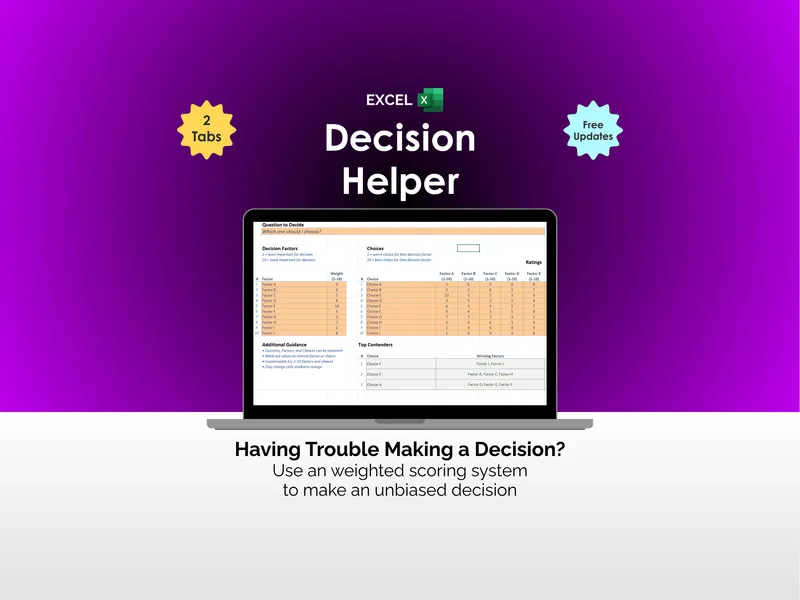
Decision Helper - Excel
Stuck on a big choice with five tabs open and zero clarity? This excel decision helper is a weighted decision matrix template that ranks options for you.
Big DecisionsView details - $14.95 Spreadsheet

Job-Offer Decision Helper — Weighted Decision Matrix to Compare Job Offers (Excel & Google Sheets)
Compare competing job offers with a weighted decision matrix — score pay, benefits, growth, commute & fit, and rank offers by overall fit.
Big DecisionsView details - $14.95 Spreadsheet

Buy-vs-Rent (Home) Decision Helper - Break-Even Year, Readiness Gates & Weighted Scoring (Excel + Google Sheets)
Settle whether to buy or keep renting. Computes your break-even year, runs six readiness checks, and weights 16 criteria to your household.
Big DecisionsView details - $14.95 Spreadsheet

True Cost of Homeownership Calculator — Every Carrying Cost, the Replacement Reserves & the Buy-vs-Rent Break-Even Year (Excel & Google Sheets)
Find what a specific home really costs per month — the mortgage payment plus the seven lines listing sites leave out — and the year owning beats renting.
Big DecisionsView details - $18.95 Spreadsheet

Business-Entity Decision Helper — Compare LLC, S-Corp, Sole Proprietorship & C-Corp (Excel & Google Sheets)
Compare LLC, S-Corp, sole proprietorship & C-Corp with a weighted scorecard and a self-employment-tax estimator — find your best-fit structure.
Big DecisionsView details - $14.95 Spreadsheet

Elder-Care Decision Helper — Weighted Scorecard to Compare Assisted Living, Memory Care & In-Home Care (Excel & Google Sheets)
Compare elder-care options — assisted living, memory care, nursing homes & in-home care — with a weighted scorecard that ranks them by cost, care & fit.
Big DecisionsView details