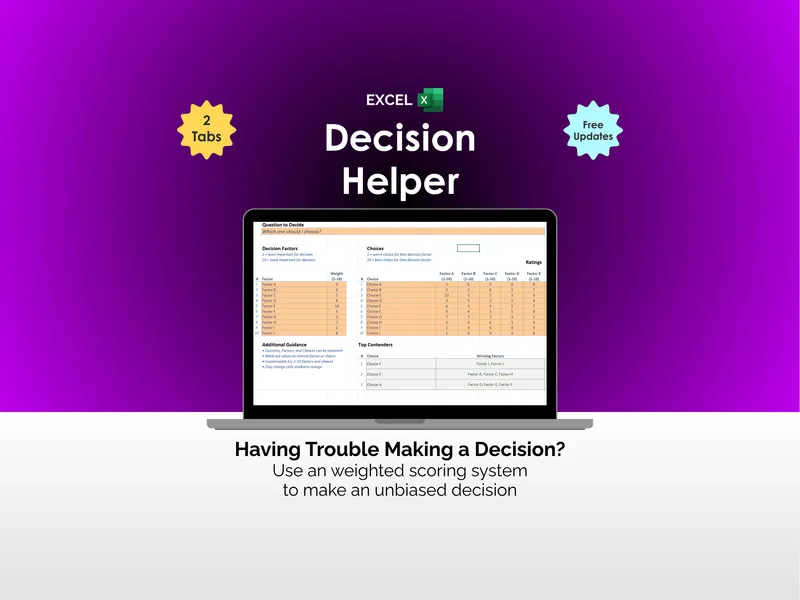
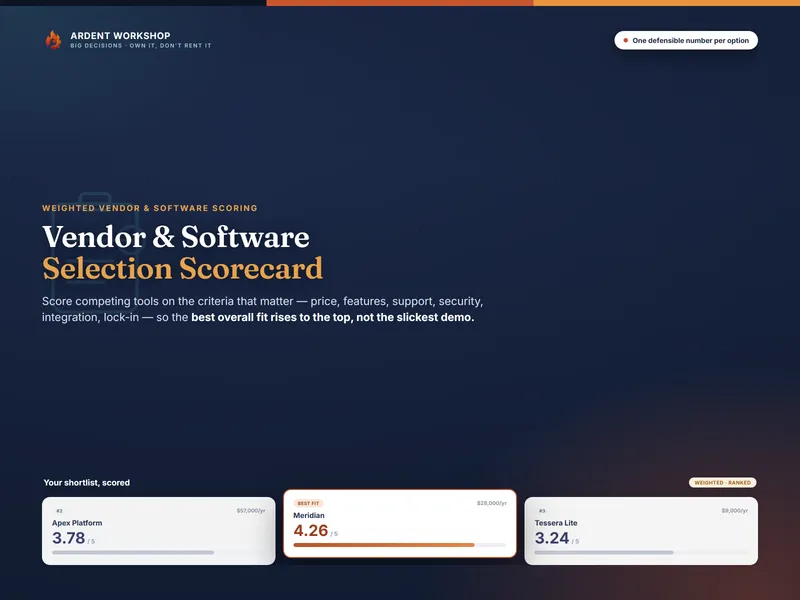
Here is the honest framing. If you asked a matrix "am I a good decider?" it would have nothing to say — it doesn't know what you predicted or how sure you were, and by the time the outcome arrives it has been closed for months. If you asked a journal "which of these three houses should I buy?" it would also have nothing to say — it isn't a scoring tool and it holds no opinion about your options. They're complements, not competitors.
The quick verdict
- Use a decision matrix if you're comparing two or more options right now, some criteria matter far more than others, or you have to justify the choice to someone else.
- Use a decision journal if you make several significant decisions a year and want to know — with evidence rather than a feeling — whether your judgment is any good and where it fails.
- Use both if the decision is big enough to score and long enough to review. The matrix picks the option; the journal records why you set the weights the way you did, and grades that reasoning later.
Side by side
| What matters | Decision journal | Decision matrix |
|---|---|---|
| The question it answers | How did I decide, and was that any good? | Which of these options fits best? |
| When you fill it in | Before you act, then again months later | While you're choosing |
| What it records | The choice, the options rejected, the reasoning, a confidence number, a prediction | Criteria, weights, and a score per option |
| What it outputs | A track record you can grade — and, eventually, a calibration reading | A ranked list with a winner |
| Handles luck? | Yes — that's the point. It separates a good decision from a good outcome | No — it has no view of what happened afterward |
| Pays off | Over years, and only if you come back | The same afternoon |
| Useless when | You never review it, or your predictions are too vague to score | There's really only one option, or the weights are set to justify a choice already made |
What only the journal can do
Two things, and both come from the same feature: a confidence number attached to a prediction that could turn out to be wrong.
- It separates the decision from the result. You control the process; the world controls the outcome. A journal that records how carefully you decided — before you know how it went — lets you tell a sound call that got unlucky from a reckless one that happened to pay. Grading yourself on results alone rewards the second and punishes the first.
- It measures calibration. Group every prediction by the confidence you stated and count how many came true. If your 80% calls come in at 55%, you are overconfident at 80 by a measurable number of points. No amount of reflection produces that number; only a written record can.
What only the matrix can do
Force the trade-offs into the open on the day. Writing down that schools matter twice as much as the commute, and then discovering the house you liked scores worst on your own weights, is uncomfortable in exactly the useful way. See weighted decision scoring for the arithmetic, and decision matrix vs pro/con list for why an unweighted list quietly misleads.
Using them on the same decision
- Score the options in a matrix. Note which criterion the winner actually won on — that's usually the real reason.
- Open a journal entry the same day. Record the chosen option, the ones you turned down, and why the weights were set the way they were.
- Add a confidence number and one prediction with a threshold and a date: not "this will work out" but "we won't have moved again inside two years."
- Set a review date and forget about it.
- When it comes around, mark the prediction right, wrong, or too vague to score — and ask the more useful question: were the weights right? A choice that scored well and still disappointed is worth a second question: was it the weights, or was it luck? The journal is the only record that lets you tell those apart — and when it was the weights, that is the most transferable lesson a review produces.
If you want the journal half on paper before you commit to a file, the free one-page decision journal is a printable version of exactly this loop — a worked example on the first page, a blank sheet on the second, no email required.
Owned either way
Both work best as files you keep. A decision journal in particular ends up holding candid notes about your work, your money, and the people around you — which is a poor fit for a subscription that can raise its price, change its export, or shut down, and a good fit for a file you own outright: one you can keep offline in Excel or LibreOffice, back up, and still open years from now. That timescale isn't incidental — a journal only pays once there is enough of it to read.
Frequently asked questions
- What's the difference between a decision journal and a decision matrix?
- A decision matrix helps you make the call: it scores several options against weighted criteria and ranks them, so the trade-offs are explicit on the day. A decision journal helps you get better at making calls: it records what you chose, why, how confident you were and one prediction, then has you come back months later and grade that record against what actually happened. One is a tool for the decision in front of you; the other is a tool for the decisions behind you.
- Do I need both a decision journal and a decision matrix?
- Not for a single choice. Use a matrix when you're comparing options right now, and don't feel obliged to journal a decision you'll never revisit. But if you make several significant decisions a year and want to know whether your judgment is improving, the journal is the only one of the two that can tell you — a matrix has no memory once the choice is made.
- Can a decision journal tell me whether I'm overconfident?
- Yes, and it is the only ordinary tool that can. Because a journal records a confidence number attached to a prediction specific enough to be marked right or wrong, you can eventually group your predictions by the confidence you stated and count how many came true in each band. If you're right about 55% of the time on calls you rated 80% likely, that gap is a measurement, not a feeling. A matrix records no confidence and no prediction, so it can never produce that reading.
- Should I start with a decision journal or a decision matrix?
- Start with whichever matches the pressure you're under. If a specific choice is looming, a weighted matrix earns its keep in an afternoon. If you keep having the vague sense that you don't learn much from your own decisions, start the journal instead — its payoff is slower but compounds, and the first entry has to be written before you know an outcome, so there is no way to catch up later.
- Can you use a decision journal and a decision matrix together?
- That's the natural combination. Run the matrix to make the call, then paste its result — the winning option, the score, and the reasoning behind the weights you chose — straight into the journal entry, along with your confidence and one prediction. Months later the review tells you not just whether the choice worked, but whether the weights you set were the right ones.