The five components of total cost of ownership
Whatever the asset, a total-cost-of-ownership model has the same shape:
- Acquisition. The purchase price plus everything it takes to complete the purchase — closing costs, taxes, fees, delivery, setup.
- Financing. The interest paid over the life of the loan, plus any insurance the lender requires as a condition of lending.
- Operating costs. The recurring costs of simply holding it — property tax, insurance, dues, utilities, fuel, licensing.
- Maintenance and replacement. Routine upkeep, plus a reserve for the components that wear out on a schedule. This is the component most often left out of a model — and the one that arrives as a lump sum rather than a monthly line.
- Disposal. What it costs to get out — agent commissions and transfer taxes on a house, depreciation and reconditioning on a car. Netted against whatever the asset is still worth.
Why the replacement reserve is the part that catches people
A roof does not become expensive the year it leaks. It becomes expensive the day it is installed — you simply do not get the bill until later. Every major component has a service life and a replacement cost, so dividing the one by the other tells you what you should be setting aside each year. Do that for every component and the total is your capital reserve, sometimes called a sinking fund.
This is exactly how a well-run condo association or commercial landlord budgets. Individual owners rarely have anything that forces the same discipline, and the consequence is predictable: a replacement arrives on schedule and is experienced as an emergency.
Total cost of ownership for a house
Applied to a home, the five components become concrete:
- Acquisition — the price plus closing costs, all due in cash on the same day.
- Financing — mortgage interest, plus mortgage insurance for as long as the balance is above 80% of the original purchase price.
- Operating — property tax, homeowners insurance, association dues, and utilities.
- Maintenance and replacement — routine upkeep scaled to the home's age and condition, plus a reserve for the roof, furnace, water heater, windows, and the rest.
- Disposal — commissions, transfer taxes, and concessions when you sell, paid on the full appreciated value.
Only the first two of those show up in PITI, which is why a lender's payment quote is a poor proxy for what a house costs. The True Cost of Homeownership Calculator models all five, and the free True Monthly Cost of a Home Estimator covers the operating side in about a minute.
Total cost of ownership for a car
A car runs the same five components on a much shorter clock, and the proportions are almost inverted:
- Acquisition — the out-the-door price: the negotiated price plus sales tax, title, registration and dealer fees, less any trade-in or incentive.
- Financing — loan interest, or, if you pay cash, the return that cash is no longer earning. A lease is a different animal again: a depreciation charge plus a rent charge derived from the money factor.
- Operating — fuel or charging, insurance, and annual registration and taxes.
- Maintenance and replacement — servicing that climbs as the car ages, plus tires, which are a replacement reserve in exactly the sense above: a set is being consumed on every mile long before it is bought.
- Disposal — depreciation, netted against what the car is still worth when you sell it.
The difference from a house is that the largest line is the one nobody invoices. A house's disposal cost is a commission you write a check for; a car's is depreciation, which is very often the single biggest cost of owning it and never appears on a statement. That is why a car is best compared on cost per mile rather than on price, and why the ranking between two cars can flip depending on how far you drive and how long you keep them — the argument worked through in cost per mile vs sticker price.
The free True Monthly Cost of a Car Estimator gives you the past-the-payment number for one car in about a minute, with no signup. The Car Total Cost of Ownership Calculator models all five components for up to three cars at once and solves for both of those flip points.
The one rule that makes total cost of ownership useful
A total-cost model is only meaningful against an alternative. The cost of owning a home means little on its own — living somewhere always costs money. It becomes decision-grade when you set it against renting the same home and investing the money you did not put down, over the number of years you will actually stay.
That comparison has one more subtlety worth naming: the opportunity cost. Cash tied up in a down payment is cash not earning a return elsewhere. A total-cost model that ignores it flatters ownership; one that counts it tells you the truth, which is the whole point of building the model in the first place.
Templates that implement this
Workbooks that model total cost
6 templates
Two cost engines that model a home or a car across its whole life, and the weighted scorers that rank options on everything a cost total can't measure.
- $14.95 Spreadsheet
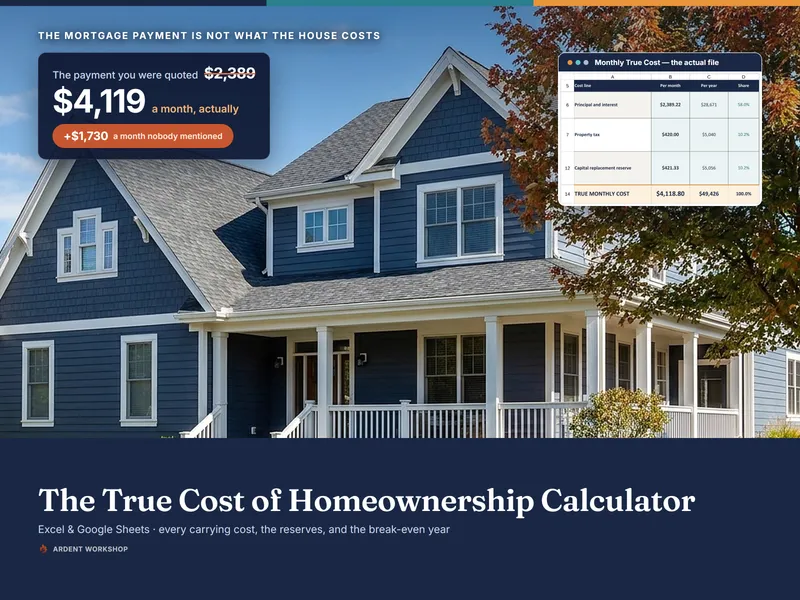
True Cost of Homeownership Calculator — Every Carrying Cost, the Replacement Reserves & the Buy-vs-Rent Break-Even Year (Excel & Google Sheets)
Find what a specific home really costs per month — the mortgage payment plus the seven lines listing sites leave out — and the year owning beats renting.
Big DecisionsView details - $12.95 Spreadsheet

Car Total Cost of Ownership Calculator — Cost Per Month and Per Mile, Depreciation Curve & Lease vs Finance vs Cash (Excel & Google Sheets)
Work out what a car really costs — per month and per mile — for three cars at once, and find the mileage where the cheapest one changes.
Big DecisionsView details - $2.95 Excel
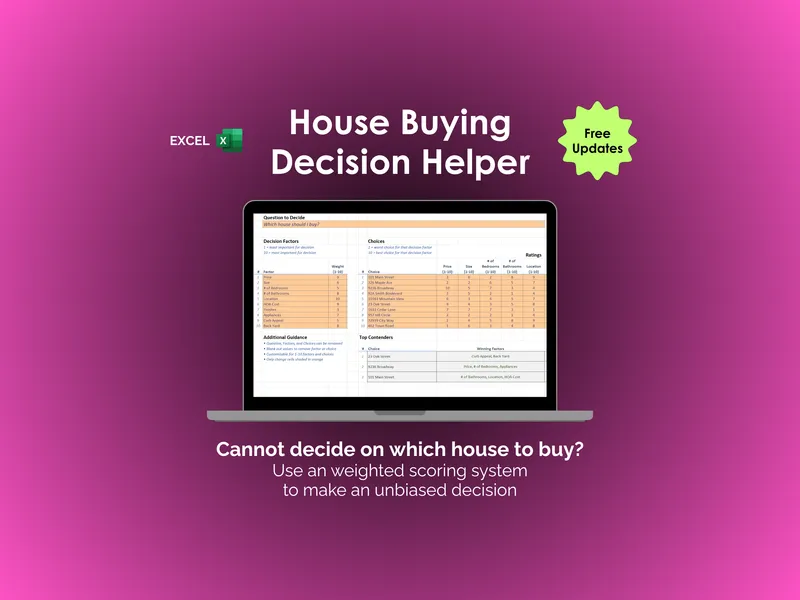
House Buying Decision Helper - Excel
Which house actually wins on the factors you care about? An excel house buying decision helper that scores up to 10 homes against 10 weighted factors.
Big DecisionsView details - $2.95 Excel
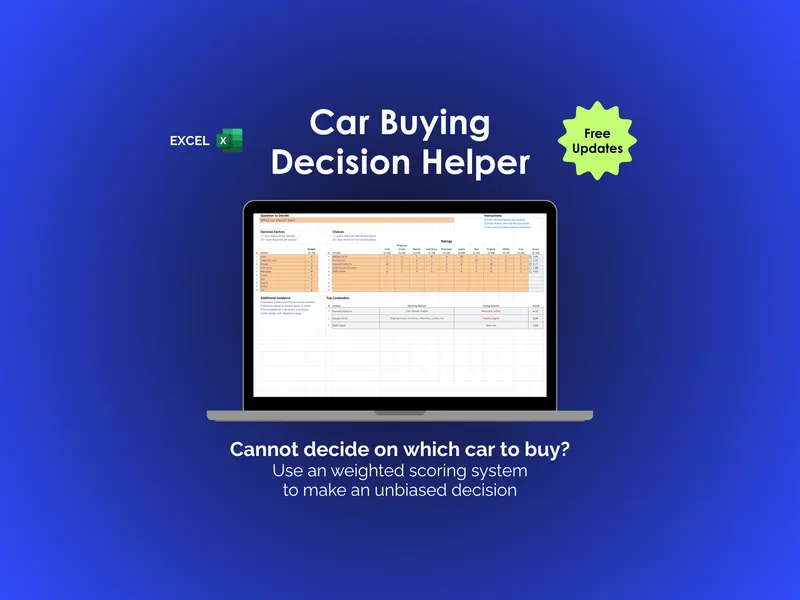
Car Buying Decision Helper - Excel
There are two kinds of car shoppers: the ones who score every option, and the ones who guess. This Excel car buying decision helper turns gut feel into weighted math.
Big DecisionsView details - $2.95 Excel
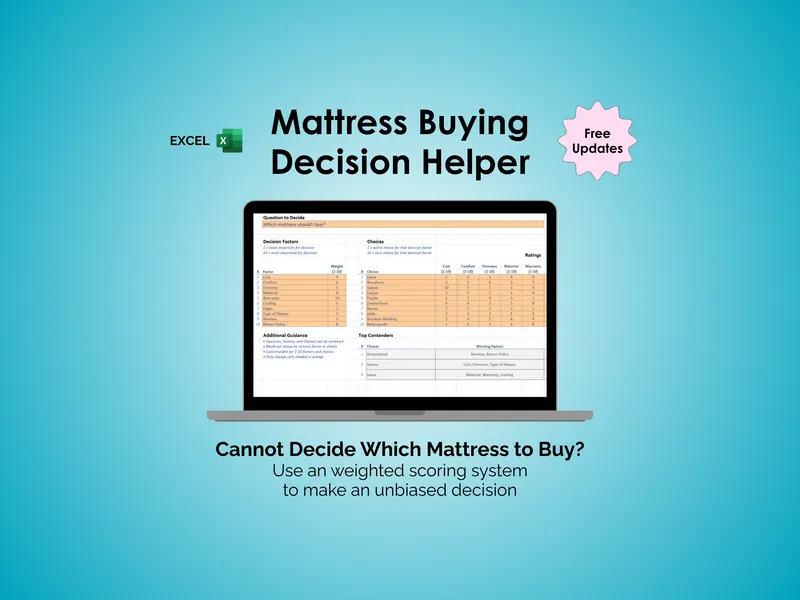
Mattress Buying Decision Helper - Excel
When did you last buy something you'll use 30,000 hours? The excel mattress buying decision helper scores up to 10 options across 10 weighted factors.
Big DecisionsView details - $2.95 Excel
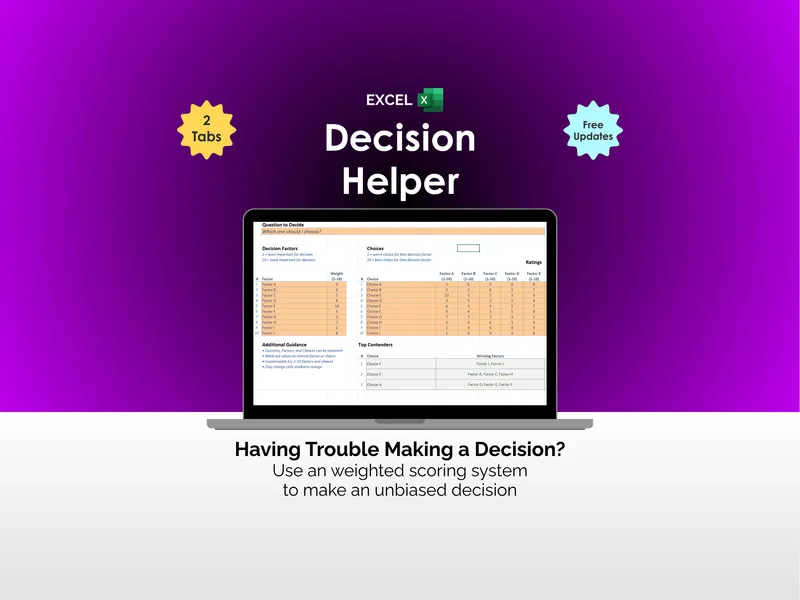
Decision Helper - Excel
Stuck on a big choice with five tabs open and zero clarity? This excel decision helper is a weighted decision matrix template that ranks options for you.
Big DecisionsView details