Ask five people whether grad school is worth it and you will get five confident answers. Your former professor says yes. Your friend two years into loan payments says absolutely not. Your parents think it sounds safer than the job market. They are all describing their own outcome, which is the one thing your outcome will not be.
Here is what makes this year different: the federal government just narrowed the question for you. As of July 1, 2026, Grad PLUS loans are gone for new borrowers and hard caps replaced them. For a lot of programs, “is grad school worth it” is no longer a philosophical question about self-investment. It is a financing question with a ceiling.
The short answer: grad school is worth it when a specific job you can name requires the credential, or when someone other than you is paying for a substantial share of it. Outside those two cases, run the four numbers below before you write a personal statement — because roughly 40% of master’s degrees (opens in new tab) leave their graduates financially worse off.
What “Worth It” Actually Means
Worth it means one thing here: the money you gain over a career exceeds the money the degree costs you, adjusted for the risk you never finish.
Most people only count the first half of the cost. The full equation has three inputs and one risk adjustment, and they get short names here that the rest of the post reuses:
- Out-of-pocket cost (N1) — tuition, fees, books, and health insurance, minus scholarships and assistantships. What leaves your account.
- Forgone earnings (N2) — the salary you don’t earn while enrolled, minus whatever you earn on the side. Usually the largest number, and usually the one nobody puts on paper.
- Salary delta (N3) — what you’ll make afterward compared with what you’d have made if you had just kept working and kept getting raises. Not compared with what you make today.
- Completion risk — the possibility you leave with the debt and no credential. Not a number you divide by; a haircut you apply at the end.
The first three combine into a single answer: payback period (N4), the years it takes the salary delta to repay the investment. Completion risk is then a haircut you apply to it. Every honest analysis of graduate education is an argument about those numbers, and The Four Numbers That Decide It below is where you fill them in. First, the case on both sides.
The Case for Grad School
The wage premium is real and measurable
Among full-time, year-round workers ages 25 to 34, median earnings for those with a master’s degree or higher were $80,200, about 20% higher than the $66,600 earned by those whose highest credential was a bachelor’s degree (2022 data), according to the National Center for Education Statistics indicator on annual earnings by educational attainment (opens in new tab). That gap compounds across a career.
In some fields the return is enormous
This is where the averages stop being useless and start being decisive. A Foundation for Research on Equal Opportunity analysis of nearly 14,000 graduate programs (opens in new tab) found that 97% of master’s degrees in computer science, engineering, and nursing produce a positive return, most of them above $500,000 over a career. “Return” here means one specific thing — the lifetime earnings the degree adds, minus everything it cost to get. The median master’s degree overall returns $83,000, and the top 20% of programs clear $500,000.
The same analysis (opens in new tab) finds advanced professional degrees do better still: the median return across law, medicine, and doctoral programs is $513,000, with only 14% showing a negative return. Almost half of medical degrees return more than $1 million, and 93% of law programs are positive.
Sometimes the credential is the job
The strongest argument for grad school isn’t financial modeling at all. It’s a locked door. In most states you cannot practice as a nurse practitioner, a licensed clinical therapist, a physician, a pharmacist, or a school psychologist without the degree, and a professional degree is the practical route into law and architecture nearly everywhere — though a handful of states keep narrow experience-based alternatives, so check your own state board. In those fields the comparison isn’t “degree vs. no degree” — it’s “this career vs. a different career.” The ROI math still matters for choosing which program, but it no longer decides whether.
Funding changes the entire equation
A fully funded PhD with a tuition waiver and a stipend has a direct cost near zero and a partially offset opportunity cost. An employer-paid master’s you complete while still working has an opportunity cost of zero. These are structurally different products from the same degree bought at sticker price, and they should not be evaluated with the same skepticism.
The Case Against Grad School
Four in ten master’s degrees lose money
The same FREOPP analysis (opens in new tab) that found half-million-dollar returns in nursing found that 40% of master’s degrees fail to produce any positive return at all. Not “modest returns.” Negative. The graduate would have been better off financially never enrolling.
The average hides the distribution
A 20% median premium sounds like a safe bet until you see how it’s distributed. Field of study, not degree level, is the dominant variable:
| Field | Share with a positive return | Size of the return |
|---|---|---|
| Computer science, engineering, nursing | 97% | Most above $500,000 |
| Law | 93% | 24% above $1 million |
| Social work | 88% | Only 14% clear $250,000 |
| Medicine | Not reported | Nearly half above $1 million |
| Business / MBA | Under 40% | 10% above $1 million |
| Education doctorates | About 40% | Not reported |
| Arts and humanities | Not reported | Median −$400,000, across all programs |
All figures from the FREOPP analysis of nearly 14,000 graduate programs (opens in new tab), which reports different fields different ways — “not reported” means that source doesn’t publish that particular cut.
Two people can enroll in “a master’s program” the same September and be making opposite financial decisions.
Your baseline is not your current salary
This is the error that does the most damage, and it inflates the apparent payoff of every degree. People compare their post-degree offer with what they earn today. The honest comparison is with what they’d be earning after the same number of years of raises, promotions, and job changes without the degree. Two years of ordinary career progression is not zero. In the worked example below, using today’s salary as the baseline inflates the delta by nearly a third — and the longer the program, the worse it gets.
The degree may not be causing the earnings
Selective programs admit people who were already going to do well. Some of the measured premium is the degree; some of it is the sorting. Nobody can cleanly separate the two for your specific case, which is a reason for humility about any projection — including a favorable one.
You might not finish
Not finishing is the one outcome where you keep the entire cost and receive none of the benefit. It is the dominant risk in long doctoral programs and a smaller one in one- and two-year master’s programs. Ask any program you’re considering for its completion rate and its median time to degree — most can produce both, and a reluctance to share them is itself an answer. Any honest model applies a haircut for it.
What Changed for Graduate Borrowers in July 2026
This is new, it is large, and it is easy to miss if you started researching programs before this summer.
The new caps
The 2025 reconciliation law eliminated the Grad PLUS program and set hard borrowing limits effective July 1, 2026; the Department of Education’s rulemaking on those loan provisions (opens in new tab) implements them. Grad PLUS previously let graduate students borrow up to the full cost of attendance — the school’s official total including living expenses, not just tuition — minus other aid. That ceiling is gone.
| Borrower | Annual federal limit | Total limit |
|---|---|---|
| Graduate students (most master’s, including the MBA) | $20,500 | $100,000 |
| Professional-degree students (see below) | $50,000 | $200,000 |
| One student, lifetime, across all their own federal student loans | Not applicable | $257,500 |
The $257,500 lifetime figure and the interim exception below both come from the Federal Student Aid guidance on the new loan limits (opens in new tab). That lifetime total counts undergraduate borrowing too. Loans a parent takes out on your behalf sit under their own separate limit.
Which programs count as “professional” is unsettled right now, and it matters more than anything else in this table. The RISE final rule defined the category narrowly, a federal court preliminarily stayed that definition in June 2026, and the Department is operating from a broader court-ordered interim list of professional degree programs (opens in new tab) while the litigation runs. As of the July 10, 2026 update that list covers 28 program codes and includes nursing (MSN and DNP), physical therapy, physician associate, audiology, speech-language pathology, occupational therapy, and a range of psychology doctorates — alongside medicine, law, and the other fields you would expect. The Department says the designations “may change as litigation in the case proceeds.” Check the current list for your program before assuming which cap applies to you; the difference between the two rows above is $100,000.
If you’re already enrolled
You keep the old rules if both of these are true:
- You were enrolled in the program as of June 30, 2026, and
- You had already received a Direct Loan for that same program before July 1, 2026.
If both hold, the pre-July-2026 limits last for what the guidance calls your “expected time to credential” — and that is narrower than it sounds. It is the lesser of three academic years or your program’s published length minus the part of it you had already completed on July 1, 2026, which is less than the time you actually have left if you’re running behind schedule.
Two consequences worth knowing:
- A long program runs out of legacy eligibility before it runs out of years. Someone in the first year of a six-year program keeps the old limits for three academic years, then falls onto the new caps for the rest of it.
- A program you’ve already sat through in full has none left. Four years into a four-year program, the remaining-length figure is zero.
Starting a new program resets you onto the new caps regardless.
Why program choice matters more now
Any gap between your program’s cost of attendance and these caps has to be closed by you — savings, family, an assistantship, or private loans without federal repayment protections. For an expensive private program, that gap can be tens of thousands of dollars a year. It is now a load-bearing part of the decision rather than a footnote.
That makes cost comparison across programs matter more than it used to. Average graduate tuition and fees ran $12,596 at public institutions and $28,017 at private nonprofits in 2021–22, the most recent year NCES reports at this level of detail (opens in new tab). Even at those figures, choosing the public program is often worth more than any scholarship you’ll win at the private one — and tuition is only part of the bill, as the real cost of a year of college breaks down for the undergraduate case.
The Four Numbers That Decide It
Here is the whole calculation. Four numbers, one division.
-
Out-of-pocket cost (N1). Tuition and fees for the whole program, plus books, plus health insurance if the school requires it, minus every dollar of scholarship, assistantship, and employer contribution. Use the program’s real published cost of attendance — the school’s official total including living expenses, not a per-credit rate you multiplied yourself.
-
Forgone earnings (N2). Your current salary times the years you’ll be out, minus anything you’ll earn while enrolled. If you’re going part-time while working, this can be near zero — which is often the single biggest lever available to you.
-
Salary delta (N3). Look up actual job postings for the specific title you’d hold after graduating. Take the midpoint. Then subtract what you’d be earning by then without the degree, not what you earn today. Use your own last three years of raises for that; if you have nothing to go on, roughly 3% a year is a serviceable placeholder.
-
Payback period (N4).
(N1 + N2) ÷ N3. That’s how many years of the higher salary it takes just to get back to even.
What counts as a good N4? There is no official threshold, so here is the test we’d apply: the payback has to be short enough that you will still be in the field to collect it, and ideally shorter than the loan term you’re signing. As a rough personal bar — under about seven years is comfortable, seven to ten needs a reason, and past ten needs a non-financial one.
A worked example
Illustrative numbers only — the point is the shape of the calculation, not these specific figures. Picture someone earning $62,000 who is considering a two-year, full-time master’s at a public university.
Step 1 — what it costs you (N1)
| Line | Value |
|---|---|
| Tuition and fees ($12,600 × 2 years) | $25,200 |
| Books, fees, required health insurance ($3,000 × 2) | $6,000 |
| Partial assistantship | −$8,000 |
| N1 — out-of-pocket cost | $23,200 |
Step 2 — what you give up (N2)
| Line | Value |
|---|---|
| Salary forgone ($62,000 × 2 years) | $124,000 |
| Summer and part-time earnings while enrolled | −$18,000 |
| N2 — forgone earnings | $106,000 |
Step 3 — what you gain, and when it pays back (N3, N4)
| Line | Value |
|---|---|
| Total investment carried forward (N1 + N2) | $129,200 |
| Post-degree salary from real job postings | $78,000 |
| What they’d earn in 2 years without the degree (3% raises) | $65,800 |
| N3 — salary delta | $12,200 |
| N4 — payback period | 10.6 years |
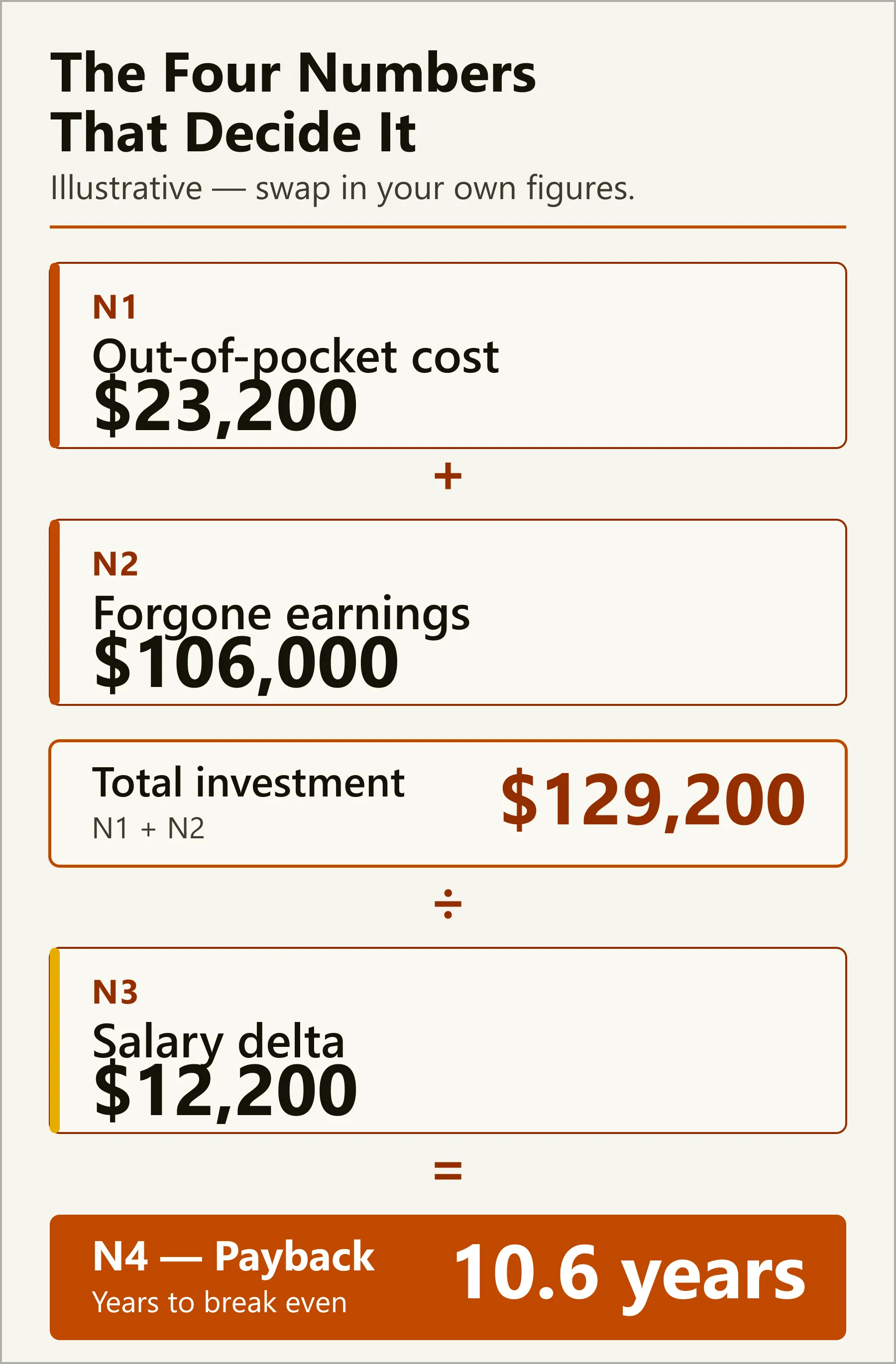
More than ten and a half years before this degree has paid for itself, and that’s before loan interest. Now change one number. If the same person were entering a field where the post-degree role pays $95,000 instead of $78,000, N3 becomes $29,200 and the payback drops to 4.4 years. Same tuition, same two years out, completely different decision.
That gap between 10.6 and 4.4 years is the answer to “is grad school worth it.” It has almost nothing to do with the quality of the program and almost everything to do with what the job on the other side pays.
Two adjustments most people skip
- Apply a completion haircut. If you’re honestly 85% likely to finish, your expected benefit is 85% of the salary delta while your cost stays 100%. Long programs with heavy attrition deserve a bigger discount.
- Add loan interest to N1. If you’re borrowing the $23,200 above and repaying over ten years, the interest is real money that belongs in the numerator.
The four numbers tell you whether the degree pays back. They don’t tell you whether you can carry the payments while it does — which, with the new federal caps closing off the easy financing, is now a separate live question. The Big-Purchase Affordability Calculator answers that second one, computing your ceiling three ways — cash and reserves, debt-to-income, and a plain multiple of your income — and naming which of the three is actually binding. It ships a per-year tuition purchase type, so grad school goes in as itself.
Where the Real Dividing Line Is
After all of that, the dividing line is narrower than the debate suggests, and it isn’t drawn where most people draw it.
It is not prestige, or passion, or whether you “love the subject,” or whether the job market is bad right now. It is these two questions:
- Can you name the specific job that requires this credential? Not a field. A job title, with postings you have read, at employers you could name, where the degree appears under requirements rather than preferences. If you can’t, you are buying an option, not a qualification — and options are priced accordingly.
- Is a meaningful share of the cost being paid by someone else? An assistantship, a fellowship, a tuition waiver, a GI Bill benefit, or an employer. Funding doesn’t just reduce N1; it usually signals that the program itself competes for students rather than the reverse.
On that second question, one lever is routinely left unpulled: employers can pay up to $5,250 a year of your education costs tax-free under a Section 127 educational assistance program — an employer-funded education benefit. That is a single combined cap, and it can go to graduate tuition or — now permanently — to student loan payments (IRS Publication 970 (opens in new tab)). The IRS’s educational assistance program FAQs (opens in new tab) put the figure at $5,250 “adjusted for increases in the cost of living for taxable years beginning after 2026,” so expect it to drift upward from there. It is easy not to ask, on the assumption the answer is no. Asking costs nothing and can move N1 by five figures across a program.
Two yeses and the math almost always works. Two noes and it almost never does. One of each is where the four numbers earn their keep.
The Verdict
Grad school is not a good or bad investment. It is a category containing both, and the label on the box tells you almost nothing about which one you’re holding. Find your situation:
- The job legally requires the credential — Go. But still compare programs on total cost, because the caps are real now.
- Funded PhD, or an assistantship covering tuition plus a stipend — Usually go. Your out-of-pocket cost is near zero and your forgone earnings are partly covered.
- Employer pays while you keep working — Usually go. You give up no salary, and the first $5,250 a year is tax-free.
- Technical or clinical field, specific target role, partial funding — Likely worth it. Run the four numbers and confirm the payback lands well under a decade.
- Full-price MBA, unfunded, mid-career — Be skeptical. More than 60% show no positive return (opens in new tab); a funded one is a different question.
- Unfunded humanities or arts master’s — Probably not, financially. A median return of negative $400,000 is a price, and you should know you’re paying it.
- None of the above, but you can name the job — Run the four numbers. Two yeses to the questions above and the math almost always works; two noes and it almost never does. One of each is exactly what N4 is for.
- “I’m not sure what else to do right now” — No. This is the most expensive way to postpone a decision.
That last one deserves emphasis, because it’s a common real reason people apply, and one that rarely appears in a personal statement. Two years and six figures is an expensive way to avoid choosing. If that’s where you are, the problem you’re solving isn’t education — it’s direction, and there’s a cheaper way to work on it. The same weighted-scoring approach works on it: it’s what we walk through for choosing a college major, and it costs nothing to run.
How to Score It Before You Apply
Do this in an evening, before the application fees start. A blank spreadsheet is enough — the structure is the point.
- Pick your three real options — and make one of them “don’t go.” A comparison with only schools in it has already answered the question.
- Fill in the four numbers for each. For the do-nothing option all four are zero — it’s the baseline every other option is measured against, so it wins on money by definition and gets compared on the non-financial factors in step 3 of this checklist instead.
- Weight what actually matters to you — payback period, licensure, location, program length, funding, risk of not finishing — and score each option against those weights instead of arguing them one at a time. If you’d rather not build the grid yourself, the Decision Helper is a weighted decision matrix built for exactly this shape of problem: your factors, your weights, ranked contenders.
- Write down why, and what you expect. Record the salary you’re projecting and the payback year you’re accepting. A Decision Journal & Outcome Tracker scores your reasoning the day you decide and then measures it against what actually happened — which is how you find out whether you’re a good forecaster of your own career before the next six-figure decision.
- Sleep on it, then re-read your salary delta. It’s the number people inflate. If you can’t point to five real job postings supporting it, lower it.
You will face this shape of decision again — a job offer, a relocation, a second degree — and a scorecard you build once transfers to all of them.
You don’t need certainty to decide well. You need your own four numbers instead of five other people’s outcomes. If the comparison you’re really running is between a program and a job offer already on the table, the same logic applies to choosing between two job offers — score it, don’t agonize over it.
Frequently Asked Questions
Is grad school worth it financially?
It depends almost entirely on field and funding, not on the degree itself. Roughly 40% of master’s programs leave the graduate financially worse off, while most master’s degrees in computer science, engineering, and nursing return more than $500,000 over a career. Both figures come from the FREOPP graduate ROI analysis (opens in new tab).
How much can graduate students borrow after July 2026?
Most graduate students can borrow $20,500 a year in federal loans, up to $100,000 total. Students in programs the Department of Education designates as professional degrees can borrow $50,000 a year up to $200,000 total, and that designation is currently governed by a court-ordered interim list that is broader than the rule’s original definition. A $257,500 lifetime cap applies to one student across all their own federal student loans, including undergraduate borrowing; loans a parent takes out on your behalf sit under a separate limit. The caps come from the Department of Education’s rulemaking (opens in new tab) and the Federal Student Aid loan-limit guidance (opens in new tab).
Does a master’s degree actually raise your salary?
At the median yes, by about 20%, but that midpoint conceals an enormous spread. The premium is large in licensed and technical fields and negative in several others, so the national figure is the least useful number for your specific decision. The 20% figure is NCES median earnings by educational attainment (opens in new tab), 2022 data.
Is an MBA worth it?
More than 60% of MBAs and other business master’s degrees do not show a positive return, which makes the MBA the clearest example of a degree whose reputation outruns its measured economics. A funded or employer-paid MBA is a different question from a full-price one. The share comes from the FREOPP graduate ROI analysis (opens in new tab), which also finds 10% of business degrees clear $1 million.
How much debt do master’s students take on?
Among graduate school completers who borrowed, the average cumulative balance for master’s degree holders was $66,000, and 60% of master’s completers had student loan debt at all. Those figures come from NCES data on student loan debt for graduate school completers (opens in new tab), covering 2015–16 in constant 2016–17 dollars, and the average excludes completers who borrowed nothing. That data is now a decade old, and the new federal caps mean a larger share of any gap comes from private lenders than it used to.
Sources and methodology
Every statistic in this post comes from one of the sources below. The worked example is modeled, not reported — its inputs are round illustrative figures anchored to the NCES public-university tuition average, and its outputs are plain arithmetic on them.
- National Center for Education Statistics — Annual Earnings by Educational Attainment (opens in new tab) — supports the $80,200 vs $66,600 median earnings and the ~20% premium. Full-time, year-round workers ages 25–34, 2022 data.
- Foundation for Research on Equal Opportunity — Is Grad School Worth It? A Comprehensive Return on Investment Analysis (opens in new tab) — supports every return-on-investment figure, including the 40% negative share, the $83,000 median, and the whole field-by-field table. Covers nearly 14,000 graduate programs.
- U.S. Department of Education — rulemaking implementing the 2025 reconciliation law’s student loan provisions (opens in new tab) — supports the elimination of Grad PLUS and the $20,500/$100,000 and $50,000/$200,000 caps, effective July 1, 2026.
- Federal Student Aid — Frequently Asked Questions on the new loan limits (opens in new tab) — supports the $257,500 lifetime aggregate limit and the interim exception for students already enrolled. Dated May 20, 2026.
- Federal Student Aid — Update to List of Professional Degree Programs Due to Court Order (opens in new tab) — supports the court-ordered interim professional-degree list and the fields it covers. Updated July 10, 2026; explicitly subject to change as the litigation proceeds.
- NCES Digest of Education Statistics — average graduate tuition and required fees by control of institution (opens in new tab) — supports $12,596 public and $28,017 private nonprofit. Academic year 2021–22, current dollars, the most recent year this table reports.
- NCES — Trends in Student Loan Debt for Graduate School Completers (opens in new tab) — supports the $66,000 average balance and the 60% who borrowed. 2015–16, in constant 2016–17 dollars, and the average excludes completers with no loans.
- IRS Publication 970, Tax Benefits for Education (opens in new tab) — supports the $5,250 annual tax-free employer educational assistance exclusion and its coverage of graduate coursework and loan payments.
- IRS — updated FAQs on educational assistance programs (opens in new tab) — supports the $5,250 being a single combined cap and its inflation adjustment for tax years beginning after 2026.