Ask five people whether you should accept a counteroffer and you will get five confident answers. Your recruiter says never — people who take them are gone in six months anyway. Your parents say a bird in the hand. A coworker who did it two years ago says it was the best money he ever made. Someone on the internet says it’s career suicide.
The short answer: accept a counteroffer when pay was genuinely the whole problem, when the fix is written down rather than promised, and when you’d still take the job at that number with no outside offer in hand. Refuse it when the reason you started interviewing had nothing to do with money — because that is the one thing a counteroffer cannot repair.
If you’re reading this with the offer still on the table and someone waiting on you: don’t answer today. Ask for 48 hours. Nobody reasonable refuses, and every test below works better with two days in hand.
The rest of this is the honest case on both sides, where the real dividing line sits, and three tests that take about twenty minutes.
Weighing two outside offers rather than an offer against a counteroffer? That’s a genuinely different problem — start with how to choose between two job offers instead.
What a Counteroffer Actually Is
A counteroffer is a retention offer: an improved package your current employer proposes after you tell them you’re leaving, intended to keep you from taking an outside job. It usually arrives as a pay increase, sometimes with a title change, a new reporting line, or a promise about scope.
Two things about it are worth knowing before you feel special.
It is routine. Robert Half’s research on the Australian market — the most specific published figure available, since its US 2026 Salary Guide publishes no counteroffer retention figures — found that 85% of Australian businesses had made a counteroffer in the past twelve months (opens in new tab). There’s no reason to think US employers behave very differently, but note that the number describes a different market. Getting a counteroffer is not evidence that you are irreplaceable. It’s evidence that you are expensive to replace, which is a different and much more common thing.
It is fast because replacing you is slow. The gap between your resignation and a productive successor will usually run to months rather than weeks once you add up recruiting, notice period, onboarding, and ramp. A raise that closes that gap looks cheap on your manager’s spreadsheet even when it looks enormous on yours. That doesn’t make it insincere. It makes it a business decision, which is exactly how you should evaluate it back.
The Case for Accepting the Counteroffer
The pro-counteroffer argument gets dismissed too quickly, usually by people who are paid when you switch jobs. It has real substance.
The money is unusually large, and it’s immediate. Mercer’s survey of more than 1,000 US organizations on 2026 salary increase budgets (opens in new tab) found employers planning merit increases of 3.2% and total increases of 3.5% — flat against what they actually delivered in 2025. Against that baseline, say a 12% counteroffer: that’s roughly four years of ordinary merit increases landing in a single pay period. Whatever else is true, that is not a small number, and refusing it on principle costs you real money.
Switching has costs nobody quotes you. You restart the tenure clock: PTO accrual tiers, 401(k) match vesting schedules, bonus eligibility windows, and your annual health deductible often reset or lapse when you move mid-year. You also spend down political capital you can’t transfer — the relationships that let you get things done without a meeting. None of that shows up in the offer letter, and all of it is worth something.
You know this job’s failure modes. Every workplace has them. You’ve already priced yours. The new one has failure modes too, and you get to discover them at full price after you’ve resigned. Among people who quit a job in 2021 and were employed elsewhere when surveyed, Pew Research Center found that 56% said they were earning more at the new job (opens in new tab) — but only 42% said their benefits were better, and 22% said benefits were actually worse. In fairness, the same survey found 53% gained advancement opportunities and 53% gained better work-life balance, which is exactly the ground a counteroffer can’t cover. Switching improves things on average. It does not improve everything, and averages are not promises.
Sometimes the counteroffer is a correction, not a bribe. If you were genuinely paid below market and your employer had no mechanism to discover that until you forced the issue, the raise isn’t manipulation — it’s a late repair of a real error. That situation is real, particularly at small companies with no formal compensation review.
The Case Against Accepting the Counteroffer
Now the other side, which is stronger than the money makes it look.
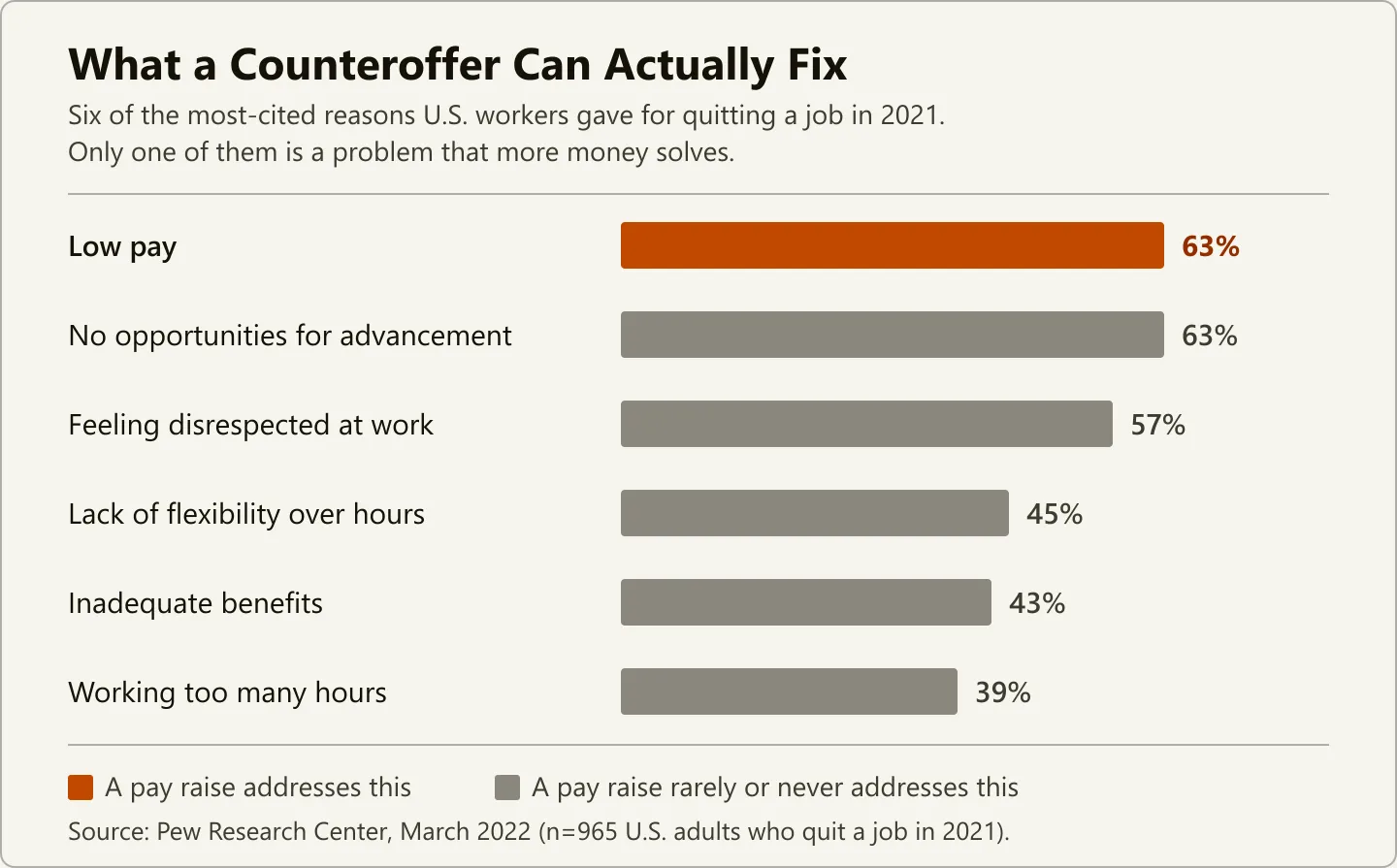
Pay is one of three reasons, not the reason. This is the argument that decides most cases. When Pew Research Center asked 965 US adults who quit a job in 2021 why they left, low pay was cited by 63% (opens in new tab) — and so was a lack of opportunities for advancement, with feeling disrespected at work close behind at 57%.
| Reason given for quitting a job | Share who cited it | Does a pay bump fix it? |
|---|---|---|
| Low pay | 63% | Yes |
| No opportunities for advancement | 63% | No |
| Feeling disrespected at work | 57% | No |
| Lack of flexibility over hours | 45% | No |
| Inadequate benefits | 43% | Rarely |
| Working too many hours | 39% | No |
Source: Pew Research Center, March 2022 (opens in new tab), surveyed February 7–13, 2022; n=965 US adults who quit a job in 2021. Pew also reports child care issues at 48%, asked only of respondents with a child under 18 at home, so it sits on a different base than the six above — and a raise doesn’t fix that one either.
A counteroffer is a precision instrument aimed at exactly one row of that table. If your reason for leaving is on any of the other rows, you are being handed a solution to a problem you don’t have.
The raise proves the money was always there. This is the part that quietly poisons the next year. If your employer can find 12% in 48 hours under pressure, that 12% existed last quarter, and the quarter before. What you’ve learned is not that they value you — it’s that their compensation process does not surface value until someone threatens to leave. That process is still in place tomorrow morning.
Out-of-cycle raises can borrow from your own headroom. Where a merit pool is set as a share of forward payroll — a common design — a large out-of-band increase eats into what’s available for you next cycle and puts you high in your band relative to peers doing similar work. Where that’s how it works, the follow-on raise is small, explained as “you’re already at the top of the range.” You may not have gotten a raise so much as next year’s raise, early.
And it often doesn’t hold. In the same Robert Half research, of the counteroffers Australian employers made, 46% kept the employee, 7% were declined outright, and 32% were accepted only for the person to leave within 12 months anyway (opens in new tab).
The Counteroffer Statistic Everyone Quotes Isn’t Real
You have probably seen the claim: 70% to 80% of people who accept a counteroffer leave within six months. It appears in recruiter blog posts, LinkedIn essays, and staffing-firm brochures, always stated as settled fact.
Try to trace it and the trail runs out. It gets attributed to unnamed industry research, to a Wall Street Journal article nobody can produce, and most often to nothing at all. No sample size, no methodology, no publication date, no dataset. It is folklore that has been repeated long enough to sound like evidence.
This matters because of who repeats it. The people quoting the 80% figure are, overwhelmingly, people whose fee depends on you taking the outside job. Your employer, meanwhile, has an equal interest in the number being zero. Neither party is a neutral narrator.
The Robert Half number above is the more useful one, and it’s worth being precise about its limits: Robert Half doesn’t publish a sample size for that question either, and it describes Australian employers rather than US ones. But it is attributable to a named firm, surveying employers, in a stated market, with the full breakdown shown rather than one dramatic number — which is more than the 80% claim has ever had.
And what it says is different in kind. Of counteroffers made, roughly a third were accepted and followed by a departure within the year; roughly half retained the employee. Note what that measures: whether someone was still there, not whether they were glad they stayed. It is not a career catastrophe with a 4-in-5 failure rate. It’s a decision that holds more often than not — good enough odds to take seriously, and uncertain enough to think hard about.
Where the Real Dividing Line Is
Both sides above are correct in different situations, and the thing that separates those situations isn’t the size of the raise. It’s this:
Did you go looking, or did the job find you?
If a recruiter contacted you out of nowhere, you interviewed out of curiosity, and the offer turned out to be excellent — you were not leaving. You were shopping. A counteroffer that closes the pay gap genuinely resolves the situation, because pay was the only thing that ever made the outside job interesting.
If you updated your resume at 11pm on a Sunday because of something that happened at work on Friday, you were leaving. The outside offer is the vehicle, not the reason. A counteroffer aimed at your salary is answering a question you never asked — and you’ll be back at the same 11pm on a Sunday before long, with less credibility and a manager who may now factor “flight risk” into your next assignment.
You usually know which of these you are the moment you read the question. The trouble is that a large number is very good at making you forget the answer.
Three Tests That Settle It
Take the counteroffer seriously, evaluate it as a third option rather than a yes-or-no on the second, and run it through these three tests. Do this on paper, not in your head — the number distorts everything it sits next to.
1. The written-down reason test
Before you look at the counteroffer amount, write down the reason you started interviewing. One sentence, past tense, specific. Not “growth” — “I have asked for a path to senior twice in 14 months and been told to revisit it next cycle.”
Then ask whether the counteroffer addresses that sentence. Not whether it’s generous. Whether it addresses that sentence. If your sentence was about pay, a matching offer is a genuine fix. If it was about your manager, your ceiling, your hours, or how you’re treated, more money is a payment for continuing to tolerate it.
2. The structural test
Name everything in the counteroffer that isn’t the number: a title, a new reporting line, a defined scope change, a promotion review on a specific date. Then ask for those in writing with dates attached.
The response to that request is more informative than the offer itself. A company solving a real retention problem will document it. A company buying six months of quiet will explain why documenting it isn’t how things work here. Verbal commitments made during a resignation are among the easiest promises to let lapse — the urgency that produced them disappears the moment you say yes.
3. The no-other-offer test
Imagine the outside offer was withdrawn this morning. The counteroffer stands. Would you take this job, at this number, with this manager, for the next two years?
If yes, accept it without guilt — you’ve simply repriced a job you like. If the honest answer is “no, but the money makes it hard to leave,” you have your answer, and the money is doing what it was designed to do.
How to Score It Instead of Agonizing Over It
Three options are now on the table, and comparing them by feel is how people end up somewhere they didn’t choose. Score them side by side on the criteria that actually matter to you, weighted by how much each one matters.
Weight the rows first, before you fill in a single score — spread 100 points across the six rows, then rate each option 1 to 5. Weighting after you’ve seen the numbers is just rationalizing with extra steps. The grid below is deliberately blank — copy it onto paper or into a sheet and fill it in yourself:
| Criterion | Weight | Stay (w/ raise) | New job | Stay (as-is) |
|---|---|---|---|---|
| Total compensation | — | — | — | — |
| Advancement path | — | — | — | — |
| Manager and team | — | — | — | — |
| Flexibility and hours | — | — | — | — |
| Risk and stability | — | — | — | — |
| Commute or location | — | — | — | — |
Treat “Stay (as-is)” as a real column. The option you’re implicitly rejecting deserves a score too.
If you’d rather not draw it up by hand, our free Job-Offer Web Scorer runs a weighted comparison in your browser with no signup — it takes two options across five fixed criteria, weighted out of 100, so it fits if you drop the “Stay (as-is)” column and score the counteroffer against the new job. For all three columns on criteria you choose, the Job-Offer Decision Helper compares up to four options and folds base, bonus, equity, employer match, health premiums, and commute into one comparable annual figure — then shows the best-fit option next to the best-paid one and names the gap in dollars, which is the number this whole decision turns on.
What to Do in the First 48 Hours
Whatever you eventually decide, these five moves protect the decision while you make it.
- Don’t answer in the room. “Thank you — that’s a serious offer and I want to give it a serious answer. Can I come back to you in two days?” Nobody reasonable refuses this, and the request itself is a small test of how the next year will go.
- Get it in writing before you evaluate it. Not because you distrust anyone, but because writing it down is what converts a conversation into a commitment.
- Hold the outside offer’s real deadline. Ask the other company for their actual latest date rather than guessing at it. Most will give you a few days; almost none will give you two weeks.
- Separate the number from the flattery. Being wanted feels good, especially if you’ve felt overlooked. That feeling is not information about the job.
- Write down what you expect to be true in six months — under both choices — before you decide.
If you decide the counteroffer is worth negotiating rather than simply accepting or refusing, that’s a different skill, and it’s the one covered in our guide on how to negotiate salary without losing the offer. The Salary & Job-Offer Negotiation Toolkit is built for that moment specifically — it fixes your target, anchor, walk-away, and BATNA before the conversation and includes ready-to-send scripts for the competing-offer play.
Common Questions About Counteroffers
Can you accept a counteroffer after you’ve already resigned?
Usually yes, as a practical matter rather than a legal one. A resignation an employer is glad to un-process gets un-processed; what actually binds you depends on your contract and notice terms, so read them. The harder problem is the outside offer: backing out after you’ve accepted a written offer burns that employer, and often the recruiter who placed you. Treat a signed acceptance elsewhere as the real point of no return, not the resignation.
How long do people stay after accepting a counteroffer?
In the best-documented breakdown available, roughly half stay and about a third leave within the year anyway. The full split, and why the “80% leave within six months” figure isn’t real, is above.
Does accepting a counteroffer hurt your reputation?
It depends on how you ran the resignation more than on the counteroffer itself: a calm resignation with real notice is usually unremarkable to come back from, while an explicit ultimatum is not. If you presented the offer as a threat, you’ve told your employer that pay conversations here require leverage — and that is what gets remembered at the next planning cycle.
The Bottom Line
Accept a counteroffer when pay was genuinely the whole problem, when the fix is documented rather than promised, and when you’d still take the job at that number with no outside offer in hand. In that case you haven’t been manipulated — you’ve discovered your market rate and captured it without the risk and reset costs of switching, and the widely-quoted claim that you’ll be gone in six months is folklore whose trail runs out under any attempt to check it.
Refuse it when your written-down reason had nothing to do with money, when the structural piece stays verbal, or when the honest answer to the no-other-offer test is no. In those cases the counteroffer isn’t solving your problem. It’s buying time on it — theirs, at your expense.
Either way: decide it on paper, in the criteria you weighted before you saw the number. That’s the difference between choosing and being chosen for.
And write down what you expect to be true in six months, under whichever option you take. The Decision Journal & Outcome Tracker logs the call, the reasoning, and one falsifiable prediction on the day you decide, computes a review date from the horizon you set, and flags it when it’s due — then sorts what happened into good-decision and good-outcome quadrants, so you find out whether you were right or just lucky. That’s the part that makes you better at the next one of these instead of just getting through this one.
Sources
- Pew Research Center, “Majority of workers who quit a job in 2021 cite low pay, no opportunities for advancement, feeling disrespected” (opens in new tab) — March 2022. Supplies every figure in the reasons-for-quitting table and the switcher outcomes (56% earning more, 42% better benefits, 22% worse, 53% advancement, 53% work-life balance). Surveyed February 7–13, 2022; n=965 US adults who quit a job in 2021. Note this is 2021 behavior, the most recent Pew reading on the question.
- Mercer, “Most US employers plan to keep 2026 salary increases flat” (opens in new tab) — merit increases of 3.2% and total increases of 3.5% planned for 2026, from a survey of more than 1,000 US organizations conducted in October 2025.
- Robert Half (Australia), “Counteroffers” (opens in new tab) — supplies the 85% and the 46/32/7 breakdown quoted above. Australian employers; no sample size published. Two caveats worth knowing: Robert Half’s US 2026 Salary Guide (opens in new tab) publishes no counteroffer retention figures (checked July 2026), and trade coverage attributing counteroffer statistics to “the 2026 Robert Half Salary Guide” is reporting the Australian edition — which is why the Australian data is used here and should not be read as a US statistic. Robert Half’s own page also summarizes the same research as a “54% success rate,” which doesn’t reconcile with the 46% in its body text, and its three shares sum to 85 rather than 100; the 46/32/7 split is quoted because it is the version Robert Half states twice, including in its FAQ.
Disclaimer: This post is for informational and educational purposes only and does not constitute financial, tax, legal, or employment advice. Compensation structures, equity vesting, bonus clawbacks, notice requirements, and non-compete enforceability vary enormously by employer, state, and individual contract — consult a licensed financial advisor, CPA, or employment attorney before making decisions based on this content.