Someone asks what you’re majoring in. You give them an answer — and then you hear yourself say it, and you realize you picked it because a teacher you liked taught it, or because the intro course was the one that didn’t meet at 8 a.m., or because it was the answer most likely to end the conversation.
Sound familiar?
Here’s the thing: you’re not being flaky, and you’re not bad at making decisions. You’re making a five-figure, four-year decision with exactly one input — how it feels — because nobody ever gave you a second one. Choosing a college major on a vibe isn’t a character flaw. It’s what happens when the only tool you’ve been handed is your gut.
So let’s hand you a second tool.
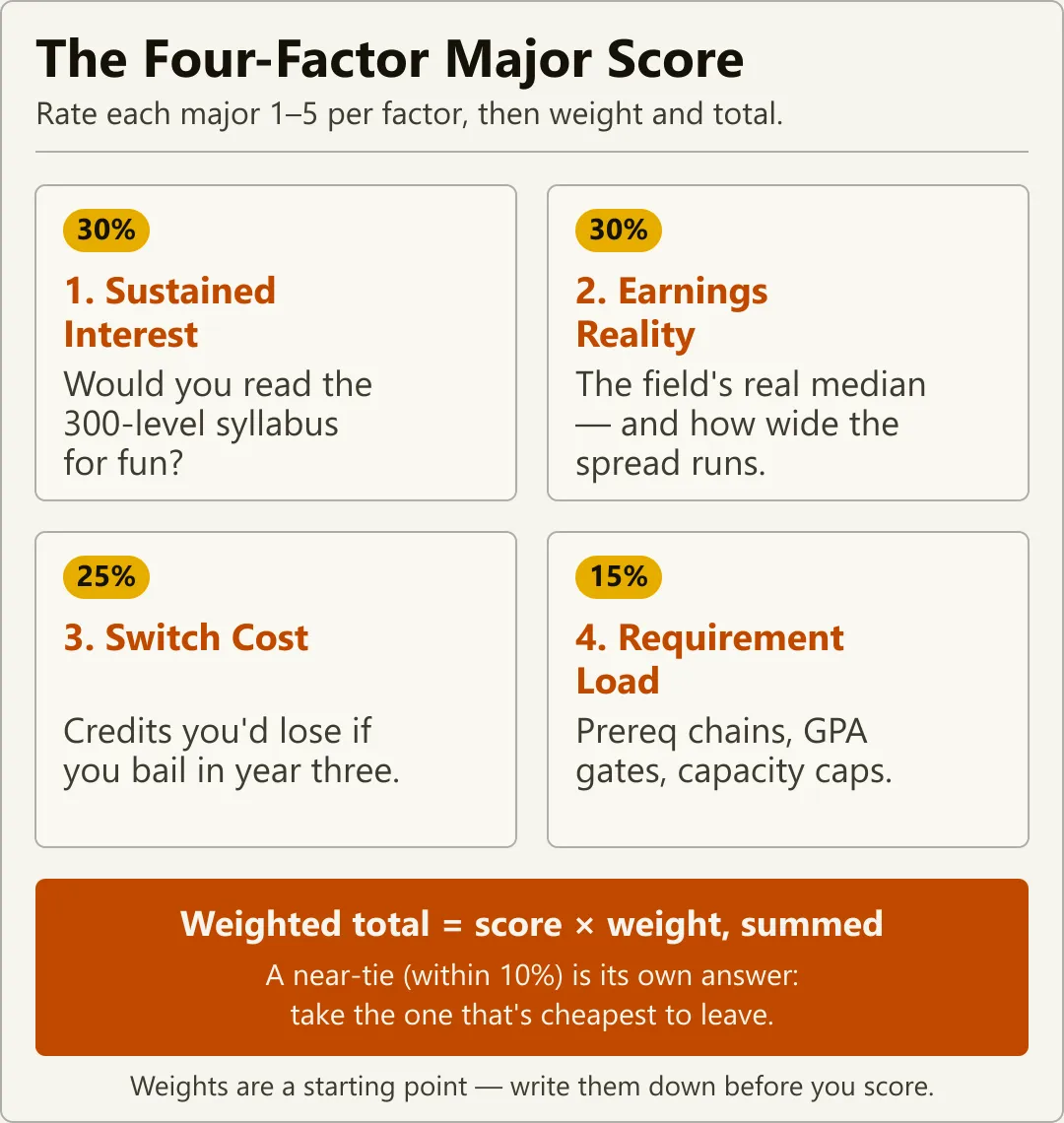
The short version: choose a college major by scoring three to five candidates against four weighted factors instead of one — sustained interest (30%), earnings reality (30%), switch cost (25%), and requirement load (15%). Write the weights down before you score anything, multiply each score by its weight, and add them up. Highest total wins. If two majors land within 10 percent of the higher total, that near-tie is its own answer: take the one that’s cheapest to leave. The rest of this post is why each factor is there and how to score it honestly.
Why “Follow Your Passion” Falls Apart as a Major-Picking Strategy
“Follow your passion” fails not because passion is worthless, but because it’s one input being asked to carry an entire decision by itself.
The evidence is blunt. According to the U.S. Department of Education’s study of beginning college students who change majors (opens in new tab) — its most recent national look at the question, tracking students who started college in 2011–12 — about one-third of students in bachelor’s degree programs changed their major within three years of enrolling, and 9 percent changed more than once. The rate isn’t uniform, either: mathematics majors switched at 52 percent and natural sciences at 40 percent. Students who declared a STEM major changed majors at 35 percent, against 29 percent for those who started outside STEM.
Look closely at that math number. It’s hard to wander into a mathematics major by accident — and half of them still switched. That’s not a passion problem. That’s what a one-input decision looks like when it meets a 300-level course.
Passion belongs in the decision. It just doesn’t belong there alone.
Your Major Is Not Your Job
Your major sets a starting range, not a destination — and the data on this is much less dramatic than the panic around it.
Start with the assumption that a major is a career pipeline. The Census Bureau found that only 28 percent of college-educated STEM majors actually work in a STEM occupation (opens in new tab). Among the 50 million employed college graduates aged 25 to 64 in its 2019 American Community Survey, 37 percent held a bachelor’s degree in science or engineering, but just 14 percent worked in STEM roles. The gap varies by field — engineering and computer/math/statistics majors landed in STEM jobs at around 51 to 52 percent, biology/environmental/agricultural science at 16 percent, psychology at 10 percent.
Now the earnings side. Georgetown’s Center on Education and the Workforce published The Major Payoff (opens in new tab) in October 2025, and two findings should reset how you read any “best-paying majors” list:
- The gap between fields is real but narrower than advertised. Median earnings for prime-age workers run from $58,000 in education and public service to $98,000 in STEM.
- The gap within a field is often bigger than the gap between fields. Petroleum engineering majors post a $146,000 median; miscellaneous agriculture majors — also counted as STEM — post $64,000. That’s an $82,000 spread inside one category.
- The categories overlap more than the discourse suggests. Fourteen of the 19 humanities and arts majors lead to median earnings above the 25th percentile of STEM earnings ($65,000).
The takeaway isn’t “major doesn’t matter.” It’s that a major is a probability distribution, not a salary. Anyone who tells you a major guarantees an outcome — in either direction — is reading the headline and skipping the spread.
The Four Factors That Actually Decide a Major
A major score is a weighted rating that combines the four things this framework treats as decisive: whether you’ll stay interested, what it pays, what it costs to leave, and whether you can actually finish it.
| Factor | What it measures | Score 1–5 | Weight |
|---|---|---|---|
| Sustained interest | Whether you’d still pick it in week nine | 5 = you’d read the 300-level syllabus for fun | 30% |
| Earnings reality | The field’s median, and how wide the spread runs | 5 = the range clears your needs near the bottom | 30% |
| Switch cost | Credits you’d lose bailing in year three | 5 = shares a core with your alternatives | 25% |
| Requirement load | Prereq chains, GPA gates, capacity caps | 5 = you clear every gate on your transcript | 15% |
Those weights are a starting point, not scripture. If you’re paying for school yourself, push earnings to 40 percent. If you’re on a full ride, drop it to 15 and give interest the room. The rule that matters isn’t which weights you use — it’s that you write them down before you score anything. Weights chosen after you see the results aren’t weights. They’re a rationalization.
How to Score Your Shortlist in One Afternoon
- Write down three to five candidates. Include the one you’d pick if nobody was watching. Fewer than three means you haven’t looked; more than five means you’re avoiding the decision.
- Run the syllabus test. Don’t score interest from the course catalog blurb — those are marketing copy. Pull the 300-level required courses and read the actual reading lists and assignments. That’s the major. The intro course is the trailer.
- Look up the real range. The Bureau of Labor Statistics publishes Field of Degree pages (opens in new tab) covering 37 academic subject areas, with employment and wage data for workers who hold each degree. Read the spread, not just the median.
- Price the switch cost. Ask an advisor a very specific question: “If I leave this major after sophomore year, how many of these credits count toward anything else?” The answer is a number, and it belongs in your score.
- Check the gates. Some majors ration seats or require a minimum GPA to stay enrolled. A major you can’t get into isn’t a candidate — it’s a wish.
- Multiply and total. Turn each weight into a decimal, multiply it by the score, and add the four results. Major A below works out to (5 × 0.30) + (2 × 0.30) + (2 × 0.25) + (4 × 0.15) = 3.20.
Here’s how that looks with illustrative numbers for three hypothetical candidates:
| Factor (weight) | Major A | Major B | Major C |
|---|---|---|---|
| Sustained interest (30%) | 5 (1.50) | 3 (0.90) | 4 (1.20) |
| Earnings reality (30%) | 2 (0.60) | 5 (1.50) | 4 (1.20) |
| Switch cost (25%) | 2 (0.50) | 3 (0.75) | 4 (1.00) |
| Requirement load (15%) | 4 (0.60) | 4 (0.60) | 4 (0.60) |
| Weighted total | 3.20 | 3.75 | 4.00 |
Read that carefully, because it doesn’t resolve as cleanly as it looks. Major A wins on love and loses everywhere else — at 3.20 against 4.00, it’s 20 percent off the leader, and it’s genuinely out. But Major B and Major C finish just 0.25 apart, a bit over 6 percent of the leading total. That’s a near-tie, not a win, and the honest move is to stop reading the totals and go to the tie-break below: B and C are both fine, so take the one that’s cheapest to leave — switch cost, where C scores 4 and B scores 3. C wins, but it wins on the tie-break, not on the total.
That’s the entire point of scoring. It didn’t hand you a winner; it told you A was never really in the running, narrowed the real decision to two, and named the question that actually decides it. A gut-feel process would have picked B for the money and never noticed the exit cost.
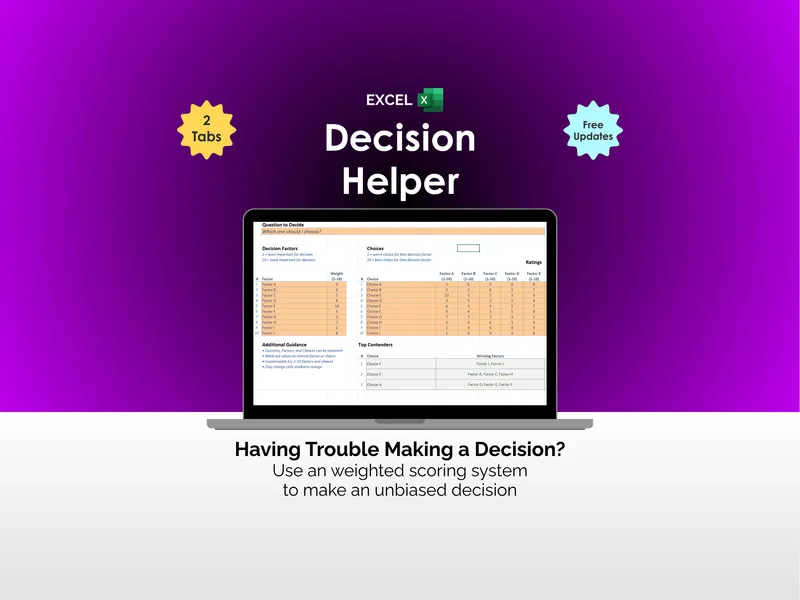
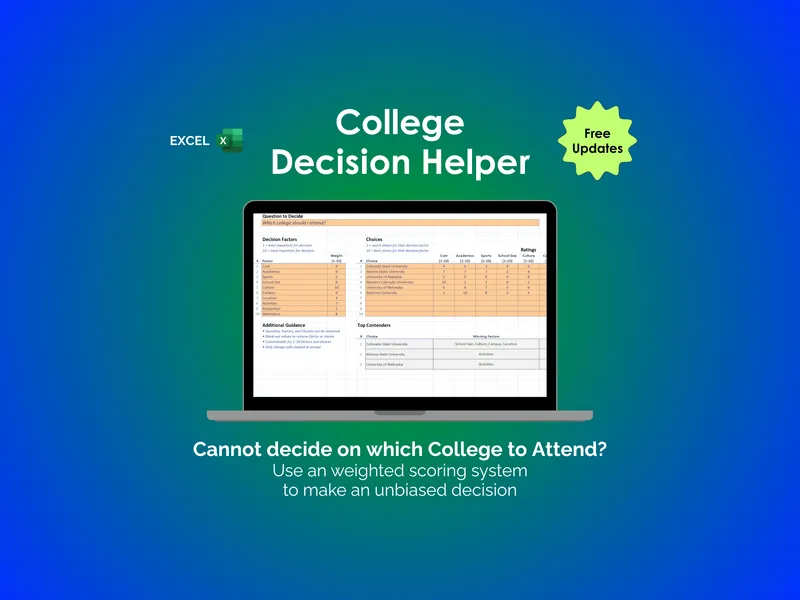
If you want the arithmetic handled for you, a weighted decision matrix like the Decision Helper does the scoring, weighting, and ranking in one sheet — you supply the factors and the honesty. It’s the same structure behind the College Decision Helper, which handles the adjacent question of how to choose a college once your acceptances land.
What to Do When Two Majors Score Within 10 Percent
A near-tie is a result, not a failure of the method. It means both majors are genuinely fine and you’ve been agonizing over a decision that doesn’t deserve the agony.
When the totals land within 10 percent of the higher one — as Major B and Major C did above — stop trying to break the tie on merit and break it on optionality instead:
- Take the one that’s cheapest to leave. Near-identical scores, different exits — pick the one whose credits survive a change of heart.
- Check whether a minor closes the gap. Two majors scoring within 10 percent often means one of them is a minor plus the other one.
- Ask which department you can actually get into. Capacity caps break ties for you whether you participate or not.
- Pick the one with the earlier decision deadline. Not because it’s better, but because a decision you can revisit for free next semester is worth more than a perfect decision you make in April.
When It’s Too Late to Switch
The deadline that actually costs you isn’t on your registrar’s calendar. In practice it’s the end of sophomore year, and the cost of missing it is measured in semesters.
The Hechinger Report, citing research from the consulting firm EAB, reported (opens in new tab) that three-quarters of students who switch majors as late as the end of junior year or the start of senior year either take longer than four years to graduate or don’t graduate at all. The same reporting cites Complete College America’s finding that bachelor’s degree recipients accumulate 15 excess credits on average — an entire extra semester of coursework they didn’t need.
That’s the switch-cost factor showing up as a bill. An extra semester isn’t just tuition; it’s another term of rent, another term of not earning, and — if you’re borrowing — interest on all of it. It’s worth understanding how much a year of college actually costs before you decide an extra one is no big deal.
But note what that EAB research does not say. It also suggests that students who pick a major immediately and never change it are slightly less likely to eventually earn a degree than students who switch by sophomore year. Switching early isn’t the failure mode — committing early and never re-examining it is.
So the rule isn’t “never switch.” It’s: score it early enough that switching is still cheap. The difference between a good switch and an expensive one was never the switch itself — it’s whether you ever ran the numbers.
Own the Decision Instead of Renting It
The uncomfortable truth about choosing a college major is that no quiz, no advisor, and no ranked list will hand you the answer. What they’ll hand you is someone else’s weights.
So write down your own. Four factors, a number next to each, and a total you can defend to yourself at 2 a.m. in week nine. You’ll still feel uncertain — that’s not a solvable problem at 18, or at 40. But there’s a real difference between being uncertain and being unmoored, and the difference is a page you can point at that says: I looked at interest, money, exit cost, and feasibility, I weighed them in this order, and this is what came out.
That page is yours. It survives the change of heart, the switched major, and the job that has nothing to do with either. Which is more than a vibe ever gave you.
Sources and methodology
- Beginning College Students Who Change Their Majors Within 3 Years of Enrollment (opens in new tab) — National Center for Education Statistics (NCES 2018-434, December 2017), drawing on the 2012/14 Beginning Postsecondary Students Longitudinal Study. Supports the one-third switch rate, the 9 percent multiple-switch figure, the 52 percent mathematics and 40 percent natural sciences rates, and the 35 percent STEM / 29 percent non-STEM comparison.
- Does Majoring in STEM Lead to a STEM Job After Graduation? (opens in new tab) — U.S. Census Bureau, 2019 American Community Survey. Supports the 28 percent STEM-degree-to-STEM-job rate, the 50 million / 37 percent / 14 percent figures, and the by-field rates.
- The Major Payoff: Evaluating Earnings and Employment Outcomes Across Bachelor’s Degrees (opens in new tab) — Georgetown University Center on Education and the Workforce, October 2025. Supports the $58,000–$98,000 range, the $146,000 / $64,000 within-STEM spread, and the humanities-versus-STEM overlap.
- Field of Degree (opens in new tab) — U.S. Bureau of Labor Statistics, Occupational Outlook Handbook. The lookup tool referenced in step 3, covering 37 academic subject areas.
- Changing majors is adding time and tuition to the high cost of college (opens in new tab) — The Hechinger Report, December 7, 2018. Reports the EAB research behind the three-quarters figure and the early-switching finding, and cites Complete College America for the 15 excess credits.
A note on data vintage: earnings figures reflect the most recent published data as of July 2026. The NCES switch rates track the 2011–12 entering cohort — the most recent cohort for which NCES has published a major-switching analysis — so treat them as the shape of the pattern rather than this year’s exact percentages.