Imagine the room, because a lot of people sit in one. There is coffee and a tray of pastries. There is a folder with your name printed on it. Someone walks you past a model unit with a balcony and a kitchenette, and the whole time you are doing quiet arithmetic in your head about how nice it would be to stop researching hotels every February.
Then the numbers come out, and they come out in a specific order: the price of a week at this resort, times thirty years, versus the price of the ownership in front of you. Framed that way, the ownership wins. It is designed to win. What that comparison leaves out isn’t hidden — it’s right there in the paperwork. It’s just never the number on the whiteboard.
The short version: a timeshare is worth it only if you buy resale, pay cash, and already take the same trip in the same season every year. At retail, the industry-average $24,740 purchase (opens in new tab) plus a $1,550-and-rising annual fee works out to roughly $632 a night (modeled) over ten years of one-week-a-year use.
Already signed? Your rescission window is short — skip to If You Already Signed.
When a Timeshare Is Worth It, and When It Isn’t
A timeshare is worth it in a narrow set of circumstances, and it is a bad deal in most others. Specifically:
- It usually doesn’t work if you’re buying at a sales presentation, financing the purchase, hoping your vacation habits will change to fit the ownership, or counting on reselling it later for something close to what you paid.
- It can work when the opposite is true across the board — a habit you already have, a resale purchase, cash on hand, no reliance on ever reselling it, and room in the budget for a fee that rises without a ceiling.
The trap isn’t the purchase price. It’s that a timeshare converts a discretionary expense into a mandatory one. A vacation you can skip in a bad year becomes a bill you cannot skip in a bad year. That is the whole trade, and everything below is just detail on it.
First, what you’re actually buying — then the four layers of cost, of which the presentation only ever puts the first on the whiteboard.
What You’re Actually Buying When You Buy a Timeshare
A timeshare is a right to occupy a resort unit for a defined amount of time each year — traditionally one week, increasingly a balance of points you spend on nights — in exchange for a purchase price plus an annual maintenance fee that continues for as long as you own it.
The legal wrapper matters more than most buyers realize. In ARDA’s 2026 State of the Vacation Timeshare Industry report (opens in new tab), prepared by Ernst & Young, 94% of responding resorts sell deeded or fee-simple real estate — an actual property interest, not a subscription. Fifty-six percent also sell right-to-use contracts that expire on a set date, and many resorts offer more than one structure.
That distinction decides how the thing ends:
- Deeded ownership doesn’t expire. It passes to your estate, along with the maintenance obligation, unless it is sold, transferred, or formally surrendered.
- Right-to-use contracts end on their own. You’re buying a term, and when the term is over, so is the bill.
The Federal Trade Commission’s consumer guidance on timeshares and vacation clubs (opens in new tab) puts the commitment plainly: “You’re committing to paying thousands of dollars — potentially for decades or for the rest of your life.”
For scale, this is not a fringe product. ARDA counts 1,434 U.S. timeshare resorts holding roughly 188,700 units, with $10.7 billion in sales volume in 2025 (ARDA / EY, 2026 edition (opens in new tab)).
Layer 1: The Timeshare Purchase Price Is the Smallest Number
The average U.S. timeshare transaction price was $24,740 in 2025, according to ARDA and Ernst & Young (opens in new tab). That’s up from $19,590 in 2021, and it moves around year to year with the mix of products sold — it dipped to $23,160 in 2024 before rebounding.
Two things about that number.
First, it is an average across weeks and points packages of wildly different sizes, so the figure a salesperson quotes you may be far higher or lower. Second, and more importantly, it is the number the entire presentation is built around — because it’s the only one that gets compared to thirty years of hotel bills.
If you finance it, add loan interest on top. Developer financing exists because a $25,000 cash outlay on a Saturday afternoon is out of reach for many buyers, and a purchase you couldn’t fund from savings is a purchase you should not be making under time pressure. Which brings us to the number that actually determines whether this works.
Layer 2: Timeshare Maintenance Fees Rise Without a Ceiling
The average annual maintenance fee billed to U.S. timeshare owners reached $1,550 per weekly interval equivalent in 2025 — up 38% from $1,120 in 2021.
| Year | Average annual maintenance fee billed |
|---|---|
| 2021 | $1,120 |
| 2022 | $1,170 |
| 2023 | $1,260 |
| 2024 | $1,480 |
| 2025 | $1,550 |
Source: ARDA / Ernst & Young, State of the Vacation Timeshare Industry, 2026 edition (opens in new tab) (2025 data, published June 2026).
Read that column honestly and it tells two stories. The 2025 increase was a relatively mild 4.7% — and for the multi-resort operators that reported in both years, a like-for-like 4.2%. But the step from 2023 to 2024 was a 17.5% jump (our calculation from the series above), part of a stretch that ARDA attributes (opens in new tab) to overall inflation and rising insurance costs associated with recent natural disasters. The point is not that fees always spike. It’s that you don’t control which kind of year you get.
The California Attorney General’s consumer guidance on timeshares (opens in new tab) states the structural problem in one sentence: maintenance fees “can rise each year without a limit, so the timeshare can quickly become unaffordable.”
Two more things the average hides. Fees scale with unit size — ARDA reports (opens in new tab) studios averaging $1,180 a year and three-bedroom units or larger $1,900. And the $1,550 figure explicitly excludes property taxes and special assessments, the one-off charges levied when a resort needs a new roof, a hurricane repair, or a reserve top-up. Owners usually don’t get a vote on whether the roof gets replaced. They get an invoice.
Whatever your number turns out to be, put it next to everything else you already pay. A running record of the annual bills leaving your account — the job a bill tracker does — is what turns “it’s about fifteen hundred a year” into a figure you can weigh before you add one more.
Layer 3: What a Timeshare Costs Per Night — A Worked Example
Here is the calculation the whiteboard never shows: total money out, divided by nights actually slept there.
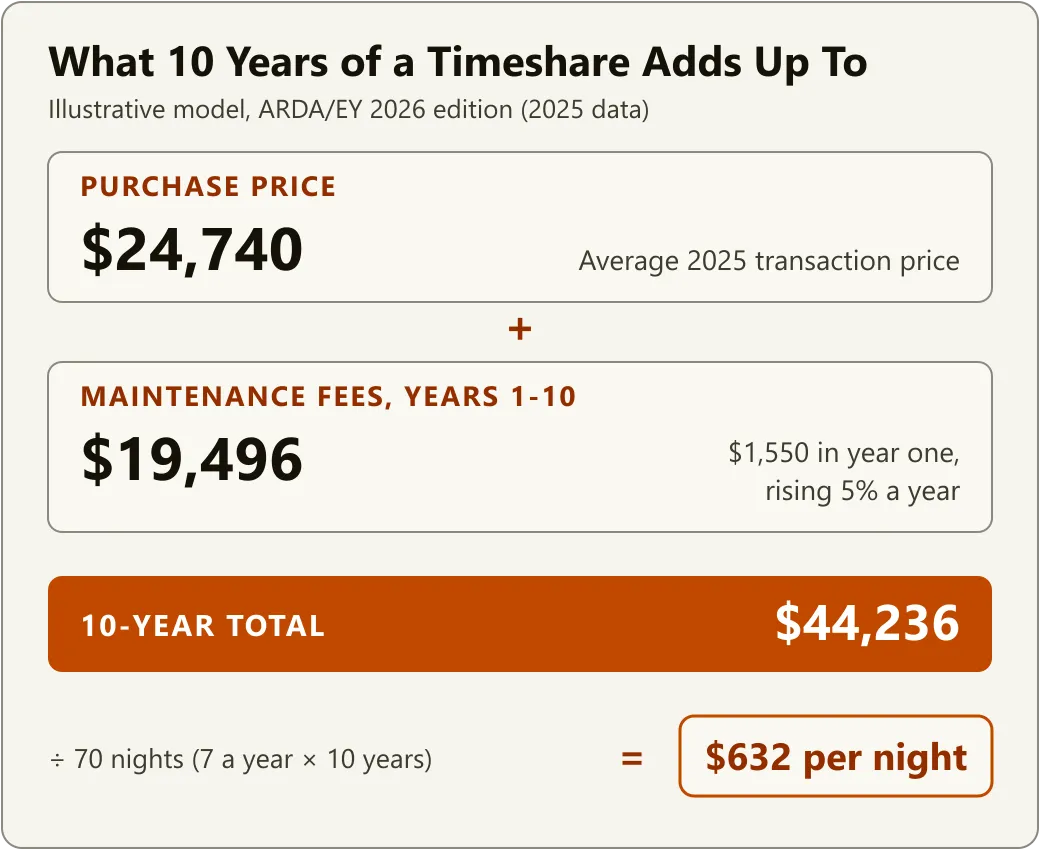
The model behind that graphic uses ARDA’s industry-average transaction price and first-year maintenance fee, then assumes the fee rises 5% a year — slightly above the 4.7% the industry actually averaged in 2025. The purchase is paid in cash, so there’s no loan interest, and usage is one full week every year with no skipped years. One caveat on units: ARDA’s $24,740 is an average per transaction of any size, while the $1,550 is per weekly-interval equivalent, so the model pairs a typical purchase with a typical week.
In other words, it is a generous scenario, and it still lands here:
| Scenario | Up front | Fees over the period | Cost per night (modeled) |
|---|---|---|---|
| Retail purchase, 10 years | $24,740 | $19,496 | $632 |
| Retail purchase, 20 years | $24,740 | $51,252 | $543 |
| Resale purchase, 10 years | $1,000 | $19,496 | $293 |
Illustrative — modeled, not reported figures. Totals: $44,236 over 70 nights (retail, 10 years); $75,992 over 140 nights (retail, 20 years); $20,496 over 70 nights (resale, 10 years). Full assumptions and exclusions are in Sources & Methodology below.
Three things fall out of that table, and they’re the whole argument.
Holding it longer barely helps. Twenty years of ownership only drops the per-night cost from $632 to $543, because the maintenance fee is compounding the entire time. You are not amortizing a fixed cost across more nights; you are adding a rising cost for every night you add.
The purchase price is the part you can fix. Buying the same interval on the resale market cuts the per-night cost by more than half — not because the vacation changes, but because the retail markup disappears.
Even the good case isn’t free. At $293 a night on a $1,000 resale purchase, the maintenance fee alone is doing all the work. If the resort you’re looking at rents comparable weeks for less than that, the ownership is a worse deal than simply booking it — and many resorts do rent to non-owners. ARDA reports (opens in new tab) that 83% of responding resorts offer some form of rental program, and that $3.3 billion in rental revenue came through those programs in 2025, which is a polite way of saying you can often sleep in these units without buying one.
Before you accept any per-night figure, run it against what your family actually spends on a trip now. Our breakdown of what a family beach vacation really costs in 2026 is a reasonable baseline for the comparison.
Layer 4: What a Timeshare Is Worth If You Want Out
This is the layer that turns a mediocre purchase into a bad one.
The California Attorney General’s guidance (opens in new tab) is blunt: “Timeshares often lose a lot of their value after they are first sold,” and “it can be hard for owners to sell timeshares, so significant discounts may be available.” Read that from the seller’s side rather than the buyer’s, and it means the resale market that makes a timeshare cheap to enter is the same market that makes it hard to exit.
And simply walking away is not an exit. Unpaid maintenance fees can be referred to collections, and because most timeshares are deeded real estate, the managing entity can place a lien on the interest and foreclose on it — Florida, for example, gives the managing entity a lien for unpaid assessments (opens in new tab) plus a trustee foreclosure procedure to enforce it, while other states set their own rules. Describing the tactics of exit companies, the Minnesota Attorney General’s office (opens in new tab) notes that arranging for an owner to stop paying can “force a foreclosure that can create more costs and harm the consumer’s credit.”
Which is why an entire industry has grown up around getting people out — and why regulators keep having to intervene in it. In January 2025, the Minnesota Attorney General announced settlements with three timeshare exit companies (opens in new tab), returning $269,378 to Minnesotans who had paid thousands of dollars in up-front fees for exit services. The office noted that in Minnesota “it is illegal to charge an upfront fee for debt-settlement services,” and warned that operators used high-pressure tactics — including scaring owners about children inheriting maintenance obligations.
Two practical rules follow:
- Before you buy, price the exit. Ask, in writing, whether the resort has a deed-back or surrender program, what it costs, and what conditions disqualify you. If nobody will answer that in writing, you have your answer.
- If you already own and want out, start with the resort. Contact the developer or management company directly before paying any third party. Up-front fees for a promised exit are the pattern at the center of the Minnesota action, and the FTC’s guidance (opens in new tab) flags advance-fee resale pitches as a warning sign too.
When a Timeshare Actually Does Make Sense
It would be dishonest to end there, because these resorts are genuinely well-used. ARDA reports average timeshare occupancy of 79.9% in 2025, against 62.3% for hotels (ARDA / EY, 2026 edition (opens in new tab), citing CoStar). People do go. The product is not a scam by construction; it’s a legitimate lodging model with a punishing retail markup and an open-ended cost.
The case for buying is real when all five of these are true:
- You have a fixed vacation habit. Same region, same season, three or more years running — not an aspiration, a track record.
- You’re buying resale, not retail. This is the single biggest lever on the whole calculation.
- You can pay cash. No developer financing, no home-equity draw.
- A doubled fee wouldn’t hurt. If $1,550 becoming $3,100 would change your year, the fee owns you rather than the reverse.
- You’ve verified availability. Not the brochure inventory — the specific weeks you would actually travel, at the specific resorts you’d actually use.
Miss any one of those and the honest recommendation is to book the trip and keep your money liquid. If you’re weighing the broader question of how to spend a fixed vacation budget, the same discipline applies to the cruise vs. all-inclusive resort decision — the winner is usually the option you can walk away from next year.
How to Score the Decision Before the Presentation Ends
The reason presentations work is that they replace a scoring exercise with a time limit. The fix is to bring your scoring exercise with you, filled in before you arrive.
Rate each criterion 1–5, multiply by its weight, and add the six results. The maximum possible score is 5.0.
| Criterion | Weight | What a 5 looks like |
|---|---|---|
| Vacation habit | 25% (0.25) | Same region and season, 3+ years running |
| Cash purchase | 20% (0.20) | Paid in full from savings, no financing |
| Fee headroom | 20% (0.20) | The annual fee could double without straining the budget |
| Resale entry | 15% (0.15) | Buying resale at a deep discount, not retail |
| Exit plan | 10% (0.10) | Deed-back or surrender terms confirmed in writing |
| Booking reality | 10% (0.10) | Availability verified for your actual travel weeks |
A worked example: habit 4 × 0.25 = 1.00; cash 5 × 0.20 = 1.00; fee headroom 2 × 0.20 = 0.40; resale entry 1 × 0.15 = 0.15; exit plan 2 × 0.10 = 0.20; booking reality 3 × 0.10 = 0.30 — total 3.05, below our 3.5 cutoff, so: walk.
Our cutoff: under 3.5 out of 5, walk. Not “think about it” — walk, and let the rescission period be irrelevant because you never signed. A weighted score below 3.5 means the ownership depends on something you’re hoping will become true.
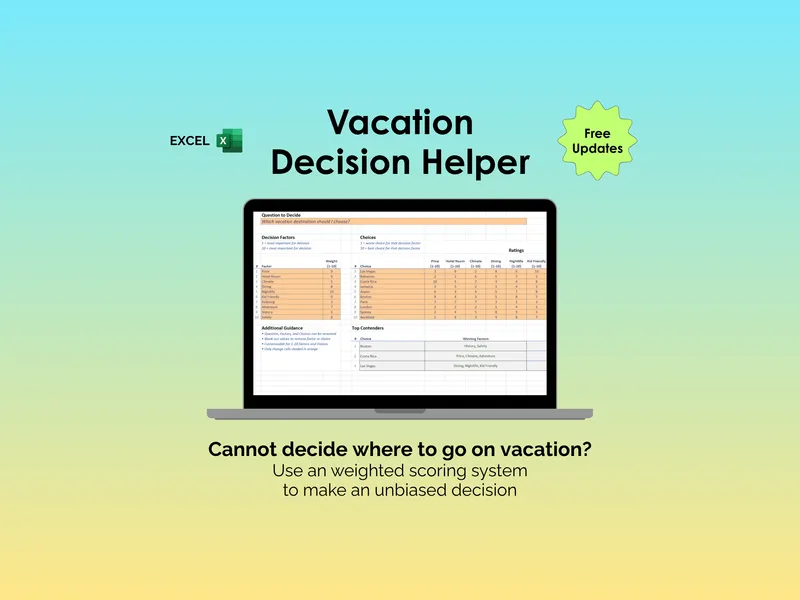
That structure isn’t specific to timeshares. It’s the same weighted-criteria method behind the Vacation Decision Helper, which scores competing options — including the trip you’d otherwise just book — against criteria you set (or the general-purpose Decision Helper if you’d rather keep one file for every big call). Score it once, own the file, and reuse it the next time somebody puts a folder with your name on it in front of you.
If You Already Signed: Your Rescission Window
Timeshare purchases come with a cancellation window, and it is short. In Florida — which ARDA counts (opens in new tab) as the state with the most timeshare resorts, 337 of the national total of 1,434 — Statute 721.10 (opens in new tab) gives a purchaser until midnight on the 10th calendar day after the later of the contract’s execution date or the day they received all required documents. The statute states the right “may not be waived,” and requires a refund within 20 days of the purchaser’s demand, or 5 days after the purchaser’s check clears, whichever is later.
Windows vary by state, so the deadline written into your contract is the one that matters, not this page.
If you’re inside the window and want out:
- Send written notice immediately. Don’t call. The FTC’s advice (opens in new tab) is to “send a letter to the seller by certified mail and ask for a return receipt, so you’ll have a record.”
- Use the address in the contract, not the one on a business card.
- Keep the receipt and a copy of the letter. Postmark date is what proves timeliness.
- Don’t accept an offer to “modify” the contract instead. A modification can restart or complicate the analysis; a clean cancellation ends it.
This is general information, not legal advice — your contract’s deadline and your state’s rules govern, and a consumer-protection attorney is worth a call if anything is ambiguous.
Common Questions About Timeshares
Do timeshares hold their value?
No. Timeshares typically resell for a fraction of what they cost new, which is why buying resale is the biggest single lever on the total cost, and why selling one later is hard.
What happens if you stop paying timeshare maintenance fees?
Stopping payment does not end the obligation. The unpaid amount can be referred to collections and harm your credit, and a deeded interest can, depending on the state, be foreclosed on by the managing entity. Ask the resort about a deed-back or surrender program instead.
Can you cancel a timeshare after you buy it?
Only inside your state’s rescission window, and it is short. Florida allows 10 calendar days, other states set their own deadlines, and the date in your contract is the one that governs.
Is it cheaper to buy a timeshare or just book a hotel?
On the modeled numbers in this post, one week a year at the industry-average retail price works out to roughly $632 a night over ten years. If the resort you are considering rents comparable weeks for less than that, booking is cheaper.
The Takeaway
A timeshare is not a vacation. It’s a prepaid lodging contract with an annual fee that rises without a ceiling, resells at a steep discount, and — if it’s deeded — doesn’t end on its own.
That can still be a good deal. It’s a good deal when you buy it resale, pay cash, and have a decade of identical vacations behind you to prove the habit is real. It is almost never a good deal when the decision has to be made in ninety minutes, in a room designed to make ninety minutes feel like enough.
Score it before you go, and write down why you decided while you still remember — before hindsight edits the memory. A decision journal turns “we thought it seemed reasonable” into a record you can check against what actually happened three years later, which is the only way anyone learns whether their scoring was any good.
The presentation can’t add time pressure to a decision you already made.
Sources & Methodology
Industry figures come from ARDA and Ernst & Young’s State of the Vacation Timeshare Industry, 2026 edition, which reports calendar-year 2025 data and was published in June 2026 (accessed August 2026). The modeled costs are ours, not ARDA’s: they assume the average transaction price paid in cash, a first-year maintenance fee of $1,550 compounding at 5% a year, one week of use every year with no skipped years, and $1,000 all-in for the resale scenario. They exclude special assessments, property taxes, exchange and booking fees, and loan interest.
- ARDA / Ernst & Young, State of the Vacation Timeshare Industry: United States Study, 2026 edition (opens in new tab) (full report PDF (opens in new tab)) — sales volume, average transaction price, maintenance fees and unit-size breakdown, occupancy, rental programs, resort and unit counts, legal structures, resorts by state
- CoStar (opens in new tab), cited within the ARDA report — the 62.3% U.S. hotel occupancy comparison
- Federal Trade Commission, Timeshares, Vacation Clubs, and Related Scams (opens in new tab) — presentation tactics, rescission rights, written-cancellation guidance, advance-fee resale warning signs
- California Attorney General, Timeshares (opens in new tab) — maintenance fee escalation, resale value, resale scam red flags
- Minnesota Attorney General, settlements with timeshare exit companies (January 23, 2025) (opens in new tab) — exit-company enforcement, consumer refunds, and the consequences of being advised to stop paying
- Florida Statute 721.10, Cancellation (opens in new tab) — 10-day rescission period and refund requirements
- Florida Statute 721.16, Liens for overdue assessments (opens in new tab) — the managing entity’s assessment lien and its enforcement