There’s a number you’re about to say out loud, and it feels almost arbitrary. “How does $18 an hour sound?” You picked it because it sounds fair, because it’s a little more than you made at your first job, because a friend pays about that. What to pay your first hire is one of the highest-stakes numbers a small shop ever sets — it’s the first line of a budget you’ll live with for months — and most owners set it entirely by gut.
Here’s what most people don’t realize: that hourly number is the smallest part of the decision. Underneath it sits a stack of costs you don’t see on the offer, a market rate you can actually look up, and a structure that keeps you from underpaying a loyal person or accidentally overpaying the newest one.
The short version: fair pay for a first hire is a range, not a guess. Look up the role’s real market rate (the U.S. Bureau of Labor Statistics publishes it free by metro area), set a simple minimum–midpoint–maximum band around it, and budget the loaded cost — the wage plus roughly 10–15% in mandatory employer taxes and insurance — instead of the hourly number alone. The rest of this post is how each of those pieces works.
The wage on the offer is not what the hire costs you
One of the most common mistakes first-time employers make is treating the hourly wage as the total cost. It isn’t. (This assumes you’ve already settled whether that helper is an employee or a contractor — the costs below only apply to an employee.) Every employee carries a stack of costs on top of their pay, and some of them are legally mandatory whether or not you offer a single benefit.
Start with payroll taxes. As an employer you owe 7.65% of wages in your share of Social Security and Medicare (FICA) — 6.2% up to the annual wage base plus 1.45% with no cap — on top of what you pay the worker (IRS: Topic No. 751, Social Security and Medicare withholding rates (opens in new tab)). Then there’s federal unemployment tax (FUTA), plus state unemployment tax, plus — in almost every state — workers’ compensation insurance. None of that shows up on the offer letter.
If you go further and offer benefits, the gap widens fast. Across private industry, benefits made up 29.7% of total employer compensation costs in early 2025, with wages and salaries accounting for the other 70.3% (U.S. Bureau of Labor Statistics, Employer Costs for Employee Compensation (opens in new tab)). You may not offer health insurance to a first part-timer — many small shops don’t — but the mandatory pieces alone typically add 10–15% on top of the wage, as the illustrative breakdown below shows.
Here’s how that plays out with illustrative numbers for one part-time hire at $18/hour:
| Cost layer | Rate (illustrative) | On $18/hour |
|---|---|---|
| Base wage | — | $18.00 |
| Employer FICA (Social Security + Medicare) | 7.65% | $1.38 |
| Federal + state unemployment | ~1–4% | $0.45 |
| Workers’ comp (varies widely by trade/state) | ~1–3% | $0.36 |
| Mandatory loaded cost | — | ~$20.19/hour |
| Optional: paid time off, benefits, tools | varies | adds to total |
The takeaway: a wage you can afford and a loaded cost you can afford are two different questions. Budget the second number, not the first. (Rates above are illustrative — your unemployment and workers’ comp rates depend on your state, industry, and claims history.)
How employers actually decide the number
Fair pay sits inside a range you can look up, not a number you invent. There are three anchors, and you set your wage between them.
- The legal floor. Federal minimum wage is $7.25 per hour and has been since 2009 (U.S. Department of Labor: Minimum Wage (opens in new tab)), but most states — and many cities — set a higher floor, and the higher one wins. This is your absolute bottom, not your target. If you’re hiring salaried help, there’s a second floor: to classify someone as exempt from overtime, they generally must earn at least $684 per week ($35,568 a year) (the federal level in effect as of 2026) and pass a duties test (U.S. Department of Labor: overtime salary levels (opens in new tab)). Below that, you owe time-and-a-half over 40 hours a week.
- The market rate. This is the number you’re missing, and it’s free. The BLS publishes median and percentile wages for hundreds of occupations, broken down by metro area, in its Occupational Employment and Wage Statistics (opens in new tab) program. Look up the role, find your city, and you’ll get a realistic band — the 25th percentile, the median, the 75th — instead of a guess. That single lookup is the difference between “$18 sounds fair” and “$18 is the local median for a retail sales associate, so it’s competitive.”
- What you can afford. More on this below — but the market rate is only the target if the labor cost fits your revenue.
Build a simple pay range instead of a single number
A pay band is a salary range — a minimum, a midpoint, and a maximum — for a level of work. Instead of assigning one magic number to a role, you set the range the role is worth and place each person inside it based on experience.
Why this matters even at two or three employees: a range is how you answer the questions that ambush every growing shop. Can I give a raise without breaking the structure? Why does the new hire out-earn someone who’s been here two years? What do I offer the next person? With a band, those stop being awkward one-off negotiations and become “here’s where you sit in the range, and here’s what moves you up.” (Still deciding who that next hire should even be? Our guide to the first roles a growing maker hires can help you sequence it.)
The metric that keeps a band honest is compa-ratio: a person’s pay divided by the midpoint of their band, expressed as a percentage. Someone paid right at target is at 100%; a new hire might start at 85–90%; a seasoned expert might sit at 110%. When you can see everyone’s compa-ratio on one screen, pay equity stops being a feeling and becomes something you can actually check.
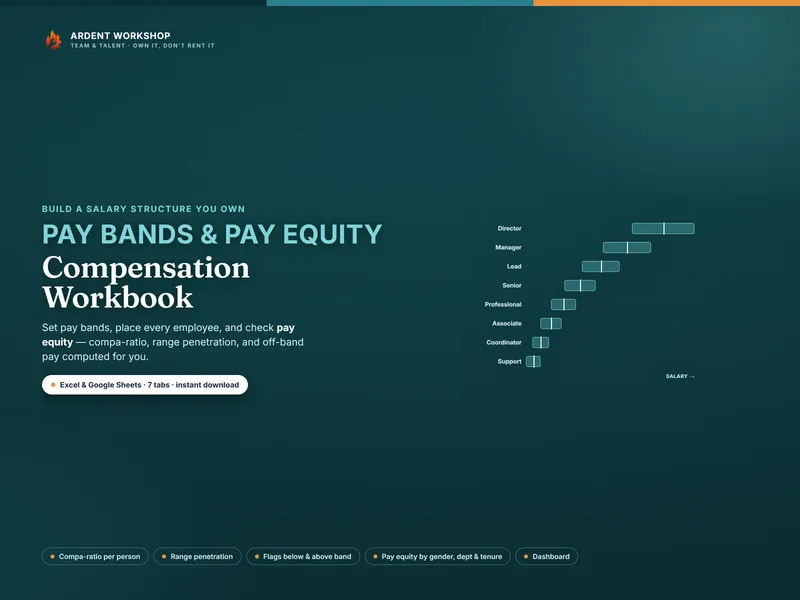
You can build this by hand, but it’s exactly the kind of structure worth owning as a file rather than rebuilding every time you hire. The Compensation Pay-Band & Pay-Equity Workbook sets a minimum, midpoint, and maximum per level, then computes compa-ratio, range penetration (where in the band a person’s pay actually sits), and a pay-equity screen for every person automatically — so you can see at a glance whether a new offer lands inside your structure before you send it. It’s the difference between a pile of individual decisions and a system you can defend.
The two questions that catch overpaying and underpaying
Once you have a market-anchored range, two checks keep you out of trouble.
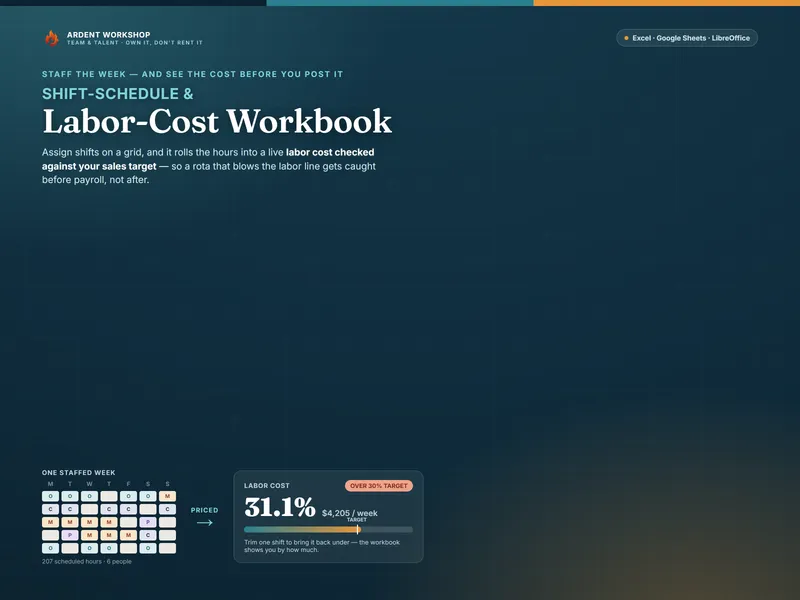
Can you afford it? The honest test isn’t your bank balance today — it’s labor cost as a percentage of revenue. Many retail and food operators lean on a rough rule of thumb — keeping labor somewhere in the neighborhood of 20–35% of revenue — but treat that as a starting guide, not a target; the right number depends on your margins and how you’re staffed. The point is to run it: multiply the loaded hourly cost by expected hours, and compare it to the sales those hours should generate. If one part-timer’s fully loaded cost eats 40% of the revenue their shift produces, the wage isn’t the problem — the schedule or the pricing is. A tool like the Shift Schedule & Labor Cost Workbook prices the hours and checks total labor cost against a sales target for exactly this reason.
Is it fair across the team? The fastest way to lose a good employee is to hire the next one at a higher wage without adjusting anyone. This is where a compa-ratio view earns its keep: if your reliable two-year employee sits at 92% of midpoint and your new hire comes in at 98%, you have a problem brewing before anyone says a word. Structure surfaces it early, while it’s cheap to fix.
Common traps to avoid
- Anchoring to what you paid yourself. It’s a common trap: founders anchor early pay to their own lean years and underpay because of it. The market doesn’t care what you got by on.
- Overpaying to close fast. A too-high offer feels generous in the moment and becomes a ceiling you can’t sustain — or a raise you can’t give. Pay the market, not your anxiety.
- Forgetting the loaded cost. Budget the $20+/hour, not the $18.
- No plan for raises. If there’s no range and no midpoint, every raise is a renegotiation. Set the structure before the conversation.
- Treating seasonal like permanent. A holiday or peak-season hire is a different math problem — you’re costing a burst, not a baseline. The Seasonal & Peak-Season Hiring Workbook sizes temp headcount and costs the season without over-committing to year-round wages.
The bottom line
What to pay your first hire is a range, not a guess. Set the legal floor, look up the real market rate for the role in your area, build a simple min-midpoint-maximum band, and budget the loaded cost — wage plus roughly 10–15% in mandatory employer costs before any benefits (the FICA, unemployment, and workers’-comp layers from the table above). Do that, and the number you say out loud stops feeling arbitrary. It becomes a decision you can afford, defend, and repeat the next time you hire. If you’d rather not rebuild the band-and-compa-ratio math from scratch, the Compensation Pay-Band & Pay-Equity Workbook is the file that does it for you.
Getting the pay right is only half of a good first hire — the other half is what happens after they say yes. If you’re there, our walk-through on onboarding your first employee picks up where this leaves off.