To hire seasonal staff, work backward instead of forward. Forecast your peak week in labor hours, subtract the hours you can personally work, divide the gap by about 15 hours per part-time hire, and round up — that’s your headcount. Then count back roughly seven weeks from the day you need trained hands: for an October 15 opening day, you write the job description on August 27 and the posting goes live September 3.
Here’s what that looks like when someone actually runs it.
Picture a home baker — let’s call her Nadia. She is a composite, drawn from the pattern that repeats in small shops every autumn, not a real person.
It is the third week of July and her kitchen is quiet. She is filling maybe eleven units a week — a slow summer week for her, and roughly a tenth of what a normal fall week looks like. There is time to answer emails, time to reorganize the pantry, time to think about whether the fall lineup should include the maple thing everyone asked about last year.
Nadia knows exactly what October looks like, because she has lived it twice. Orders roughly triple. Her days start at four and end when they end. Last year she stopped answering the order form for eleven days in November because she physically could not bake what was already sold. She lost the customers she had spent a year earning.
So this year she has a plan: hire seasonal help. She writes it on a sticky note. She puts the sticky note on the monitor. She goes back to the maple thing.
She will look at that sticky note again in late September, and by then it will be too late — not because she was lazy, but because she never worked out the one number that tells you when the sticky note becomes urgent.
Why counting forward from today fails
Here is what happens in late September. Nadia posts a job. Applications trickle in. She interviews three people in the first week of October, offers two, one accepts, that person can’t start for two weeks because of a notice period, and they arrive on October 20th knowing nothing about her kitchen. She spends the first week of her rush training instead of baking. By the time the new hire is genuinely useful, it’s the second week of November and the worst is already behind — or, more accurately, on top of — her.
Nothing in that sequence went wrong. Every step took a normal amount of time. The failure was that she counted forward from the day she remembered, instead of backward from the day she needed people on the floor.
Seasonal hiring is a scheduling problem disguised as a hiring problem. And the timing is not forgiving: the National Retail Federation expected retailers to hire between 265,000 and 365,000 seasonal workers in 2025 (opens in new tab), down from 442,000 the year before — while forecasting holiday sales would pass $1 trillion for the first time. Retailers are planning fewer seasonal hires against a bigger peak, which means the shortlist you’re competing for is being worked by employers with recruiting departments and a head start.
How many seasonal people do you actually need?
Seasonal headcount is your peak-week labor hours minus the hours you can personally work, divided by the hours one seasonal hire will actually give you — rounded up. It is not a gut feeling about how busy things “felt” last year.
Work it in that order, because each step is a number you already have or can estimate honestly.
Here is the math with illustrative numbers, using Nadia’s kitchen:
- Forecast the peak week in units. Not the season — the single worst week. Nadia’s normal week is 110 units. Her worst week last November was 320.
- Convert units to labor hours. She times herself: about 0.25 hours per unit, start to packed. 320 × 0.25 = 80 hours of production in that week.
- Subtract what you can honestly work. Nadia can sustain 52 hours in a peak week. Not 70 — she tried 70, and week three is where the mistakes and the resentment start. Gap: 28 hours.
- Divide by realistic hours per hire. Seasonal help is part-time by nature — plan on 12–18 hours a week rather than 40, and use your own last-season timesheets if you have them. At 15 hours each: 28 ÷ 15 = 1.87.
- Round up, always. 1.87 heads is 2 heads, because you cannot hire a fraction of a person — and the rounding is what buys you the buffer for the week someone calls in sick.
Nadia needs two seasonal hires. That’s it. That’s the number the sticky note was missing, and it takes about twenty minutes to produce.
Two things people get wrong at this step. First, they forecast the season instead of the peak week, which undercounts badly — an average week doesn’t break you, the worst week does. Second, they forget that the hours a new person gives you in week one are not productive hours — which is what makes the real cost per hire higher than the wage, covered in What a seasonal hire actually costs below.
Work backward from opening day
Once you know you need two people, the only remaining question is which date you have to start on. There are two that matter and they are a week apart: the day you sit down to write the role, and the day the posting goes live. Build the calendar in reverse, from the first day you need trained hands.
Every stage below takes real calendar time whether you plan for it or not:
| Working backward from opening day | Typical time | Nadia’s date |
|---|---|---|
| Day you need trained, productive help | opening day | Oct 15 |
| Training and shadowing before that | 2 weeks | Oct 1 |
| Notice period / start-date lag after acceptance | 1 week | Sep 24 |
| Interviews and decisions | 1 week | Sep 17 |
| Posting live, collecting applications | 2 weeks | Sep 3 |
| Writing the role, setting the pay range | 1 week | Aug 27 |
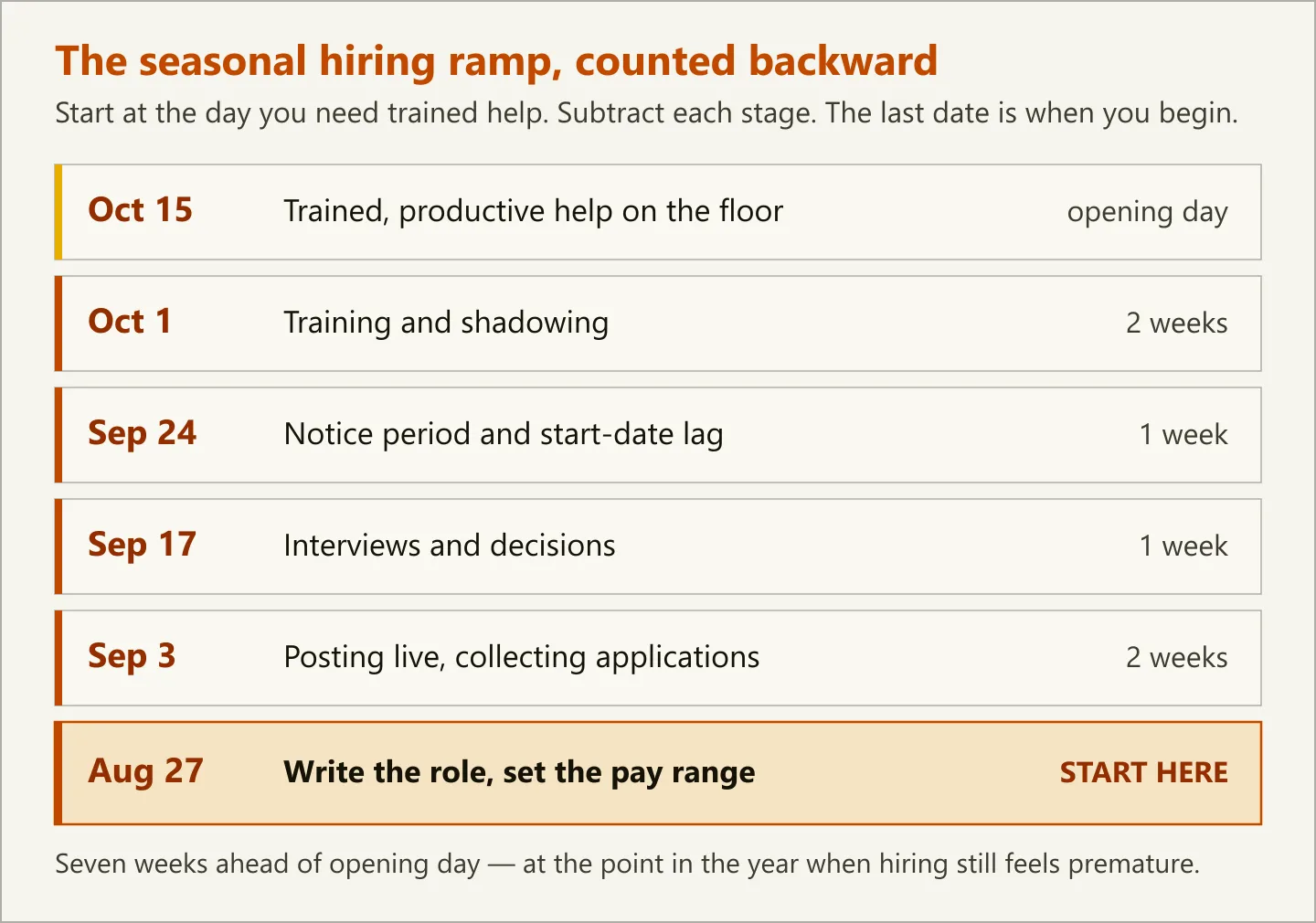
Read the bottom two rows again. To have two trained people baking on October 15, Nadia writes the role by August 27 — seven weeks ahead — and has the posting live by September 3. That first date lands at a moment when her kitchen still feels calm and hiring still feels premature.
That “feels premature” sensation is the whole trap. The month when hiring feels unnecessary is the month you have to do it in.
If your peak lands earlier — a fall festival circuit, a school-year restock, a Halloween window — slide every date left accordingly. For people trained and ready on September 20, the same ramp puts your role-writing on August 2 and your posting live on August 9.
Make more offers than you have seats
Expect to make roughly three times as many offers as the seats you need to fill. Not everyone you want says yes, and not everyone who says yes shows up.
Seasonal candidates are, by definition, people arranging temporary work around something else — school, another job, a season of their life that’s already full. They accept two things at once and drop one. This isn’t bad faith; it’s what temporary work is.
So plan the funnel with a gross-up rather than a hope. Using Nadia’s two seats and illustrative rates:
- 2 seats needed
- ÷ 70% who actually start after accepting → 3 acceptances
- ÷ 50% offer-acceptance rate → 6 offers
- ÷ ~40% of interviews worth an offer → about 15 interviews
- ÷ ~40–60% of applications worth an interview → roughly 25–38 applications
If those ratios sound pessimistic, run last year’s actual numbers instead — you will usually find they were worse. The point of the gross-up is that it changes a real decision: it tells you to keep the posting open and keep interviewing after you’ve filled the first seat, instead of closing the search the moment someone says yes.
What a seasonal hire actually costs
The hourly wage is only about 84% of what a seasonal hire really costs you per productive hour. The rest is payroll taxes and the unproductive hours you pay for while someone learns.
The employer side of payroll tax alone is 6.2% for Social Security plus 1.45% for Medicare — a combined 7.65% under IRS Tax Topic 751 (opens in new tab), before anything else — and state unemployment insurance sits on top of that at a rate that varies by state and by your own claims history. The table below assumes roughly 1.35 points of federal and state unemployment tax on top of FICA, for about 9% all in; check your own state rate.
Here’s the full picture for one of Nadia’s hires, with illustrative numbers:
| Cost line | Value |
|---|---|
| 150 hours (15/wk × 10 weeks from the Oct 1 training start) at $17/hr | $2,550 |
| Employer payroll taxes (7.65% FICA + ~1.35% assumed FUTA/SUI) | $230 |
| Total cash cost | $2,780 |
| Hours paid | 150 hrs |
| Less: training with near-zero output | −12 hrs |
| Productive hours actually received | 138 hrs |
| Real cost per productive hour ($2,780 ÷ 138) | $20.14 |
For two hires, that’s $5,560 in cash cost for the season.
That $20.14 is the number to price against, not the $17 — the wage is 84% of it. If Nadia’s margin math was built on “help costs $17 an hour,” her fall lineup carries about 18% more labor cost per unit than her spreadsheet says, and because profit is what’s left over, the hit to her margin is larger than 18%. (If you haven’t set a wage yet, that’s its own exercise — here’s how much to pay your first employee without guessing.)
The 12 unproductive hours are not a defect. They’re the cost of entry, and they’re the one line on this table you can shrink — by having the training sequence written down before anyone starts rather than improvising it during your rush. That’s a separate craft, and we’ve covered how to train seasonal employees fast enough that they’re useful in days.
Set the seasonal end date before the hire starts
Seasonal work ends. Everyone knows this abstractly, and almost nobody says it out loud at the offer stage — which is how you arrive at January 3rd owing an awkward conversation to someone who has started calling it “my job.”
Say it in the posting, say it in the interview, and put the date in writing:
- The end date, stated as a date, not a vibe (“through December 24,” not “through the holidays”).
- What “extended” would require — if there’s any chance the role continues, name the condition (“if January orders hold above X”) rather than dangling it.
- The final week’s schedule, which is usually a wind-down, not a cliff.
- What you’d want back — keys, badges, unused packaging, the shared login you forgot existed.
The generous version of this is also the useful version: a seasonal hire who knows exactly when the work ends can plan their January, and is far more likely to answer your text next September. Your best seasonal hire is a returning seasonal hire, and returning hires skip most of those 12 training hours.
The seasonal hiring plan in four numbers
Rewind the story. It’s still the third week of July, the kitchen is still quiet, and the sticky note is still on the monitor. The difference is that Nadia now spends twenty minutes producing four numbers (illustrative, from her kitchen — yours will differ):
- Peak week: 80 production hours, of which she can cover 52.
- Seasonal headcount: 2, from a 28-hour gap at 15 hours per hire.
- Write the role by August 27, posting live September 3, working backward from an October 15 opening day.
- Budget $5,560 for the pair — about $20 per productive hour, not $17.
None of those numbers required a hiring consultant, and none of them required certainty about the season. They required doing the arithmetic in July instead of the panic in October. In late August, she writes the role. In September, she interviews about fifteen people and makes six offers. On October 15, two people who already know where the sheet pans live start their shift, and Nadia bakes.
She still has a hard November. It’s just a hard November she chose.
Plan seasonal hiring in a file you own
This is exactly the kind of planning people rebuild from scratch every single year — a fresh spreadsheet each August, the same formulas re-derived, last year’s actuals lost somewhere in a folder. The whole point of the exercise is comparison over time: last year’s peak-week forecast versus what actually happened is the single best input to this year’s number.
If you just want to run step one right now, the free Seasonal Headcount Estimator does the peak-week arithmetic in a browser — enter a week’s forecast and watch the heads fall out. No email required.
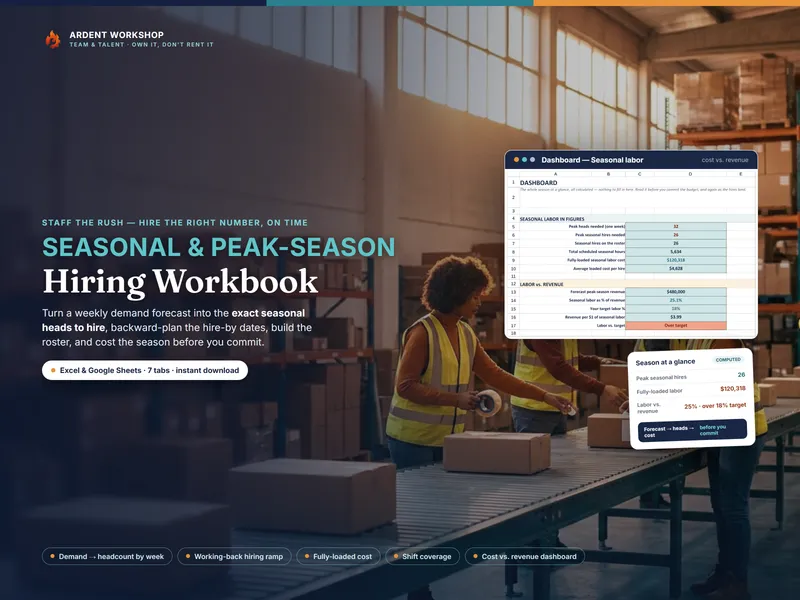
For the full season, the Seasonal & Peak-Season Hiring Workbook turns a weekly demand forecast into a dated hiring plan you keep year to year. It:
- sizes the heads you need, week by week, from your own forecast;
- schedules the post-by and hire-by dates backward from your opening day;
- builds the temp roster with each hire’s weeks, hours, and fully-loaded cost computed;
- lays out shift coverage by day and daypart, flagging any shift that’s short before it happens.
It’s one file — Excel, Google Sheets, or LibreOffice — that you re-run next year with this year’s real numbers in it.
Two neighbors to it, depending on where your gap actually is:
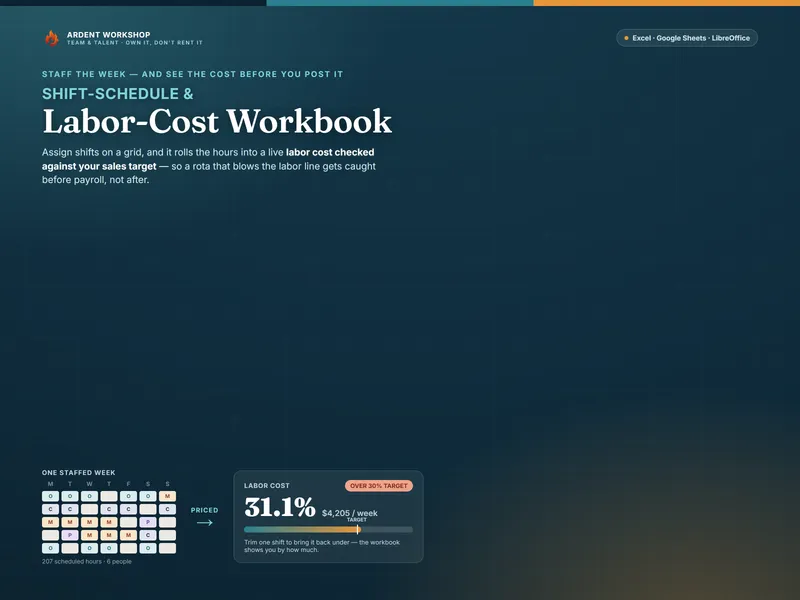
- If the problem is the schedule rather than the headcount, the Shift Schedule & Labor Cost Workbook prices the roster you’re about to commit to, shift by shift.
- If the problem is that only one person knows how to do the thing, the Cross-Training & Coverage Planner shows you where a single absence takes the whole rush down with it.
That’s the case for owning the structure rather than renting it: a workbook you keep accumulates your history, and your history is what makes next year’s forecast better than a guess. A blank spreadsheet makes you rebuild the thinking every August. Subscription staffing tools bill monthly year-round for a problem you have in three.
And when the operation outgrows a spreadsheet — when inventory, production, and sales all need to move together in real time — Ardent Seller (opens in new tab) is the next step.