Three answers you’ll hear when you ask a small-shop owner whether their new helper is an employee or a contractor:
- “She only works Tuesdays, so she’s a contractor.”
- “I gave him a 1099, so he’s a contractor.”
- “We signed an agreement that says independent contractor right at the top.”
Every one of those describes paperwork. None of them describes the thing that actually decides it.
The employee-versus-contractor choice is not a labeling decision — it is a control decision, and the label follows. You don’t get to pick the classification and then arrange the work around it. You arrange the work, and the classification is a consequence. In practice: if you need to set someone’s hours, control their method, and supply their tools — and the work is what you sell — that’s an employee, whatever the contract says. Getting that backwards is an expensive mistake to unwind, and one of the easiest to make in your first year of having help.
Both sides of this argument are real, though. There are good reasons to bring on a contractor and good reasons to hire an employee, and the shops that agonize over this usually do so because both options fit part of what they need. (If you only want the answer, jump to the verdict.)
What “employee” and “contractor” actually mean
An employee is a worker whose work you direct — you set the schedule, define the method, provide the tools, and absorb the profit or loss on their hours. You withhold income tax from their pay, pay the employer half of Social Security and Medicare, and report it all on a W-2.
An independent contractor is a business that sells you a result. They decide how and when the work gets done, use their own equipment, carry their own risk of losing money on a job, and generally serve other clients. You pay an invoice and, above a reporting threshold, issue a 1099-NEC.
The IRS sorts the evidence into three categories of control (opens in new tab): behavioral control (does the business control what the worker does and how they do it), financial control (who manages the business side — pay structure, expenses, tools), and the type of relationship (contracts, benefits, permanence, and whether the work is a key aspect of the business). No single factor decides it; the agency looks at the whole relationship.
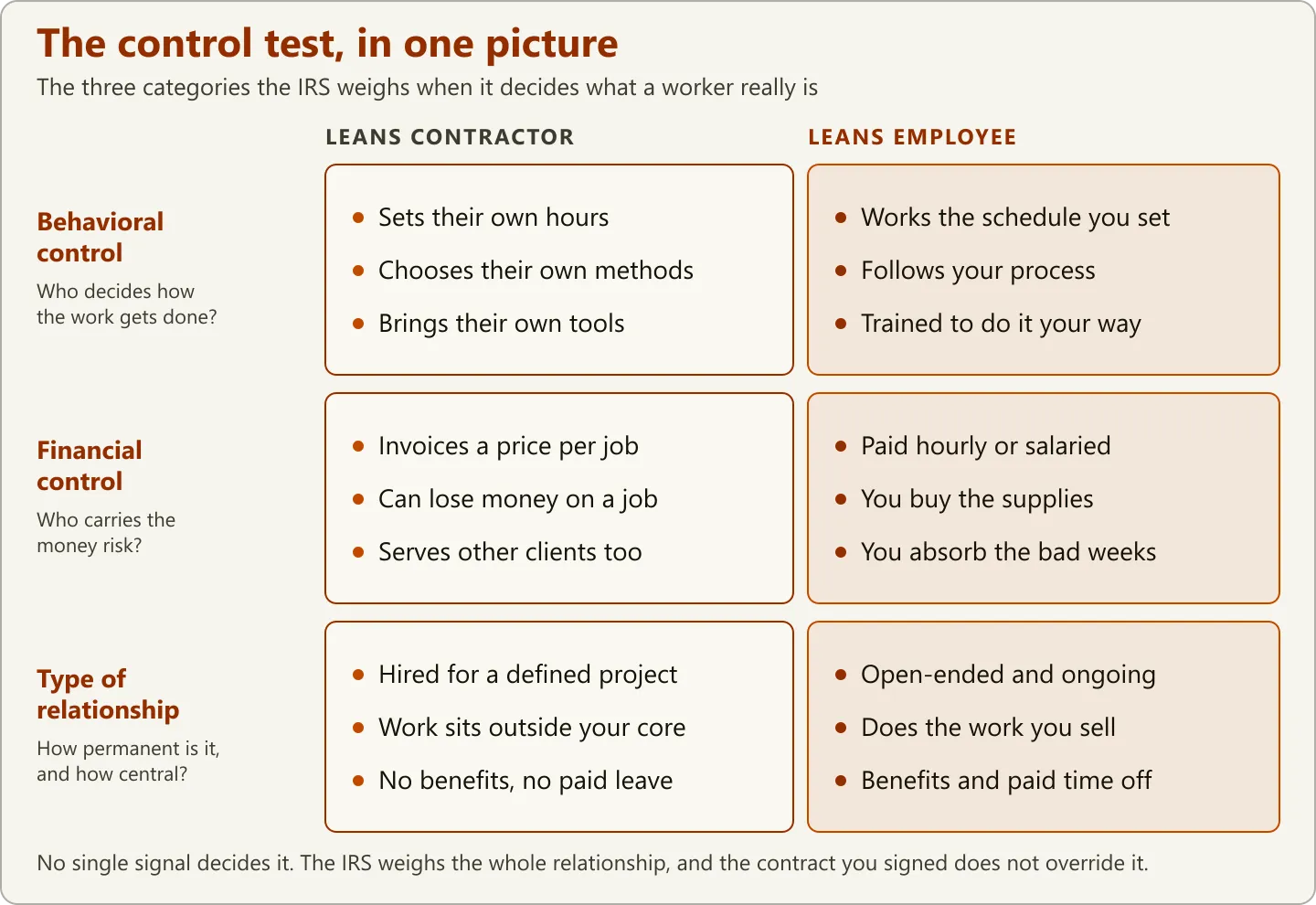
Here are the same signals in text, category by category — drawn from the IRS’s own breakdowns of behavioral control (opens in new tab), financial control (opens in new tab), and type of relationship (opens in new tab):
| The IRS category | Leans contractor | Leans employee |
|---|---|---|
| Behavioral control — who decides how the work gets done | Sets their own hours; chooses their own methods; brings their own tools | Works the schedule you set; follows your process; trained to do it your way |
| Financial control — who carries the money risk | Invoices a price per job; can lose money on a job; serves other clients too | Paid hourly or salaried; you buy the supplies; you absorb the bad weeks |
| Type of relationship — how permanent, how central | Hired for a defined project; work sits outside your core; no benefits, no paid leave | Open-ended and ongoing; does the work you sell; benefits and paid time off |
The case for a contractor
The contractor side of this argument is strong, and it isn’t just about avoiding payroll.
- You buy a defined outcome, not a slice of someone’s week. A product photographer shoots forty listings. A bookkeeper closes your month. The deliverable is the deal, and you’re not managing anyone’s day.
- You get skills you’d never hire full-time for. Nobody’s first hire should be a part-time graphic designer, a tax preparer, and a web developer. Contractors let a three-person shop rent expertise it can’t justify owning.
- The commitment ends when the project does. No layoff, no unemployment claim, no awkward conversation — the engagement simply concludes.
- The administrative load is genuinely lighter. No payroll registration, no withholding, no quarterly employment tax filings. For payments made in 2026, you generally issue a Form 1099-NEC only once you’ve paid a contractor $2,000 or more in the year, per the IRS instructions for Forms 1099-MISC and 1099-NEC (opens in new tab) — up from $600, a change made by section 70433 of the One Big Beautiful Bill Act (P.L. 119-21).
- Coverage without a headcount. For seasonal spikes, a bench of freelancers you can call is often more flexible than a person you have to keep busy year-round.
If you’re running a shop where the extra work is genuinely project-shaped — a rebrand, a photo day, a batch of custom illustrations — the contractor answer is not a dodge. It’s correct.
That bench only works if you can remember who’s on it. The Contractor & Freelancer Bench & Capability Tracker maps who can do what, who’s free, and who you’ve already used — so “who can I call for the fall rush” isn’t a scroll through old emails.
The case for an employee
Now the other side, which is easy to undervalue when you’re looking at the payroll cost and not at what the payroll cost buys.
- You can tell an employee what to do. This sounds trivial until you’ve tried to run a rush week with someone you’re legally not supposed to direct. Schedule, sequence, standards, “actually let’s do these first” — all of that is normal management with an employee and all of it is classification evidence with a contractor.
- You can train them your way. Your packing method, your finishing standard, your customer-note voice. Training someone into your process is one of the clearest employee signals there is, and it’s also the entire point of having help. If you want to build repeatable capability, you want an employee.
- They’re there when you need them. A contractor’s availability is negotiated per job and shared with every other client. An employee’s Tuesday afternoon is yours.
- Consistency compounds. The person who packed 4,000 orders knows which boxes crush. That knowledge only accrues if they keep coming back — and it’s the difference between help that costs you time and help that gives it back.
- You keep the capability. Every hour you invest in a contractor’s skills walks out the door with them. Every hour you invest in an employee stays in the shop.
Once you have more than one person doing the same work, the follow-on question is whether to cross-train your team or hire a specialist — a trade-off we work through kitchen-side in a separate guide, and one that only really exists on the employee side of this line.
What an employee vs a contractor really costs per hour
Contractors look more expensive per hour and employees look cheaper. Both impressions are wrong, and the gap is smaller than the sticker suggests.
Here’s a worked comparison — a helper working roughly 25 hours a week, using illustrative but realistic rates. Your state unemployment rate and workers’ comp class will differ.
| Cost layer | Contractor | Employee |
|---|---|---|
| Agreed rate | $32.00 / hr | $20.00 / hr |
| Social Security + Medicare (7.65%) | None | $1.53 |
| Unemployment (FUTA + state) | None | $0.25 |
| Workers’ comp (1.5%) | None | $0.30 |
| Paid time off (10 days) | None | $0.80 |
| Cost per hour in this example | $32.00 | $22.88 |
The “None” cells aren’t zeros that happen to round down — those layers simply don’t exist on the contractor side, which is exactly why their hourly rate is higher. At 25 hours a week — about 1,250 working hours a year once you subtract the paid time off — that’s roughly $28,600 for the employee against $40,000 for the contractor at these rates.
The employer side of Social Security and Medicare is 6.2% plus 1.45% (opens in new tab), or 7.65% in total. Federal unemployment tax is 6.0% on the first $7,000 of wages (opens in new tab), usually reduced to 0.6% by the credit for paying state unemployment tax — though employers in credit-reduction states pay more. State unemployment insurance and workers’ comp vary widely by state and by what the work involves.
Two things fall out of that table:
The contractor’s higher rate is not markup. It’s their self-employment tax, their own insurance, their unbillable hours, and the gaps between clients. A contractor charging your wage rate is, in real terms, charging less than you’d pay an employee.
The employee’s true cost is the wage plus roughly 10–15% — the table above works out to about 14% at these illustrative rates — for a small shop offering no health or retirement benefits. Across all private industry, benefits average 30.1% of total compensation (opens in new tab) — $14.01 an hour on top of $32.60 in wages, as of March 2026 — but most of that gap is health insurance and retirement plans that a first-hire shop typically isn’t offering yet. Setting the wage itself is a separate exercise; we’ve covered how much to pay your first employee elsewhere.
Neither number is the whole story. The contractor hour buys you output. The employee hour buys you output plus availability plus the right to direct it.
If you do hire, the Shift Schedule & Labor Cost Workbook staffs the week and prices the hours against your sales target — set the rate to the loaded figure from the table above and the week prices itself at true cost rather than at the wage.
Where the real dividing line between employee and contractor is
Here’s where the debate resolves, and it resolves against a lot of small shops’ preferred answer.
The contract does not decide this. The relationship does. You can title a document “Independent Contractor Agreement,” sign it in good faith, issue a 1099 every January, and still have an employee in the eyes of the IRS and your state labor department.
Run the work you’re about to hand off through these five questions:
- Do you need to set their hours? If the answer is “they need to be here Tuesday and Thursday afternoons,” that’s an employee signal.
- Do you need to control the method? If you’d correct how they did it, not just whether it got done, that’s an employee signal.
- Whose tools and materials? If they’re using your bench, your machine, your supplies, that’s an employee signal.
- Is the work what you sell? A candle maker hiring someone to pour candles is contracting out their core business. A candle maker hiring an accountant is not.
- Is it open-ended? “Until further notice” leans employee. “Through the fall market season, then we’re done” leans contractor.
If three or more of these point to employee, hire an employee. Not because the paperwork is nicer, but because you’re going to behave like an employer anyway, and the classification will eventually be tested against your behavior rather than your intentions.
One exception before you start counting: in a state that uses the ABC test, question 4 can decide it on its own, no matter how the other four land. Read the next section first.
The clean version of the test: would I have to give up control of how and when this work happens to defend calling them a contractor — and would the work still be worth having? If the honest answer is no, you wanted an employee all along.
Your state’s ABC test may have already decided for you
The federal common-law test is the permissive one. Many states are stricter, and state law governs wage claims, unemployment insurance, and workers’ comp regardless of what the IRS thinks.
The most consequential version is the ABC test. California uses it, and a number of other states apply their own ABC-style tests — New Jersey (opens in new tab) and Massachusetts (opens in new tab) among them — though the exact wording, and which laws it governs, vary from state to state. Under California’s ABC test (opens in new tab), a worker is presumed to be an employee unless the hiring business proves all three of the following:
- (A) Freedom from control. The worker is free from the company’s control in performing the work.
- (B) Outside the usual course. The worker performs work outside the usual course of the hiring entity’s business.
- (C) An independent trade. The worker is customarily engaged in an independently established trade of the same nature.
Prong B is what catches small shops. A jewelry maker hiring a jeweler cannot pass it — soldering is squarely inside the usual course of a jewelry business — no matter how flexible the hours are or how the contract reads. That same jewelry maker hiring a photographer or a CPA passes prong B easily.
Whatever your state, search your state labor department for “independent contractor test” before you decide — the wording varies even among ABC-test states. The state test, not the IRS one, is what governs a wage claim or an unemployment filing against you.
Federal rules are also in motion. On February 27, 2026, the Department of Labor proposed rescinding its 2024 independent-contractor rule and restoring a five-factor economic-reality test that gives extra weight to two “core” factors: control over the work, and the worker’s opportunity for profit or loss. According to a summary of the 2026 proposed rule from the law firm Jackson Lewis (opens in new tab), the comment period closed April 28, 2026, and the 2024 rule remains in effect for private litigation under the Fair Labor Standards Act — though the department has stopped enforcing it and directed field staff to an earlier 2008 framework. None of that changes the IRS test or your state’s test, which is exactly why “the federal rules got friendlier” is not a reason to reclassify anyone.
What happens if you misclassify a worker
Misclassification isn’t a fine you pay and move on from. It’s a reconstruction of what you should have withheld and remitted.
- Back employment taxes. The employer share, plus amounts you failed to withhold, plus interest and penalties.
- Reduced-rate relief may apply. Under Internal Revenue Code section 3509 (opens in new tab), an employer who filed the required information returns can sometimes remit at reduced rates rather than the full amount.
- Section 530 can end it entirely. Section 530 relief (opens in new tab) protects a business from federal employment tax liability if it meets three tests: reporting consistency (you filed the 1099s), substantive consistency (you never treated a substantially similar worker as an employee at any time since 1977), and reasonable basis — one of three safe harbors (a prior audit, judicial precedent, or industry practice) or another reasonable basis such as advice from an attorney or accountant. Note the trap in the second test: treating one packer as an employee and another as a contractor can cost you the relief for the one you called a contractor.
- The worker can start it. A worker who believes they were misclassified files Form 8919 (opens in new tab) to report their uncollected Social Security and Medicare tax, often alongside a Form SS-8. That filing can put the question in front of the IRS without any action from you.
- You can ask first. Either party can file Form SS-8 (opens in new tab) for an official determination — though the IRS says it can take at least six months to receive a decision (opens in new tab), so it’s a planning tool, not an answer for next Tuesday.
The honest read: the downside is asymmetric. Classifying a genuine contractor as an employee costs you the 10–15% from the cost table above that you didn’t have to spend. Classifying a genuine employee as a contractor costs you back taxes, penalties, and possibly a state wage claim. When the call is close, the cheap mistake is the employee one.
The verdict: employee or contractor?
Both sides are right about different work. The mistake is applying one answer to every pair of hands that walks into your shop.
When to hire a contractor
| Shape of the job | Why |
|---|---|
| A defined project outside your core — photos, books, a website, a rebrand | You’re buying an outcome, not directing a process |
| Occasional overflow you can hand off whole | It’s genuinely project-shaped, and the method is their business |
| A specialist skill you’ll never develop in-house | Renting expertise beats an unjustifiable headcount |
When to hire an employee
| Shape of the job | Why |
|---|---|
| Recurring production on your schedule, at your bench | You need to direct it, so classify it that way |
| Anything you’d need to train into your process | Training to your method is the clearest employee signal there is |
| Your core craft, in a state using the ABC test | Prong B fails no matter how the contract is written |
Whichever way you land, the decision deserves a record you actually keep — a file you own and can reopen next spring when the question comes back, not a subscription you rent to answer it once. If you hired, that record is the Shift Schedule & Labor Cost Workbook; if you went the contractor route, it’s the Contractor & Freelancer Bench & Capability Tracker. And once you’ve settled what the person is, the next question is which role to hire first — a five-role hiring ladder, in the order the roles usually show up.
If you take one thing from this: decide the shape of the work first, then classify it — not the other way around. The shops that get burned start from “I’d rather not run payroll” and reverse-engineer the arrangement to fit. The classification test doesn’t care how you’d rather do it.
Sources & methodology
- Independent contractor (self-employed) or employee? — Internal Revenue Service (opens in new tab) — the three categories of control, with the agency’s detailed breakdowns of behavioral control (opens in new tab), financial control (opens in new tab), and type of relationship (opens in new tab) behind the signals table
- Instructions for Forms 1099-MISC and 1099-NEC — Internal Revenue Service (opens in new tab) — the $2,000 reporting threshold for 2026
- Topic no. 751, Social Security and Medicare withholding rates — Internal Revenue Service (opens in new tab) — employer FICA, 6.2% + 1.45%
- Topic no. 759, Form 940 and federal unemployment tax — Internal Revenue Service (opens in new tab) — FUTA at 6.0% on the first $7,000, and the 5.4% state credit
- Worker reclassification — Section 530 relief — Internal Revenue Service (opens in new tab) — the three Section 530 tests and the 1977 cutoff
- 26 U.S.C. § 3509, Determination of employer’s liability for certain employment taxes — Cornell Legal Information Institute (opens in new tab) — reduced rates for employers who filed information returns
- About Form 8919, Uncollected Social Security and Medicare Tax on Wages — Internal Revenue Service (opens in new tab) — how a worker raises misclassification
- About Form SS-8, Determination of Worker Status — Internal Revenue Service (opens in new tab) — either party may request a determination
- Completing Form SS-8 — Internal Revenue Service (opens in new tab) — “at least 6 months to receive an IRS decision”
- Employer Costs for Employee Compensation, March 2026 — U.S. Bureau of Labor Statistics (opens in new tab) — benefits at 30.1% of total compensation (current-release page, updated quarterly; figures quoted are the March 2026 release)
- Independent contractor FAQ and the ABC test — California Department of Industrial Relations (opens in new tab) — California’s three ABC prongs
- Independent contractors and misclassification — New Jersey Department of Labor (opens in new tab) — an example of a second state’s ABC-style test
- Massachusetts General Laws c. 149 § 148B — Massachusetts Legislature (opens in new tab) — the Massachusetts three-prong test, including the “outside the usual course” prong
- DOL’s proposed 2026 independent contractor rule — Jackson Lewis (opens in new tab) — the February 2026 proposal and the status of the 2024 rule
Rates and thresholds are current as of July 2026. Federal unemployment credit-reduction states, state unemployment insurance rates, and workers’ compensation rates change annually — and the federal independent-contractor rule was still in rulemaking when this was published.
Disclaimer: This post is for informational and educational purposes only and does not constitute legal, tax, accounting, or employment advice. Worker classification turns on the specific facts of each relationship, and federal rules, state tests, and reporting thresholds change — consult a licensed attorney, CPA, or payroll professional, and check your state labor department’s rules, before classifying anyone.