To organize your insurance policies, build one page: a row per policy carrying eight fields — carrier, policy number, term and renewal date, premium, deductible, the limits that matter, the 24-hour claims line, and the named insureds or beneficiaries. File the full policy PDFs in one folder, keep photo proof of what you own separately, and make sure a second adult can reach the page. It takes about 45 minutes. Here is why that page is the thing that matters.
Here is a hypothetical, and it is a boringly common one.
It is 6:40 on a February morning. A supply line behind an upstairs sink gave out sometime in the night, and by the time anyone notices, water is coming through the kitchen ceiling in a slow brown ring around the light fixture. The main is off. There is a mixing bowl on the counter catching what still comes down. Everyone is standing in the kitchen in socks, and someone says the sensible thing: call the insurance company.
And that is where the morning stops.
This household has homeowners insurance. They have paid it every month for eleven years, through two carriers and one refinance. Coverage is not the problem. The problem is that at 6:40 a.m., with the ceiling still dripping, nobody in the house can answer three questions:
- Who is the carrier right now?
- What is the policy number?
- What is the deductible on water damage?
The dec page is in an email from a broker who has since left the agency. The login is saved in a browser on a laptop that is upstairs, in the room with the water. The bill is on autopay, so the last person to actually look at the policy did so during the refinance, in 2023.
Nothing here is a coverage failure. It is a retrieval failure — and retrieval failures are the ones you can fix in an afternoon, on a day when nothing is dripping.
The short version is seven steps and about 45 minutes: skip straight to the pass, or read on for what goes in the index and why.
Insurance Trouble Is Often a Retrieval Problem, Not a Coverage Problem
Household insurance failures at claim time are often retrieval failures rather than coverage failures: the policy exists and the premium is current, but nobody can produce the four or five facts the claims line asks for in the first ninety seconds. The extreme version of that gap — life insurance nobody can find — is measurable, and it is large.
The National Association of Insurance Commissioners runs a free tool that matches people against life insurance policies and annuities they may be a beneficiary of but cannot find. Since the tool launched in 2016 and through August 31, 2025, insurers had reported more than 611,000 matches totaling $13.18 billion in benefits (opens in new tab) through that one tool. Thirteen billion dollars of coverage that was bought, paid for, and in force — and simply could not be found by the people it was bought for.
That is the same failure as the kitchen ceiling, scaled up and made permanent. Somebody paid the premium. Nobody wrote down where it was.
There is a second reason this keeps happening, and it is structural rather than personal. Your policy history does not live in one place because it was never designed to. Each carrier keeps your documents in its portal, and when you switch carriers — which every rate increase pushes another wave of households to do — that history stays behind. Your agent has a copy until your agent changes agencies. Your lender has the declarations page it required at closing, and only that one. The only party with an interest in the whole picture across time is you, and you are the only party without a system for it.
So build the system. It is one page.
How Many Insurance Policies Does a Household Actually Have?
Before you can index your policies you have to find them, and the count is easy to undershoot. It is easy to name three — house, cars, life — and miss the rest. Work through the list below and most households land closer to seven or nine, because several policies are invisible: they sit inside a benefits package, ride along with a credit card, or hide escrowed in a mortgage payment.
| Policy | Who usually holds it | Where the document usually is | The part nobody can find |
|---|---|---|---|
| Homeowners or renters | You, directly | Carrier portal, broker email | The deductible, and whether it is a flat amount or a percentage |
| Auto | You, directly | Glovebox card, carrier app | Liability limits and whether you carry uninsured motorist |
| Flood | Often required by the lender | Escrowed, buried in closing documents | Whether you have one at all |
| Umbrella or excess liability | You, directly | Same carrier as home and auto | The underlying limits it sits on top of |
| Life (personal) | You, directly | Filing cabinet, sometimes nowhere | The beneficiary designation |
| Life, AD&D, disability (employer) | Your employer | Benefits portal you visit once a year | The coverage multiple and whether it is portable |
| Scheduled personal property (riders) | Attached to homeowners | An endorsement page, not the main policy | Which items are actually scheduled |
| Travel and rental car coverage | Your credit card | The card’s benefits guide | That it exists at all |
| Pet, dental, vision, identity theft | Various | Wherever you signed up | The claims number |
The invisible ones matter more than they look. Employer life insurance is one of the easiest coverages to forget you have: it is real money, often one or two times salary, it never arrives as a bill, and it ends with the job unless someone converts or ports it. Credit card rental car coverage can wipe out the counter waiver, one of the more expensive add-ons on a rental bill — but only if you know the coverage is there before you decline, and many cards cover secondarily rather than first.
And if you are working through a parent’s or spouse’s affairs rather than your own, add one more step: check your state’s unclaimed property database through the National Association of Unclaimed Property Administrators (opens in new tab), and run the NAIC’s life policy locator (opens in new tab). Both are free, both take minutes, and both exist because this problem is universal.
What to Record for Each Policy: The Eight Fields
A policy index is a single list, one row per policy, that records where each policy lives and what a claim will ask you for. It is not a copy of the policy. It is the map to the policy, and the whole point is that it fits on one page and can be read by someone who is upset.
For each policy, record these eight fields:
- Policy type and carrier. The legal entity name, not the brand you see in ads — claims lines are often organized by underwriting company.
- Policy number. Exactly as printed, including letters and dashes — or, if the page leaves the house or gets shared around, the last few digits plus a pointer to where the full document lives.
- Term and renewal date. When the current term ends is the single most useful date in the row.
- Premium and how it is paid. Autopay from which account, or escrowed inside which mortgage payment. This is how you notice a lapse.
- Deductible. Write the number, and note if it varies by peril. In hurricane-exposed states, the named-storm deductible is frequently a percentage of the home’s insured value rather than a flat dollar amount — the NAIC notes these hurricane and named-storm deductibles (opens in new tab) run from 1% to as high as 15%, and that as of June 2025 nineteen states plus the District of Columbia have them. That is a very different number than people expect.
- The two or three limits that matter. Dwelling and personal property for a home policy; liability limits for auto; the death benefit for life. Not every limit — the ones that decide whether you are made whole.
- Claims phone number. The 24-hour claims line, which is usually not your agent’s number. Your agent goes home at five. Losses do not.
- Named insureds and beneficiaries. Who is on the policy, and for life policies, who receives it. Beneficiary designations generally override wills, and they go stale after marriages, divorces, and deaths.
If you only ever fill in four of these, make them the carrier, the policy number, the deductible, and the 24-hour claims line. Those four turn a two-hour morning into a ten-minute phone call.
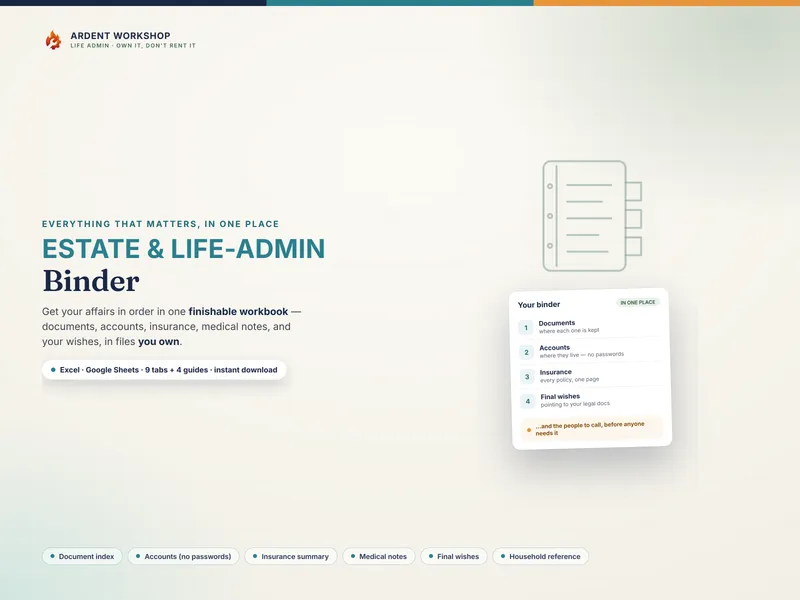
The Estate & Life-Admin Binder carries an Insurance tab holding most of these fields — policy type, insurer, policy number, what it covers, premium, renewal or term, who to call, and where the document lives — sitting beside the accounts, documents, and final-wishes tabs. Add columns for the deductible, the limits, the 24-hour claims line, and the named insureds or beneficiaries, and the whole index lives with everything else a household needs to be able to hand someone.
Where to Keep Insurance Policies: The Three-Tier Rule
The mistake most people make when they finally sit down to organize this is trying to put everything in one place. That fails because the three things you are storing have completely different jobs, different places, and different urgency.
Split them into three tiers.
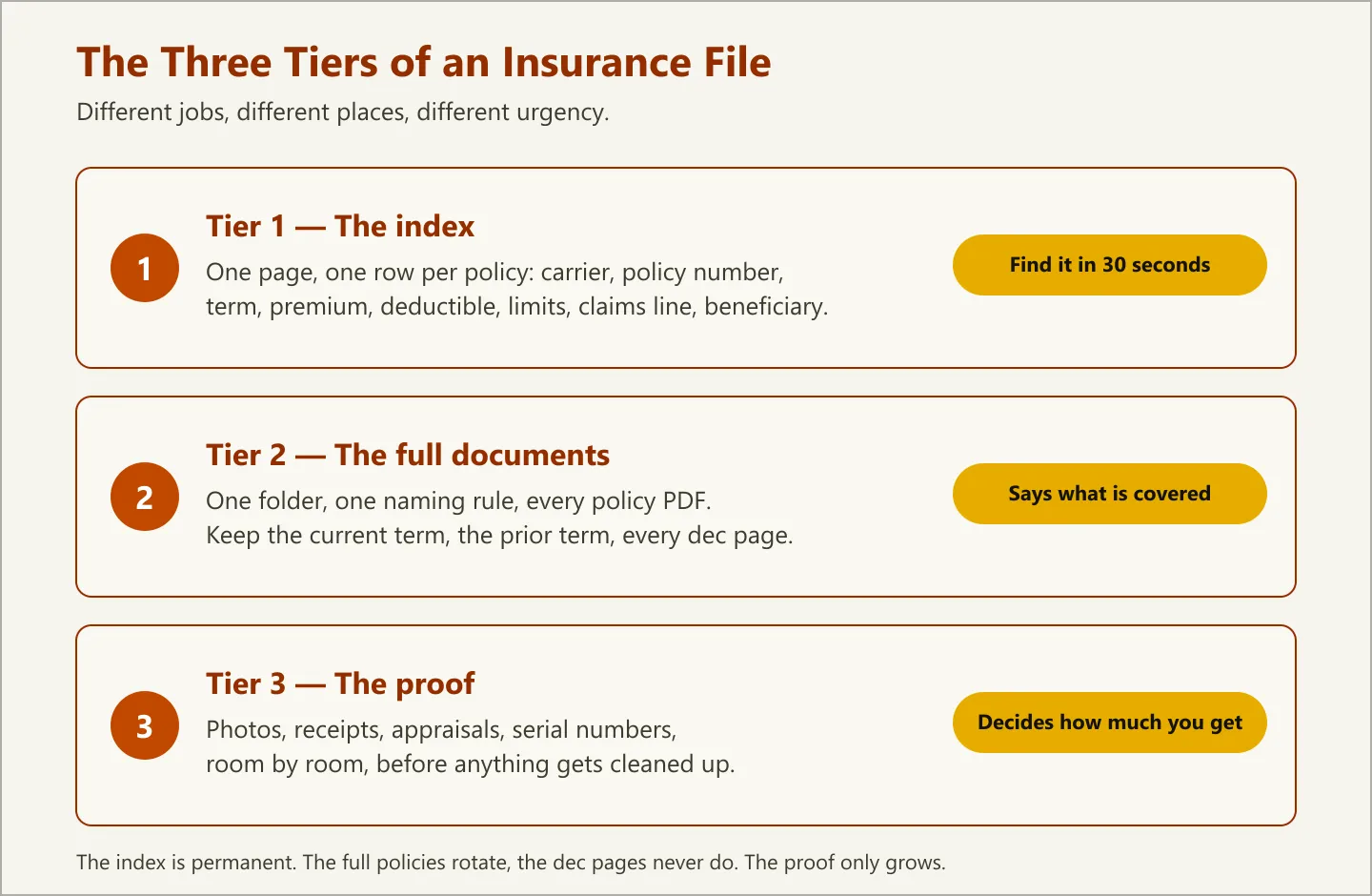
Tier 1 — the index. One page. The eight fields above, one row per policy. This is the tier that has to be findable in thirty seconds by a person who is stressed, possibly on a phone, possibly not you. It should exist in at least two places: wherever your household documents live, and a printed copy with your emergency papers. Because this page aggregates a lot in one spot, keep the printed copy somewhere locked or fireproof rather than loose in a filing drawer — and note accounts the way a bank statement does, as “checking ending 4412”, rather than writing a full account number down at all.
Tier 2 — the full documents. This is the tier that says what is actually covered. One folder, every policy PDF, one naming rule. Something like 2026-Home-CarrierName-Policy.pdf works, because sorting by name groups every year of a policy together and puts the newest at the bottom. Keep the current term and the prior term of each full policy, and keep the dec page of every term you have ever held. Property losses get discovered months after they happen, and the policy in force on the date of loss is the one that pays — for liability the tail is far longer, because coverage is generally triggered by the date of the incident rather than the date of the claim.
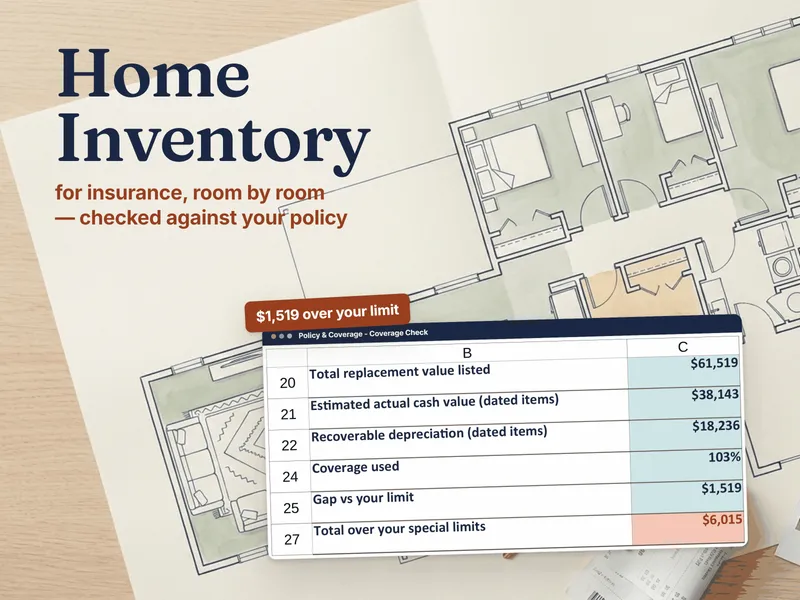
Tier 3 — the proof. Photographs, receipts, appraisals, serial numbers, captured room by room and, after a loss, before anything gets cleaned up. This is the tier that decides how much you get, and it is the one nobody builds in advance. An insurance adjuster will ask you to list what was damaged, when you bought it, and what it cost. A room-by-room photo pass on your phone takes twenty minutes and answers most of that; our room-by-room home inventory walkthrough covers what to record for each item, and the Home Inventory spreadsheet gives you the item, cost, and proof columns already set up.
The tiers also answer the retention question. The index is permanent. Tier 2 rotates its full policies but never discards a dec page. Tier 3 grows and only shrinks when you sell something. For why an expired policy is not old paper — and for the rest of the filing box — we covered how long to keep documents separately.
How to Organize Your Insurance Policies in 45 Minutes
This is the afternoon. Budget about 45 minutes of your actual attention, spread across a longer stretch of wall-clock time — much of the gap is portals loading and a carrier emailing you a document back.
-
Find the policies you are already paying for. Pull the last 12 months of checking and credit card statements and write down every payment that went to an insurer, an agency, or a premium finance company. Statements find policies memory does not. Twelve months matters because annual-pay policies only appear once.
-
Add the policies that never show up as a payment. Employer life, AD&D, and disability sit in your benefits portal — some employer-paid, some deducted from payroll — and never look like an insurance bill. Credit card travel and rental car coverage costs nothing extra. Flood and mortgage insurance may be escrowed inside the mortgage payment. None of these appear as an insurance charge, and all of them are real coverage. Open your benefits portal and your card’s benefits guide and write down what is there.
-
Get one declarations page per policy. The declarations page — the “dec page” — is the two-to-four-page summary at the front of a policy that lists the named insureds, the policy number, the term dates, the limits, and the deductibles. Everything the index needs is on it. If you cannot find one, most carrier portals let you download a current copy directly, and the carrier can email one on request.
-
Fill in the eight fields for each policy. Type and carrier, policy number, term and renewal date, premium and payment method, deductible, the limits that matter, claims phone number, named insureds and beneficiaries. Do not editorialize. This is a lookup table, not a review.
-
File the full documents in one folder with one naming rule. Download the PDFs while you have each portal open — that is the moment of least friction you will ever get, and it is the step people skip and then repeat next year.
-
Put a copy where a second person can reach it. An index only one person can open is a single point of failure, and the scenarios where the index matters most are exactly the scenarios where that person is unavailable. Give a second adult access, or keep a printed copy with the rest of your household emergency papers.
-
Write the renewal dates somewhere you will see them. Every renewal date on one calendar, with a reminder at least 30 days ahead. Thirty days is the floor, not the target: it is roughly when renewal notices arrive, so it is the last point at which a competing quote can still change anything. For insurance specifically the real shopping room is closer to three months out. Required notice periods are set by state, and your state insurance department (opens in new tab) has the specifics.
When you finish, there is a good chance you will find at least one of the following: a policy you are paying for and no longer need, a beneficiary designation naming someone from a previous era of your life, or a deductible that is meaningfully higher than you remember agreeing to.
The Ten Minutes a Year That Keep the Index True
An index that is not maintained becomes a liability, because it produces confident wrong answers. The maintenance is small.
Once a year, on a date you pick and keep:
- Confirm the carrier and policy number for anything you switched.
- Re-read the deductible line. Deductibles drift upward at renewal, sometimes as the mechanism by which a carrier holds your premium flat.
- Check that the dwelling limit still resembles what it would cost to rebuild, which is a construction-cost question, not a market-value question.
- Re-read the beneficiary designations after any marriage, divorce, birth, or death.
- Delete the policies you cancelled, and note the date you cancelled them.
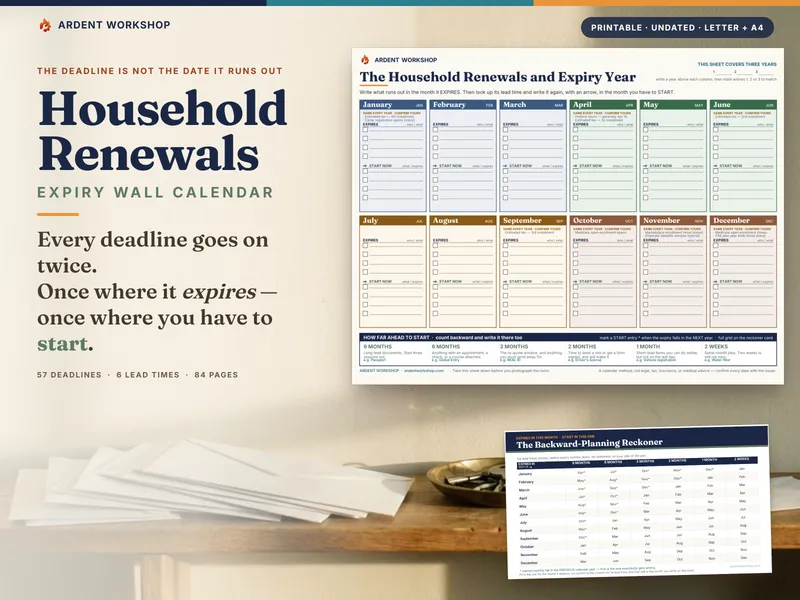
The renewal dates are the part that reliably falls over, because they are scattered across the year by accident of when you bought each thing. If a calendar reminder is not sticking, the printable Household Renewals & Expiry Wall Calendar exists for this specific failure mode: it is a wall chart that lists household deadlines with the lead time attached — insurance sits in a three-month band — so the prompt goes up when there is still time to act rather than on the day the thing expires.
Three Things That Make a Claim Go Faster
Once the index exists, three habits do most of the remaining work.
Know which peril you are claiming. This sounds pedantic and it is worth real money. A burst pipe is water damage and is generally covered by a homeowners policy. Water that rises from outside is a flood, and flood is excluded from standard homeowners policies — it requires a separate policy, and FEMA’s flood insurance program (opens in new tab) generally imposes a 30-day waiting period before a new policy takes effect. That waiting period is the reason flood coverage is an August decision and not a forecast-week decision.
Write down the date and time you noticed. Start a one-page claim log the moment something happens: when you discovered it, what you did to prevent further damage, who you called, what they said, and the claim number. Insurers ask you to mitigate further damage, and a contemporaneous log is what demonstrates you did — it is also most of what a proof of loss asks you to substantiate. If the loss is large enough that a rebuild follows, the Disaster-Recovery Claims & Rebuild Binder is built for that longer arc — loss inventory, additional living expenses, claim deadlines, and an adjuster log.
Take the photos before you clean up. The instinct is to fix it. Fixing it first destroys the evidence of what it was. Two minutes of video from the doorway of every affected room, then clean up.
Back to the February Morning
Run the same scenario with the index in place.
At 6:40 a.m. someone opens one page. Carrier, policy number, 24-hour claims line, $2,500 deductible, water damage covered, dwelling and personal property limits right there. The call is placed at 6:47. By the time the water is mopped, there is a claim number, and the photos were taken before anyone touched anything, because that was step three on a list somebody wrote on a Sunday in August when nothing was wrong.
The loss is identical. The difference is entirely in the first hour, and the first hour is the part you can build in advance.
That is the whole argument for a policy index, and it is the argument for household paperwork generally: the value is not in owning the documents, which you already do. It is in being able to find them from a standing start, with your hands full and the light fixture dripping. A carrier portal will not do that for you, because it only knows about itself and only for as long as you stay. A page you keep will.
What to Do This Week
If the afternoon is more than you have right now, do these four things in fifteen minutes and you will have captured most of the value:
- Write down the carrier, policy number, deductible, and 24-hour claims line for your home or renters policy and your auto policy. Eight facts, one page.
- Open your benefits portal and note whether you have employer life and disability coverage, and at what multiple.
- Check the beneficiary on any life insurance policy you own personally.
- Put that page where a second person in your household can find it.
That is the system — the rest is just filling it in. If you want it to sit alongside the other documents that get looked for on the worst day, our guide to what to include in a family emergency binder covers the neighbors of this list.
Common Questions About Organizing Insurance Policies
What is a declarations page?
A declarations page is the summary at the front of an insurance policy, usually two to four pages, that lists the named insureds, the policy number, the term dates, the coverage limits, and the deductibles. Everything a policy index needs is on it, and most carriers will email a current copy on request.
How many insurance policies should I expect to find?
Working through the checklist in this guide, many households find closer to seven or nine than the three they can name, because several policies are invisible: employer life, AD&D and disability sit inside a benefits package, travel and rental car coverage rides along with a credit card, and flood or mortgage insurance can be escrowed inside the mortgage payment.
What should I have ready before I call the claims line?
Have the carrier, the policy number, and the deductible in front of you, and call the 24-hour claims line rather than your agent. In the scenario above, those four facts are the difference between a two-hour morning and a ten-minute phone call.
Where should the insurance index itself live?
The index should exist in at least two places: wherever your household documents live, and a printed copy with your emergency papers. Keep the printed copy somewhere locked or fireproof, and make sure a second adult can reach it — an index only one person can open is a single point of failure.
Sources
- NAIC Life Insurance Policy Locator results through August 31, 2025 (opens in new tab)
- How to use the NAIC life insurance policy locator (opens in new tab)
- National Association of Unclaimed Property Administrators state unclaimed property search (opens in new tab)
- NAIC on hurricane and named-storm deductibles (as of June 2025) (opens in new tab)
- FEMA’s flood insurance program and the NFIP waiting period (opens in new tab)
- NAIC directory of state insurance departments (opens in new tab)