The Household Renewals & Expiry Wall Calendar is an undated printable pack covering 57 once-a-year household deadlines. Every one carries a lead time — how far ahead you have to start — and the specific thing it costs when you miss it, so each deadline goes on the wall chart twice: once where it expires, and once, earlier, where you have to begin.
Missed renewals are among the most avoidable costs a household carries, and the reason is usually the same. The deadline arrives once a year — an interval no household routine is built around — and it lives in a drawer, in an email filter, or nowhere at all. The only reminder most households have is the failure: the registration that lapsed, the policy that auto-renewed at a number nobody looked at, the passport that could not be renewed in time for the trip.
This is that whole year, taken out of the drawer and put on a wall.
Why a renewal calendar needs two dates, not one
A calendar that tells you when something expires is already too late.
A passport is a nine-month job, not a two-week one: processing is measured in weeks before the application is even opened, and many destinations want six months of validity beyond your travel dates — both worth confirming with the issuing agency before you plan around them. An insurance renewal is worth nothing on the day it lands — the money is in the three months before, when you still have room to shop the same cover somewhere else. A professional license is really a deadline for continuing education that ended months earlier.
So every deadline in this pack sits in one of six lead-time bands, and it goes on the chart twice. A glance at January says nothing expires this month, but three things start. That second entry is the whole product.
The card that does the counting
The Backward-Planning Reckoner turns an expiry month into a start month for you: twelve expiry months down the side, the six lead times across the top, and the month to begin printed in every single cell. Find the row, run across, write the month down.
There is no arithmetic on your side of the pen — and every start month that lands in the previous calendar year is marked, because counting backward across a January by hand is exactly where the off-by-one comes from.
Try one card of it, free
One card of this pack is free and ungated: the Renewal Lead-Time Card — twelve household deadlines that cost money when they are missed, each with how far ahead to start it and what a miss costs, plus a three-band backward-planning grid. No email, no signup. If it earns a place on your fridge, the full pack adds the other 45 deadlines, the twelve-month chart, the other three lead times on the full reckoner, the fill-in cards and the private booklet.
What goes on a wall, and what doesn’t
A completed reference chart is a full inventory of a household’s documents and the dates it will be dealing with them. On a wall it is read by every visitor, every tradesperson, every delivery — and every photograph taken in that room, every video call made from it, and every listing photo if you ever sell the house.
So the chart and 10 of the 12 fill-in cards — the eight pre-printed category cards and the two blanks — ask for four things and nothing else: what it is, whose it is, the month it expires, and the month to start. No document numbers. No account references. No provider names. Nowhere that any document is kept.
All of that lives in a separate private booklet for a locked drawer or the household binder — and the split is enforced when the files are built, not left to a line in the instructions. The build reads the rendered text of every wall-facing page and fails if a private field label appears on one. The two cards that do carry money figures on purpose — the re-quote card and the done-this-year log — say so on their own footers and belong in the drawer too.
What a free printable calendar leaves out
A blank twelve-month grid tells you which month you are in. This tells you, for all 57 deadlines: the cycle it runs on, how far ahead to start it, why that lead time is what it is, the specific thing missing it costs, and where to check the real number for your own state and provider.
That “why” column is the difference. A checklist says a vehicle inspection is annual. The reference explains that two months is not for the test — it is for the repair the test finds, and that a failed inspection with two weeks left is a scramble for a parts order and a shop slot at the same time. A deadline you understand is a deadline you will actually start early.
Every artifact in the pack is generated from that one list, so the chart, the lead-time cards, the fill-in cards and the reference cannot disagree with each other about a cycle or a lead time. Even the worked example computes its start months rather than typing them.
Cross out the deadlines your household doesn’t have
Thirty-nine of the 57 carry the condition that makes them yours at all. No pets, no pet license. No septic system, no pump-out certificate. No business, no annual report. Nobody in college, no aid deadlines.
So the first thing you do is go down the reference with a pen and rule through everything that is not yours. In the worked example that pass rules out 21 of the 57 in about ten minutes, and what remains stops feeling like a backlog. The worked example shows an invented household doing exactly that — 21 items ruled through, 31 deadlines written in. For the setup itself, step by step, see how to never miss a household renewal deadline.
The renewals worth re-quoting
Auto-renewal costs money in one specific situation: where the price you are quoted as an existing customer and the price a new customer is quoted are two different numbers. That is not true of a passport fee. It applies wherever renewal pricing and new-customer pricing are set separately — commonly in insurance, and in subscriptions billed annually with a card on file. Check your own renewal notice against a fresh quote.
The reference marks 18 of the 57 as worth shopping rather than letting roll, sets out a forty-minute method for doing it properly — compare the deductible and the limit, not just the premium; take the best quote back to the incumbent once; never cancel the old cover until the new one is in force — and the re-quote card arrives pre-printed with all 18.
Own it, don’t rent it
A reminder fires once, while you are doing something else, and trains you to dismiss it. It also fires on the expiry date, because that is the date you typed in — which is the wrong date for almost everything here. And it only knows about the renewals you already remembered to enter, which are not the ones costing you money.
A sheet on a wall is passive and permanent — the full comparison is here. It needs no battery, no signal, no login, and no live subscription; everyone in the household can read it without being added to an account; and it will still be there in year three, when the app you would otherwise have trusted has been sunset, repriced, or quietly forgotten.
That is the space Ardent Workshop works in — between a blank sheet of paper and a rented app. You own the files, you print them as often as you like, and nothing expires.
Wall chart or household binder — which do you need?
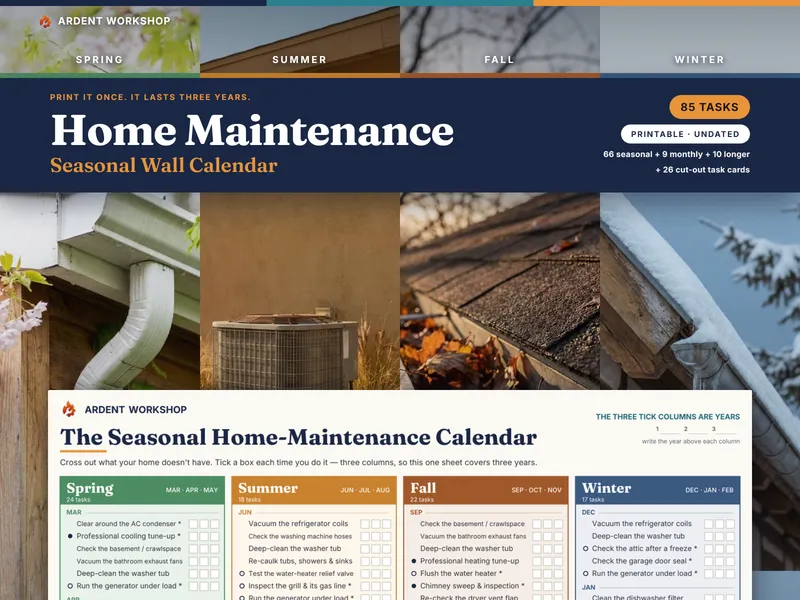
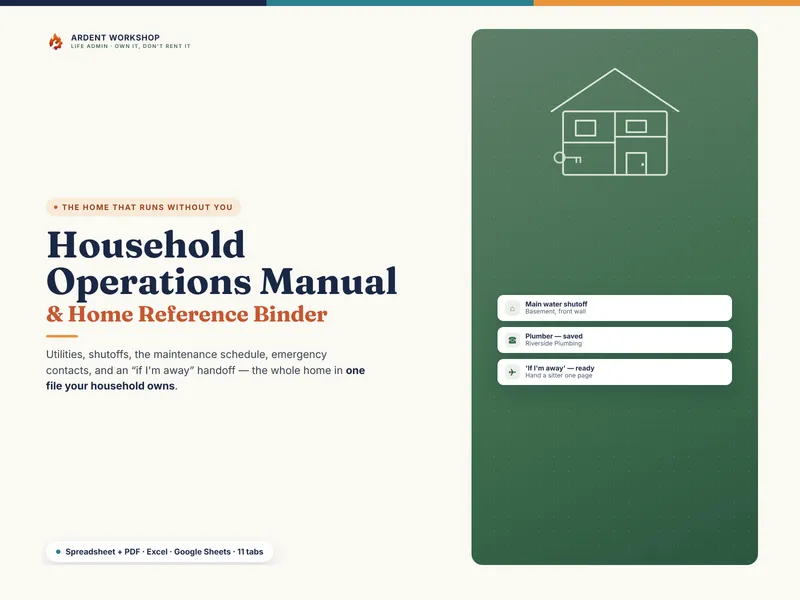
This pack is the year: what runs out, when to start it, and what a miss costs, on a sheet you hang. If what you want is the file — where the policies, the manuals, the accounts index and the who-to-call actually live — that is the Household Operations Manual, a binder rather than a wall chart. Neither contains the other, and this chart is the thing that tells you when to open that one. For the maintenance half of a home’s year, on paper, see the Home Maintenance Seasonal Wall Calendar & Task Cards.
What this pack is not
It is a calendar method with a reference attached. It is not legal, tax, insurance, immigration, or medical advice, and it is not a filing system. Every lead time in it is a planning allowance rather than a published standard, and every jurisdictional detail is a starting point for an ordinary US household — each item names where to check your own. Where your state, your agency, your licensing board, your insurer, your manufacturer, or a professional you are paying says something different, follow them. Confirm every date with the issuer before you rely on it. The example household is entirely invented and its dollar figures are illustrative.