The bill arrives looking finished. Official letterhead, an account number, a line that says Amount Due, and a date by which you’re supposed to pay it. Everything about the document says a decision has already been made and your only remaining job is to find the money.
Here’s the hard truth: that number is a first draft. It was assembled by people who weren’t in the room when you got care, translated into codes, passed through at least one insurance system, and printed. Any of those handoffs can go wrong — and when you dispute a medical bill, you are not asking for a favor. You are asking someone to check their work.
Almost nobody tests that. Among HealthCare.gov marketplace plans, insurers denied about 20% of in-network claims in 2023 — and consumers appealed fewer than 1% of those denied claims (opens in new tab), according to KFF’s analysis of federal data. The people who ask get a different outcome than the people who pay.
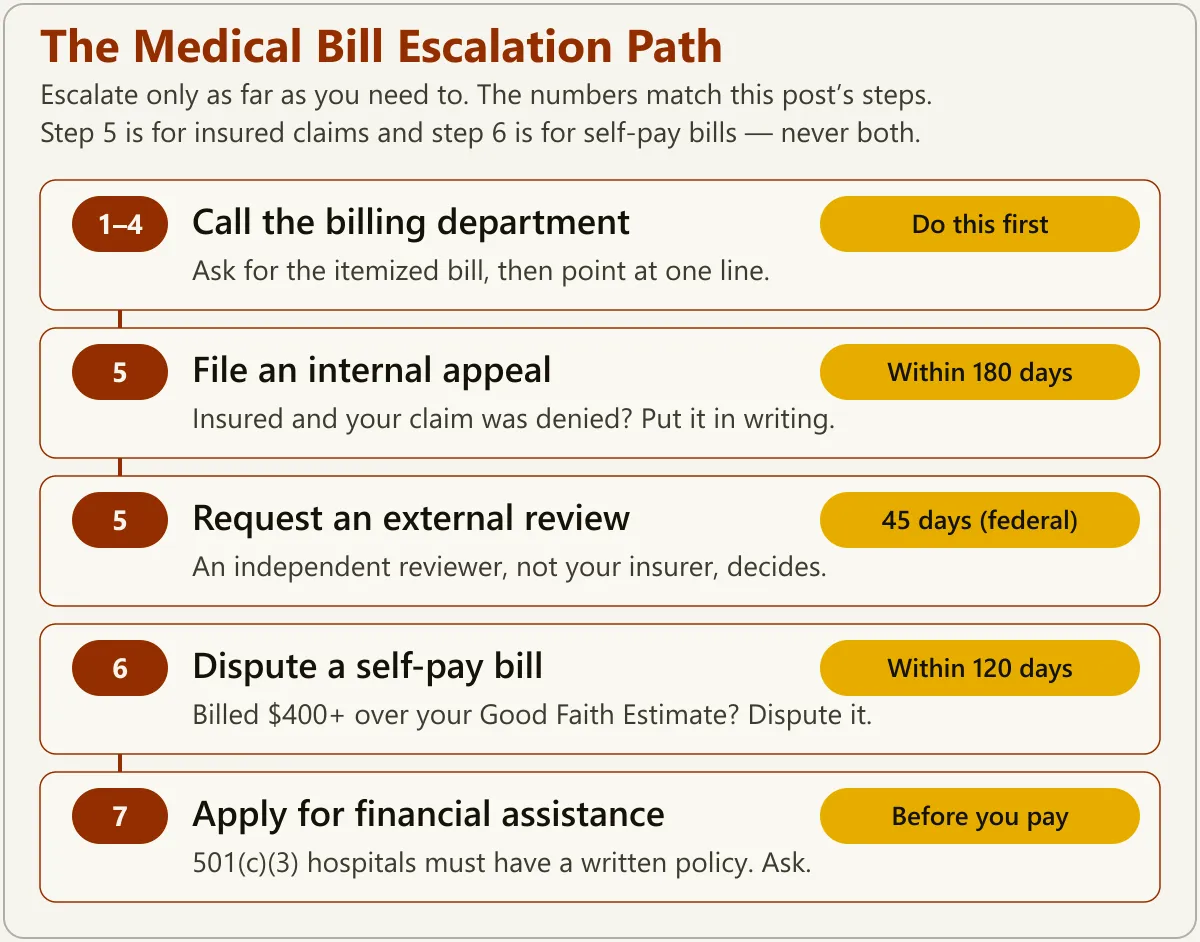
To dispute a medical bill: request the itemized bill and don’t pay yet, compare it line by line against your Explanation of Benefits, run six error checks to find the bad line, then call the billing department back and log the call. That much applies to everyone. After that the route forks: if you’re insured and the plan denied the claim, appeal within 180 days and escalate to an independent external review; if you’re uninsured or self-pay, dispute a bill that came in $400 or more over your Good Faith Estimate within 120 days. You will use one route or the other, not both. Either way, ask about financial assistance before you agree to a payment plan.
If you only do one thing today: call the number on the bill and ask for an itemized statement. Don’t pay yet. Every other step below depends on having that one document.
Here is the whole escalation path in one picture — you only walk one side of the fork:
Why medical bills are wrong so often
A medical bill is not a receipt. A medical bill is a claim about what happened to you, converted into standardized billing codes by an administrative department, and priced against a contract you have never seen. A receipt records a transaction that already settled. A bill proposes one.
That gap is where the errors live. The Consumer Financial Protection Bureau found that medical debt in collections accounted for $88 billion on consumer credit reports (opens in new tab) as of June 2021 — that’s the size of the arena these disputes happen in, not the size of the error rate. A companion CFPB review of consumer complaints found people being pursued for bills that had already been paid in full, covered by insurance, or resolved through charity care (opens in new tab) — and that from 2018 to 2021, complaints about collection attempts on medical bills that were not owed increased by 31%.
None of that requires anyone to be acting in bad faith. It’s what happens when a bill has to travel that far before it reaches your mailbox.
Step 1: Ask for the itemized bill (and don’t pay yet)
The statement you received is almost certainly a summary. It shows a total and maybe a few department-level groupings. You cannot find an error in a summary, because a summary is designed to hide the detail.
So the first move is always the same: call the billing department and request an itemized bill. CMS’s own guidance is to ask your provider’s billing department for a detailed bill (opens in new tab) — a list of the costs for each individual medical item or service you’re being charged for.
While you’re on the phone, ask two more things:
- Put a hold on the account while it’s under review. Get a name and a date.
- Ask whether the account has been sent to collections yet, and if not, when it would be.
Do not pay the balance to “sort it out later.” Once money moves, you’re asking for a refund instead of a correction, and refunds are slower, smaller, and easier to deny.
Do not ignore it either. Ignoring is what turns a $600 billing error into a collections account. (And if it already has, skip to what to do if the bill is already in collections — it isn’t over.)
Step 2: Compare the bill against your Explanation of Benefits
If you used insurance, you have a second document — and it’s the one that settles most arguments.
An Explanation of Benefits (EOB) is a notice from your health plan, not a bill. CMS describes it as a statement showing the services you got, the date you got them, the amount your plan agreed to pay, and the amount you owe, if anything (opens in new tab). You should normally get the EOB before the provider’s bill arrives. If you never got one, call your plan — it may mean the provider never filed the claim.
The check is simple, and it catches a surprising share of bad bills:
The check: does the amount the EOB says is your share match the balance due on the provider’s bill?
If those two numbers disagree, one of them is wrong, and you now have a documented disagreement between two institutions rather than a complaint from a customer.
While you’re there, learn four of the amounts CMS says appear on most bills, because billing departments use them as though everyone knows them:
| Term | What it actually means |
|---|---|
| Total charges | The full list price for the services and items — before any discount |
| Allowed amount | The maximum your plan will pay for a covered service (also called the negotiated rate) |
| Adjustments | What the provider subtracts because it agreed to a discounted rate |
| Balance due | What the provider says you still owe — the deductible or coinsurance |
If a provider is out of network and charges more than the allowed amount, the difference is called balance billing — and in many situations, including most emergency care and care from out-of-network providers at an in-network facility, the No Surprises Act now protects you from that bill (opens in new tab). Ground ambulance rides are the big exception: they are still allowed to bill you at out-of-network rates. Check which side of that line your charge falls on before you accept a large out-of-network balance as legitimate.
Step 3: Run the six error checks
This is the part people skip, and it’s the part that finds the money. CMS publishes its own list of checks for finding errors on a medical bill (opens in new tab); the table below adapts that list, adding two checks CMS covers on its other billing pages, in the order that finds problems fastest.
| # | Check | What a hit looks like |
|---|---|---|
| 1 | Your name, account number, and dates of service | A date you weren’t there, or a service billed under the wrong person |
| 2 | The charges against your medical records | A service, drug, or supply that isn’t documented anywhere in your chart |
| 3 | The same service billed twice | Duplicate charges — most common when more than one provider treated you |
| 4 | The billing code for each line | The code’s published description doesn’t match the care you actually got |
| 5 | Bill totals against the EOB | The EOB “your share” and the bill “balance due” don’t agree (this is Step 2 — tick it off) |
| 6 | The bill against your Good Faith Estimate | The bill runs well past the estimate (self-pay only — see Step 6) |
If you’d rather work from paper next to the phone: the six checks above are how you look; the free Itemized Bill Review Checklist is the ten error types you’re looking for — upcoding, unbundling, wrong units, out-of-network surprises, prices far above the going rate. Printable, no signup.
Two of the checks deserve a note.
Check 2 is the strongest one you have. CMS’s guidance is blunt about it: you shouldn’t get a bill for anything that isn’t documented in your records. Ask the provider for a copy of your medical records and read them against the itemized bill. Some providers charge a records fee, so ask the billing department about that up front.
Check 4 is easier than it sounds. You don’t need to learn medical coding. Type the code number from the bill plus the phrase “medical billing code” into a search engine and read the description that comes back. (Use a private window and stay signed out — a procedure code is health information about you, and you don’t want it landing in a logged-in search history.) If the description is a procedure nobody performed on you, that’s your line.
CMS also notes that medical billing is genuinely complicated, and that a patient advocate or your state’s Consumer Assistance Program can do this on your behalf if the bill is large or the coding is dense. That is not a failure of nerve — it’s the correct move on a five-figure hospital bill.
Step 4: Call back with the line number and log the call
You now have something better than an objection. You have a line number.
Call the billing department back and be specific and boring about it: “On the itemized statement for the March 4 visit, line 7 charges for an ultrasound. My medical records don’t show one. I’d like that line reviewed.” One line, one factual reason, one request.
Then write down five things before you hang up:
- The date and time of the call
- The name of the person you spoke to
- The reference or ticket number
- What they agreed to do
- The date they said it would happen by
This log is not busywork. Billing disputes are decided months later by whoever can produce a record of what was said, and it is almost never the patient. Everything in the rest of this post gets easier if this log exists.
Step 5: Appeal the denial — you have 180 days
This step is for insured readers whose plan denied the claim. If you’re uninsured or self-pay, skip to Step 6 — this is the fork in the escalation path at the top of this post, and you only walk one side of it.
If the problem is that your insurer refused to pay, the billing department can’t fix it. You need the appeals process, and it runs on a clock that starts without telling you.
An internal appeal is a formal request that your health plan reconsider its own denial. You generally have up to 180 days from the denial to file one (opens in new tab). Once filed, the plan must complete the appeal within 30 days for care you haven’t received yet, and 60 days for care you already got.
An external review is a second look by an independent reviewer who does not work for your insurer. If the internal appeal fails, the final denial notice must tell you how to request one. In the federal process, standard external reviews are decided no later than 45 days after the reviewer receives the request (opens in new tab); expedited reviews are decided within 72 hours or less depending on medical urgency. Some states run their own external-review process on their own timelines, so check which one applies to you. In urgent situations you can request an external review without finishing the internal process first.
A useful appeal letter is short and contains five things:
- Your identifiers — member ID, claim number, dates of service
- What was denied, quoted from the denial notice, including the reason code they gave
- Why that reason doesn’t apply, in one or two sentences
- The evidence, attached — the itemized bill, the EOB, the relevant pages of your records, and a letter of medical necessity from your provider if the denial was about necessity
- What you want — the claim reprocessed and the balance corrected
Send it through your plan’s secure member portal or by certified mail with return receipt, not plain email — that packet is the densest collection of your health information you will assemble in this whole process. Keep a copy of exactly what you sent and the date you sent it.
Keep it to a page. You are not writing a persuasive essay; you are handing a reviewer the documents that make approving you the easiest option on their desk.
Come back to the number from the top of this post before you decide it isn’t worth the stamp: on HealthCare.gov plans, fewer than 1% of denied claims get appealed, and roughly four in ten of the denials that were appealed (opens in new tab) did not survive the appeal — insurers upheld their original denial on internal appeal 56% of the time. The process is under-used, not ineffective.
Step 6: No insurance? Use the Good Faith Estimate rule
This step is for uninsured and self-pay bills. Insured readers whose claim went through their plan can skip it — Step 5 is your route.
If you’re uninsured or you chose not to run the care through your plan, you have a different and less-known option.
A Good Faith Estimate is a written estimate of expected charges that a provider must give an uninsured or self-pay patient — on request before care, or automatically once you’ve scheduled an item or service at least three business days in advance (CMS explains the requirement here (opens in new tab)). Keep it, and keep it in writing: CMS is explicit that you can’t use the No Surprises Act dispute process without an estimate.
If the final bill comes in at least $400 more than the Good Faith Estimate, you may be able to dispute it through the federal patient-provider dispute resolution process (opens in new tab) run by HHS, where an independent third party — not the provider — determines what you actually have to pay. Three details matter:
- You have 120 days from the date of the initial bill (opens in new tab) to start the dispute.
- There is a $25 non-refundable administrative fee, and the dispute doesn’t start until it’s paid — but if the dispute is decided in your favor, that $25 comes off what you owe the provider (opens in new tab).
- The provider cannot retaliate (opens in new tab) against you for filing.
This is the closest thing to a referee that exists for self-pay patients, and it’s the least-known option in this whole post.
Step 7: Ask for financial assistance before you agree to a payment plan
Here is the lever that gets pulled least and reduces bills most: hospitals with 501(c)(3) nonprofit status are legally required to have — and publicize — a written financial assistance policy, and the rules around it are stricter than most patients realize.
A financial assistance policy (FAP) is a written policy stating who qualifies for free or discounted care and how the discount is calculated. Under Section 501(r) of the tax code, such a hospital must establish one in writing and publicize it widely (opens in new tab), covering all emergency and medically necessary care at that facility. The hospital sets its own eligibility criteria — but two further requirements are worth quoting at a billing department:
- A patient who qualifies under the FAP may not be charged more than the “amounts generally billed” (opens in new tab) to insured patients for emergency or medically necessary care — that is, not the list price.
- Before taking extraordinary collection actions, the hospital must make reasonable efforts to determine whether you’re eligible (opens in new tab) for assistance under that policy.
So don’t ask “can I have a discount?” Ask: “Please send me your financial assistance policy and the application.” Ask before you sign a payment plan, because a signed plan is an agreed balance, and agreed balances are harder to reopen.
What to do if the bill is already in collections
A bill reaching a collector doesn’t end the dispute. It changes which rules apply.
When a debt collector first contacts you, it must send a validation notice with information about the debt. From there you have 30 days to dispute the debt in writing — and if you do, the collector must pause collecting the disputed amount (opens in new tab) until it sends you written verification, such as a copy of the original bill.
Send the dispute in writing, keep a copy, and ask specifically for the itemized bill behind the balance. A collector who bought or was assigned the account frequently cannot produce one quickly, and an unverifiable balance is a very different negotiation from a documented one.
What happens to your credit while you dispute
This is the fear that makes people pay bills they don’t owe, and the picture is better than most patients assume.
The nationwide credit reporting companies changed how medical collections are handled, and the CFPB summarized the result in May 2023 (opens in new tab): unpaid medical collections now wait a full year from the date you saw the doctor before they can appear on your report, medical collections under $500 don’t appear at all, and medical debt you’ve already paid should have come off entirely.
Rules in this area have shifted repeatedly, some states add their own protections, and the CFPB page above is now archived — so check your actual credit report rather than assuming. But the practical takeaway holds: the one-year window exists precisely so you can resolve a billing or insurance problem before it becomes a credit problem. Use it to dispute properly instead of paying quickly.
The part that decides it: the paper trail
Every step above produces paper — an itemized bill, an EOB, a call log, a records request, an appeal letter, a denial notice, a financial assistance application. Seven months later, when someone asks you to prove that a representative agreed to reprocess line 7 on March 12, the dispute is decided by whether you can find that note.
This is the unglamorous reason disputes fail. Not weak arguments — missing records. The people who win these are rarely the most persuasive; they’re the ones who can produce the document.
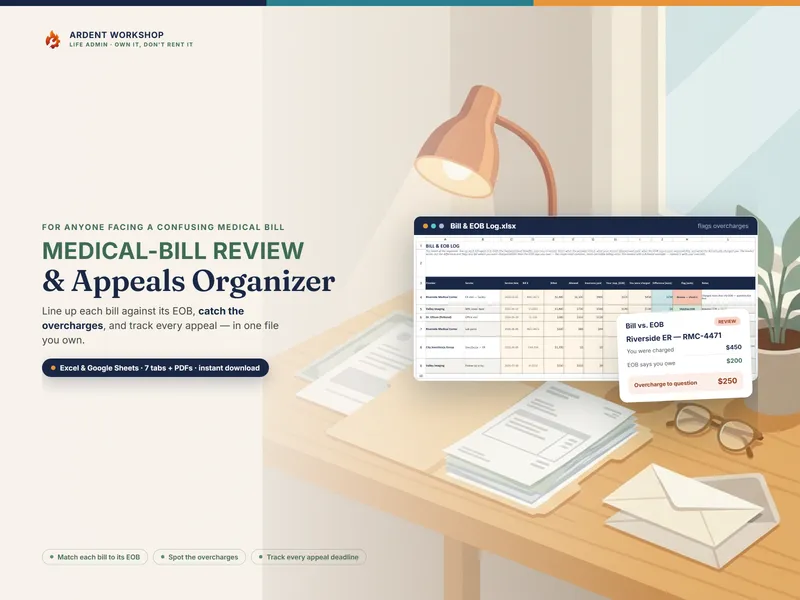
Which is why it’s worth keeping the whole thing in one structured place instead of a folder of PDFs named scan_003. The Medical Bill Review and Appeals Organizer was built for exactly this shape of problem: one row per disputed charge, the EOB comparison beside it, the call log with dates and names, and the appeal deadlines calculated rather than remembered.
Not ready for that? The free Itemized Bill Review Checklist lists the ten error types on their own — printable, no signup.
If your situation is bigger than one bill, two others pick up where it stops:
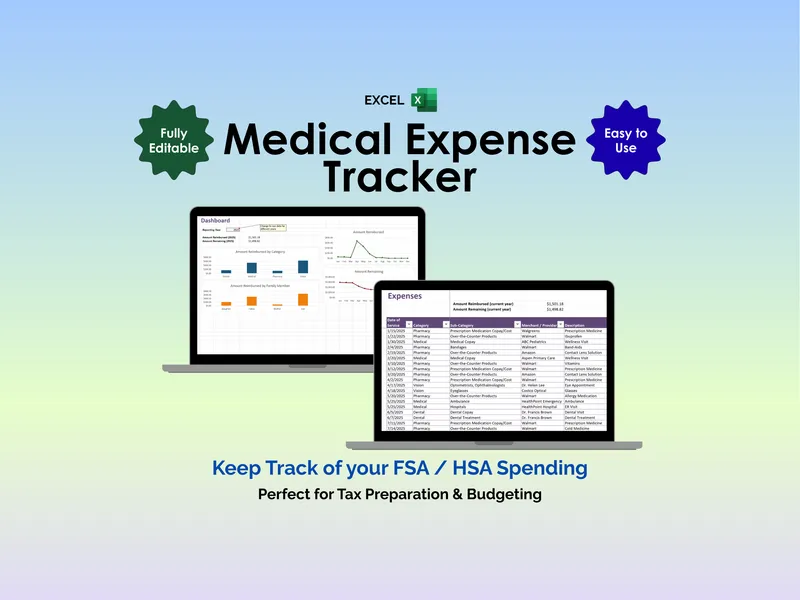
- A whole year of costs, not one dispute — the Medical Expense Tracker runs the year’s totals by category and family member and tracks what’s been reimbursed against what’s still owed, and the same records double as a deductible-expense log at tax time. It’s the workbook recommended in what a year of doctor visits actually costs.
- Doing this for someone else — chasing documents you were never copied on is a harder records problem than your own. The Caregiver’s Binder is the system described in how to organize an aging parent’s records, already built.
The point of all of it is the same: structure you own, sitting on your side of the table, so the next bill starts an inquiry instead of a scramble.
The takeaway
A medical bill is an opening position, not a verdict. The system that produced it makes mistakes the CFPB has documented as common, and it has formal, deadline-bound processes for correcting them — an itemized bill on request, a 180-day appeal window, an independent external reviewer, a federal dispute process for self-pay patients, and a legal obligation on 501(c)(3) nonprofit hospitals to publicize financial assistance before they come after you.
None of those are favors. They’re procedures, and procedures reward the person who follows the right one and writes everything down.
Ask for the itemized bill. Compare it to your EOB. Find the line. Then take the route that’s yours — the appeal if the claim went through your plan, the Good Faith Estimate dispute if it didn’t.
Sources and methodology
All figures and deadlines below were verified against the linked primary sources in August 2026. Credit reporting rules and No Surprises Act guidance change — confirm a deadline against its source before you rely on it.
- KFF: Claims Denials and Appeals in ACA Marketplace Plans in 2023 (opens in new tab) (HealthCare.gov marketplace plans only)
- Consumer Financial Protection Bureau: CFPB estimates $88 billion in medical bills on credit reports (opens in new tab)
- Consumer Financial Protection Bureau: Medical Debt Burden in the United States (opens in new tab)
- Consumer Financial Protection Bureau: Report spotlights medical billing and collection challenges (opens in new tab)
- CMS: Check your medical bill for errors (opens in new tab)
- CMS: How to read your medical bill (opens in new tab)
- CMS: Know your rights (opens in new tab)
- CMS: Know your rights without insurance (opens in new tab)
- CMS: What is a good faith estimate? (opens in new tab)
- CMS: Dispute a bill (patient-provider dispute resolution) (opens in new tab)
- CMS: Payment resolution with patients (opens in new tab)
- HealthCare.gov: Internal appeals (opens in new tab)
- CMS: External review process facts (opens in new tab)
- IRS: Financial assistance policy — Section 501(r)(4) (opens in new tab)
- IRS: Limitation on charges — Section 501(r)(5) (opens in new tab)
- IRS: Billing and collections — Section 501(r)(6) (opens in new tab)
- Consumer Financial Protection Bureau: Can a debt collector still collect a debt after I’ve disputed it? (opens in new tab)
- Consumer Financial Protection Bureau: Anything already paid or under $500 should no longer be on your credit report (opens in new tab) (May 2023, archived)
Disclaimer: This post is for informational and educational purposes only and does not constitute legal, financial, tax, or medical advice. Billing rules, appeal rights, and credit reporting requirements vary by state, by plan, and by provider, and they change — consult a licensed patient advocate, an attorney, or your state’s Consumer Assistance Program before making decisions based on this content.