What senior downsizing actually involves
"Downsizing" sounds like decluttering. It isn't. Decluttering is optional and open-ended; senior downsizing has a date on it, a fixed amount of space at the other end, and consequences for getting it wrong. A typical downsize runs across five threads at once:
- The sort — every item in the house gets a decision: take it, gift it, sell it, donate it, dispose of it, or genuinely undecided.
- The fit — whether what is being kept will physically go into the new home, room by room. This is the thread that most often goes unquantified, and the one whose consequences show up latest — on the truck, or in the new hallway.
- The money — movers price by volume on a local move and by weight on a long one, so the sort and the cost are the same question asked twice. It is safer to plan on the sale proceeds not covering the move.
- The logistics — quotes, elevator and loading-dock reservations, a certificate of insurance for the new building, donation pickups booked weeks ahead, and everything a mover will not carry (federal hazardous-materials rules rule out fuel, propane, paint, ammunition, and aerosols; most movers additionally decline perishables and live plants by policy).
- The records — the organizations that need the new address, and where the deed, the policies, and the will end up afterward.
Why "will it fit?" is the question that matters
A four-bedroom house typically holds several times what a two-bedroom apartment holds. Until somebody works out how much more, every conversation about the china cabinet is a conversation about feelings with no facts in it — which is exactly why those conversations go badly. Nobody is being difficult; there is simply nothing on the table to point at.
The way to put something on the table is to size things in cubic feet — the unit a local move is usually priced in, and the one that converts to the weight a long move is priced by — and total what is being kept against each new room's realistic capacity. When a room reads over capacity, that stops being an opinion about anyone's belongings and becomes a number about the room — and a number is much easier to disagree with kindly.
What things are actually worth
Budgeting on the proceeds is a common way for a downsize to go wrong. Estate-sale companies, auctioneers, and appraisers have written for years about the collapse in what is often called "brown furniture" — dark-wood dining sets, china cabinets, formal china, crystal, and silver plate, which were expensive when bought and now routinely sell for a small fraction of it — while tools, mid-century furniture, jewelry, quality rugs, and recent working appliances still find buyers. Resale demand varies a lot by region and by year, so ask a local estate-sale company or auctioneer what is actually moving in your market before you count on a number, and get anything you suspect is genuinely valuable appraised rather than guessed at.
That is not a reason for gloom — it is a reason to be clear about why you are selling: to place things well and lighten the load, not to fund the move. Once the move is priced off volume, the more useful arithmetic appears: on many moves, deciding not to take something saves more than selling it would earn, and the saving arrives without a listing, a viewing, or a no-show buyer. That one is worth working out at your own rate rather than taking on trust.
Senior downsizing vs a senior move manager
A senior move manager is a professional hired to run some or all of this — sorting, coordinating the sale and the donations, and often unpacking and setting up the new home. They can be genuinely worth it, particularly for a family spread across states. What they do not remove is the decisions: what to keep is still the family's call. A binder and a move manager are complements, not alternatives — the binder is where the decisions and the records live either way.
Downsizing binder vs estate binder vs caregiver binder
These overlap and are often needed within a few years of each other. An estate binder organizes what an executor needs to settle someone's affairs. A caregiver binder organizes the active coordination of care — medications, appointments, providers. A downsizing binder is about a single, dated transition: what is in the house, what happens to each thing, whether it fits, what the move costs, and who has to be told. A downsizing move is very often the moment a family discovers it needs all three.
Where to start
Start with the new home, not the boxes — measure the rooms before sorting a single thing, because everything downstream measures against those numbers. Then take the free Downsizing Room-by-Room Sort List into one room and work through it. For the full method, see managing a parent's downsizing move, and the caregiver templates hub for the wider set. This is a planning and record-keeping approach — not legal, tax, financial, real-estate, or medical advice, and not an appraisal or a mover's estimate.
Templates that implement this
Run the downsize on paper you own
3 templates
A workbook that sizes what you own in cubic feet, checks room by room whether it fits the new home, and prices the move off what you keep.
- $21.95 Spreadsheet

Senior Downsizing & Move-Management Binder — Room-by-Room Inventory, a Cubic-Feet 'Will It Fit' Check Against the New Home, and a Move Priced Off What You Keep (Excel + Google Sheets)
Senior downsizing, made into arithmetic: size every item in cubic feet, check whether it fits the new home room by room, and price the move off it.
Life AdminView details - $24.95 Spreadsheet

Caregiver / Aging-Parent Care Binder — Medications, Refill Alerts, Appointments & an Emergency Handoff Sheet That Writes Itself (Excel + Google Sheets)
Caregiver binder for an aging parent: medications with refill alerts, appointments, care team and documents — plus a self-writing emergency handoff sheet.
Life AdminView details - $29.95 Spreadsheet
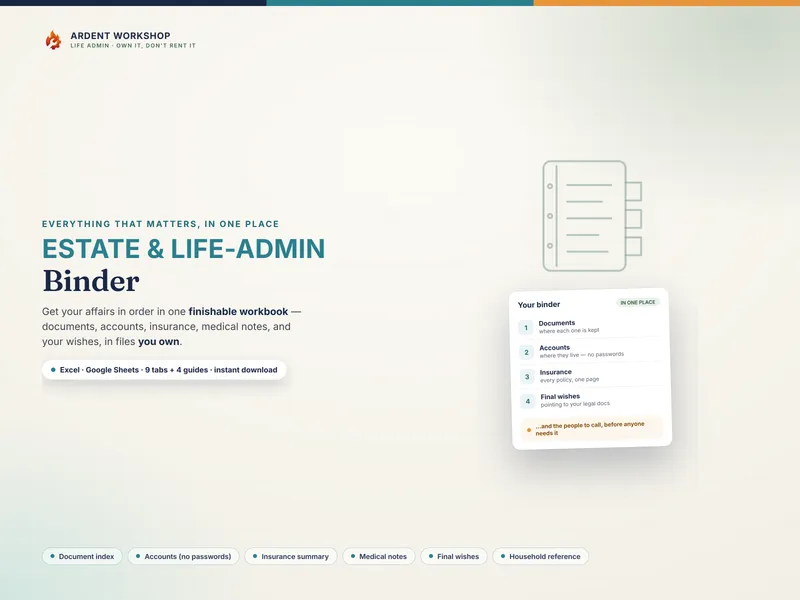
Estate & Life-Admin Binder — Important Documents, Accounts, Insurance & Final Wishes Organizer (Excel + Google Sheets)
An estate & life-admin binder for Excel & Google Sheets — organize important documents, accounts, insurance, and final wishes in one file you own.
Life AdminView details