Coordinate an aging parent’s care in one place you own
Caregiving rarely arrives with a plan. It builds up — a diagnosis, then a second doctor, then a new prescription — until one person is quietly holding all of it in their head. That works right up until the day it can’t: a hospital visit, a trip out of town, a sibling who needs to take a turn.
The Caregiver / Aging-Parent Care Binder gets that knowledge out of one head and onto the page. Medications, appointments, the care team, insurance, the daily routine, and where the important documents live — all in one workbook your family controls, so care can be shared without a long, anxious briefing.
And then it does something a blank spreadsheet can’t: it fills the hardest pages in for you.
The page that writes itself
Fill in the Care Summary, the Medications list and your Key Contacts, and the Emergency Handoff sheet builds itself from them — the person, the allergies, the conditions, the primary doctor, the preferred hospital, the current medication list, who holds the healthcare power of attorney, and where the advance directive is kept. Print it for the front sleeve and the fridge.
That’s the point. A handoff page you maintain by hand is out of date the first week. A handoff page assembled from the tabs you were already keeping is right on the day someone needs it — which is the only day it matters.
The binder tells you what needs attention
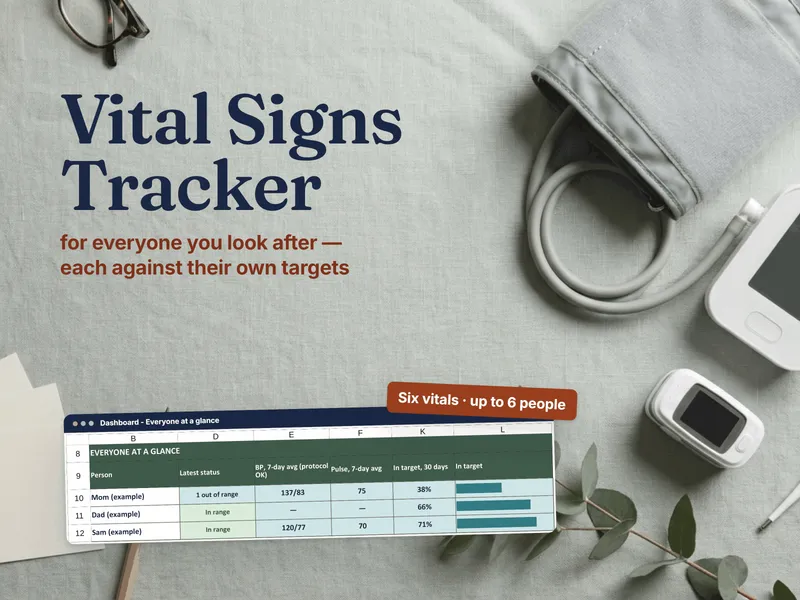
The Care Dashboard reads every other tab and answers the question you actually have when you sit down with it: what needs doing today?
- Medications to reorder — put each refill date in and the binder flags it Order now once it’s passed and Due soon in the week before, so nobody discovers an empty bottle on a Sunday.
- The next appointment — the date, how many days away, who it’s with, and what it’s for.
- Questions waiting for the next visit — counted from your notes, so you walk in with the list.
- How far along the binder is — a real progress bar, and a quiet flag on anything you marked done but haven’t looked at in three months.
Medications, appointments, and the care team — joined up
- Medications — every current medication, the dose, when it’s taken, what it’s for, the prescriber, and the pharmacy, plus the refill flag above. Bring a photo of it to every appointment. It’s a record you keep, not medical advice.
- The Medication Board — the same list, laid out as a morning / midday / evening / bedtime board a stand-in caregiver can follow. It builds itself from the schedule you picked, and it shows when a dose is due — never how much to give. That’s on the bottle, and in the column beside it.
- Appointments — what’s coming up, the reason, how they’ll get there, and a short note of what each past visit decided. Each one counts itself down: Today, This week, Upcoming, Past.
- Visit Prep & Notes — the change you noticed on Tuesday and the question you meant to ask, written down when you thought of it. Anything still marked To raise is your list for the next appointment.
- Care Team (providers) — every doctor, specialist, pharmacy, and home aide, with direct numbers — no more hunting for a phone number in a hurry.
The Care Summary an ER can act on
The page a paramedic, an ER nurse, or a fill-in caregiver needs in the first five minutes: conditions, allergies, blood type, mobility, the primary doctor, the preferred hospital, and where the advance directive is kept. Fill it once and it feeds the Emergency Handoff sheet forever.
One rule that keeps it safe to share
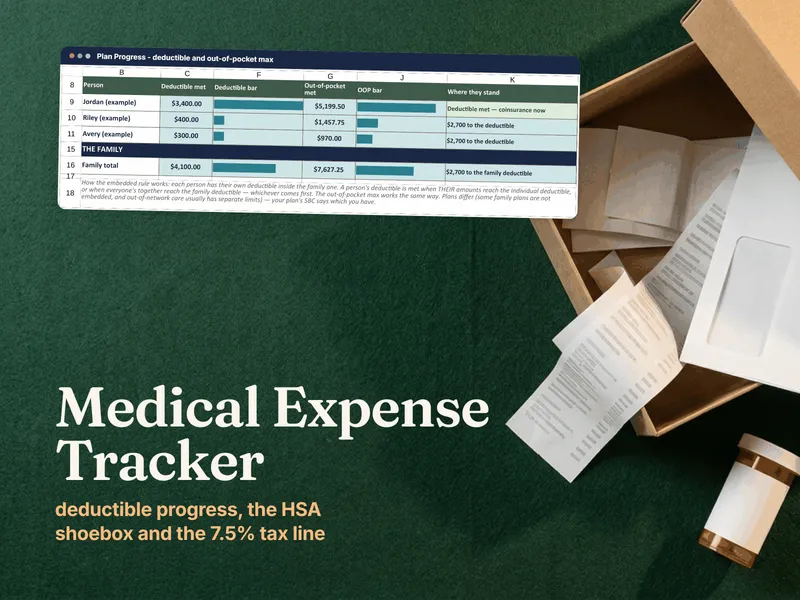
A care binder is shared by its nature — family, neighbors, and aides may all open it. So it’s built on a single rule that runs through every tab: it records the care and where documents live — never patient-portal logins, insurance passwords, or full member numbers. The Insurance & Coverage tab has a “where the card is” column and, by design, no password column. The binder is a record of care, not a set of keys.
What a substitute caregiver needs to step in
A Daily Care Schedule maps the routine and who handles each part, so someone can step in without a briefing. Key Contacts & Emergency gathers the family, the healthcare power of attorney, and who to call first. Important Documents records where the power of attorney, advance directive, and ID are kept. And a finishable Start Here Checklist counts what’s done, so the whole thing feels finite, not endless.
Own it, don’t rent it
For something this personal, the file should be yours. Unlike a subscription care app, it doesn’t live on a company’s server, can’t be locked behind a lapsed payment, and won’t vanish if the service shuts down. You decide where it’s stored and which family members can see it. It’s the middle ground between a blank spreadsheet and a rented app: real structure, on a file you keep.
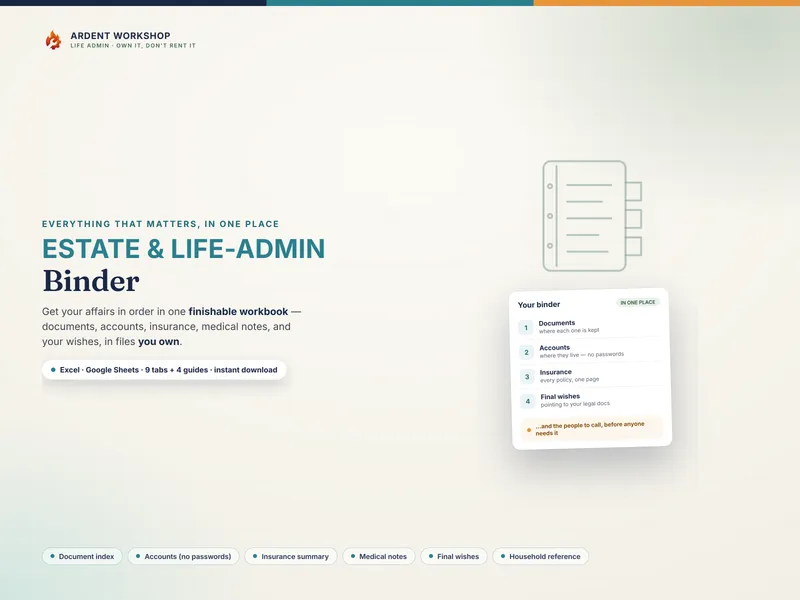
It opens in Excel, Google Sheets, and LibreOffice (the Google Sheets version is a one-click “Make a copy,” no import), and prints to a paper binder if you’d rather fill it in by hand. Pair it with the Estate / Life-Admin Binder for the whole household picture.
Try the free version first
Not ready for the full binder? The free Caregiver Quick Sheet is a one-page printable — current medications, key contacts, allergies, and the primary doctor — for the fridge or a bag. It’s a real taste of what the full binder organizes.
An honest note
This is a record-organizing workbook for coordinating care. It is not medical, legal, or financial advice, not a diagnosis, treatment plan, or prescription, and not an advance directive or a Do Not Resuscitate order — where it mentions those, it only records where the signed document is kept. Always defer to the treating clinician and pharmacist. The workbook ships pre-filled with a clearly fictional example you overwrite with your own. Not affiliated with or endorsed by Medicare, any insurer, or hospital.