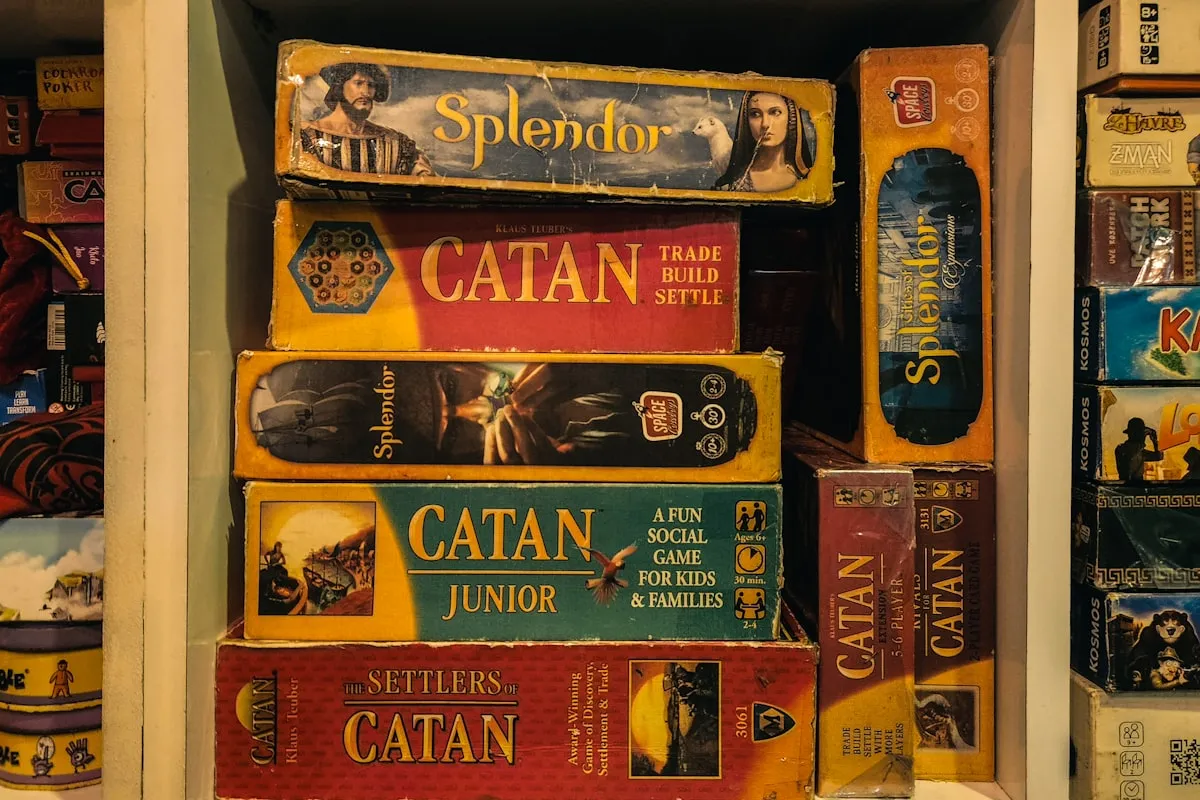
To downsize a collection, stop sorting keep-or-go and sort by the question each object is asking instead. Every shelf holds seven kinds of thing — Core, Duplicate, Half-Built, Trophy, Someday, Inherited and Offsite — and each one has a single test and a default verdict. Name the type first, and the deciding gets dramatically faster.
Here’s the failure it prevents. Picture a Saturday morning in August. Someone decides today is the day. They pull everything off the shelf and onto the floor, because that’s the standard advice. Four hours later, everything is back on the shelf in a slightly different order, and one item has made it into the donate bag: a duplicate paperback with a cracked spine. (A composite scene, not a confession — though you may recognize yourself in it.)
That is not a willpower failure. It is a classification failure. A collection looks like one thing — a shelf, a stash, a library, a longbox — so we try to make one decision about it, over and over, several hundred times in an afternoon. But the objects on that shelf are not all posing the same question. Seven different questions are wearing the same jacket.
Below: each type, what it’s really doing to you, the one test that resolves it, and the verdict it usually earns.
Why “keep or go” piles never work on a collection
The two-pile method assumes every object is asking do I want this? Almost none of them are.
One is asking whether you can tell it apart from the thing next to it. One is asking whether you’re still the person who was going to finish it. One is asking you to admit what you paid. One is a gift, which means it’s not really asking about the object at all. Answering all of them with the same question is why you stall at item nine and start “organizing” instead — reordering is what tends to happen when the deciding runs out and you still want to feel productive.
A collection is not an inventory of objects. It’s an inventory of unresolved decisions. The good news is that there are only seven kinds.
The 7 types of things in every collection, and what each one is asking
1. The Core
The small fraction — call it a fifth, though the exact share doesn’t matter — you would carry out in a fire. The reason the collection exists at all: the run of first editions, the six games that built the group, the records you’d replace the same week if they vanished.
The Core is not the problem. It is also, in most collections, badly served: buried among things it has nothing in common with, stored in the same conditions as the filler, and — critically — impossible to describe to an insurance adjuster.
The test: if this were gone tomorrow, would you re-acquire it at today’s price, at today’s difficulty?
Verdict: keep, and stop storing it like everything else. The rest of this article is really in service of this pile. Downsizing is not a purge; it’s the process of making the Core visible again.
2. The Duplicate You Argued For
The second copy. The variant. The “different pressing.” The one you bought because the first one was in a box at your parents’ house and you were not, at that moment, at your parents’ house.
Duplicates survive because they arrive with a justification attached, and the justification is usually true. Different edition, better condition, backup for lending. All defensible. What’s rarely true is that you needed both justifications to survive five years.
The test: say the difference out loud, in one sentence, without using the word “just.” If you can’t, they’re the same object.
Verdict: goes. Keep the better copy — this is the single fastest pile in the whole exercise.
It’s also the reason it pays to know what you own before you shop, which is exactly what the catalog you build once for a collection you’ve been growing for years is for.
3. The Half-Built Thing
The model that got as far as primer. The sweater with one sleeve. The campaign you prepped four sessions for and ran two of. The game you’re eleven hours into and have not launched since March.
This is usually the hardest pile to let go of, and the research complicates what’s being defended. Norton, Mochon and Ariely’s studies of the “IKEA effect” — the increase in valuation of self-made products (PDF) (opens in new tab) (Harvard Business School working paper 11-091, 2011; published in the Journal of Consumer Psychology in 2012) found that people saw their own amateurish creations as comparable in value to the creations of experts. But the authors name a boundary condition: “Our account suggests that labor leads to increased valuation only when labor results in successful completion of tasks; thus when participants built and then destroyed their creations, or failed to complete them, the IKEA effect dissipated.”
That’s a narrow lab result — participants were stopped two steps short of finishing a flat-pack storage box in a single lab session, not a model that got as far as primer in 2019 — but it points somewhere useful. The valuation bump comes from finishing. Whatever a half-built thing is doing for you, it isn’t the thing a finished build does. One plausible read: the attachment is to the version of you who was going to finish it, not to the object.
What about the sealed, never-opened kit? That one isn’t half-built at all — no labor went into it, so there was never a bump to explain. It belongs to a different type entirely: the Someday Item, two sections down.
The test: put a date on it. Not “this winter” — a date, on a calendar, with the hours blocked out.
Verdict: date it or release it.
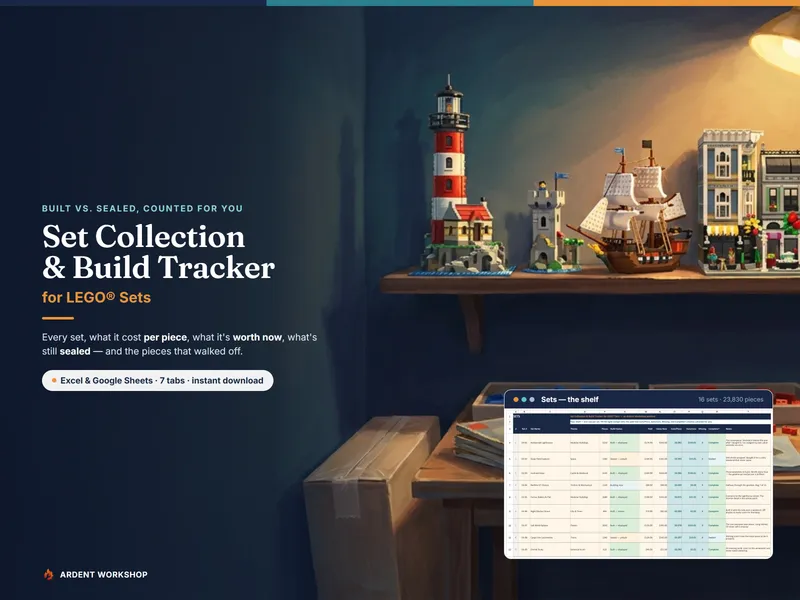
If the pile happens to be bricks, the Set Collection & Build Tracker counts everything still unbuilt — started or sealed — and totals what that pile cost you, which is usually the number that breaks the tie.
A someday with no date on it is not a plan. It’s storage with better branding.
4. The Trophy That Cost Too Much to Admit
The expensive one. The centerpiece acquisition. The thing you saved for, waited for, won at the last second — and have used four times.
Here is the mechanism, and it has a well-known experimental basis. In Kahneman, Knetsch and Thaler’s experimental tests of the endowment effect (opens in new tab) (Journal of Political Economy, 1990), objects were handed out at random and then traded. What people demanded to give an object up ran far above what people would pay to get the same object — so far that trading volume collapsed to a fraction of what standard economics predicts. Ownership itself moves the price.
That’s worth holding next to the number in your head. Some of that number is the item’s real value: genuine scarcity, condition, the fact that it’s out of print. Some of it is a tax you charge yourself for letting go. The experiments don’t measure that split. But the size of the gap they did find makes it reasonable to suspect the second share is larger than it feels — with the caveat that they ran on cheap, randomly assigned objects owned for minutes, not on a centerpiece you chose and kept for years. Don’t treat the whole gap as illusion.
The test: the “buy it again” question — if you did not own this and saw it listed today at what you’d refuse to sell it for, would you buy it? Not “would it be nice.” Would you enter the card number.
Verdict: if the answer is no, it goes — at the real price, not the imaginary one. The gap between those two numbers is what keeps items sitting in a “to sell someday” corner for years: the two-pile method’s secret third pile, pretending to be a decision.
5. The Someday Item
Usually cheaper than the Trophy, and far more numerous. Bought for a future self who has more time, more space, more skill, or a group that plays on Thursdays. The still-sealed kit from release day. The intermediate-level pattern. The four-player game for a household of two. The seven skeins for the blanket.
Someday Items are not mistakes. They’re optimism with a receipt. The problem is that they compound: each one is individually reasonable, and collectively they are the reason there’s no room for the Core.
The test: name the specific condition that unlocks it, then ask whether that condition has moved any closer in the last two years.
Verdict: keep the ones whose condition is genuinely approaching; release the rest.
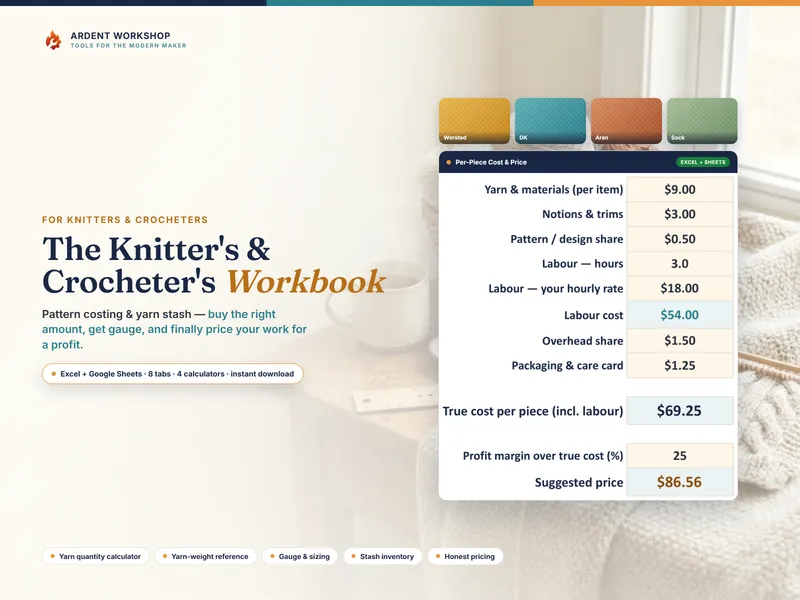
For a stash that’s raw material rather than clutter, the answer isn’t fewer items — it’s knowing what’s in there. That’s why The Knitter’s & Crocheter’s Workbook carries a yarn stash inventory down to weight, fiber, color and dye lot: “I might already have that in the right dye lot” is unanswerable from memory.
6. The Inherited Object You’re Not Allowed to Touch
Your grandfather’s camera. The set your friend gave you when they moved. The thing that arrived with a story attached and has been quietly occupying prime shelf space ever since, doing nothing but generating guilt.
This one is genuinely different from the other six, because the object is not the point — the relationship is. And that’s the opening: the memory doesn’t have to live in the object — a photograph and two sentences hold more of it than a shelf does.
The test: photograph it, write two sentences about who it came from and why it mattered, and keep the single best piece. Then decide about the rest with the record already made.
Verdict: keep one, document the rest, release without penalty.
If the anxiety is that letting go erases a record, the fix is to make a better record than a shelf — which is why every home needs a home inventory spreadsheet anyway.
7. The Offsite Box
The collection that lives somewhere else. The boxes in your parents’ basement. The bins in the garage you have not opened since the move. The unit off the highway.
This is the type nobody counts, because it isn’t in the room. It’s also the only one with a running meter. The national average street rate for self-storage — measured across all unit sizes, climate-controlled and not — was $135 a month in June 2026, according to that month’s edition of RentCafe’s monthly self-storage report (opens in new tab), which draws its rate data from Yardi Matrix and refreshes monthly. That’s about $1,620 a year.
The uncomfortable question isn’t the rate. It’s whether you could currently list what’s inside.
The test: without opening the box, name five things inside it. If you can’t, you are not storing a collection; you’re storing a question.
Verdict: nothing offsite gets to stay unlisted. Either it comes back into the room, gets cataloged where it sits, or it goes. Paying rent on an unknown is the most expensive way to own anything.
If you can’t name what’s in the box, you don’t own a collection. You own a bill.
The 7 tests on one page
| Type | What it looks like | The one test | Default verdict |
|---|---|---|---|
| 1. The Core | The fraction you’d carry out in a fire | Would you re-acquire it today, at today’s price and difficulty? | Keep — and store it better |
| 2. The Duplicate | Second copy, variant, “different pressing” | Say the difference in one sentence, no “just” | Goes — keep the better copy |
| 3. The Half-Built Thing | Primed but unpainted, one sleeve, half a campaign | Put a real date on the calendar | Date it or release it |
| 4. The Trophy | Expensive, used four times | Would you buy it again at your own asking price? | Goes, at the real price |
| 5. The Someday Item | Still sealed, bought for a future self | Has the unlocking condition moved in two years? | Keep the near ones only |
| 6. The Inherited Object | Arrived with a story and guilt | Photograph it, write two sentences about it, keep the best one | Keep one, document the rest |
| 7. The Offsite Box | Basement, garage, storage unit | Name five things inside without looking | Nothing stays unlisted |
How to downsize a collection in one afternoon
The method is short because the seven types are doing the heavy lifting. You are no longer deciding — you are only sorting, and the verdicts are already written down. Expect two shelves in an afternoon, three once the tests are second nature; the collection follows from there.
- Pick one shelf, not the collection. Three feet of it. The floor-dump approach converts a sorting job into a rebuilding job, and the rebuild usually outlasts your energy.
- Sort into seven, not two. Physical piles or sticky notes. Do not evaluate anything yet — just name its type. This pass should be fast enough to feel careless, because naming a type is a much cheaper judgment than deciding a fate.
- Run each pile’s test as a batch. All the duplicates at once. All the Someday items at once. Batching keeps you in one mode instead of switching frames on every object, which is what tends to eat the energy.
- Give the “goes” pile a destination and a deadline. “Sell” is not a destination. A donation run on Saturday is. Anything without a deadline tends to reattach itself to the shelf.
- Put the Core back first, alone. Fill the good shelf with the Core before anything else is allowed back. What doesn’t fit was never really competing for the space; it was just there first.
Budget about ninety minutes for a working pass on one shelf. Two more shelves and you’ll have the tests memorized.
The maybe box: for anything you cannot resolve, one box, sealed, dated on the lid. Unlike the “to sell someday” corner, this one has a lid and a date: if you have not opened it to retrieve something specific within a month, it goes without being reopened. Reopening is how the whole thing starts again.
What survives should be written down
Here’s the part that decides whether this afternoon holds: the collection that grows back is the one nobody wrote down.
Duplicates return because you shop from memory. Someday items return because the stash is unknowable. Offsite boxes return because a box is easier than a decision. All three are the same failure — no record — and a record is a genuinely small artifact. A row per item, a handful of fields, and a number at the bottom.
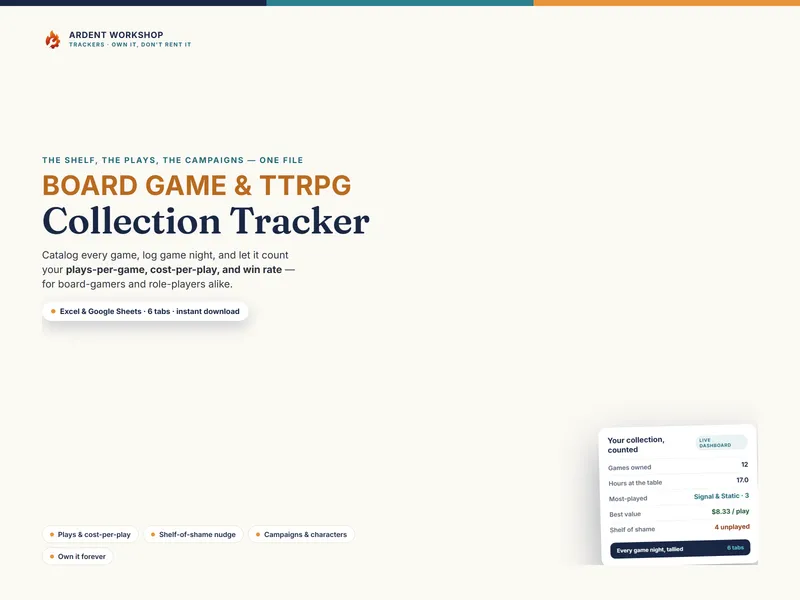
That’s the whole idea behind the trackers we build. The Board Game & TTRPG Collection Tracker computes plays-per-game and cost-per-play, so which items earn their shelf stops being a matter of opinion and becomes a column you can sort — the same logic that runs underneath tracking what a hobby actually costs you. And if the “goes” pile turned out to be forty items you actually intend to sell, the Reseller / Flipping Inventory & Profit Workbook tracks cost of goods and net-after-fees per item — the difference between a cleared shelf and a vague sense that you made some money.
All of them are files you own outright: one download, no account, no monthly fee for the privilege of reading your own list. A collection you’ve spent years building deserves a record that isn’t hosted on someone else’s servers and priced by the month.
The takeaway
Downsizing a collection stalls because a shelf poses seven different questions and we answer all of them with one. Name the type first — Core, Duplicate, Half-Built, Trophy, Someday, Inherited, Offsite — and each one comes with its own test and its own default verdict, most of which you already agree with before you start.
Then write down what survived. Not to be tidy, and not to feel virtuous about it. Because the pile you can see, count and sort is a collection, and the pile you can’t is just accumulation with a nicer name.
If the collection is one shelf in a bigger clear-out, the kind you do so your family never has to, that practice has a name: Swedish death cleaning, which applies the same “decide it now, write it down” logic to the whole house.
Start with three feet of shelf this weekend. And if you decide you’d rather own the record than the pile, the collection trackers are where we keep ours.