You picture it going gently. Your parent stays sharp and independent, you visit on Sundays, and if their health ever slips, you’ll deal with the paperwork then — calmly, with time to spare. It’s a comforting picture. Almost everyone carries some version of it.
Here’s the hard truth: it rarely arrives on schedule, and it almost never arrives calmly. It arrives as a 6 a.m. phone call from an emergency room, a nurse asking what medications your mother takes and whether she has an advance directive, and you standing in your kitchen realizing you don’t know either one. The information exists. It’s just scattered across your parent’s house, their memory, a shoebox of statements, and four logins you’ve never seen.
A caregiver binder is the fix — and the best time to build one is the boring, uneventful stretch before you need it. This is what goes in it, how to gather it without a single overwhelming weekend, and the conversation that has to come first.
What a caregiver binder is
A caregiver binder is a single organized place — physical, digital, or both — that holds everything you’d need to step in and manage an aging parent’s medical, financial, and legal life if they suddenly couldn’t. Think of it as the answer key to questions you’ll otherwise be asked at the worst possible moment: What does she take? Who’s her doctor? Where’s the will? How do we pay the mortgage this month? Who has power of attorney?
It is not the same as building your own family emergency binder. That one you assemble from your own life, on your own terms. A caregiver binder is harder, because most of the information lives inside another adult’s world — one they may not be eager to hand over. That difference is the whole reason this is worth doing deliberately.
The goal isn’t to take control. It’s to make sure that if control ever has to pass to you, it doesn’t pass through a fog.
Why “I’ll figure it out when I have to” is the most expensive plan
The “figure it out later” plan fails because crises don’t leave time for archaeology. You’re making decisions under pressure, often while a parent is sedated, confused, or gone — exactly when you most need information you can’t ask for anymore.
And this isn’t a rare situation. An estimated 53 million Americans were serving as unpaid family caregivers as of 2020, more than one in five adults, according to the AARP and National Alliance for Caregiving “Caregiving in the U.S. 2020” report (opens in new tab). If you’re reading this, you are very likely either in that group already or about to join it.
The paperwork side is even less prepared than the people side. As of 2025, only 24% of Americans said they have a will — down from 33% in 2022, according to the Caring.com 2025 Wills and Estate Planning Study (opens in new tab). So the realistic starting point for most families isn’t “where are Dad’s documents?” It’s “do they even exist yet?” A caregiver binder surfaces that gap now, while your parent can still help close it — instead of during probate.
Here’s what the “later” plan actually costs:
- Time you don’t have. Hours on hold with insurers, banks, and pharmacies, reconstructing facts a single page could have answered.
- Money that leaks. Missed bills, lapsed insurance, late fees, and accounts no one knew to keep funded.
- Access you legally can’t get. Without the right paperwork on file, a bank or doctor can — and will — refuse to talk to you. More on that below.
- Decisions made blind. Guessing at a parent’s medical wishes is a weight no one should carry unnecessarily.
The binder doesn’t remove the hard parts of caregiving. It removes the avoidable scramble layered on top of them.
Start with the conversation, not the binder
The single most important step in building a caregiver binder isn’t organizing anything — it’s getting your parent’s buy-in first. Walk in and start demanding account numbers and you’ll trigger exactly the resistance you fear: Why do you need this? Are you trying to take over?
Frame it as protecting their wishes, not seizing control. A few openers that tend to land:
- “If you ever got sick and couldn’t tell the doctors what you wanted, I’d want to get it right. Can you help me know what ‘right’ looks like?”
- “I’m putting my own emergency info in one place. Want to do yours at the same time so it’s off both our minds?”
- “I don’t want to make a single decision for you. I just don’t want to be guessing if something happens.”
A few ground rules that keep the conversation from going sideways:
- Make it mutual. Build your own binder alongside theirs. It reframes the project from “managing you” to “us getting organized together.”
- Let them keep control. They decide what goes in and where the binder lives. You’re the scribe, not the owner.
- Go in passes, not one interrogation. One sitting won’t cover it, and trying will exhaust everyone. Expect several short conversations.
- Loop in siblings early. Decide together who the point person is before a crisis turns logistics into a fight.
If the health side of that conversation feels daunting on its own, it deserves its own dedicated talk — here’s how to run a health check-in with an aging parent without it turning into a lecture.
What goes in a caregiver binder: the five sections
A complete caregiver binder has five sections: medical, financial, legal, daily-care contacts, and digital access. You don’t need all of it on day one — but you do need to know what “complete” looks like so you can fill the gaps over time.
| Section | What to capture | Why it matters in a crisis |
|---|---|---|
| Medical | Medications and doses, all doctors and specialists, allergies, conditions, insurance and Medicare, pharmacy, advance directive, HIPAA authorization | The ER asks for this in the first five minutes |
| Financial | Bank and investment accounts, income (Social Security, pension), recurring bills and how each is paid, insurance policies, debts, tax records | Bills don’t pause; someone has to keep the lights on |
| Legal | Will, durable power of attorney, healthcare proxy, advance directive — and where the originals live | Determines who is legally allowed to act |
| Daily-care contacts | Family, close friends, neighbors, faith community, home aides, the pets’ vet | The people who fill the gaps you can’t physically cover |
| Digital access | List of key accounts and how a trusted person can reach them (via your parent’s password manager — never a plaintext list) | Modern life is locked behind logins no one else has |
A word on that last column: never keep a loose list of passwords in a binder or a notes file. Store credentials in a reputable password manager and record only where the manager is and who can access it. The binder points to the keys; it isn’t the keychain.
If you’d rather not build that scaffolding from scratch, a purpose-built caregiver binder for an aging parent is organized around exactly these five sections — medications, appointments, providers, insurance, and documents in one file you own and keep, so you’re filling in a structure instead of inventing one.
Start with the one-page version first
If five sections feels like too much to ever begin, build the one-pager and stop there for today. On a single sheet, capture: your parent’s full legal name and date of birth, the first three people to call, current medications and the pharmacy, the primary doctor, where the will and advance directive are stored, and which account covers the main monthly bills.
That one page handles the majority of true emergencies. Everything else is depth you add later. A messy starter sheet that exists beats a perfect binder that’s still “on the list.”
The access problem: why having the documents isn’t enough
You can assemble a flawless binder and still hit a wall, because knowing your parent’s information does not give you the legal right to act on it. This is the part that blindsides families most often, so it’s worth understanding before a crisis tests it.
Two documents do the heavy lifting:
- Durable power of attorney (POA). Authorizes a named person to handle financial and legal matters if your parent can’t. Without it, a bank can legally refuse to let you pay your parent’s bills from their account — even to keep their own mortgage current.
- Healthcare proxy / advance directive. Names who makes medical decisions and records your parent’s wishes about care. Without it, hospitals fall back on state default rules, which may not match what your parent would have chosen.
There’s also the medical-privacy wall. Under federal privacy law, a provider generally can’t share a competent adult’s health information with you unless you’re their authorized personal representative or your parent has signed an authorization naming you. As the U.S. Department of Health and Human Services explains in its guidance on HIPAA personal representatives (opens in new tab), that authority comes from documents like a healthcare POA — not from being the next of kin who happens to be standing there.
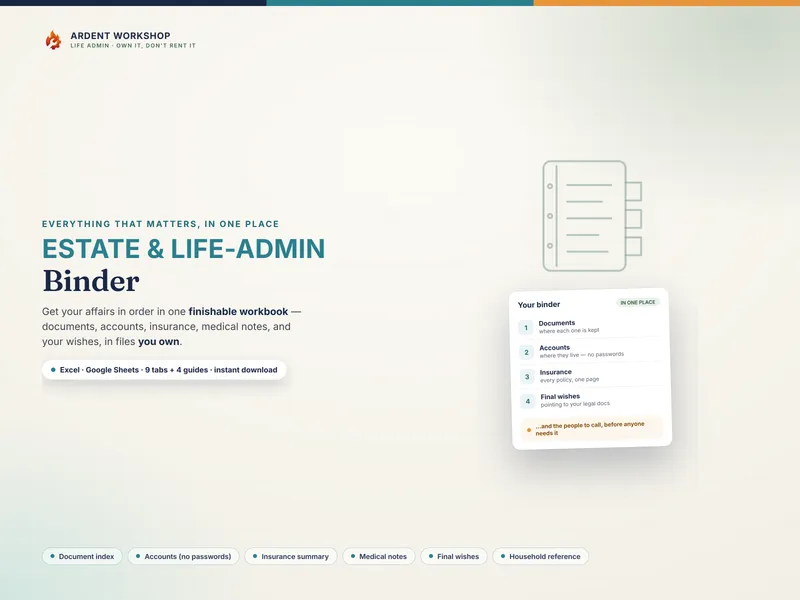
The takeaway: a caregiver binder isn’t just a record, it’s a prompt. Building one surfaces every one of these documents you don’t have yet, while your parent is still able to create them. An estate and life-admin binder is built around exactly this — important documents, accounts, insurance, and final wishes in one owned file, so the gaps are obvious and fixable rather than discovered too late.
How to build it without one giant overwhelming weekend
The fastest way to never build a caregiver binder is to treat it as a single marathon project. Break it into four short passes instead — each one valuable on its own, even if you never get to the next. The four passes fill all five sections: your daily-care contacts list starts in pass one and gets finished in pass four, and digital access is captured in pass four alongside the legal documents.
- Pass one: the conversation + the one-pager. Get buy-in, fill the single starter sheet — including the first few daily-care contacts. If a crisis hit tomorrow, this alone would carry you.
- Pass two: the medical layer. Sit with your parent and a pill bottle lineup. Capture every medication, dose, and prescriber, plus doctors, allergies, insurance, and pharmacy.
- Pass three: the financial layer. Map where money comes in and goes out — accounts, income, recurring bills, insurance, debts. You’re not auditing; you’re locating.
- Pass four: legal, access, and contacts. Confirm which documents exist, where the originals live, and who’s named; capture how a trusted person reaches the accounts and the password manager (your digital access); and round out the daily-care contacts list. This is where you flag what’s missing and book the attorney visit.
Each pass might be an hour on a Sunday. Spread across a month, the whole thing gets done without anyone dreading it — and the most critical information is in place after pass one.
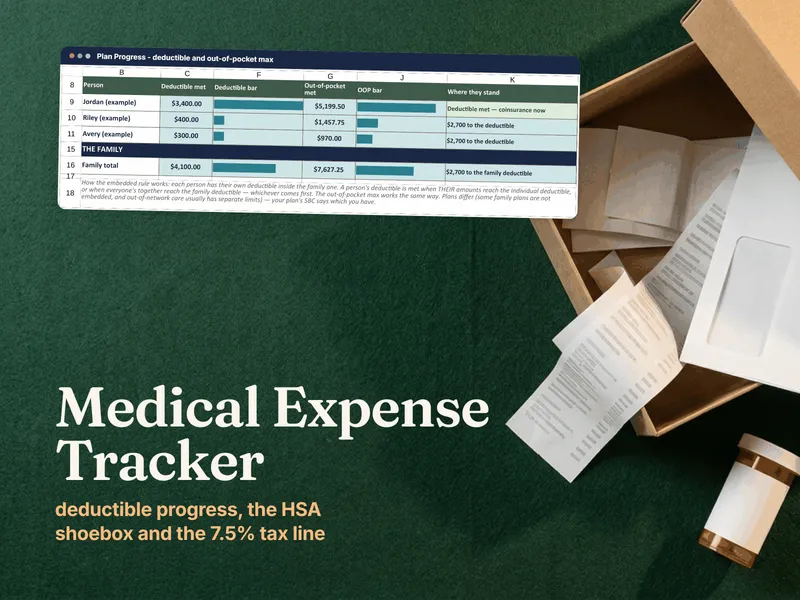
For the bills and reimbursements that pile up during a caregiving stretch, a medical expense tracker keeps the dates, providers, and flexible-spending or health-savings-account (FSA/HSA) claims in one place so nothing slips when no one has spare attention.
Keep it current: the 20-minute refresh
A caregiver binder is only as good as its most outdated page — a binder with last year’s medications can be worse than none, because it’s trusted. Build a habit of refreshing it.
- Twice a year, on a fixed date, spend 20 minutes confirming medications, doctors, account changes, and contacts. Tie it to something you’ll remember — a birthday, the start and end of daylight saving time.
- After any big event — a hospital stay, a new diagnosis, a move, a death in the network — update the affected section while it’s fresh.
- Tell the other key people it changed. A binder no one can find or knows is current isn’t doing its job.
The takeaway
You can’t control when a parent’s health turns, or how. But you can decide, today, that the people who love them won’t also be fighting a paperwork fog when it happens.
A caregiver binder is the difference between making hard decisions with information and making them blind. Start with one conversation and one page. Add a layer when you have an hour. Point to the keys, store the documents, and name the people who are legally allowed to help. Do it now — calmly, with time to spare — so that the version of you who gets the 6 a.m. call has everything they need already waiting.