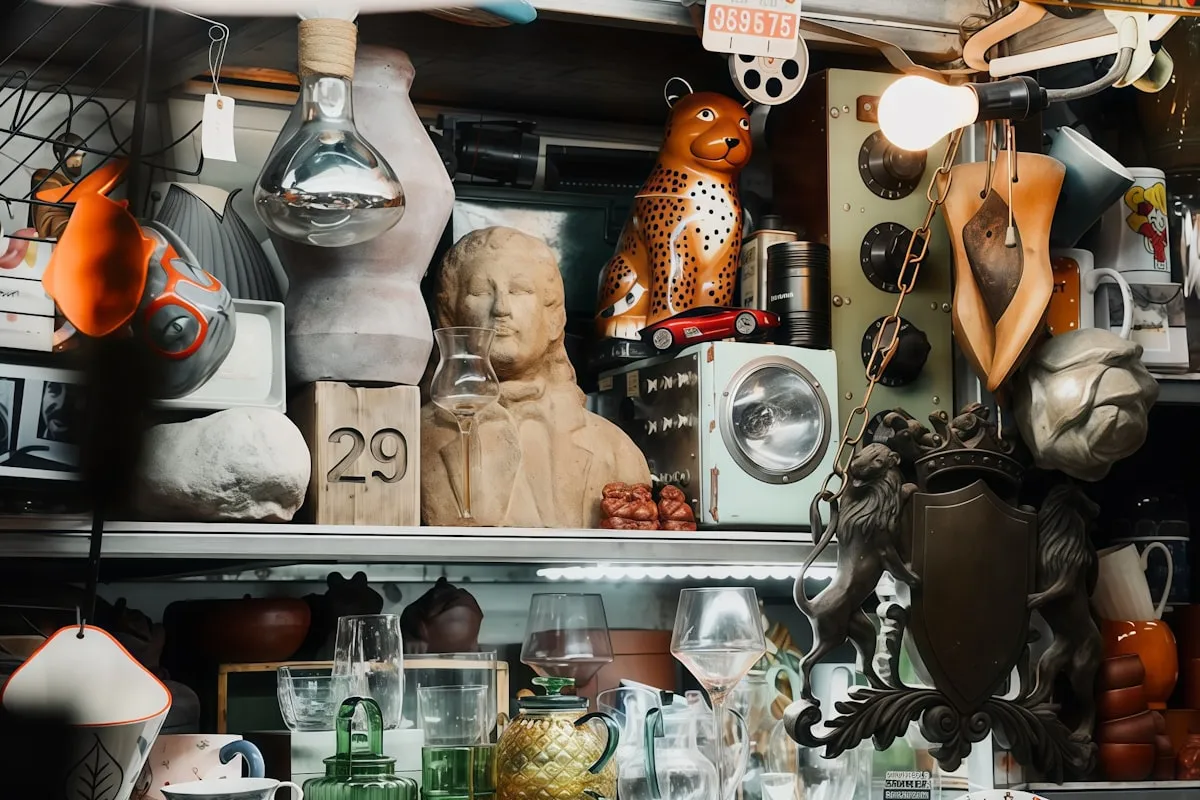
Picture the second weekend at a parent’s house after the funeral. The kitchen table is covered in things nobody can throw out and nobody wants: a drawer of keys to locks no one can find, forty years of greeting cards, a set of china that three siblings are each too polite to take. Every object is a small decision, and the one person who could have made it quickly is the one who isn’t there.
Swedish death cleaning is the practice of making those decisions yourself, while you still can, so the people who inherit your home don’t have to. The Swedish word is döstädning, from dö (death) and städning (cleaning). Most people meet it as a decluttering trend. It is really an editing job for an audience of one: whoever opens your drawers next.
Two things make that job hard. The first is sheer volume: every room holds hundreds of items, each needing its own keep, give, sell or donate call. The second is fit: if a move is part of the plan, what you keep has to fit somewhere smaller. The Senior Downsizing & Move-Management Binder handles both. It is a room-by-room inventory where every item gets that call and its size in cubic feet, checked against the rooms it has to fit into. The method matters more than the tool, though, so here it is in full.
What is Swedish death cleaning?
Swedish death cleaning is decluttering done for the benefit of the people who will sort your belongings after you die. The idea reached English-speaking readers through Margareta Magnusson’s book The Gentle Art of Swedish Death Cleaning. Her official site (opens in new tab) says it “can be undertaken at any age or life stage but should be done sooner than later, before others have to do it for you.”
Magnusson practiced what she wrote. She died in March 2026 at 91, and her daughter told The World (opens in new tab) that her apartment “was pretty much empty when she died.” That is the whole goal of the method in one sentence.
Why death cleaning is not ordinary decluttering
Ordinary decluttering asks a question about you: do I use this, do I love it, does it earn its space? Death cleaning asks a question about someone else: will the person who inherits this be glad to have it, or will it be one more thing they have to decide?
That one change reshapes the whole job:
- A thing you love can still go. Your ski trophies may mean everything to you and nothing to anyone else, so the kind thing is to enjoy them now and let them go before someone else has to.
- A thing you never use can stay. The good roasting pan your daughter has already claimed isn’t clutter. It’s an inheritance with a name on it.
- Paper matters more than furniture. A sofa is easy to get rid of. A drawer of unlabeled bank statements takes an executor a week.
Death cleaning has two halves: the stuff you remove, and the record of what’s left. The second half is the easier one to overlook.
The five parts of Swedish death cleaning
Swedish death cleaning comes down to five working parts. The first three come from Magnusson: one is how she began, per her daughter, and two are her advice as TIME reported it. The fourth and fifth are Ardent Workshop’s suggestions.
| Part | What it means in practice | Source |
|---|---|---|
| 1. Start with the big things | Attic furniture, storage-unit contents, the spare-room bed. Our reasoning: large items tend to carry fewer memories, so the decisions come faster. | Magnusson began with the big things in the attic, per her daughter (The World) (opens in new tab) |
| 2. Give things away while you’re here | Hand items over casually, when family and friends come for dinner, rather than holding a solemn handover. | Magnusson’s advice, per TIME (2017) (opens in new tab) |
| 3. Keep one box that’s just for you | A box of things that matter only to you, which your family can throw away. | Magnusson’s advice, per TIME (2017) (opens in new tab) |
| 4. Leave photographs and letters until last | The sentimental layer is where people stall. Do it once the easy categories are cleared and the habit is built. | Ardent Workshop’s suggestion. Magnusson herself read her letters one by one before shredding them, per her daughter (The World) (opens in new tab) |
| 5. Write down what’s left | Where the documents are, which accounts exist, what’s been promised to whom, what’s actually valuable. | Ardent Workshop’s addition. See below. |
The “just for me” box deserves a word, because it is the most humane idea in the method. It gives you permission to keep a few private things without making them anyone else’s job.
Swedish death cleaning room by room
The order matters because momentum matters. Start where decisions are fast and emotions are low, and work toward the rooms that are the other way around. The room-by-room sequence below is our suggested order, built on how Magnusson herself began, with the big things in the attic. If a move date is already set, our tutorial on how to manage a parent’s downsizing move covers the timeline side.
- Attic, basement, garage and storage units. Mostly things nobody has touched in years. Price them honestly: a storage unit that costs more per year than its contents would sell for is a bill, not a savings account.
- Closets and linens. Clothes that no longer fit, bedding for beds you no longer own, coats for a climate you left.
- The kitchen. Keep what you cook with this year. Offer the special-occasion sets to family by name, and if nobody claims them, let them go.
- Living areas and furniture. Anything large that a relative has asked for gets a name taped under it now, not a line in a will they’ll argue about later.
- Books, hobbies and collections. A collection is several different things sharing a shelf. Our guide on how to downsize a collection breaks it into types that each have a different exit.
- Papers. Shred what’s expired, file what’s live, and write down where the live files are (see the next section).
- Photographs and letters. Last, slowly, and without a deadline. Scan the handful that tell the family story, label who is in them while you still know, and put the rest in the just-for-me box or let them go.
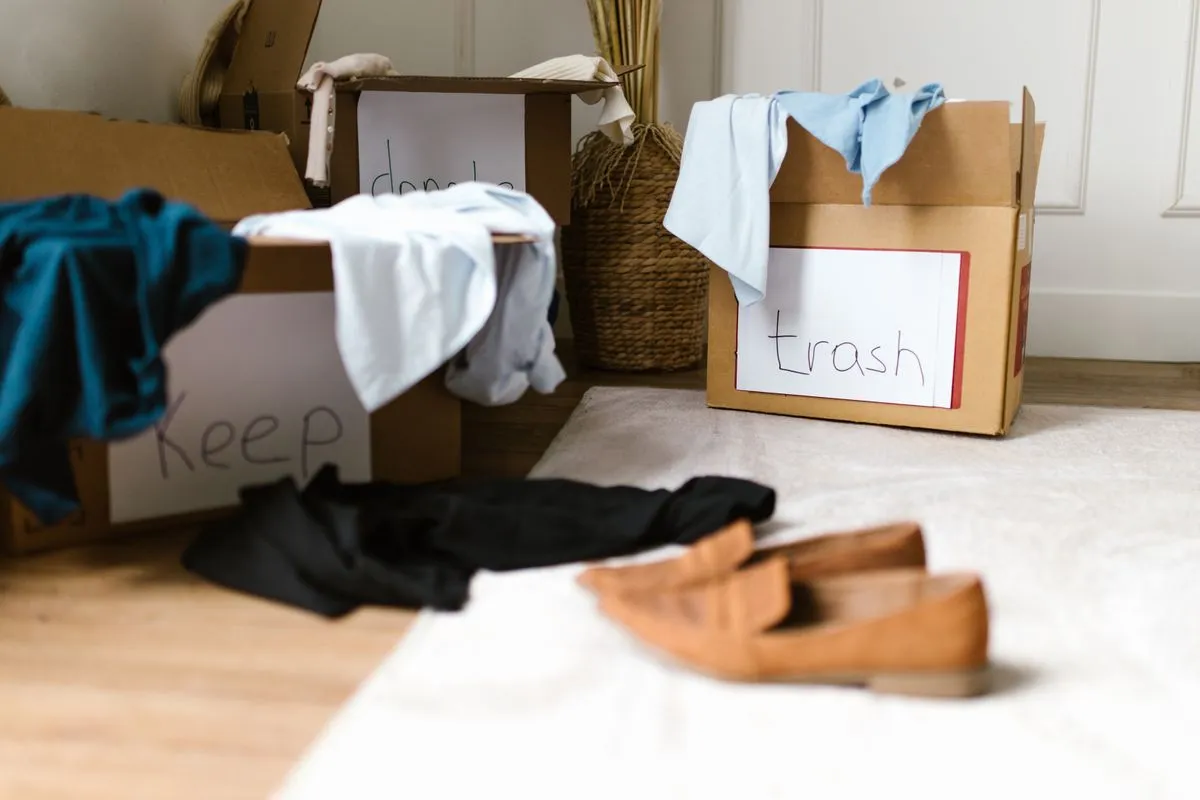
Four sort piles cover almost everything: keep, give (to a named person), sell, donate, plus a fifth for trash. The piles are the easy part. What fails is losing track of which item went into which, and whether a promised piece ever reached its person.
What to write down when you death clean
The second half of Swedish death cleaning is a written record of what remains. It can save your family a great deal of time, because the hardest things for them to sort after a death aren’t objects. They are unknowns: whether an account exists, where the deed is, whether the painting in the hallway is worth anything.
Write down, in one place your family knows about:
- Where the important documents are. Will, deed, titles, insurance policies, and the key to anything locked.
- Every account, financial and digital. Banks, pensions, utilities, subscriptions, email and photo storage. Our guide to what happens to your accounts when you’re gone covers the digital side.
- Who has been promised what. The roasting pan, the watch, the quilt. A written list turns a future argument into an instruction.
- What is actually valuable, and what only looks it. Collectors’ pieces, jewelry with a receipt, and the heirloom that turns out to be costume.
- Who to call. Your lawyer, accountant, financial adviser, and the neighbor with the spare key.
- What you want to happen. Funeral preferences, the charity for donations, the things you’d like kept in the family.
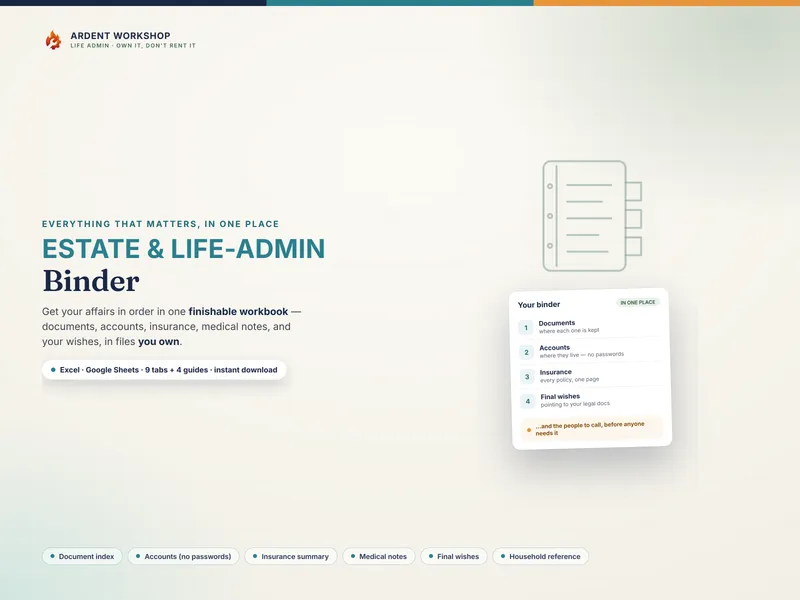
A list scattered across notebooks and sticky notes fails exactly when it’s needed. The Estate & Life-Admin Binder keeps documents, accounts, insurance and final wishes in one file you own and update, rather than an app your family would need your login to open.
When to start Swedish death cleaning
There is no fixed age to start Swedish death cleaning. Magnusson’s advice, as TIME reported it in 2017 (opens in new tab), is to begin as soon as you’re old enough to think about your own mortality. Her official site puts it as “sooner than later.”
In practice, natural starting points are triggers like these:
- Retirement. Time frees up, and the work-life paperwork can finally be retired too.
- A move. A smaller home forces the same decisions on a deadline, so fold the death-cleaning question into them.
- A diagnosis. Your own or a spouse’s.
- The month after you clear someone else’s house. Nobody who has done that job wants to leave it to their own children.
Starting early has a practical payoff: at 60 you can carry the boxes to the donation drop-off yourself. At 85, someone else carries them, and they have to ask you about every one.
How to bring up death cleaning with a parent
Raise it as a gift to the family, not a verdict on their age. “When you’re ready, I’d love to know which things matter to you, so we get it right” lands better than “we need to deal with all this stuff.”
Three habits help:
- Ask about stories, not stuff. “Where did this come from?” opens the conversation that “Do you still need this?” closes.
- Take one category per visit. Linens one Sunday, the garage another. No marathons.
- Write down the answers the same day. The value of the conversation is in the record it leaves.
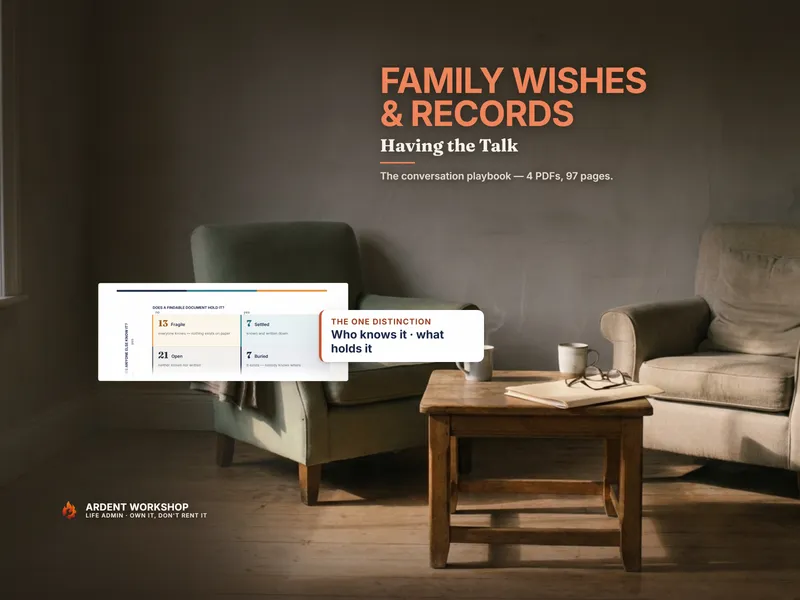
If the harder subjects are the ones you’re avoiding (wills, final wishes, where the records are), the Having the Talk conversation playbook sets out those questions across four sittings, and our tutorial on how to talk to your parents about their will covers that one conversation in depth.
Common questions about Swedish death cleaning
Is Swedish death cleaning morbid?
Less than the name suggests. The word is blunt, but the practice is ordinary housekeeping with one extra question attached: who will have to deal with this, and will they thank me for it?
What age should you start Swedish death cleaning?
There is no fixed age. Magnusson’s advice, as TIME reported it, was to start as soon as you are old enough to think about your own mortality, and the practical answer is at the next natural trigger: retirement, a move, a diagnosis, or the month after you have finished clearing someone else’s home.
Is Swedish death cleaning the same as downsizing?
No. Downsizing is forced by a smaller space and has a deadline; death cleaning is chosen, has no deadline, and is measured against a person rather than a floor plan. The two often happen together, and when they do, downsizing sets the timetable while death cleaning decides what to keep. For downsizing on its own terms, see what senior downsizing is.
Swedish death cleaning leaves a short list
Swedish death cleaning ends with fewer things and a clearer record of the ones that remain. The stuff half is a series of small, generous decisions. The paper half is one document your family can open on the worst week of their lives and find everything already answered.
If a move is part of your plan, the Senior Downsizing & Move-Management Binder turns the sorting into a room-by-room inventory checked against the new home. For the record itself, the Estate & Life-Admin Binder is the one place to write it down. Both are files you own, not a subscription.