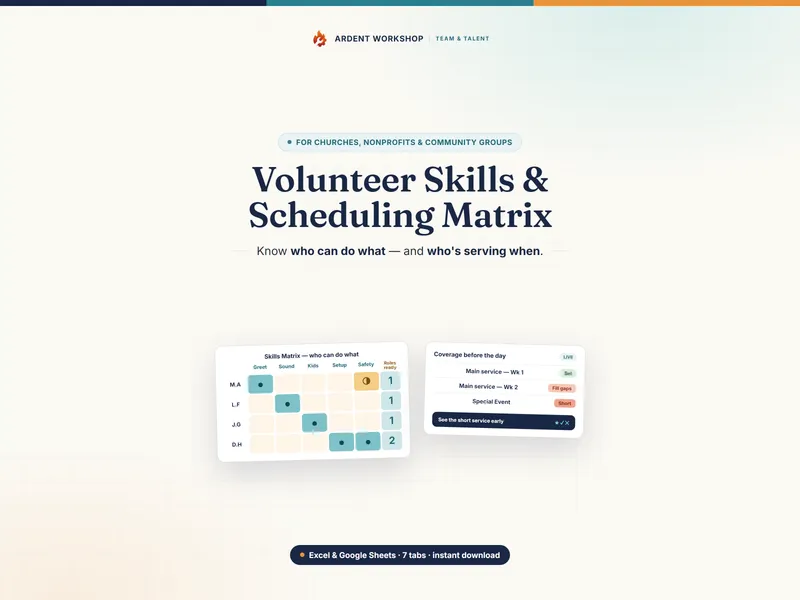
The grid in detail
- Rows — volunteers. Every volunteer on the team, often with their main area and rough availability alongside.
- Columns — roles. The specific roles a service or event needs filled — greeter, sound, nursery, setup, safety — grouped so the board has sections.
- Cells — readiness. How far each volunteer has got on each role, on a short defined scale (see below).
- Coverage row. A count, per role, of how many volunteers can fill it on their own — the number that matters most.
- Gap. A role you need versus how many are trained for it. The cell that becomes a recruiting or onboarding job.
The readiness scale matters
A volunteer skills matrix is only as good as the scale behind it. “Has helped with the nursery” doesn't separate the volunteer who shadowed once from the one who can run the room alone. A working scale has four behavioral steps:
- Shadowing. Learning the role alongside a current volunteer. Cannot fill it without someone there.
- Can assist. Helps under guidance, or handles part of the role unaided. Not yet signed off to serve alone.
- Can serve solo. Trained and trusted to fill the role on their own, on the day. This is the first step that counts as coverage.
- Lead / Trainer. Serves solo and can onboard and sign off new volunteers — your training capacity for the role.
The exact words don't matter; the same scale used for every cell does. Coverage only counts from “Can serve solo” up — a keen volunteer who's nearly there is still progress, not someone you can roster alone.
What a volunteer skills matrix shows you
- Single points of failure. A role only one volunteer can fill is a key-person risk — the day they're away, the role goes with them.
- Recruiting priorities. A role no one is trained for, or a critical role with no backup, is where the next ask goes.
- Training capacity. A role with coverage but no Lead can be filled today but not taught — protect those before the trainer moves on.
- Roster building. Match a service's roles against the matrix and the roster is half-done — you already know who's qualified.
- Fair serving. Everyone can see what each role needs and what the next sign-off is, so growth and load feel even.
Skills matrix vs. the sign-up sheet
A sign-up sheet tells you who said yes. A volunteer skills matrix tells you who's actually ready — and that's the difference between a roster that holds and a service where the one person who can run sound called in sick. The two work together: the matrix says who can fill a role, the schedule says who is, and the gap between them is the work.
How to build a volunteer skills matrix
- List the roles your services actually need, grouped, with how many volunteers each takes.
- Note which roles need a background check or other clearance first — which roles require one, and what a check must cover, are set by your own safeguarding policy and local law.
- Put your volunteers down the side and pick a readiness level for each cell.
- Be strict about the “Can serve solo” line — a board that overstates coverage hides the gap it was built to show.
- Read the coverage counts: every critical role with one trained volunteer or none is your next job.
- Refresh it on a regular rhythm — volunteers train up, step back, and move between roles.
Common mistakes
- Rounding people up. Marking someone “can serve solo” because they're keen and nearly there. When in doubt, mark the lower level.
- No defined scale. “Knows the role” means different things to different leads. Define the steps.
- Filling it in once. A matrix from last year describes a team that has moved on.
- Skipping clearances. Rostering an uncleared volunteer into a children's or safety role because the board didn't flag it.
Related templates and concepts
A volunteer skills matrix is a cousin of the workplace skills matrix and the ILUO matrix, applied to volunteers and roles. The Volunteer Skills & Scheduling Matrix builds one for you — readiness, coverage counts, and a roster in one owned spreadsheet. Prefer to try it first? The free volunteer roster starter rosters one service with no signup. A matrix tells you who is trained; it does not tell you whose background check has lapsed, because that date lives somewhere else. The Nonprofit & Congregation Operations Kit joins the two — trained-and-cleared counts, clearance expiry, and the roles only one person can cover. See the templates for nonprofits hub for the broader toolset, or compare a volunteer scheduling spreadsheet vs volunteer-management software for the stage your team is at.
Templates that implement this
The template that builds a volunteer skills matrix
1 template
Track each volunteer's readiness on every role, build the roster for your upcoming services, and see coverage gaps before the day — one owned spreadsheet for Excel and Google Sheets.