Somewhere in the next grant report your organization files, there is a sentence like this: volunteers contributed 4,300 hours to this program.
Somebody has to produce that number. Often that somebody is a program coordinator at 10pm the night before the deadline, reverse-engineering it from a sign-in binder, a group chat, two calendars and their own memory of who showed up in March.
Track volunteer hours with one appended log carrying four fields — date, volunteer name, program, and hours to the quarter hour — captured at the end of the shift rather than reconstructed later. Totals get computed from those rows; they never get typed.
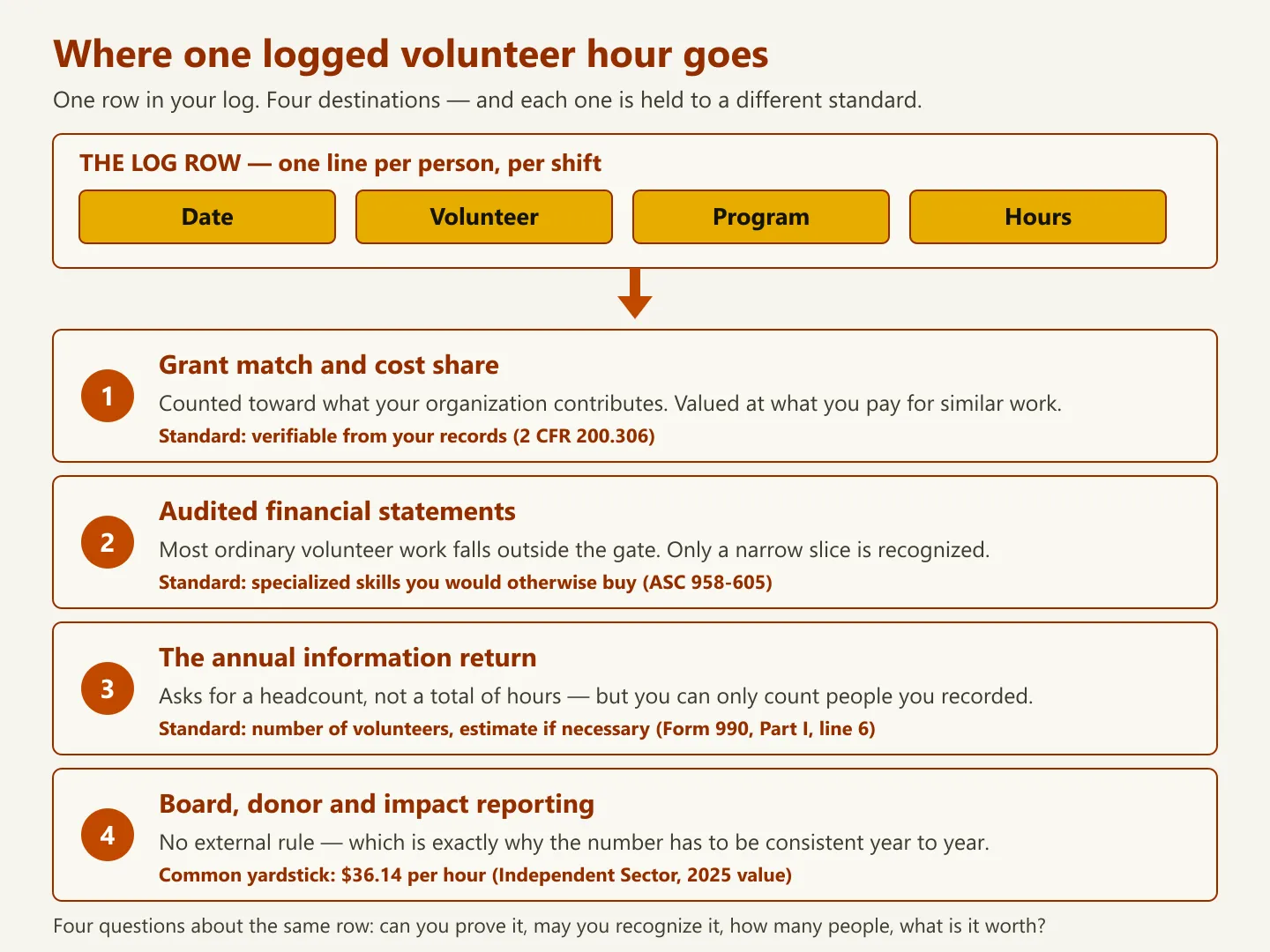
The reason that simple log is enough is the part most people never see: the number does not go to one place. It goes to four, and each destination holds it to a completely different standard — one wants proof, one barely wants it at all, one wants a headcount instead, and one has no rule whatsoever. Once you know which is which, tracking volunteer hours stops being a chase.
Where Volunteer Hours Actually Get Used
A volunteer hour is a single record that gets read by four different audiences, each applying a different test to it. Understanding those four tests is what tells you which fields your log needs.
| Where the number goes | What it’s used for | The standard it’s held to | What you must be able to show |
|---|---|---|---|
| Grant match / cost share | Counting your organization’s own contribution toward a funded project | Contributions must be verifiable from your records, and not counted against any other federal award | Dated rows, named people, hours, project |
| Audited financial statements | Recognizing donated services as revenue and expense | Only services requiring specialized skills, provided by people who have them, that you’d otherwise buy | Who did it, what their profession is, what it would have cost |
| The annual information return | The governance and activity picture the public sees | Number of volunteers — a headcount, estimated if necessary | A distinct-person count for the year |
| Board, donor and impact reporting | Fundraising, annual reports, grant narratives | No external rule at all | Consistency with what you said last year |
The clean way to see this is as one row with four exits. Four destinations, four questions about the same Saturday morning: can you prove it, may you recognize it, how many people were there, and what is it worth?
Grant match is the strictest reader
If any of your volunteer time is being counted toward the match on a federal award, it is subject to the federal cost-sharing rules. The uniform guidance on cost sharing at 2 CFR 200.306 (opens in new tab) requires that contributions be “verifiable in the recipient’s or subrecipient’s records” and that they are “not included as contributions for any other Federal award.”
Read those two clauses as an instruction about file format. Verifiable from your records means an auditor can trace the total back to individual dated entries — a number in a spreadsheet cell with nothing behind it is not verifiable. Not counted for any other award means each row needs to know which project it belongs to, so the same Saturday morning cannot quietly be claimed twice.
Your financial statements will ignore most of it
Here is the part that surprises most boards. The recognition gate is narrow enough that most ordinary volunteer work falls outside it and never appears in audited financial statements at all.
Under the accounting standard FASB set out in Statement No. 116 and now codified as ASC 958-605 (opens in new tab), contributions of services are recognized “only if the services received (a) create or enhance nonfinancial assets or (b) require specialized skills, are provided by individuals possessing those skills, and would typically need to be purchased if not provided by donation.”
That is a narrow gate. The attorney who drafted your bylaws for free usually clears it, assuming you would otherwise have paid someone to do it. So does the CPA who did your books, and the electrician who rewired the community room. The forty people who sorted food boxes on Saturday do not — not because their time is worth less, but because sorting food boxes is not a specialized skill you would have gone out and purchased.
So your log needs one small flag: was this a professional service? Nobody else is going to know to ask.
The annual return asks a different question entirely
Form 990 does not ask for total volunteer hours. Part I, line 6 of the IRS Form 990 (opens in new tab) asks for the “Total number of volunteers (estimate if necessary)” — a headcount, with permission to estimate right there in the question.
That “estimate if necessary” is a small mercy, and it is also a trap. Organizations that estimate every year end up with a number that drifts: 200 one year, 350 the next, 180 the year after, with nothing underneath explaining the swing. A log with names in it gives you a real distinct-person count as a by-product, and it costs nothing extra.
What Is a Volunteer Hour Worth?
A volunteer hour is worth $36.14 as a communications figure — and something completely different as an accounting or grant figure. This is the single most common mix-up in volunteer reporting, and it is worth being precise about.
Independent Sector and the Do Good Institute at the University of Maryland put the value of a volunteer hour at $36.14 (opens in new tab) — that is the 2025 value, released in April 2026, a 3.9% increase on 2024. It is not a plain wage average: Independent Sector’s published methodology (opens in new tab) builds it from the Bureau of Labor Statistics Current Employment Statistics average hourly earnings for production and non-supervisory workers on private non-farm payrolls, plus a 15.3% uplift for the value of fringe benefits. The main value-of-volunteer-time page (opens in new tab) carries the state-by-state figures and notes that the 2025 estimate uses preliminary data pending final BLS release.
It is an excellent number for an annual report. It is the wrong number for a grant budget or a financial statement. Three uses, three different rules:
| The number | Where it belongs | How the rate is set |
|---|---|---|
| $36.14 per hour | Board reports, donor letters, impact narratives, “our volunteers contributed the equivalent of…” | A national earnings average plus a 15.3% fringe-benefit uplift |
| Your own comparable pay rate | Volunteer time counted as match on a federal award | What you pay for similar work — or, if nobody on staff does that work, the local market rate for it |
| What the service would have cost | Audited financial statements, for qualifying professional services only | Fair value of that specific professional service |
The middle row has real teeth. 2 CFR 200.306 (opens in new tab) states that “rates for third-party volunteer services must be consistent with those paid for similar work by the recipient or subrecipient,” and where the required skills are not found in your workforce, “rates must be consistent with those paid for similar work in the labor market where the recipient or subrecipient competes for the services involved.” Fringe benefits that are allowable, allocable and reasonable may be included in the valuation.
Translated: if you pay your own warehouse staff $19 an hour, your volunteers doing warehouse work are worth $19 an hour on that grant — not $36.14. Applying the national average across the board puts the match straight out of line with the rule.
The takeaway: track hours, not dollars. Rates change, rules differ by destination, and a log full of hours can be revalued three different ways in about a minute. A log full of dollars cannot be taken apart again.
The Four Fields a Volunteer Hours Log Actually Needs
Volunteer tracking systems fail because they ask for too much. Every extra field is another reason a tired person walks past the clipboard.
Four fields carry almost all the value:
- Date. Not the month. The actual date, because both the grant period and the fiscal year cut somewhere in the middle of a month, and a monthly total cannot be split afterwards.
- Volunteer name. One consistent spelling per person. This is what turns your log into a headcount for the annual return, and it is what lets you send someone their own total.
- Program or activity. Which project the hours belong to. Without it you cannot allocate to a grant, and you cannot prove the same hours weren’t claimed twice.
- Hours. A number, to the quarter hour. Not a start time and an end time you have to subtract later.
Then three conditional fields, each of which exists for a specific reader identified above:
- Skilled-service flag — yes/no, plus the profession. Only the “yes” rows are candidates for recognition in your financial statements. Only a small minority of rows will be a yes — and those are the rows your accountant needs.
- On payroll? — yes/no. This one is a compliance guard rail, explained below.
- Funded project code — only if the hours are being claimed as match. It stops double-counting at the point of entry rather than at the point of audit.
Seven fields, four of them mandatory. That is the whole schema. Anything else — emergency contacts, training records, background-check status, availability — belongs in your volunteer roster, not in the hours log. Keeping the two separate is what keeps the hours log fast enough that people actually use it, and it also keeps the more sensitive material out of the file that gets opened most often — the roster deserves the tighter access of the two.
Which raises the part that is easy to skip: this log is personal data about identifiable people. Names, professions, employment status and a dated record of where someone was on a given Saturday. Restrict the file to the coordinators and finance staff who actually need it rather than dropping it in a shared drive everyone can browse — and within the log itself, rows for volunteers under 18 record a named minor’s times and locations, so lock those down harder still. Tell volunteers at sign-up that their name, date and hours are recorded and why; where the volunteer is a minor, tell a parent or guardian. Then set a retention period tied to your grant record-retention obligation instead of keeping every row forever. Federal retention rules — 2 CFR 200.334 (opens in new tab) sets a three-year minimum from the date the final financial report is submitted — are a floor for supporting documentation, not an instruction to hold personal data indefinitely.
How to Track Volunteer Hours Without Chasing Anyone
The chase is a design problem, not a discipline problem. Every hour you spend chasing a timesheet is an hour someone else decided not to make easy to capture. Five rules fix it.
-
Put capture where the work happens. The single highest-yield change is moving capture to the place and moment the work ends. A clipboard by the door that people sign on the way out. A form linked directly from the shift reminder message. A coordinator who fills in the rows during the last five minutes of the shift while everyone is still standing there. Anything that requires someone to remember, later, at home, has already failed.
-
Make the unit the shift, not the minute. Pre-fill the shift length — “Saturday distribution, 3 hours” — and let people adjust it up or down. Round to the quarter hour. Nobody can recall whether they left at 3:47 or 3:52, and the difference does not change a single number downstream. Precision you cannot defend is just friction.
-
Keep one log, appended and never rewritten. One row per person, per shift, added to the bottom of one file. Not a tab per program. Not a file per month. Not a cell someone overwrites with a new total. Totals get calculated from the rows; they never get typed. This is the whole difference between a record an auditor can trace and a number they cannot.
The discipline here is the same one that makes tracking employee training and certifications work: capture each completion as its own dated row, then compute the status from it. The moment you start editing history to make the current total look right, you have lost the ability to answer “what did we report last March, and why?”
-
Give the number back within a week. Send each volunteer their own running total, and the program total, within a week of the shift. This is not a nicety — it is the mechanism. A log people never hear about is a log people stop filling in, and a log people see themselves in is one they will correct for you when it is wrong. Free error-checking, delivered by the people best placed to do it.
-
Reconcile once a month, not once a year. Fifteen minutes, monthly, against the roster. Details below — but the principle is that a gap found four weeks later can still be filled from someone’s memory, and a gap found eleven months later cannot be filled at all.
Three Ways to Collect Volunteer Hours, Compared
There is no single right method. There is a right method for your shift pattern, and it is usually the least sophisticated one that fits. The audit-strength ratings below are our own assessment of how well each record holds up when someone asks you to substantiate a total, not an external standard.
| Method | How capture happens | Audit strength | Best for | Where it breaks |
|---|---|---|---|---|
| Paper sign-in sheet | Clipboard at the door, one line per person, transcribed weekly | Strong — volunteer-initialed original | Fixed-location shifts, events, volunteers who do not work from a phone | Transcription backlog. It is also a list of named people, so bring it in at the end of the shift rather than leaving it on the wall |
| Shared digital form | Link in the shift reminder; the form writes straight into the log | Strong if it timestamps, cannot be edited retroactively, and respondents cannot see each other’s entries or open the destination sheet | Distributed volunteers, remote work, anyone already getting shift reminders on their phone | The further the shift recedes, the more the form competes with everything else in an inbox — and the answer has to come from memory rather than from the moment |
| Coordinator entry | The shift lead fills in all rows at the end of the shift | Moderate — second-hand, so name accuracy matters | Small teams, one-off events, groups arriving together | One-person dependency; falls apart when they are away |
Most organizations end up running two of these at once — paper at the fixed site, a form for everyone else — and that is fine, as long as both feed one log. Two collection methods is a workflow. Two logs is a reconciliation problem you will discover in the last week of the grant period.
Five Mistakes That Make Volunteer Hours Unusable
These are the failures that turn a year of diligent recording into a number nobody can defend.
-
Recording totals instead of rows. “March: 412 hours” is not a record, it is an assertion — when a funder asks you to substantiate it, there is nothing underneath.
-
Letting paid staff log volunteer hours on their own job. The Department of Labor’s FLSA guidance on volunteers (opens in new tab) treats people who donate services “not as employees and without contemplation of pay” as non-employees — and states plainly that public sector employers “may not allow their employees to volunteer, without compensation, additional time to do the same work for which they are employed.” That sentence is written for public agencies, and the page does not extend it to private nonprofits — but it shows what the analysis looks like, and whether a paid employee’s unpaid hours are genuinely volunteering is a fact-specific question your counsel should answer, not one to settle in a spreadsheet. That is what the on payroll? flag is for: it makes the situation visible at entry, while it is still easy to ask.
-
Claiming the same hours against two grants. 2 CFR 200.306 (opens in new tab) rules this out explicitly for federal awards, and it almost never happens deliberately — two program managers each pull from the same sign-in sheet. A project code on every row is the cheapest possible prevention.
-
Valuing everything at the specialized rate. Ten hours of pro bono legal work and ten hours of stuffing envelopes are not the same asset, no matter how much you value both people. Applying a professional rate across a whole program values most of those hours on a basis §200.306(e) does not support — and it is the valuation basis, not one line, that a reviewer would then be looking at.
-
Backfilling from memory at report time. A reconstructed number tends to run low, because the shifts easiest to forget are the small ones and the extra ones — which means the under-count also under-claims match and under-sells the program to funders.
The 15-Minute Monthly Reconciliation
Do this on the same day every month and the annual report becomes a copy-paste job.
- Pull the roster of shifts scheduled last month, and check that every one has rows in the log.
- Chase only the gaps. Not everyone — the three shifts that are missing.
- Normalize names. An initial-plus-surname entry and the same person’s full name are one person, and only one of them counts toward your headcount.
- Confirm every row has a program, and every match-eligible row has a project code.
- Check the skilled-service flags. Any yes rows go to whoever prepares your financials, that month, not next June.
- Send each volunteer their own total; send program and organization totals to program leads and the board packet.
- Note the running distinct-person count for the year.
Seven checks. The first time takes an hour because you are fixing history. Every month after is a quarter of an hour.
Own the Log, Don’t Rent It
The log itself is four mandatory columns, plus three that only some rows need. You do not need to buy it — open a blank sheet, put those seven headers across the top, and start appending. That is the honest version of this section, and it is why the schema above is written out in full rather than hidden behind a download.
What is worth owning is everything that sits around the log. Volunteer management platforms exist, and if you are coordinating hundreds of people across dozens of sites, one may well be worth the subscription. But most organizations reaching for one are trying to solve a spreadsheet-sized problem with a per-seat monthly fee — and getting your history back out again depends entirely on that vendor’s export terms, so read them before you commit. Your volunteer record is one of the few datasets you genuinely cannot reconstruct.
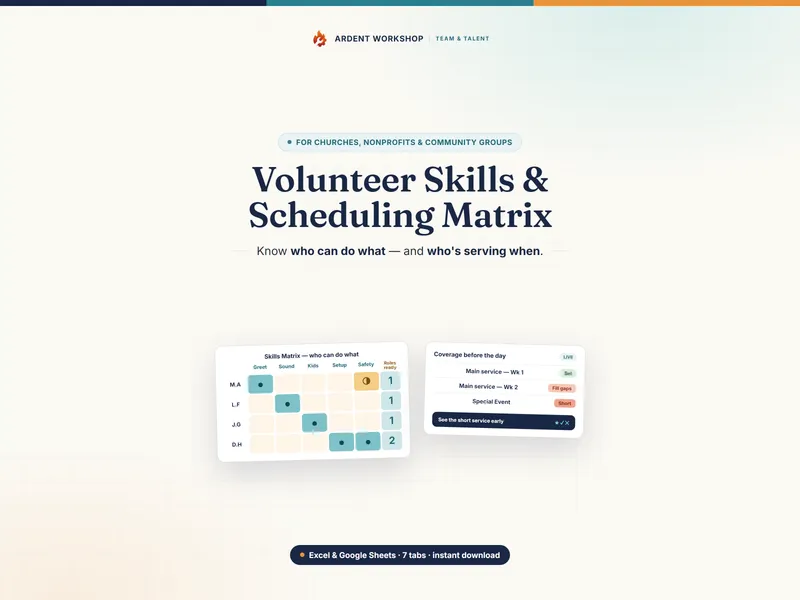
The rostering half — who is trained for which role, which roles need clearance, and who is actually scheduled on Saturday — is what the Volunteer Skills & Scheduling Matrix is built for. It puts readiness by role on one board, flags coverage gaps before the day rather than on it, marks which roles require a background check before anyone serves, and keeps a dated review log of what changed on the board and which gaps are still open. It also makes visible something worth knowing regardless of hours: which roles have only one trained volunteer. That is what the bus factor is, applied to a volunteer team. If you just want to try the rostering side for one service, the free volunteer roster starter is an ungated download — roles, how many you need, and who is covering each.
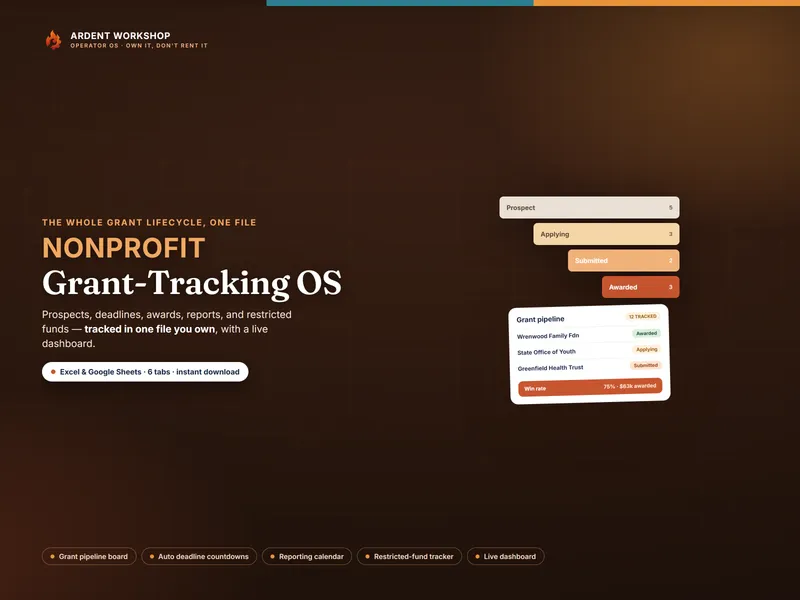
The reporting half — if those hours are feeding grant reports and funder deadlines — is the Nonprofit Grant-Tracking OS: pipeline, reporting calendar, restricted-fund tracking and deadline countdowns in one connected file, so the report that needs your hours total is not a surprise. And for the governance paperwork around all of this, the Nonprofit Board & Volunteer Policy Template Pack covers the sixteen documents small organizations are asked for and rarely have — the volunteer application, agreement and code of conduct, the incident report, and the document-retention policy with the schedule to slot the log into.
The one thing to take away: you are not tracking hours because a funder asked. You are tracking them because four different readers will each ask a different question about the same Saturday morning, and a dated row with a name on it is the only artifact that answers all four.
Sources
- 2 CFR 200.306 — Cost sharing (opens in new tab), the federal uniform guidance on verifiability and volunteer-service valuation
- FASB Statement No. 116, Accounting for Contributions Received and Contributions Made (opens in new tab), the recognition test for contributed services now codified as ASC 958-605
- IRS Form 990 (opens in new tab), Part I, line 6 — total number of volunteers
- Independent Sector’s 2026 value of volunteer time release (opens in new tab), its value of volunteer time methodology (opens in new tab), and the main value of volunteer time page (opens in new tab) with the state-by-state figures
- 2 CFR 200.334 — Record retention requirements (opens in new tab), the three-year federal minimum for grant supporting documentation
- The Department of Labor’s FLSA guidance on volunteers (opens in new tab)
Figures and regulatory text verified August 2026, against the 2025 Form 990 and the eCFR text then current. The value of a volunteer hour is revised annually by Independent Sector, typically in April.