Ask five organizations why they lose volunteers and you’ll get five versions of the same answer: people are busy. It’s true, and it’s useless. “People are busy” doesn’t tell you whether to send more reminders, prep more work in advance, or stop asking one exhausted person to do everything.
Here’s the more useful frame. Volunteer retention isn’t one problem. It’s six, and they show up on the same roster at the same time. The person who came once and never returned, the retiree who has opened the building every Tuesday for a decade, and the accountant who gives you eleven hours in March are all “volunteers,” and every single thing that keeps one of them is irrelevant to the other two.
The short version: you retain volunteers by matching the move to the type. Give the Anchor a successor to train. Prep the work before the Surge Crew arrives. Invite the Season Regular by name a month early. Use the Specialist only at the top of her skill. Make the Overcommitter subtract. And give the One-and-Doner a specific second ask within a week.
What follows is a working taxonomy of those six — what each one is actually worth, what keeps them, and the specific mistake that loses them. Not personality types. Behavior patterns, which is the only kind you can plan around.
The number that explains your volunteer retention problem
Start with the shape of the roster, because it is stranger than most organizations assume.
According to U.S. Census Bureau and AmeriCorps data on volunteering (opens in new tab), 28.3% of Americans aged 16 and up — about 75.7 million people — formally volunteered through an organization between September 2022 and September 2023, contributing an estimated 4.99 billion hours. Independent Sector and the University of Maryland’s Do Good Institute put the value of a volunteer hour at $36.14 (opens in new tab) for 2025, a 3.9% increase over the previous year — though how to track volunteer hours, and what that dollar figure can and cannot be used for, is a separate question.
Now the number that matters for retention. In that same Census data (opens in new tab), the average volunteer served 70 hours in the year. The median volunteer served 24.
Sit with that gap for a second. A median of 24 hours means half of everyone who volunteered in America gave no more than three working days of their time across an entire year. The average is nearly three times higher only because a small group at the top is carrying an enormous load. Those are national, per-person figures rather than a census of any one roster — but the shape tends to carry: a long tail of near-strangers with a handful of anchors holding up the other end, rather than a bell curve of moderately engaged people.
That is why generic retention advice underperforms. It is usually written for the middle of a distribution that does not exist.
The pressure is real, too. In a 2023 Do Good Institute report on the state of volunteer engagement (PDF) (opens in new tab), based on a 2022 survey of 1,210 nonprofit CEOs, 46.8% said recruiting sufficient volunteers was a “big problem” — up from 29% when a comparable survey was run in 2003. In the same report, 38.4% called finding volunteers available during the traditional workday a big problem, and 35.4% said the same about finding volunteers with the necessary skills.
Those last two figures are the tell. Availability and skill are separate constraints, and they define separate types of volunteer.
Why one retention strategy fails all six types
Most volunteer retention advice collapses into three moves: thank people, recognize people, communicate more. None of that is wrong. All of it is insufficient, because the six types do not leave for the same reason.
The Specialist does not leave because you forgot to thank her. She leaves because you asked a licensed electrician to hand out flyers. The One-and-Doner does not leave because communication was poor. He leaves because nothing in the experience suggested there was a second step. Send both of them the same appreciation email and you have addressed neither.
Two questions place every volunteer you have:
- How many hours do they give in a year? Not how enthusiastic they seem. Hours.
- What breaks if they stop showing up? Sometimes a lot, sometimes nothing — and the two answers are far less correlated than people expect.
Plot those and the roster sorts itself into four zones with six recognizable residents — placement below is a working model for sorting a roster, not measured data:
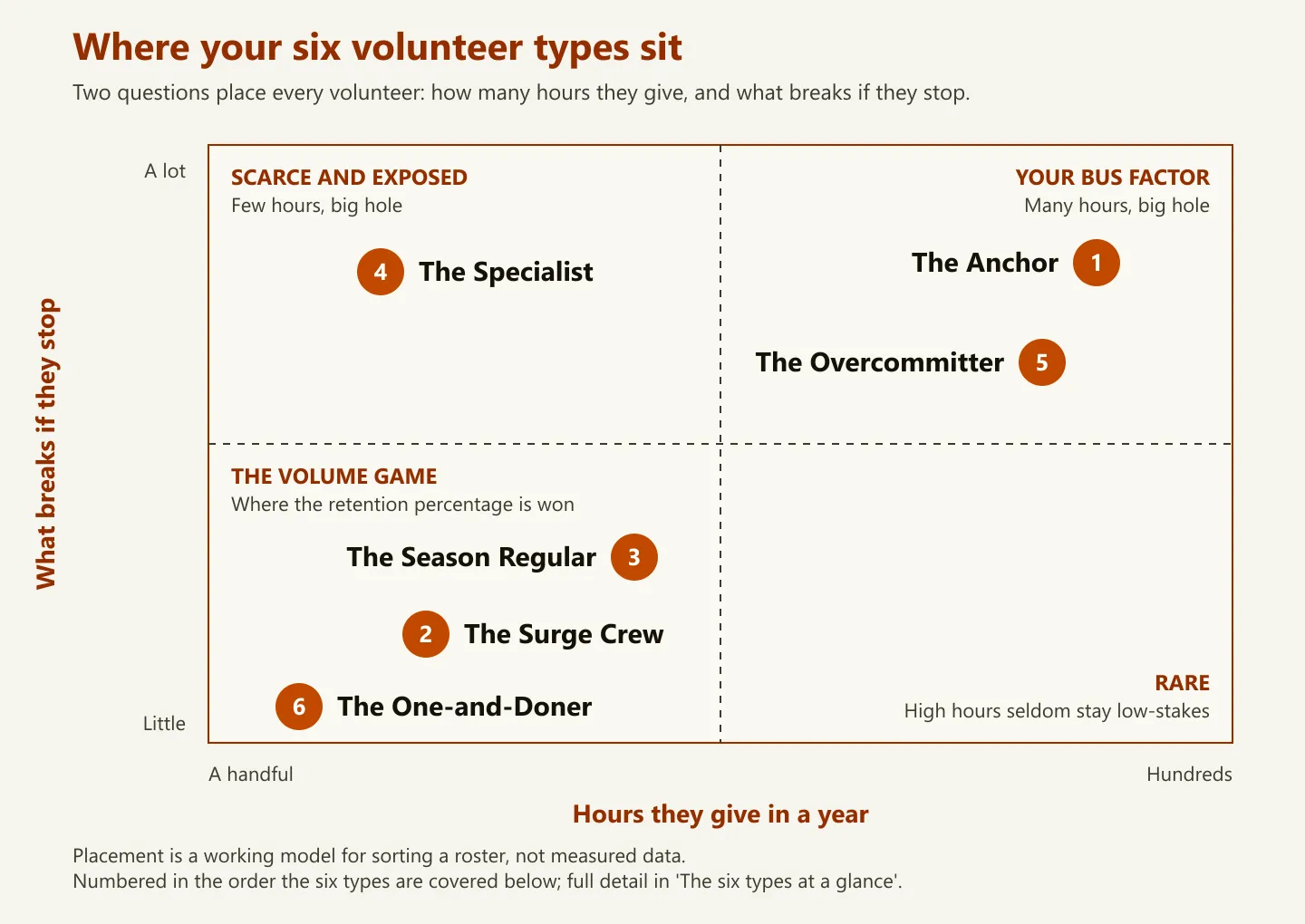
The four zones, in text:
- Scarce and exposed (few hours, big hole) — the Specialist, alone.
- Your bus factor (many hours, big hole) — the Anchor and the Overcommitter.
- The volume game (few hours, small individual hole) — the Season Regular, the Surge Crew and the One-and-Doner. This is where the retention percentage is won.
- Rare (many hours, low stakes) — no residents, on purpose.
Scarce-and-exposed is the zone easiest to miss. A volunteer can give you eleven hours a year and still be the hardest person on the roster to replace.
The rare zone is empty for a reason: high-hour volunteers seldom stay low-stakes. If someone is giving you hundreds of hours, something is already resting on them, whether or not anyone has written down what.
The 6 types of volunteer, and how to retain each one
1. The Anchor
You’ll recognize them by: the same shift, the same day, for years. They know where the spare key is, which door sticks, and the name of the person who donated the piano. They are, functionally, unpaid institutional memory.
What actually keeps them: continuity and standing. Anchors are rarely motivated by novelty — they are motivated by the place being the same place. What loses them is not boredom but disrespect: a schedule change made without asking, a new coordinator who reorganizes their space, a sense that the thing they built is being redecorated around them.
The mistake that loses them: treating their reliability as infrastructure rather than as a relationship. Nobody checks in on the person who never causes problems.
The risk nobody plans for: an Anchor leaving is not a scheduling gap, it is a knowledge loss. This is exactly what the bus factor is — the number of people who would have to disappear before the work stops — and a volunteer organization can sit at a bus factor of one for years without noticing. It costs nothing to ask an Anchor to spend two shifts teaching someone else the routine. Our read is that the willingness is far more common than the ask.
2. The Surge Crew
You’ll recognize them by: arriving as a bloc. The corporate team day, the youth group, the eleventh-grade service requirement. Twelve people, three hours, once, usually on a date you did not pick.
What actually keeps them: honestly, mostly they do not come back as a group — and that is not the win to chase. The win is that a Surge Crew is a recruiting event disguised as a work shift. Somewhere in those twelve people are one or two who would come back alone if anyone gave them a reason to.
The mistake that loses them: not having the work ready. A Surge Crew that stands around for forty minutes while someone finds the gloves has learned that you are disorganized, and twelve people now believe it. Prepped, stacked, obviously-worth-doing work is the entire retention strategy here.
The move: before they leave, ask the two who worked hardest whether they would want to come back on their own, and get a way to contact them directly — and if the crew came from a school or a youth group, route that through their organizer rather than collecting a student’s details yourself. Not a sign-up sheet passed around the group. A specific ask, to a specific person, while they are still holding a broom.
3. The Season Regular
You’ll recognize them by: appearing in one predictable window a year and vanishing the rest of it. The holiday food drive, the tax-prep season, the summer camp, the county fair booth. They may have done it for a decade and still not consider themselves “involved.”
What actually keeps them: being asked early, by name, for the same slot they had last year. Season Regulars have organized their annual calendar around you without telling you. Their loyalty is real, but it is fragile in one specific way: if the ask arrives late, they have already committed the week to something else — and a missed year is the kind of gap that tends not to close on its own.
The mistake that loses them: treating them as new every year. Making a decade-long volunteer re-register from scratch, re-explain what they do, and wait to be told which station they are on is a small insult delivered annually.
The move: a standing invitation with a date on it, sent a month before you think you need to.
4. The Specialist
You’ll recognize them by: the license, the credential, or the trade. The CPA who reviews your books. The attorney who reads the lease. The nurse at the health fair. The person who actually knows how the website works. Their hours are usually small; their replacement cost is enormous.
What actually keeps them: being used at the top of their skill, and only there. A Specialist who spends her volunteer hours doing the specialized thing feels like an expert donating something rare. The same person stuffing envelopes feels like a warm body, and warm bodies quietly stop replying.
The mistake that loses them: the well-meant “we need all hands today.” One all-hands weekend is fine. A pattern of it teaches a professional that her expertise was not the point.
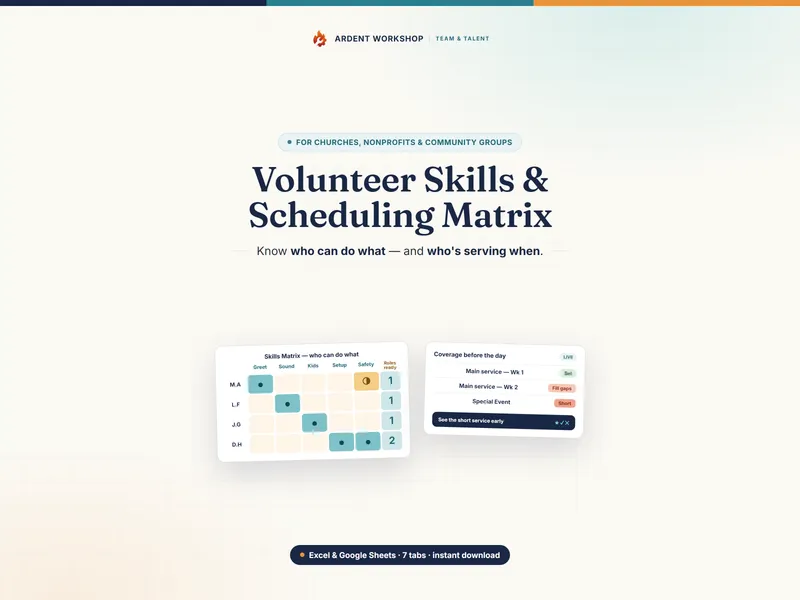
Why this type deserves the most attention per hour: the Specialist is the only volunteer who can be barely present and still be your biggest single point of exposure. If your entire technical, financial, or legal capability rests on one person’s goodwill, that is a structural fact about your organization, not a footnote about a volunteer. Know who those people are before you need to. A written record of who can do what — the sort of skills-and-availability grid in the Volunteer Skills & Scheduling Matrix — turns that from something living in a coordinator’s head into something the organization owns.
5. The Overcommitter
You’ll recognize them by: yes. Always yes. They are on three committees, they run the newsletter, they came in on their day off, and they are visibly, cheerfully heading for a wall.
What actually keeps them: permission to do less, delivered by someone with the authority to make it stick. Overcommitters rarely scale back on their own, because every individual ask sounds small and saying no feels like letting people down. The organization has to do it for them.
The mistake that loses them: enjoying it while it lasts. An Overcommitter’s departure is usually not a gentle taper: expect it abrupt, expect hurt feelings, and expect it to take several roles at once.
The move: an annual conversation whose explicit purpose is subtraction. “You are doing four things. Which two do you actually want?” Then give the other two away, on purpose, while there is still time to hand them over properly.
One caution: when a volunteer’s hours and responsibilities start to resemble a staff job, that is worth a conversation with an employment attorney rather than a hope that nobody asks. The line between volunteer and employee is a legal question, not a philosophical one.
6. The One-and-Doner
You’ll recognize them by: a single entry in the log, months ago, and nothing since. They are also the most ignored, which is backwards: a median of 24 hours a year tells you the typical volunteer sits far closer to this end of the roster than to the Anchor. In many rosters they are the largest group by headcount too — worth counting in your own log rather than assuming either way.
What actually keeps them: a second ask that is specific, soon, and small. The window is narrower than people think. A generic “we would love to see you again” newsletter three months later is not a second ask; it is a broadcast, and it converts like one.
The mistake that loses them: assuming the first shift was a referendum. It is worth assuming it was not. The likelier explanation is usually not a bad experience but an absent one: nothing named a second date, and the moment passed.
The move: within a week, a short message that names what they did, names a real upcoming date, and names the person who would be glad to see them. Three specifics. That is the whole intervention, and it is the highest-leverage item on this list because it operates on what is usually your biggest cohort.
The six types at a glance
| Type | Typical hours a year | What breaks if they stop | The one move that keeps them | What loses them |
|---|---|---|---|---|
| The Anchor | Hundreds | Institutional memory and a routine nobody documented | Ask them to teach their routine to one other person | Changing their world without asking |
| The Surge Crew | A few, once | Nothing immediately, but you lose the recruiting pool | Ask the best two, individually, before they leave | Work that is not prepped and ready |
| The Season Regular | Ten to forty, in one window | Nothing day to day; one predictable event gets much harder | Invite them by name, a month early, for the same slot | Making them start over every year |
| The Specialist | Often under twenty | A capability you cannot buy at this price | Use them only at the top of their skill | A habit of “all hands today” |
| The Overcommitter | Hundreds | Three or four roles at once, with no warning | An annual conversation about doing less | Letting them keep saying yes |
| The One-and-Doner | One shift | Nothing individually, everything in aggregate | A specific second ask within a week | Waiting, then sending a newsletter |
The hour ranges are illustrative bands for recognizing a type, not measured figures.
If you only fix one thing this year
Fix the second ask.
The One-and-Doner is usually your largest cohort and your cheapest win. Every other move on this list is worth making, but they operate on smaller groups: you may have three Anchors, one or two Specialists, a dozen Season Regulars. Open your log and count the people who came once — in most rosters it is a bigger number than anyone expects.
A second ask costs one message and converts some non-trivial fraction of a very large number. Nothing else on the roster has that arithmetic.
If you fix a second thing, make it the Specialist — not because there are many of them, but because they sit in the scarce-and-exposed zone: few hours given, big hole left. That is where organizations discover their exposure at the worst possible moment.
The system underneath all six types
Every move above depends on knowing something specific about a specific person: what they can do, when they are free, when they last came, and what you asked them last. That is four facts, and most organizations keep them in four different places — a sign-in sheet, a coordinator’s phone, an email thread, and someone’s memory.
That is the actual failure. Not indifference; fragmentation. You cannot send a Season Regular a by-name invitation a month early if nobody can tell you who the Season Regulars are, and you cannot protect a Specialist’s time if their skill is only recorded in the head of the person who recruited them.
What replaces it is unglamorous: one file where a volunteer is a row, their skills and availability are columns, and their history sits next to their name — what a volunteer skills matrix is, in other words. That is what the Volunteer Skills & Scheduling Matrix is built to hold — skills, who is available for which service, and coverage in one connected workbook rather than four disconnected surfaces. If your hours also have to be defensible for a grant report or a service requirement, that is a related but distinct job; we have written separately on how to track volunteer hours without chasing timesheets.
Two adjacent pieces are worth having in place at the same time. Written role descriptions, and the basic policies around them — conflict of interest, working with minors, confidentiality — are the artifacts that make a role survive the person in it. If you are starting from nothing there, our guide to what policies a small nonprofit needs walks the short list, and the Nonprofit Board & Volunteer Policy Template Pack supplies the documents. And for congregations, where volunteer scheduling sits tangled up with giving records, service rotas, and building use, the Place-of-Worship Operations Workbook keeps those together instead of in three separate places.
The point is not the tooling. It is that a volunteer roster you own — one you can sort, filter, and hand to your successor — is what makes any of these six retention moves possible in the first place. A system nobody else can see is not a system. It is a person, and eventually that person leaves. So start with the log you already have: find three people who came once and never came back, and send each of them a date this week.
Common Questions About Volunteer Retention
What is a good volunteer retention rate?
There is no benchmark you can safely hold your own roster against, and any number quoted as an industry standard is worth treating with suspicion until you can find the study behind it. The closest thing to one sits in the Do Good Institute’s 2023 State of Volunteer Engagement survey of 1,210 nonprofit CEOs: the median CEO reported retaining 70% of their volunteers in the survey’s most recent window, up from a median of 60% in the window spanning 2019 into 2020. Read it carefully, though — the same report cites an 80% median back in 2003, and notes that CEOs may know their retention rates less precisely than the people who actually run the volunteers, although the researchers did ask respondents to check with colleagues where needed.
Those medians come from the Do Good Institute report (PDF) (opens in new tab) cited earlier, which takes the 80% from a 2004 Urban Institute study rather than from its own survey. National and state volunteer retention figures also exist, but they measure whether individuals volunteered again in a later year — not whether your roster came back — so they cannot tell you whether your number is good.
Retention also means different things per type: a Surge Crew that never returns as a group is not a failure, while a Season Regular who misses one year usually is. Measure each type against its own pattern — did the Anchors stay, did the Season Regulars come back, did any share of the One-and-Doners convert to a second shift — rather than against a single roster-wide percentage.
How often should you contact volunteers between shifts?
Often enough that the next ask isn’t the first thing they’ve heard from you, and rarely enough that they don’t filter you into the folder where newsletters go to die. The frequency matters less than the specificity: one message naming a real date and a real job outperforms four general updates, and that is the difference between an ask and an announcement.
Should volunteers get written role descriptions?
Yes, and the reason has nothing to do with formality: a role description is the only artifact that survives the person who wrote it. When an Anchor retires, the difference between a two-week handover and a two-year rebuild is whether anyone wrote down what they did. Half a page is enough — the tasks, the timing, who to ask, and what “done” looks like.
Sources
- U.S. Census Bureau, “New U.S. Census Bureau and AmeriCorps Research Tracks Virtual Volunteering for First Time” (opens in new tab), reporting the Civic Engagement and Volunteering Supplement — the 28.3% formal volunteering rate, 75.7 million volunteers, 4.99 billion hours, and the 70-hour average against the 24-hour median. Covers September 2022 to September 2023; published November 2024, and still the most recent released wave.
- Independent Sector and the Do Good Institute, Value of Volunteer Time (opens in new tab) — the $36.14 hourly value and the 3.9% year-on-year increase. This is the 2025 figure, released April 2026.
- Do Good Institute, The State of Volunteer Engagement: Insights from Nonprofit Leaders and Funders (PDF) (opens in new tab) — the 46.8% / 38.4% / 35.4% “big problem” figures and the 70% and 60% median retention rates quoted in the FAQ, from a 2022 survey of 1,210 nonprofit CEOs; published February 2023. The two 2003 comparison figures it quotes — the 29% who called recruiting a big problem, and the 80% median retention rate — come from the earlier Urban Institute Volunteer Management Capacity study, surveyed in 2003, the retention figure as reported in the Urban Institute’s 2004 Volunteer Management Practices and Retention of Volunteers.
Note that the two national datasets are different vintages: the hours distribution is 2022-23 survey data, while the dollar value of an hour is the 2025 figure. Figures verified August 2026.