The formula, and why it uses 200,000
TRIR — Total Recordable Incident Rate — is calculated as:
TRIR = (number of OSHA-recordable cases × 200,000) ÷ total hours worked
A "recordable case" is any work-related injury or illness that needed more than first aid, or that meets one of OSHA's other recordability tests — the same cases that go on the OSHA 300 log. "Hours worked" is every hour actually worked by every employee across the period, from payroll or timekeeping records, not hours scheduled or paid.
The 200,000 is not an arbitrary round number. It represents 100 full-time employees working 40 hours a week for 50 weeks a year — a stand-in for "100 workers, one typical year." Multiplying by 200,000 before dividing by actual hours rescales the result to what it would be at that reference headcount, which is the only reason a six-person shop's rate and a six-hundred-person site's rate can sit on the same scale at all.
To run it on your own year, the free TRIR Calculator & Near-Miss Report Pad does the arithmetic in one tab. To keep it current all year, the Workplace Incident, Near-Miss & Injury Log Workbook calculates it from your log.
A worked example
Take a fictional 2025 for a small crew: 121,759 hours worked across the year, 4 OSHA-recordable cases, 2 of which involved days away, restricted work, or a job transfer (DART cases), and 16 near misses logged alongside them.
- TRIR = 4 × 200,000 ÷ 121,759 = 6.57
- DART rate = 2 × 200,000 ÷ 121,759 = 3.29
- Near-miss ratio = 16 ÷ 4 = 4.0 near misses per recordable case
TRIR vs. DART rate vs. near-miss ratio
All three come off the same log, but they answer different questions:
- TRIR counts every recordable case — the broadest measure of how often something crossed the line into "OSHA-recordable."
- DART rate counts only the recordable cases that also caused days away, restricted work, or a transfer — a narrower slice that generally tracks the more severe end of the recordable cases.
- Near-miss ratio isn't an OSHA metric at all — a near miss is not recordable on the 300 log because no injury or illness occurred. It's a leading indicator you build yourself: near misses logged divided by recordable cases for the same period, which tells you how many near misses you log for each recordable case. In a period with no recordable cases the ratio can't be calculated, so watch the near-miss count on its own.
Why a small crew's rate swings so much
The smaller the hours-worked denominator, the more one case moves the rate. On the 121,759 hours in the example above, a single additional recordable case adds 200,000 ÷ 121,759 ≈ 1.64 to TRIR by itself. A 500-person site logging about a million hours a year moves only about 0.2 per case; a 60-person crew can watch its TRIR jump by more than a point from one incident. That's not a flaw in the formula — it's the denominator doing exactly what it's supposed to do. It does mean a small employer's month-to-month rate is a noisy number, and reading too much into a single month's swing is an easy way to misread TRIR.
Rolling 12 months vs. calendar year
Your annual OSHA 300A summary totals one calendar year — the cases and the hours worked from January through December. It carries those totals, not a rate, and a calendar-year TRIR calculated from them only updates once a year, which means a bad first quarter doesn't show up in that number until the following January.
A rolling 12-month rate — recalculated every month from the most recent 12 months of cases and hours, dropping the oldest month as the newest one is added — gives you a current answer year-round instead of one snapshot in January. It uses the identical formula; only the window of hours and cases feeding it changes.
How TRIR connects to your OSHA recordkeeping
TRIR isn't a separate filing — it's simply what your existing 300 log produces when you run the formula. A few recordkeeping timelines shape when that log, and therefore the rate, is current:
- A recordable case has to be entered on the 300 log and the related 301 incident report within 7 calendar days of the employer receiving the information (29 CFR 1904.29).
- Days away and restricted work may be capped at 180 calendar days combined on the log — that cap is optional, not required (29 CFR 1904.7).
- The annual 300A summary is posted from February 1 through April 30, and a company executive has to certify it before it goes up (29 CFR 1904.32). Records are kept for 5 years after the year they cover (29 CFR 1904.33).
- Employers with 10 or fewer employees company-wide at all times during the last calendar year, and establishments in certain low-hazard industries, are partially exempt from this routine recordkeeping (29 CFR 1904.1, 29 CFR 1904.2) — but both still have to report a fatality within 8 hours and an in-patient hospitalization, amputation, or loss of an eye within 24 hours (29 CFR 1904.39).
- Separately, establishments of a qualifying size and industry submit their 300A electronically each year, and some also submit the 300 and 301, due March 2 (29 CFR 1904.41).
Calculate it free, or track it all year
If you just want this year's rate, the free TRIR Calculator & Near-Miss Report Pad is four printable near-miss report cards plus a one-tab calculator, pre-filled with a worked year: type in your recordable cases, DART cases, near misses and hours, read off TRIR, DART rate, and your near-miss ratio.
Carrying that math forward all year — instead of re-typing it every time someone asks — is what the Workplace Incident, Near-Miss & Injury Log Workbook is for: one log for every near miss, first-aid case, and recordable injury, feeding a rolling 12-month TRIR and DART rate off a monthly hours ledger, the near-miss-to-recordable ratio above, 300A-ready year-end totals, and a corrective action tied to each event with an OVERDUE flag when it slips. See also what a near miss is, and the templates built for contractors for the rest of the toolset.
Templates that implement this
Log every case, and the rate follows
3 templates
The incident log carries the TRIR math forward all year, rolling 12 months at a time, from a near miss through its corrective action. The other two keep the training record and the weekly safety talks that sit beside it.
- $29.95 Spreadsheet
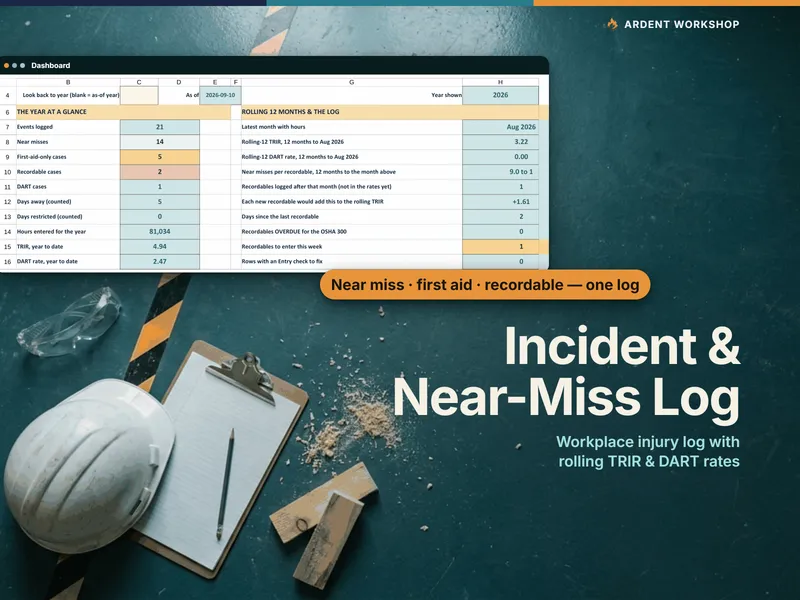
Workplace Incident, Near-Miss & Injury Log Workbook - Rolling TRIR & DART Rates (Excel + Google Sheets)
Incident and near-miss log for Excel & Google Sheets: one log for every event, rolling TRIR and DART rates, linked fixes and 300A-shaped totals.
Team & TalentView details - $29.95 Spreadsheet
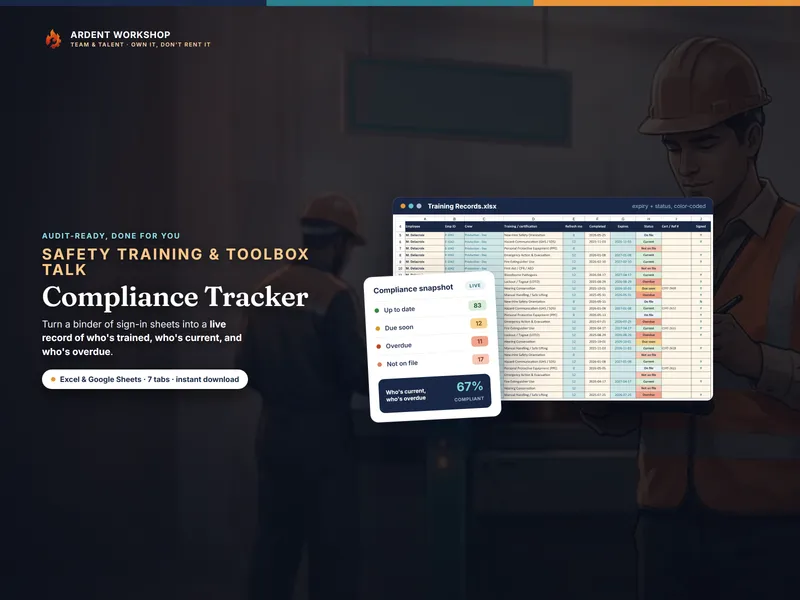
Safety-Training & Toolbox-Talk Compliance Tracker — Excel & Google Sheets
A safety-training & toolbox-talk tracker for Excel & Google Sheets — automatic refresher expiry, color-coded status, and audit-ready compliance dashboard.
Team & TalentView details - $19.95 Mix

Weekly Toolbox-Talk & Safety-Meeting Script Library — 52 Ready-to-Read Safety Talks, One Page Each, With a Sign-In Slip and Six Computed 52-Week Rotations
52 ready-to-read toolbox talks, one page each with the sign-in slip on the same sheet, plus six computed 52-week rotations. A year of safety meetings.
Team & TalentView details
Frequently asked questions
- What is a good TRIR?
- There isn't a number this page can hand you. A TRIR only means something next to a comparable rate — and a fair comparison needs an external benchmark broken out by industry, because a roofing crew and an office are never working the same base risk. That kind of published, industry-specific figure isn't something this page states or the workbook supplies. What a small crew's own TRIR is genuinely good for, without any outside number at all, is tracking whether your own rate is rising or falling year over year and after a change you made.
- What is the difference between TRIR and DART rate?
- Both use the same formula and the same 200,000-hour base — they differ only in which cases get counted. TRIR counts every OSHA-recordable case: anything that needed more than first aid, or met one of the other recordability tests. DART rate counts only the recordable cases that also involved days away from work, restricted duty, or a job transfer — a narrower, generally more severe slice of the same log.
- How is the 200,000-hour base calculated?
- 200,000 is 100 full-time employees × 40 hours a week × 50 weeks a year — a stand-in for "100 workers, one typical year." Multiplying your case count by 200,000 before dividing by your actual hours worked rescales your result to what it would be at that reference size, which is what makes a rate from a 12-person shop and a rate from a 1,200-person plant comparable numbers at all.
- Do near misses count toward TRIR?
- No. TRIR is built entirely from OSHA-recordable cases — events where an injury or illness actually occurred. A near miss is, by definition, an event where nothing happened, so it never reaches the OSHA 300 log and never enters the TRIR calculation. It's still worth logging separately: tracked against your recordable count, it becomes a near-miss ratio that shows how many near misses you log for each recordable case.
- How often should you calculate TRIR?
- A calendar-year rate uses a full January-to-December year of cases and hours — the same period your OSHA 300A summary totals. That number only lands once a year, though, which is late to catch a bad month. Recalculating on a rolling 12-month basis every month you close your hours ledger gives you a current rate that always reflects the most recent full year behind you, instead of waiting for December.
- Does OSHA require every employer to calculate TRIR?
- No. OSHA's recordkeeping rule (29 CFR Part 1904) requires covered employers to keep the underlying 300 log and 301 incident reports and post the annual 300A summary, which carries case totals and hours worked — not a rate. TRIR is simply what those records produce when you run the formula. Employers with 10 or fewer employees company-wide at all times during the last calendar year (§1904.1), and establishments in certain low-hazard industries (§1904.2), are partially exempt from that routine recordkeeping, though even they must report a fatality within 8 hours and an in-patient hospitalization, amputation, or loss of an eye within 24 hours (§1904.39). Separately, establishments of a qualifying size and industry must submit their 300A — and in some cases the 300 and 301 as well — electronically each year (§1904.41).