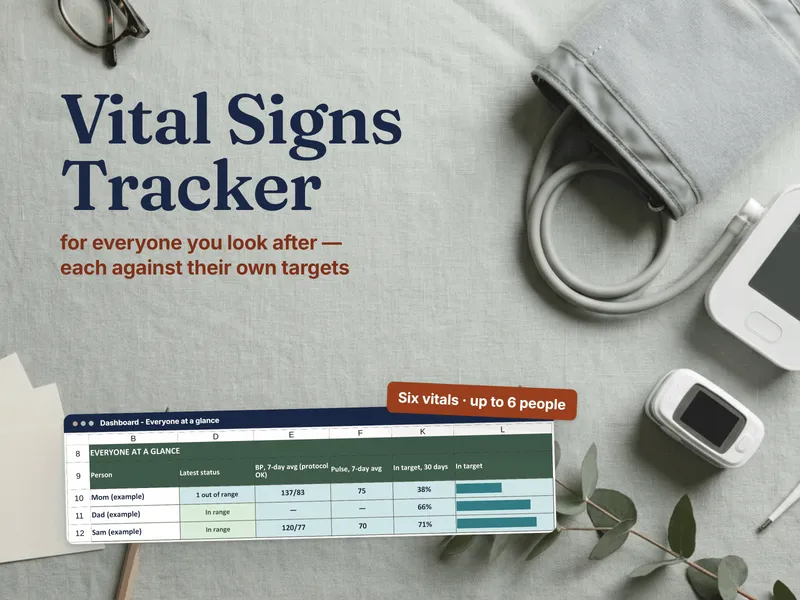
Caring for someone’s health at home means readings from more than one place: the cuff in the kitchen, the oximeter by the bed, a thermometer reading texted by a sibling. This vital signs tracker for Google Sheets keeps them in one shared record in your own Google Drive, and judges every reading against that person’s own targets, not a generic chart.
Your own copy in Google Drive, in one click
The download includes a link that makes your own copy of the workbook in Google Drive. It opens as a native Google Sheet with every formula, dropdown and flag already working, and nothing to upload or convert. Because it is a Sheet, you can log a reading from a phone or tablet at the bedside and share it with the brother, sister or partner who takes the evening shift. It holds health readings, so share it only with the people you name, never with an “anyone with the link” setting.
The copy opens on a worked example, 125 readings for 3 fictional example people, so every tab shows real results before you touch it. When you are ready, clear the example entries and type your own; the Start Here tab marks which cells are yours, and the guide walks through clearing the example.
Everyone you care for, each with their own targets
People & Targets holds up to 6 people, one column each. For every vital you type the low and high their clinician gave them (SpO2 takes a low only), and you add the call-my-clinician thresholds from their care plan, which turn a reading’s status to CALL. Until you replace them, a column follows the general adult examples on the Reference tab, each with its source where one exists (the blood pressure lows and the SpO2 low are left blank for the clinician), and says so. Temperature is set once in °F or °C.
One log, six vitals, flagged as you type
The Log has room for 2,000 readings of blood pressure, pulse, respiration, SpO2 and temperature, plus weight if you track it, each with the person and the context it was taken in. The Sheet works out morning or evening, a flag per vital against that person’s targets, mean arterial pressure, pulse pressure, the 2025 AHA/ACC reference category for blood pressure, and a status. Three yes/no checks before each blood pressure reading, with a seated-and-rested context, decide whether it is Protocol OK; readings that miss one are kept but left out of the average.
The home blood pressure week, averaged
The 2025 AHA/ACC high blood pressure guideline (opens in new tab) asks for two readings a minute apart, morning and evening, for 7 days (at least 3), and then the average. Home BP Average does that for one person and one week: sessions and days covered, the readings left out, the average of the protocol-OK readings, morning against evening, and the reference category of the average, not of one alarming reading. The categories use the home cut-offs from the 2017 ACC/AHA table of corresponding home and office values (opens in new tab) — Stage 2 starts at 135/85 at home rather than the office 140/90 — and they are a reference, not a diagnosis, so ask the clinician how they read a home average. In the example, Mom’s week averages 137/83 over 26 protocol-OK readings: Stage 2 at the home cut-offs (office cut-offs would say Stage 1), and above her example target.
Ready for the appointment
Visit Summary takes any person and date range and returns the readings, average, lowest and highest per vital, the share inside their own target, out-of-range counts, and morning and evening blood pressure. Print it with Fit to page for one sheet, or save it as a PDF to bring along. Trends adds 8 weekly averages and compares the last 7 days with a baseline of the person’s own readings, and the Dashboard shows the whole household at a glance.
Printables for the paper side of care
The 13-page Start Here guide covers setup and how to take each reading so it counts. The 5-page Printable Vitals Log carries a 7-day home blood pressure week sheet and a paper log, and the 4-page Care Plan Card is printed and filled in by hand with each person’s clinician, then copied onto People & Targets.
Prefer Excel?
The same download carries the .xlsx as a worked example and a blank copy, for Excel 2016 or later, Microsoft 365, Excel for Mac and LibreOffice Calc. The Excel listing is the same product: Vital Signs Tracker for Excel. Either way there is no subscription and no device to pair: readings from any cuff, oximeter or thermometer are typed in.
Want to try the log first? The free Vital Signs Log Starter is a one-person, one-tab log of the same six vitals, each reading flagged against a general adult example range, with the lowest, highest and average kept for you. It opens on a fictional worked example. No email, no signup.