You’ve seen it at every cookout, every kid’s soccer game, every long afternoon in the yard: someone gets quiet, goes pale, says they’re “just a little overheated,” and shuffles off to find shade. Nine times out of ten, they sit down, drink some water, and they’re fine.
It’s the tenth time that should scare you. Because heat exhaustion and heat stroke can look almost identical in the first few minutes — and one of them is a medical emergency that can cause permanent organ damage or death in the time it takes to find a chair. The difference between “go sit in the AC” and “call 911 right now” comes down to a handful of signs most people have never learned to read.
Here’s what’s actually happening inside the body when heat builds up, how to tell the two apart on the spot, and what to do about each.
What heat illness actually is
Heat illness is what happens when your body loses the fight to stay near 98.6°F. Most of the time, you never notice that fight happening. Your body is a remarkably good thermostat: when your core warms up, blood vessels near the skin dilate to dump heat into the air, and you sweat so that evaporation pulls more heat away. On a mild day, that system has enormous spare capacity.
Hot, humid weather attacks that system from two directions at once. High air temperature means there’s less of a gap between your skin and the environment, so radiating heat away gets harder. High humidity means sweat doesn’t evaporate well — which is the entire reason sweating cools you. Add direct sun, physical exertion, or dehydration, and the thermostat starts falling behind.
Heat illness isn’t one condition. It’s a ladder, and each rung is more dangerous than the last:
- Heat cramps — painful muscle spasms, usually in the legs or abdomen, from heavy sweating and lost salt.
- Heat exhaustion — the body is still cooling itself, but it’s overwhelmed and running low on water and salt.
- Heat stroke — the cooling system has failed. Core temperature climbs unchecked, and the body can’t bring itself back down without help.
The reason this matters: people tend to treat all three as the same “too hot” problem. They’re not. The first two are warnings. The third is the actual emergency, and it can arrive faster than you’d expect.
Heat exhaustion vs. heat stroke: the one difference that matters
The single most important dividing line is the brain. Heat exhaustion makes you feel terrible but leaves you mentally clear. Heat stroke changes how you think — confusion, slurred speech, strange behavior, or loss of consciousness. That change in mental status is the alarm bell that turns a “rest and rehydrate” situation into a “call 911” situation.
The second tell is the skin. With heat exhaustion, skin is typically cool, pale, and clammy, and the person is usually still sweating heavily. With heat stroke, the cooling system has broken down, so skin is often hot and red — and may be either dry or still damp. (Don’t wait for dry skin to confirm heat stroke; in exertional cases, the person can still be sweating.)
Here’s the full side-by-side, drawn from the National Weather Service heat-illness guidance (opens in new tab) and the CDC’s heat-related illness reference (opens in new tab):
| Sign | Heat Exhaustion | Heat Stroke (emergency) |
|---|---|---|
| Mental state | Alert, but weak and miserable | Confused, slurred speech, agitated, or unconscious |
| Skin | Cool, pale, clammy | Hot and red; dry or damp |
| Sweating | Heavy sweating | May stop sweating — or keep sweating |
| Body temperature | Elevated, usually below 104°F | Above 103–104°F (about 40°C) |
| Pulse | Fast and weak | Fast and strong |
| Other signs | Headache, nausea, dizziness, fainting, muscle cramps | Throbbing headache, nausea, fainting, seizures |
| What it means | A serious warning — cool down now | A 911 emergency — cool down and call for help |
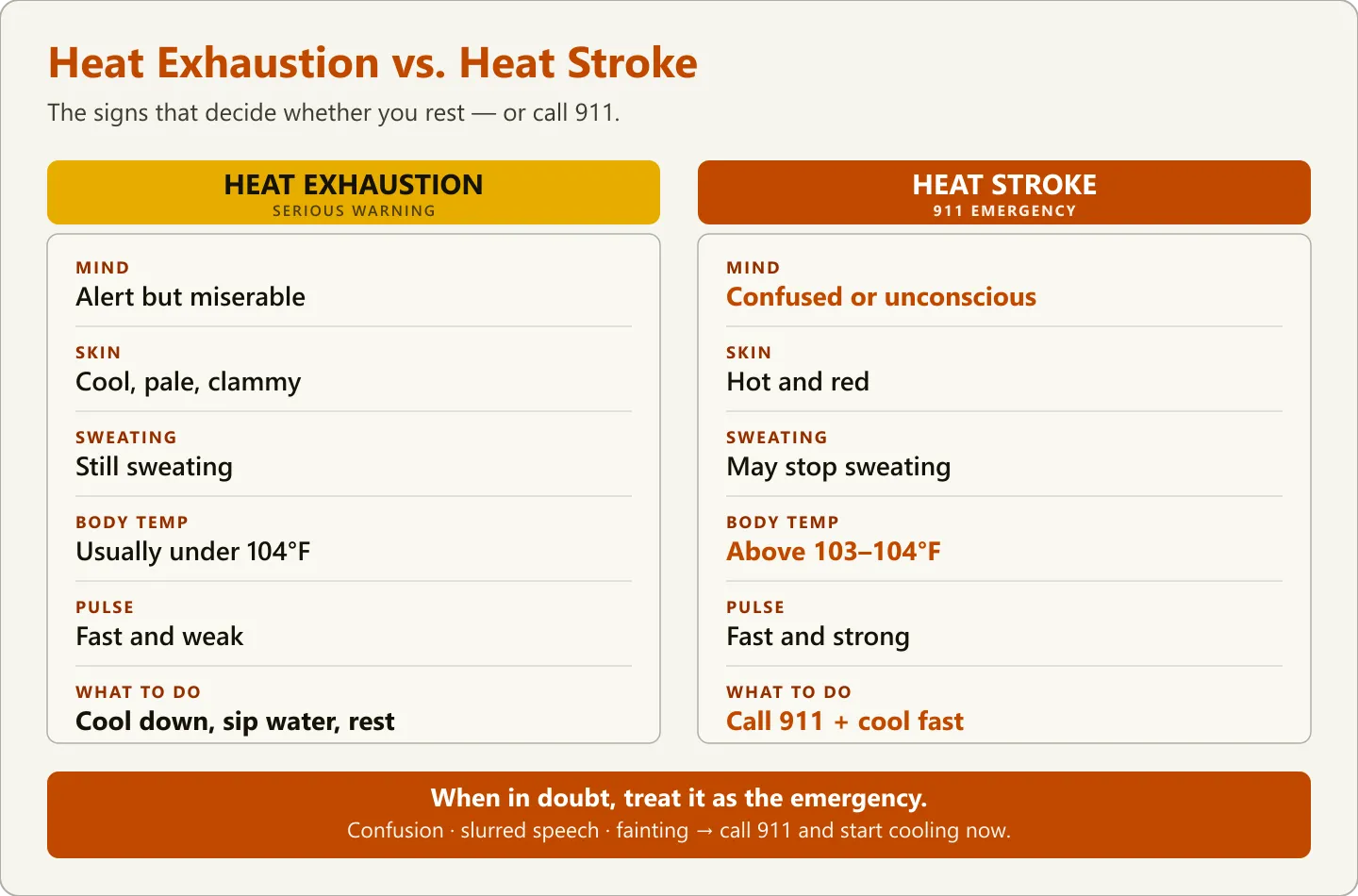
The CDC notes (opens in new tab) just how fast the dangerous rung can hit: in heat stroke, body temperature can climb to 106°F or higher within 10 to 15 minutes. That’s why hesitation is the real risk. If someone who’s been in the heat starts acting confused, can’t answer simple questions, or passes out, you don’t need to confirm a thermometer reading. Treat it as heat stroke and call 911.
The warning signs, in the order they usually show up
Heat illness rarely jumps straight to the emergency. It usually announces itself first — if you know the sequence. Watch for these in roughly this order:
- Early (heat cramps / mild strain): heavy sweating, muscle cramps in the legs or belly, strong thirst, fatigue.
- Middle (heat exhaustion): headache, dizziness, nausea, cool clammy skin, weakness, a fast but weak pulse, maybe a brief faint.
- Late (heat stroke): confusion or disorientation, slurred speech, hot skin, a pounding pulse, throbbing headache, seizures, or collapse.
The takeaway most people miss: the early and middle stages are your window to act. If you catch it at cramps or exhaustion and cool down properly, you almost never reach heat stroke. The emergency is largely what happens when the earlier warnings get ignored — by the person who “doesn’t want to make a thing of it,” or by everyone around them who assumes they’ll be fine.
What to do for each
The response is different for each rung, and getting it wrong — especially giving fluids to someone who’s barely conscious — can make things worse.
Heat cramps
Stop the activity and move to a cooler spot. Gently stretch or massage the cramping muscle. Sip water or an electrolyte drink. Per the National Weather Service (opens in new tab), seek medical attention if cramps last longer than an hour, especially for anyone on a low-sodium diet or with heart problems.
Heat exhaustion
- Get out of the heat — into AC or deep shade.
- Loosen or remove extra clothing.
- Cool the body — cool wet cloths on the skin, a cool shower, or a fan.
- Sip cool water slowly (skip alcohol and caffeine).
- Rest and watch closely.
The CDC and NWS both say to get medical help if the person is vomiting, if symptoms get worse, or if they don’t improve within about an hour. Worsening or unimproving heat exhaustion is how heat stroke begins.
Heat stroke — call 911 first
This one is a true emergency. The steps, in order:
- Call 911 immediately. Heat stroke can cause permanent disability or death without emergency treatment.
- Move the person to a cooler place.
- Cool them aggressively, right now — a cold-water or ice bath is best; if that’s not possible, soak the skin with cold wet cloths, mist with water, and fan them. Focus on the neck, armpits, and groin.
- Do not give them anything to drink. Someone confused or losing consciousness can choke, and fluids won’t fix a failed thermostat.
The order matters: cool aggressively while you wait for help. Every minute spent above a dangerous core temperature raises the risk of lasting harm, so don’t just call and stand by — start cooling.
Why this is worth taking seriously
It’s easy to file heat under “uncomfortable” rather than “dangerous,” but the numbers say otherwise. Heat is the deadliest weather-related hazard in the United States — according to National Weather Service data compiled by USAFacts (opens in new tab), it kills more Americans in an average year than hurricanes and tornadoes combined. And it’s getting worse: that same analysis of CDC figures found heat-related deaths rose from under 300 in 2004 to roughly 1,700 in 2022 — a more than fivefold increase.
The encouraging flip side: heat stroke is one of the most preventable medical emergencies there is. It almost always has a runway of warning signs, and the people who get hurt are usually the ones who didn’t recognize them in time.
Certain people climb the ladder faster and deserve extra watching on hot days:
- Infants and young children, who heat up faster and can’t communicate well.
- Adults over 65, whose bodies regulate temperature less efficiently.
- People with heart, lung, or kidney conditions, or those on certain medications (some blood pressure and diuretic drugs affect heat tolerance).
- Outdoor workers and athletes, who generate internal heat through exertion on top of the ambient load.
- Anyone without reliable access to air conditioning during a heat wave.
How to keep it from ever getting that far
Prevention is almost entirely about staying ahead of dehydration and heat load before your thermostat falls behind:
- Hydrate before you’re thirsty. Thirst lags behind actual fluid loss, so on hot or active days, drink on a schedule rather than on demand. (We broke down how much water you actually need in summer — it’s more nuanced than “eight glasses.”)
- Time outdoor activity for early morning or evening, and take real breaks in the shade or AC.
- Dress for it — light, loose, light-colored clothing, plus a hat.
- Acclimatize gradually. It takes a week or two of exposure for your body to adapt to a hot environment, so the first hot days of summer — before you’ve adjusted — carry extra risk. Ease into outdoor heat rather than spending your first 90°F day doing yard work all afternoon.
- Never leave anyone — child, adult, or pet — in a parked car, even briefly. Interiors can hit lethal temperatures within minutes.
- Check on at-risk people during heat waves.
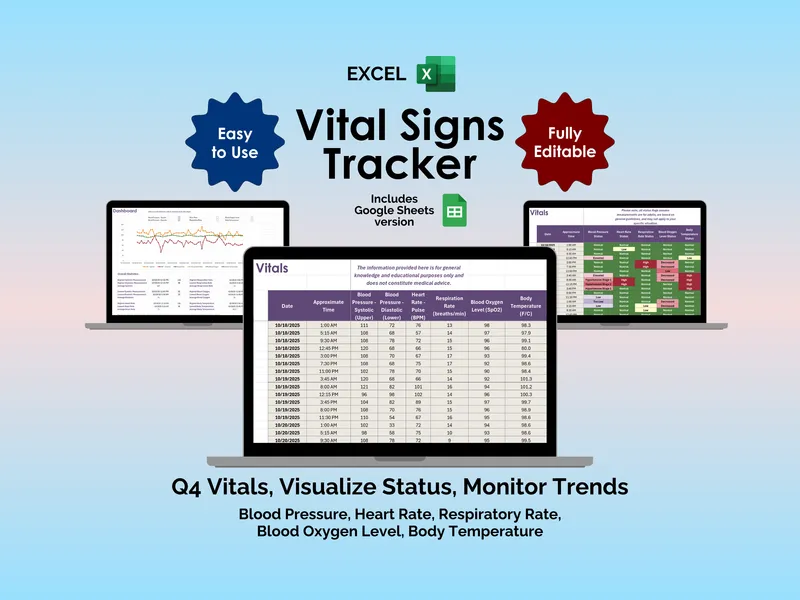
One underrated prevention tool is simply paying attention to your own baseline. If you track vitals like resting pulse and temperature, you’ll recognize “off” faster — a resting heart rate that’s running high on a hot day is one early signal your body is working harder to cool itself (here’s what your resting heart rate actually tells you). A simple hydration tracker makes the “drink on a schedule” habit stick instead of leaving it to guesswork, and a vital signs tracker gives you a place to log temperature, pulse, and symptoms — useful both for spotting trouble early and for showing a doctor a clear picture afterward. If you’re building a broader summer health routine for your household, the health and wellness bundle packages hydration, vitals, and more into one system.
The bottom line
If you remember nothing else from this post, remember the dividing line: heat exhaustion leaves the mind clear and the skin cool and clammy; heat stroke clouds the mind and turns the skin hot. The moment someone in the heat becomes confused, slurs their words, or passes out, stop treating it as “they just need to cool off” — start cooling them aggressively and call 911. That single judgment call is the one that saves lives.
Sources
- Heat-Related Illnesses — National Weather Service (opens in new tab) — symptoms and first aid for heat cramps, heat exhaustion, and heat stroke.
- Heat-Related Illnesses — CDC (NIOSH) (opens in new tab) — symptom lists, the 106°F-in-10-to-15-minutes figure, and emergency response.
- How many people die from extreme heat in the US? — USAFacts (opens in new tab) — National Weather Service and CDC data on heat as the deadliest weather hazard and the 2004–2022 death trend.
Disclaimer: This post is for informational and educational purposes only and does not constitute medical advice. Heat illness can progress quickly and affects each person differently depending on age, health conditions, and medications — when in doubt, call 911 or consult a licensed medical professional rather than relying on this content.