The hardest part of a hospital stay, for the family, is not the medicine. It is that nobody hands you a summary of what changed.
Somewhere between the ward and the front door, tablets get added, tablets get stopped, and doses move. Then somebody reads a discharge sheet out loud at speed, and you go home with a paper bag and a memory of it.
This kit is the paperwork side of that week. It is a print-and-carry field kit, a set of cut-out cards for the clipboard, and a fillable PDF whose two working pages do arithmetic you would otherwise be doing in your head in a corridor: a 16-row medication reconciliation that names every medicine that changed, and a discharge readiness ledger that counts what is still open.
This is an organizing kit, not medical advice. It records what you are told and compares what you write down. It contains no clinical guidance, no symptom lists, no thresholds and no dosing help. There is a fuller note at the foot of this page.
The medicine list, as a comparison rather than a list
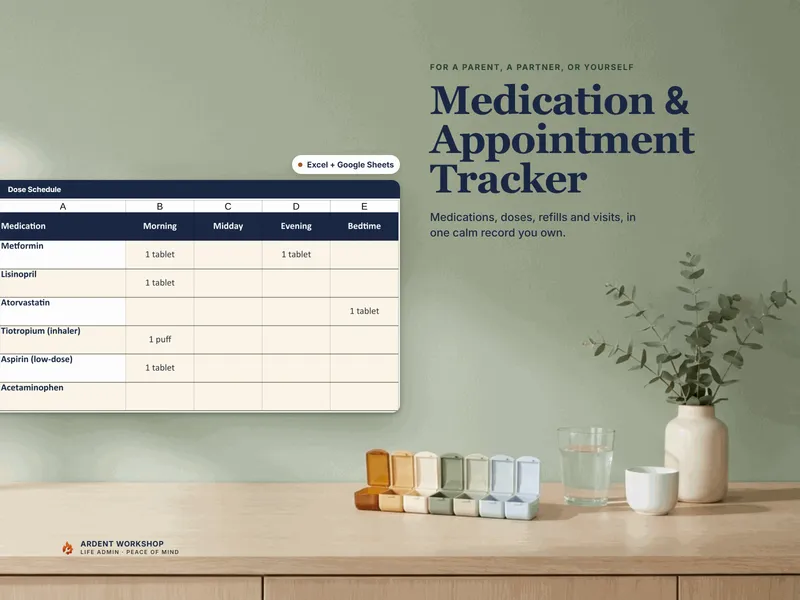
The hospital binders and discharge checklists we surveyed give you one flat field labeled Medications. This one gives you three columns and 16 medicine rows: what was taken at home, what is being given here, and what they are being sent home on.
You write those three. The kit writes the fourth column.
Row by row, it names each medicine New, Stopped, Dose changed or Unchanged — home against going-home, which is the pair that matters at the front door. Then it counts them and writes the answer out as a sentence. In the worked example that reads “5 of 11 medicines changed: 2 new, 2 stopped, 1 with a different dose or time.”
That is the number to ask about while somebody is still standing there.
And the page you hand over writes itself
The last working page is the one you give to the pharmacy, or to the family doctor at the follow-up, or to whoever is taking over the care at home. It carries the reconciliation count, and three lists — started here, stopped here, different dose or time — written from the reconciliation sheet. Nobody has to explain the list twice.
A discharge readiness count, before anyone signs anything
Discharge is not one decision. It is 18 small ones across 6 domains: medicines, equipment, follow-ups, warning signs, transport, home setup.
Write the answer and who gave it to you. A box with nothing in it is still open, whatever was said out loud — and the ledger underneath counts the open ones and names which domains they are in. In the worked example: 4 items still open — 1 in Equipment, 1 in Follow-ups, 1 in Warning signs, 1 in Home setup.
Written for a family standing at a bedside
The discharge templates we looked at are mostly written for case managers, and they read like it. Every capture prompt in this kit — 87 of them — is a sentence you can say out loud, with the shape of a clear answer beside it, who to ask, and a line to read back what you were told. You can write while somebody is still talking.
What you carry, and what you cut out
26 print-and-carry pages run in the order the days actually happen: the first hours, every day on the ward, the pages before you leave, and the three days after you get in the door. The kit does not stop at the discharge doors — getting in the door, the help schedule for the first three days, and a day-by-day log all have pages of their own.
12 cut-out cards in 5 designs, imposed with trim marks — who’s who on a team that changes every shift, what to ask at rounds, today’s medicines, the shift hand-over between relatives, and a wallet card for the question that comes at 2am: call the ward, or go back? It holds the numbers you were given and the order to call them in — the ward’s day line, the ward’s night line, the family doctor’s after-hours line, and who to call second — printed eight to a sheet so there is one for every wallet in the family. You fill the numbers in; the kit never judges what counts as serious.
Two situations a general checklist skips
11 more sheets cover the weeks and days around an operation and the day itself, and a move to a rehab or nursing facility — which runs on a different set of questions, and a different set of deadlines, than a hospital discharge does.
Nothing invented
The reference sheet carries 9 cited statements — the discharge and records rights the kit leans on, plus two free official guides published for patients and families — each with what it says and what it means for you. Alongside them sits a separate table of 14 request wordings: the exact sentences to use when you ask.
They are attributed by name to 6 named sources: CMS, two Medicare.gov pages, the HHS Office for Civil Rights and AHRQ — five federal documents — and AARP, which is a membership organization rather than a public body. Each is listed in full, with its URL, so you can go and check any of them yourself. Everything else in the kit is something you write down.
Start with the free one-page summary
There is a free, ungated One-Page Patient Summary on this site — no email, no signup. It is the sheet you hand over on arrival: who this person is, what they already live with, what they take at home, the aids they use, how they communicate, what a normal day looks like for them, who decides if they cannot, and who to call in what order. Print it and write on it, or type in it and email it.
What it deliberately does not do is the reason this kit exists. It will not tell you which medicines are different from the ones already in the cabinet at home, it will not count them, and it will not tell you how many things are still unanswered while somebody is still standing there to answer them. Take the free sheet in with you on day one; the kit is for the rest of the week.
Own it, don’t rent it
One download. No account, no seat, no subscription. The four files you print and carry come in both US Letter and A4. Print at 100%, as often as you need — for this stay, and for whoever needs it next.