A pre-trip inspection checklist takes five minutes to learn, and you’re about to have the real one. Not a 60-line form someone made up, but the 11 parts the federal DOT rule actually names, what to look at on each, and the move to make when one fails. In short: service brakes, parking brake, steering, lights and reflectors, tires, horn, wipers, mirrors, coupling devices, wheels and rims, and emergency equipment.
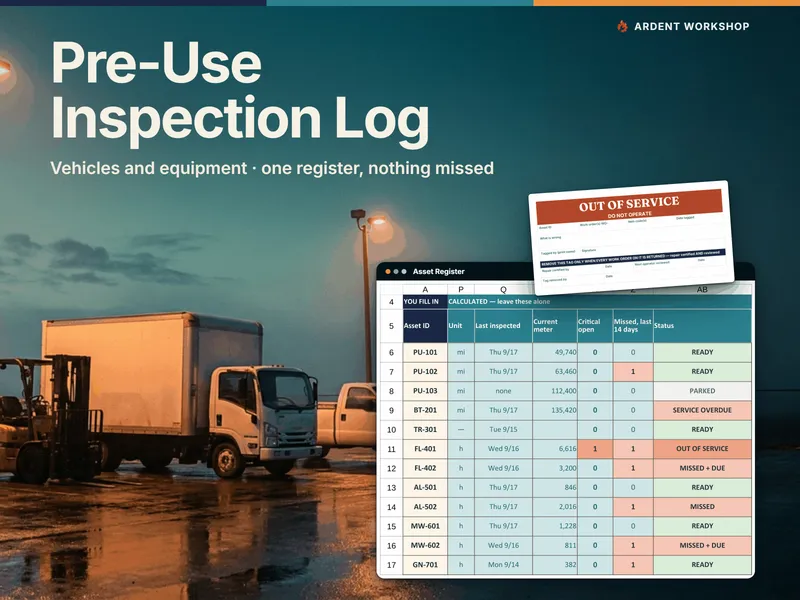
The checklist is the easy half. The half that goes wrong is the fail: a cracked mirror noted on Monday and still cracked on Friday, because the note lived on a clipboard nobody reopened. If you run more than one truck, the Vehicle & Equipment Pre-Use Inspection Log turns every fail into a numbered work order and flags any vehicle that should not be running. For a single vehicle, the free daily vehicle inspection checklist is a printable page. Here’s the list either way.
What a pre-trip inspection is
A pre-trip inspection is the check a driver makes before driving a commercial vehicle, to be satisfied it is safe to operate. Two federal rules define it:
- 49 CFR 392.7(a) (opens in new tab) says a commercial motor vehicle “shall not be driven unless the driver is satisfied” that 11 named parts and accessories “are in good working order.”
- 49 CFR 396.13 (opens in new tab) adds that before driving, the driver must be satisfied the vehicle is in safe operating condition and, when the last inspection report listed a defect, review that report and sign it.
It is the other end of the day from the driver vehicle inspection report (DVIR), which is written after the day’s driving. The pre-trip catches what happened overnight; the DVIR records what went wrong on the road.
The pre-trip inspection checklist: all 11 items
These are the 11 items, in the order 392.7(a) lists them. The rule names the parts; it does not say how to check them. The last two columns are practical guidance, not regulation text.
| Item named in 392.7(a) | What to look at | A fail usually looks like |
|---|---|---|
| Service brakes, including trailer brake connections | Pedal feel, air pressure build-up on air brakes, hoses and gladhands to the trailer | Soft pedal, an air leak you can hear, a chafed or loose line |
| Parking (hand) brake | Set it and try to roll gently | The vehicle creeps against it |
| Steering mechanism | Free play at the wheel, linkage you can see | Excess play, a clunk, a leak at the box |
| Lighting devices and reflectors | Every lamp working, lenses intact, reflectors present | A dead lamp, cracked lens, missing reflector |
| Tires | Tread, sidewalls, inflation | Cuts, bulges, exposed cord, a visibly low tire |
| Horn | Sound it | Nothing, or a weak sound |
| Windshield wiper or wipers | Blades and washer | Torn blade, streaking, no fluid |
| Rear-vision mirror or mirrors | Glass, mount, adjustment | Cracked glass, a loose mount |
| Coupling devices | Fifth wheel, hitch, pin, safety chains | Unlocked jaws, a missing pin, chains not crossed or attached |
| Wheels and rims | Lug nuts, rims, hubs | A loose or missing lug, rust streaks from a nut, a cracked rim |
| Emergency equipment | Extinguisher and warning devices (next section) | Missing, discharged or unmounted |
Walk the vehicle in the same order every time. The order matters less than doing it the same way, because a routine is what makes a missing step stand out.
Emergency equipment is two specific things
“Emergency equipment,” the last item in the table, means a fire extinguisher and stopped-vehicle warning devices, defined in 49 CFR 393.95 (opens in new tab) and pulled into the pre-trip by 49 CFR 392.8 (opens in new tab):
- A fire extinguisher rated 5 B:C or more, or two rated 4 B:C or more, for a vehicle not hauling placarded hazardous materials.
- It must be mounted and readable. Mounted securely so it cannot slide or roll, readily accessible, and with an indicator that shows whether it is fully charged.
- Warning devices: three bidirectional reflective triangles, or at least six fusees. Fusees and other flame signals are barred on vehicles hauling Division 1.1, 1.2 or 1.3 explosives, on cargo tanks used for flammable gas or liquid (loaded or empty), and on vehicles running on compressed gas.
Check the gauge needle, not just that the extinguisher is there. Missing or discharged equipment fails the emergency-equipment item.
The two pre-trip steps drivers skip
A walk-around covers 392.7, but when the last report listed a defect, 396.13 asks for two more steps before you drive. Both happen in the cab, before the key turns:
- Review the last inspection report. If the previous driver wrote up a defect, read it.
- Sign it. Your signature acknowledges you reviewed it and that there is a certification the required repairs were done. The rule does not require a signature for listed defects on a towed unit that is no longer part of the combination.
So if yesterday’s report says “left mirror cracked” and nobody certified a repair, you have not finished your pre-trip, however good the walk-around was.
What to do when an item fails
When an item fails, the move is: do not drive it, write it up, and get the repair certified. The rules behind that loop are in 49 CFR 396.11(a)(3) (opens in new tab):
- The carrier must repair any defect “likely to affect the safety of operation of the vehicle” before a driver operates it.
- The carrier must certify on the report that the defect was repaired, or that repair was unnecessary, before the vehicle is operated again.
- The next driver reviews that certification and signs (the 396.13 step above).
The DVIR glossary entry walks through that defect, repair, certify, sign loop in detail, and the daily vehicle inspection checklist tutorial shows how to run it as a program across a fleet. The practical point for a pre-trip: a fail that affects safe operation and can’t be cleared is a vehicle that stays parked. Tag it so the next person knows too.
Does the rule cover your pickup or van?
The federal rule covers commercial motor vehicles, and a contractor’s pickup can be one. Under 49 CFR 390.5 (opens in new tab), a vehicle used on a highway in interstate commerce is a commercial motor vehicle when its gross vehicle weight rating, gross combination weight rating, or actual gross or combined weight, whichever is greater, is 10,001 pounds or more. It also counts if it is designed or used to carry more than 8 passengers including the driver for compensation, more than 15 when not for compensation, or hazardous materials in a quantity that requires placards. A heavy-duty pickup towing an equipment trailer can cross that line even when neither one does alone.
Three things to know:
- Interstate commerce is the federal trigger. A vehicle not used in interstate commerce falls under your state’s rules instead, so check them.
- A one-truck operation still does the pre-trip. 396.11(a)(5) exempts “any motor carrier operating only one commercial motor vehicle” from the DVIR rules in 396.11. Nothing in 392.7 carves it out of being satisfied the 11 items are in good working order.
- This is not the CDL skills-test inspection. That exam has its own, much longer walk-through. This is the daily one.
Bonus level: make a skipped inspection visible
A pre-trip that gets skipped leaves no trace on paper. The next day’s “all OK” looks exactly like a day with no check at all. Once you run several vehicles, that’s the gap to close:
- Log a line for every scheduled check, not only the fails, so a missing day shows as a gap.
- Give every defect an owner and an age, so last week’s cracked mirror can’t go quiet.
- Hold critical fails out of service until a repair is certified and reviewed.
That is the job the Vehicle & Equipment Pre-Use Inspection Log was built for. One file for the whole yard, with a 14-day missed-inspection grid and every fail held as a work order, yours to keep instead of priced per vehicle each month. And if your crew meets weekly, a pre-trip walk-around makes a good entry on your list of toolbox talk topics for each month.
Common questions about pre-trip inspections
Is a pre-trip inspection required by law?
For a commercial motor vehicle, yes. 49 CFR 392.7 says the vehicle shall not be driven unless the driver is satisfied the 11 listed parts are in good working order.
Does a pre-trip inspection have to be written down?
Not by the federal rule. The written report is the end-of-day DVIR, and it is only required when a defect is discovered by or reported to the driver. What the driver must sign before driving is the previous report, when it listed defects.
How long do you keep inspection reports?
Three months from the date the written report was prepared, along with the repair certification and the next driver’s signed review. That is the retention period in 49 CFR 396.11(a)(4) (opens in new tab).