It is a Tuesday night in the back office of a small food pantry. The pantry is invented — call it Corbel Street Pantry — and we will follow it through this whole post, but the scene is a familiar one.
The volunteer coordinator, who is also the grant writer, the bookkeeper and the person who knows where the spare key is, has a foundation’s guidelines open in one tab. They say: We do not accept unsolicited proposals. Organizations may submit a letter of inquiry of no more than two pages. In the other tab is a blank document and a cursor.
To write a letter of inquiry (LOI), draft seven short paragraphs in this order — the request, the need, the program, the outcomes, who you are, the budget, and why this funder — and keep the whole letter under about 750 words. If you need the definition first, start with what a letter of inquiry is; this post is about the drafting. Candid’s guidance on what to include in a letter of inquiry (opens in new tab) makes the point that matters most here: the letters are short, but an effective one is often harder to write than a full proposal.
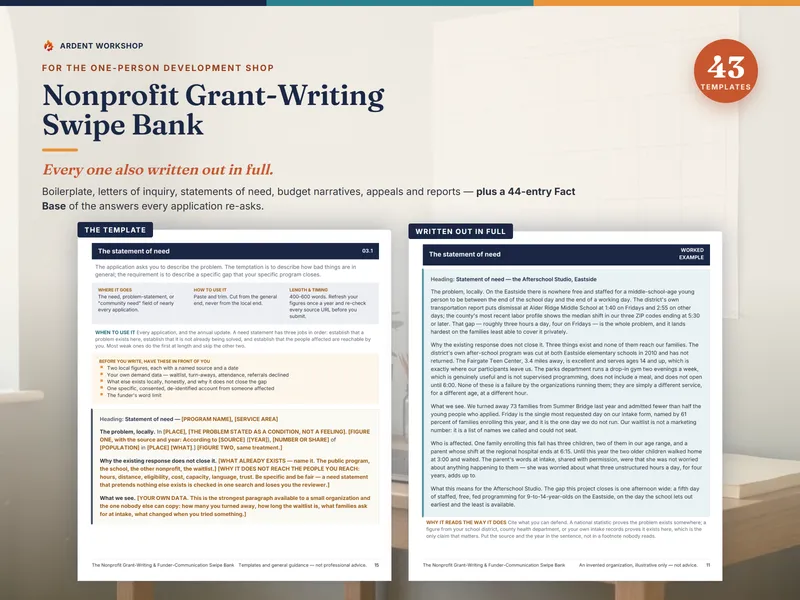
That difficulty is why first drafts tend to go wrong in the same seven places. The Nonprofit Grant-Writing & Funder-Communication Swipe Bank has a fill-in letter of inquiry with those seven blocks laid out, plus the same letter written out in full for an invented organization, so you can see the register before you write a word. But the method is below either way. It is one letter, drafted a paragraph at a time, with the version that gets written first and the version that gets a proposal invited.
Before you write: check the funder will read it
The cheapest letter of inquiry is the one you never write because the funder was never going to fund you. Before the pantry drafts anything, it checks three things in the guidelines:
- Geography. Does this funder give in your county, or only in the three it names?
- Program area. Is “food security” a priority, or is the pantry hoping “basic needs” stretches that far?
- Grant size. If the funder’s typical grant is $5,000 and you are about to ask for $50,000, the letter is already in trouble.
Where the guidelines invite contact, a five-sentence email to the program officer can answer all three quickly: who you are, what you would ask for, roughly how much, and a direct question about whether it fits. A “no” at this stage saves weeks. A “yes, send it” tells you that someone is expecting the letter.
Corbel Street Pantry’s funder — also invented, the Halvorsen-Ames Fund — gives in its county, lists “reducing barriers for working families” as a priority, and typically makes grants of $10,000 to $25,000. The pantry wants $18,000. It writes.
A word budget for a two-page letter of inquiry
Two pages on letterhead comfortably fits roughly 600 to 750 words, and the fastest way to stay inside that is to budget the words before drafting. The figures below are a working budget, not a rule from any funder. If the guidelines give a word or character limit, scale every line to it.
| Paragraph | Its one job | Words |
|---|---|---|
| Date, address, salutation | Reach a named person | 25 to 40 |
| 1. The request | Amount, period, what the money does | 25 to 60 |
| 2. The need | A local, sourced problem | 80 to 120 |
| 3. The program | What happens, when, who, how many | 90 to 140 |
| 4. The outcomes | Two or three measurable changes | 60 to 110 |
| 5. Who you are | Enough background to be credible | 70 to 90 |
| 6. The budget | Total cost, the ask, the rest | 50 to 80 |
| 7. Why this funder | One link to their stated priority | 40 to 60 |
| Close and signature | An offer and a name | 25 to 40 |
Notice where the words go. The program and the need get the most room, because that is what the reviewer is deciding on. The organization background — the part first drafts often open with, and over-spend on — gets 90.
How to open a letter of inquiry: the ask goes first
The first sentence of a letter of inquiry states the amount, the period, and what the money does. Not the mission, not the founding story. The reviewer is going to look for the number anyway, and a letter that makes them hunt for it loses the paragraph they skipped.
Here is what the pantry writes first:
First draft: Corbel Street Pantry has been a lifeline for families in the Pellbrook neighborhood for over a decade, and we are excited to share an opportunity to deepen our impact together.
Every word of that is true and none of it is useful. There is no amount, no period, and “deepen our impact” is not a thing a person can picture. The rewrite:
Rewrite: Corbel Street Pantry requests $18,000 over one year to open a Saturday-morning food distribution for households who cannot reach our weekday hours because of work.
Twenty-five words, and the reviewer already knows whether this is inside their range, how long the commitment is, and what the money buys. The phrase to borrow is a verb and an object: open a Saturday distribution, hire a coordinator, extend the program to a fifth day. If the sentence ends in an aspiration, it is not finished.
How to write the need paragraph of a letter of inquiry
The need paragraph names a local problem with one or two figures and says where each figure comes from. It is not an essay about hunger in America. A program officer at a food-security funder has read the national statistics many times; what they have not read is yours.
The first draft:
First draft: Food insecurity is a growing crisis affecting millions of Americans, and working families are increasingly struggling to put food on the table.
The rewrite uses the pantry’s own data, which is the one source nobody else can cite. The figures here are illustrative, invented for the example:
Rewrite: Our distribution runs Tuesday and Thursday, 10:00 to 2:00 — hours set when most of our visitors were retirees. That has changed. In our spring intake survey of 188 households, 41 percent said they had missed at least one distribution in the past three months because of work, and 23 households told us they had stopped coming altogether for the same reason. The nearest pantry with weekend hours is 6 miles away, and 38 percent of our households do not have a car.
The need is specific (our hours), measured (188 households, 41 percent), sourced (our spring intake survey) and it points directly at the program the next paragraph describes. That last part matters more than it looks. If the need is about transportation and the program is about Saturday hours, the letter reads as unfocused even when both are true. For more on building this paragraph out for a full application, see what a statement of need is.
How to describe the program so a reader can picture it
The program paragraph says what happens, on which days, who delivers it, and how many people it reaches — concretely enough that a skeptical reader can picture a Saturday.
The first draft:
First draft: With your support, we will launch an innovative weekend program that meets families where they are and provides dignified access to nutritious food.
“Innovative”, “meets families where they are” and “dignified access” turn up in so many letters that they carry little information. The rewrite replaces them with a schedule, again with invented details:
Rewrite: The Saturday distribution would run every week from 9:00 to 12:00 in the fellowship hall of Pellbrook Union Church, which already hosts our weekday distribution. A part-time Saturday coordinator, working 12 hours a week, would recruit and schedule a crew of 12 volunteers per shift, many of them the working parents who have asked for these hours. Households would choose their own groceries from shelves, as they do on weekdays, including fresh produce kept in a leased refrigerated unit. We expect to serve 90 households a month on Saturdays within six months of opening.
A reader can now see the hall, the shelves, the crew and the number. They can also see what the $18,000 is for — a coordinator, a refrigerator, produce — before the budget paragraph arrives to confirm it.
If your program depends on volunteers, a number like “12 per shift” is one a funder may ask you to back up later. A volunteer hour log that fills itself in is how you back it up without reconstructing it from memory.
How to write letter of inquiry outcomes a funder can score
An outcome is a change in people’s circumstances, with a number, a date, and a way of measuring it. An output is something you deliver. A common first-draft slip is listing outputs and calling them outcomes.
The first draft:
First draft: We will hold 52 Saturday distributions, distribute over 30,000 pounds of food, and recruit 40 new volunteers.
All three are outputs. They say how busy the pantry will be, not what will be different. The rewrite, with illustrative figures:
Rewrite: By the end of the grant year, 90 households a month will receive food on Saturdays, at least 60 of whom had not visited a weekday distribution in the previous three months, measured by our sign-in records. In a repeat of the intake survey in month ten, the share of households reporting a missed distribution because of work will fall from 41 percent to under 20 percent.
Two outcomes, each with a number, a deadline and a measurement method, and the second is tied back to the exact figure in the need paragraph. That is what makes a letter of inquiry feel like one argument instead of seven paragraphs: the outcome closes the gap the need paragraph opened.
Two or three outcomes is enough. A fourth usually turns out to be an output wearing a disguise.
How much organizational background to include
Three or four sentences: when you started and why, how big you are, and who already works with you or has funded you. This is the paragraph first drafts over-write, because it is the one the writer knows best.
The first draft is a page long and begins in 2014 with three congregations and a folding table. The rewrite keeps the facts a reviewer uses to judge whether the organization can deliver the program — every one of them invented for this example:
Rewrite: Corbel Street Pantry was founded in 2014 by three Pellbrook congregations after the neighborhood’s only grocery store closed. Last year we served an average of 212 households a month on a cash budget of $148,000, with one part-time director and more than 60 regular volunteers. We are a partner agency of our regional food bank, work with the family liaison at Pellbrook Elementary to reach new households, and have twice been funded by our county’s community foundation.
If you have already written a 150-word organization description, this paragraph is a trimmed version of it — which is the argument for writing that description once and keeping it. The free Organization Boilerplate Builder walks through the 60-word and 150-word versions, with the fact-gathering worksheet behind them.
How to write the budget paragraph of an LOI
The budget paragraph gives the total project cost, the amount requested, and where the rest comes from — with each other source marked committed or pending. It is not the full budget; that comes with the proposal.
The first draft:
First draft: We are requesting $18,000, which will cover the costs of the program.
That tells the reviewer this funder would carry the whole thing, which raises the question funders ask: what happens in year two? The rewrite, with illustrative figures:
Rewrite: The first-year cost of the Saturday distribution is $26,500. We are requesting $18,000 from the Halvorsen-Ames Fund, covering the coordinator’s wages, the refrigerated unit lease and produce purchases. Of the balance, $5,000 is committed from our spring appeal and $3,500 is pending with the county’s community services fund. Pellbrook Union Church provides the hall on Saturday mornings at no charge.
The funder can now see it is one of three sources, that part of the balance is already secured, and that an in-kind contribution is real rather than implied. When the funder invites a full proposal, this paragraph grows into a budget narrative — a line-by-line justification of each cost, which how to write a budget narrative covers in detail.
How to connect the letter to the funder’s priorities
One or two sentences that link the program to the funder’s stated priority, quoting their language exactly once.
The first draft quotes the funder in every paragraph, which reads as keyword-matching rather than fit. The rewrite does it once, at the end, when the reviewer already knows enough to agree:
Rewrite: The Halvorsen-Ames Fund’s guidelines name “reducing barriers for working families” as a priority. For the households in this letter, the barrier is not a lack of food nearby — it is that the food is available only while they are at work.
The second sentence is the one that earns the quote. It says, in plain words, why this program is that priority, rather than just repeating the phrase back.
The finished letter of inquiry
Assembled, with a heading, a named recipient, and a close, the pantry’s letter comes to about 500 words — the lean end of the budget, and comfortably inside two pages on letterhead. Every name, figure and organization in it is invented for this example.
Letter of inquiry — Saturday Distribution, $18,000 over one year
September 15
Renata Vell
Program Officer, the Halvorsen-Ames FundDear Ms. Vell,
Corbel Street Pantry requests $18,000 over one year to open a Saturday-morning food distribution for households who cannot reach our weekday hours because of work.
Our distribution runs Tuesday and Thursday, 10:00 to 2:00 — hours set when most of our visitors were retirees. That has changed. In our spring intake survey of 188 households, 41 percent said they had missed at least one distribution in the past three months because of work, and 23 households told us they had stopped coming altogether for the same reason. The nearest pantry with weekend hours is 6 miles away, and 38 percent of our households do not have a car.
The Saturday distribution would run every week from 9:00 to 12:00 in the fellowship hall of Pellbrook Union Church, which already hosts our weekday distribution. A part-time Saturday coordinator, working 12 hours a week, would recruit and schedule a crew of 12 volunteers per shift, many of them the working parents who have asked for these hours. Households would choose their own groceries from shelves, as they do on weekdays, including fresh produce kept in a leased refrigerated unit. We expect to serve 90 households a month on Saturdays within six months of opening.
By the end of the grant year, 90 households a month will receive food on Saturdays, at least 60 of whom had not visited a weekday distribution in the previous three months, measured by our sign-in records. In a repeat of the intake survey in month ten, the share of households reporting a missed distribution because of work will fall from 41 percent to under 20 percent.
Corbel Street Pantry was founded in 2014 by three Pellbrook congregations after the neighborhood’s only grocery store closed. Last year we served an average of 212 households a month on a cash budget of $148,000, with one part-time director and more than 60 regular volunteers. We are a partner agency of our regional food bank, work with the family liaison at Pellbrook Elementary to reach new households, and have twice been funded by our county’s community foundation.
The first-year cost of the Saturday distribution is $26,500. We are requesting $18,000 from the Halvorsen-Ames Fund, covering the coordinator’s wages, the refrigerated unit lease and produce purchases. Of the balance, $5,000 is committed from our spring appeal and $3,500 is pending with the county’s community services fund. Pellbrook Union Church provides the hall on Saturday mornings at no charge.
The Halvorsen-Ames Fund’s guidelines name “reducing barriers for working families” as a priority. For the households in this letter, the barrier is not a lack of food nearby — it is that the food is available only while they are at work.
I would be glad to send a full proposal, our most recent financial statements, or anything else that would help. Thank you for considering this request.
Sincerely,
Executive Director, Corbel Street Pantry
Read it as a reviewer would, with a queue and a rubric. The amount is in the first line. The need and the program describe the same problem from two sides. The outcomes answer the need’s own number. The background is short enough to finish. The budget shows a shared load. The priority link comes last, and it lands.
Before you send it
A letter of inquiry can make a strong case and still be declined on a check that takes five minutes. Run this list against the funder’s guidelines, not your memory of them:
- Length. Under the page, word or character limit — measured in the format they asked for.
- Format. PDF on letterhead if they did not specify; their portal’s fields, pasted in plain text, if they did.
- Recipient. A named person, spelled correctly, with their current title.
- The ask. The same dollar figure in the heading, the first paragraph and the budget paragraph.
- The arithmetic. The request plus the other sources equals the total project cost.
- The quote. Their priority phrase copied exactly from this cycle’s guidelines, once.
- Placeholders. Search the document for an opening square bracket and for “TBD” before exporting it.
- Signature. Signed by the person who leads the organization.
- File name. Something a program officer can find later:
CorbelStreetPantry-LOI-HalvorsenAmes-September.pdf.
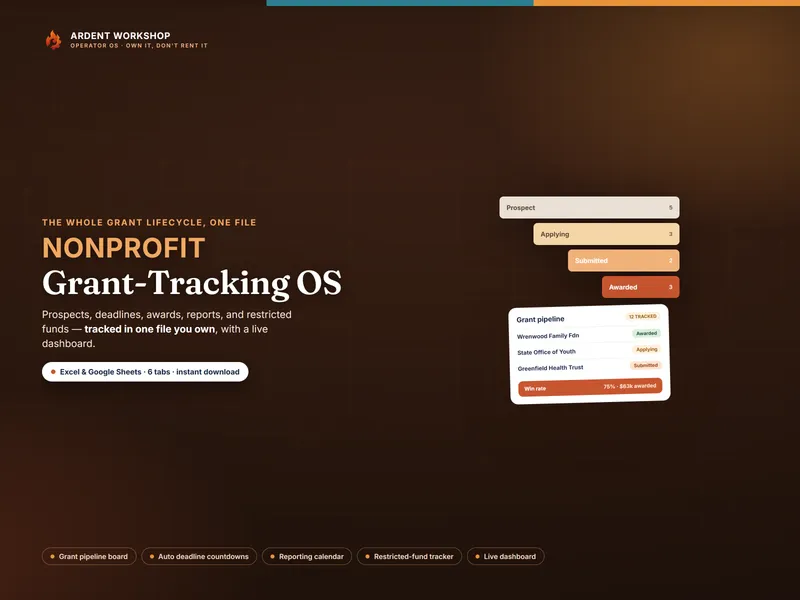
Then record the date you sent it and the funder’s published decision timeline, so the follow-up happens on schedule rather than when someone remembers. The Nonprofit Grant-Tracking OS keeps that pipeline — which letters are out, which are due, which reports are coming — in one workbook.
Common questions about letters of inquiry
How long should a letter of inquiry be?
One to two pages, unless the funder says otherwise — and if they say otherwise, their number is the only one that counts. Candid puts the ceiling at three pages (opens in new tab), but a letter that uses all three is usually carrying background the reviewer does not need.
Is a letter of inquiry the same as a letter of intent?
Often, but not always. Many funders use the two names for the same document. Some use “letter of intent” for a much shorter notice that you plan to apply. Read what the guidelines ask it to contain: if they want the amount, the need and the program, it is this letter; if they want only your organization’s name and the grant you will apply for, it is a notice, and a few sentences will do.
Should I send a letter of inquiry if the funder doesn’t ask for one?
Only if their guidelines leave the door open. A funder that accepts no unsolicited requests of any kind usually means letters of inquiry too, while “no unsolicited proposals” often still leaves room for one — the guidelines will say which. Where the guidelines invite contact but set no process, the short fit-check email described above is a better first step than a two-page letter.
Who should sign a letter of inquiry?
The executive director, or whoever leads the organization if you have no one with that title. The person who drafted it can be named as the contact, but the signature tells the funder the organization stands behind the request.
Reusing a letter of inquiry for the next funder
A letter of inquiry is a lot of work for a document whose best outcome is being asked to write a longer one. The consolation is that almost none of it has to be written twice. The need figures, the organization paragraph, the budget sentence, the outcome structure — the next funder’s letter is mostly those blocks, re-aimed at a different priority.
That is what the Nonprofit Grant-Writing & Funder-Communication Swipe Bank is built around: the letter of inquiry and 42 other templates, each also written out in full for one invented nonprofit whose figures reconcile from the first letter to the final report. They are files you own, not a portal you rent, so the paragraphs you rewrite well stay with the organization after the person who wrote them moves on.
If you are weighing whether to write these yourself at all, grant templates vs hiring a grant writer sets out where each one makes sense.