What an LOI is for
An LOI is a screening document. A foundation with two program officers and four hundred hopeful applicants cannot read four hundred full proposals, so it asks for a page and a half first and invites the ones worth a closer look. That means the LOI is not a teaser and not a cover letter — it is the whole case, at one-tenth the length.
The good outcome is an invitation to submit a full proposal, with a deadline and a format. The second-best outcome is a decline that names a reason, because a reason is something you can fix.
What goes in one
- The request, in the first sentence. The amount, the period, and what the money does — a verb and an object, not an aspiration. An LOI that saves the number for page two asks a busy reader to hold everything in suspension.
- The need, local and specific, with one or two figures and where they come from. Resist the national statistic; a program officer has read it already.
- What you would do — the activity, its schedule, who delivers it, and how many people it reaches. Concrete enough that a skeptical reader can picture a Tuesday.
- What would change, as two or three measurable outcomes, each with a number, a date, and how it is measured.
- Who you are — three or four sentences of organizational background, ending on your partners and past funders.
- The budget in brief — the total project cost, the amount requested, and where the rest is coming from, marked committed or pending.
- Why this funder — one or two sentences connecting the project to their stated priority, quoting their language once and only once.
How long, and in what format
One to two pages is the norm; some funders specify a word or character count, and a surprising number of declines are technical rather than substantive — over the page limit, wrong program, missing attachment. If the funder publishes a format, follow it exactly. If they do not, a signed letter on your letterhead, sent as a PDF, is the safe default.
LOI vs. concept paper vs. full proposal
- Letter of inquiry. A letter, one to two pages, signed, addressed to a person. The most common pre-proposal step for private and family foundations.
- Concept paper or concept note. Much the same content in a document rather than a letter, often to a prescribed outline with headings. More common with government and larger institutional funders.
- Full proposal. The complete application — need, program, outcomes, evaluation, budget and narrative, organizational capacity, and attachments — usually five to twenty pages or a portal form of the same scope.
Where LOIs go wrong
- No number in the first paragraph. The reader scrolls to find the ask anyway, having lost the paragraph you wanted them to read.
- Need and program that do not match. If the need statement is about literacy and the project is about meals, the letter reads as unfocused even when both are true.
- Outcomes that are really outputs. “We will run 34 sessions” is a delivery promise. “130 young people will attend 30 or more days, up from 118” is an outcome.
- Sending it cold when a five-sentence fit check would have done. Where guidelines invite contact, an eligibility question answered in a day saves three weeks of writing.
What happens after you send it
Most funders publish a timeline; four to eight weeks is typical, often tied to a board or committee cycle. Check the published timeline before chasing at all. Once it has passed, one short email asking whether a decision has been made is reasonable — then leave it until the next cycle.
Related templates and concepts
The LOI draws on blocks you should only write once. The free Organization Boilerplate Builder is the organization-background half of it, ungated; the full Nonprofit Grant-Writing & Funder-Communication Swipe Bank adds the LOI itself and 42 other templates, each also written out in full. See also what a statement of need is, grant templates vs hiring a grant writer, and the templates for nonprofits hub.
Templates that implement this
A letter of inquiry, already written
2 templates
The Swipe Bank includes a fill-in LOI with every block a funder expects, and the same letter written out in full for an invented nonprofit — so you can see the length and level of detail before you start.
- $19.95 Mix
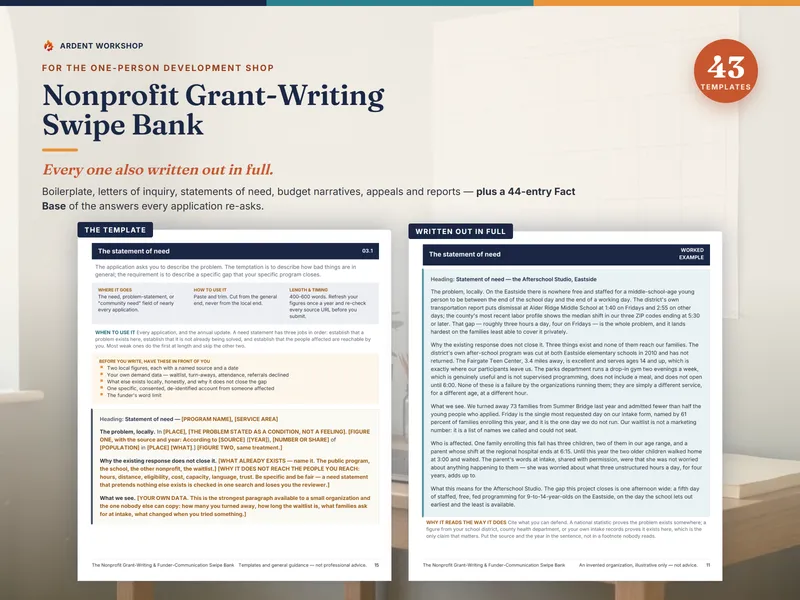
Nonprofit Grant-Writing & Funder-Communication Swipe Bank — 43 Fill-In Templates, Each Also Written Out in Full
43 nonprofit grant-writing templates — boilerplate, LOIs, statements of need, budget narratives, appeals and reports — each also written out in full.
Operator OSView details - $38.95 Spreadsheet
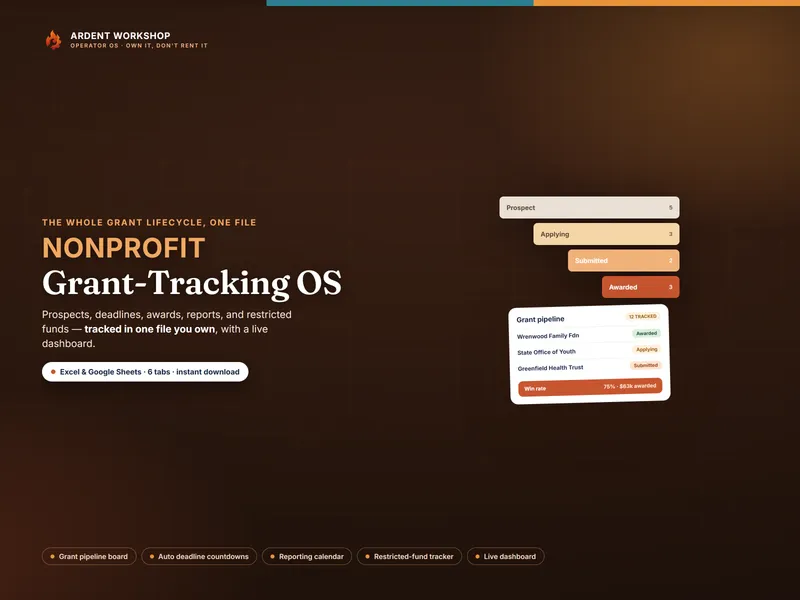
Nonprofit Grant-Tracking OS — Grant Pipeline, Deadline & Reporting Tracker for Excel & Google Sheets
A nonprofit grant tracker for Excel & Google Sheets — manage your grant pipeline, deadlines, reports, and restricted funds in one owned file.
Operator OSView details