An evening of writing today is the cheapest way to stop answering the same questions all year.
Here’s the setup. Every message a buyer sends is a question your online store didn’t answer. Not a hostile question — an anxious one. They’ve paid, they can’t see your workbench, and the only thing standing between that anxiety and your inbox is whether the answer was written down somewhere they could find it.
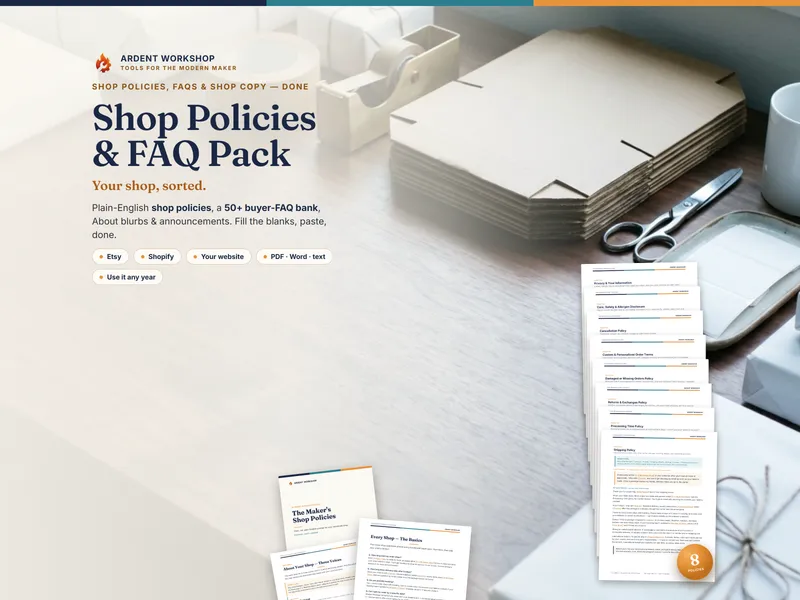
Shop policies are the short public statements on an online store that answer a buyer’s predictable questions before they reach your inbox — processing time, shipping, returns and exchanges, damaged or missing orders, and custom order terms. Plenty of stores have them already. The trouble is the ones written for a lawyer who will never read them, instead of for a buyer who is about to. Those five carry the load. If you’d rather start from a filled draft than a blinking cursor, the Maker’s Shop Policies & FAQ Pack has all eight written out in a short and a detailed version — but the five below are the move either way.
The five shop policies worth writing first
| The message you keep getting | The policy that answers it | The blank only you can fill |
|---|---|---|
| “When will this ship?” | Processing time | Business days from payment to postmark |
| “Where is my order?” | Shipping | Carriers, tracking, and what you do when a parcel goes missing |
| “Can I send it back?” | Returns and exchanges | The window, and who pays return postage |
| “It arrived broken.” | Damaged or missing orders | What proof you need, and how fast you replace |
| “Can you make it in blue?” | Custom and personalized terms | The point after which changes stop |
Now write them. Two or three sentences each — that is genuinely the whole job.
- Processing time. Give a range in business days, not “fast” or “ASAP,” and say when the clock starts. “Orders are made and posted within 3–5 business days of payment” answers the question before it gets asked. Pad the range past what you can do on your worst week, not your best one.
- Shipping. Name the carrier, say whether tracking is included, and — this is the part that gets left out — say what happens once the parcel is with the carrier. A late parcel is annoying; not knowing whose problem it is, is what turns it into a message.
- Returns and exchanges. State the window in days from delivery — at least whatever your local rules require — say who pays return postage, and list what you cannot take back. Custom, personalized, perishable and intimate items are the usual candidates for that list, and saying so up front prevents the conversation nobody enjoys having later.
- Damaged or missing orders. Ask for a photo within a stated number of days, then say exactly what you do next: replace, refund, or reship. A clear damaged-goods policy gives an unhappy buyer somewhere to go first — send a photo, get it sorted — rather than straight to the review box. That is a much better place to be than learning how to respond to a bad review after the fact.
- Custom and personalized order terms. Set an approval point and be blunt about what happens after it. “Spelling is confirmed by message before I start; once cutting begins the design is locked” is one sentence that heads off the expensive kind of remake.
Write a short and a detailed version of every shop policy
Each of the five shop policies needs two lengths, and the short one matters more.
The short version is one or two sentences that live where the buyer is already looking — the listing description, an item FAQ, the announcement bar at the top of your store. The detailed version is the fuller paragraph on your policies page, a page most buyers reach after a problem rather than before a purchase.
If you only have time for one, write the short one. A policy on a page nobody visits before checkout is not intercepting anything.
Three more shop policies: cancellations, care and safety, privacy
Three lower-traffic policies close the remaining gaps: cancellations (how long a buyer has to change their mind before you’ve cut material), care, safety and allergen disclosure (essential for candles, soap, body products and anything edible), and privacy — in many places how you handle a buyer’s address and email is regulated, not just good manners.
After those, the highest-leverage thing you can write is a plain product FAQ: the ten questions your specific craft keeps getting. Sizing. Cure time. Whether it’s food-safe. Whether it’s dishwasher-safe. Every one you answer in writing is one you stop answering by hand.
And keep this separate from your internal documentation — the policies above are what buyers read, while how to write an operations manual covers the version that tells you how the work gets done. Two different documents for two different readers.
The rule that makes shop policies work
Write only what you will actually do.
A 30-day return window you’ll quietly refuse in week three is worse than a 14-day window you honor without flinching. A two-day processing time you hit in January and miss every week of Q4 will generate more messages than the five-day version ever would. Policies aren’t marketing copy — they’re promises you have to keep on your worst day, in your busiest month, when you’re tired.
So set them at the level of your worst week. You can always beat your own policy, and a buyer whose parcel turns up two days early has nothing to message you about.
The takeaway: five short policies, each answering one predictable question, each placed where that question gets asked, each set to what you can actually deliver. That’s the whole system, and it’s a one-evening job.
The Maker’s Shop Policies & FAQ Pack is the shortcut if you’d rather edit than draft — eight policies in both lengths, a 50-plus question FAQ bank with a general set plus a section for your craft, and a note on exactly where each piece goes. Pair it with the Maker’s Customer Service Response Library for the messages that still get through.
And when your shop outgrows the spreadsheets holding it together, Ardent Seller (opens in new tab) is the next step.