Most small nonprofits are not short of a case. They are short of the language.
The facts about your organization have been written down eleven times, slightly differently, by three people, in documents nobody can find. So every application starts from a blank box and a memory of what the budget was two years ago — and then the deadline is Friday, there is half of one person doing development, and the statement of need gets written at eleven at night.
This is a bank of 43 of those passages, already written.
These are writing templates and general guidance — not legal, tax, accounting, or grant-compliance advice. What counts as an allowable cost, what an indirect rate may be, and what a donor needs in order to claim a deduction are set by the funder’s own terms, by federal and state law, and by your auditor. There is a fuller note at the foot of this page.
Every template comes twice — and the second one is the product
The first version is the template, with the blanks in brackets. Copy it, swap in your own facts, send it.
The second version is the same passage written out in full — real sentences, real numbers, the brackets all resolved. A blank template tells you the shape of a paragraph. A finished one tells you the register: how much detail is enough, where a claim becomes an overclaim, and how honest you are allowed to be about a target you missed.
Read the finished one first. Most people find they only need the template afterward, to see which bits are theirs.
Try two of them free. The Organization Boilerplate Builder is the 60-word block and the 150-word organization description, each shown both ways, with the fact-gathering worksheet behind them. No email, no signup — it is 2 of the 43, and it will tell you within a minute whether the other 41 are for you.
One nonprofit, one set of numbers, all the way through
The worked examples are not 43 unrelated samples. They are one invented organization applying for one grant — and the numbers reconcile.
The budget narrative adds up to the figure in the letter of inquiry. The award comes in $7,000 short, and the reply renegotiates the outcome targets rather than quietly promising the same thing for less. The hire slips, so the program starts nine weeks late — and there is an email that says so in September instead of a surprise in July. There is a no-cost extension request, a final report graded against the revised numbers, and a renewal question that argues why year two is not simply year one again.
Watching one set of facts travel through eleven documents is the part a template pack cannot give you, because it only exists if somebody made all of it agree.
The Fact Base: write your answers once
Open four foundation applications side by side and you will find the same questions in different boxes. What is your operating budget. How many did you serve, unduplicated, and how did you count. When were you founded. Who audits you. What is your indirect rate and what is it based on.
The Fact Base is those questions — 44 of them, in seven groups — with a place to write the answer once, a note on why a funder asks each one, and how the example organization answered it. It ships as a print-and-fill book and as a fillable tab in the index spreadsheet, with a live counter of how many you have filled in — and that workbook also comes as a native Google Sheet: one click, Make a copy, no import. Worth using for the Fact Base especially, because different people in an organization hold different answers and a shared Sheet lets them fill it in together.
The last group is not about you at all: it is the six things to keep on file about every funder — the contact, verified rather than assumed; the deadline and board date; their typical grant size; their exact priority phrase; when you last spoke and what the next contact will be.
What a funder is actually reading for
A reviewer is not reading your application the way you wrote it. They are moving through it with a scoring rubric and a queue, checking a small number of things and looking for a reason to stop.
The playbook sets that out section by section — what they check in your organization background, your statement of need, your outcomes, your budget, your capacity, your sustainability answer, and your reports, and what sinks each one. It is the fastest way to decide what to cut when the character limit bites.
The nine sections
- Your fact base and boilerplate — the 60-word, 150-word and full-page organization descriptions, the mission block and the who-we-serve paragraph that has to follow it, and organizational capacity.
- Getting in the door — the fit-check email that saves you three wasted weeks, the first approach to a program officer, the letter of inquiry, the pre-application call question set, and the site-visit invitation.
- The case — statement of need, program description, goals and measurable outcomes, the logic-model one-pager, and an evaluation plan that names what you would do if the data came back bad.
- The money — the budget narrative, justifying staff time, explaining indirect costs without apologizing for them, match and in-kind counted honestly, and sustainability answered with arithmetic instead of the diversification sentence.
- Sponsorship and in-kind asks — the tiered corporate ask, the in-kind request, renewing last year’s sponsor before they budget without you, and the small local ask a board member can send in five minutes.
- Individual donors — the major-donor ask, the lapsed-donor letter written without guilt, the year-end appeal, the monthly-giving invitation, and the gift acknowledgment with its substantiation paragraph.
- After the decision — the award thank-you, accepting the terms, the reply when you are funded for less than you asked for, the declined-application follow-up, and asking a funder what would have made it stronger.
- Reporting — interim and final reports, explaining a budget variance, telling a funder something has gone wrong before they ask, and the no-cost extension request.
- Keeping the relationship between grants — the annual update to a funder who is not currently funding you, the one-page impact story and how to get consent for it properly, the renewal request, and what to send when the person the funder knows leaves.
Honest about what it is
This is writing, not software, and it will not make a weak case strong. If the need is not evidenced, if the program has no schedule, if the outcomes are really outputs, or if you are asking a funder for three times their median grant, no phrasing rescues it.
What it does is make sure a good case is not lost to bad writing — and that a weak one becomes visibly weak to you before it becomes visibly weak to a reviewer.
The example organization is invented. Ninebark Commons Youth Project, its staff, board, funders, donors, EIN and every figure attached to it are made up. The figures are internally consistent so the worked examples hang together; they are not benchmarks and should not be reused as data.
The file that tracks what this one writes
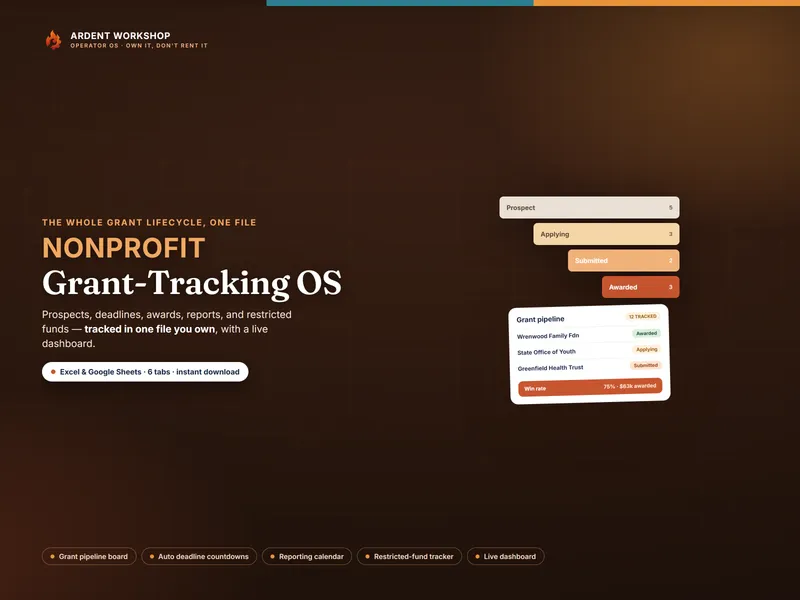
This bank writes the words. It does not tell you which of eleven funders has a report due in March, which application is still sitting in draft, or how much of a restricted award is left. The Nonprofit Grant-Tracking OS is the workbook for that — a grant pipeline with a live deadline countdown, a reporting calendar, restricted-fund balances and a funder directory, in Excel and Google Sheets. The two are built to sit side by side: the Fact Base is where the language lives, and the tracker is where the dates do.
Own it, don’t rent it
These are files you own. No account, no seat, no subscription that decides one day it is no longer strategic and takes your boilerplate with it. Copy them, edit them, keep the ones you rewrite better than we did, hand them to the person who takes the job after you.
The fine print. These are writing templates and general guidance. They are not legal, tax, accounting, or grant-compliance advice and are not a substitute for any of them. What counts as an allowable cost, what an indirect rate may be, what a grant agreement obliges you to do with unspent funds, what a donor needs in order to claim a deduction, and what your state requires before you solicit in it are set by the funder’s own terms, by federal and state law, and by your own auditor — and they change. Check anything with money or compliance attached with your accountant, your counsel, or the funder themselves.