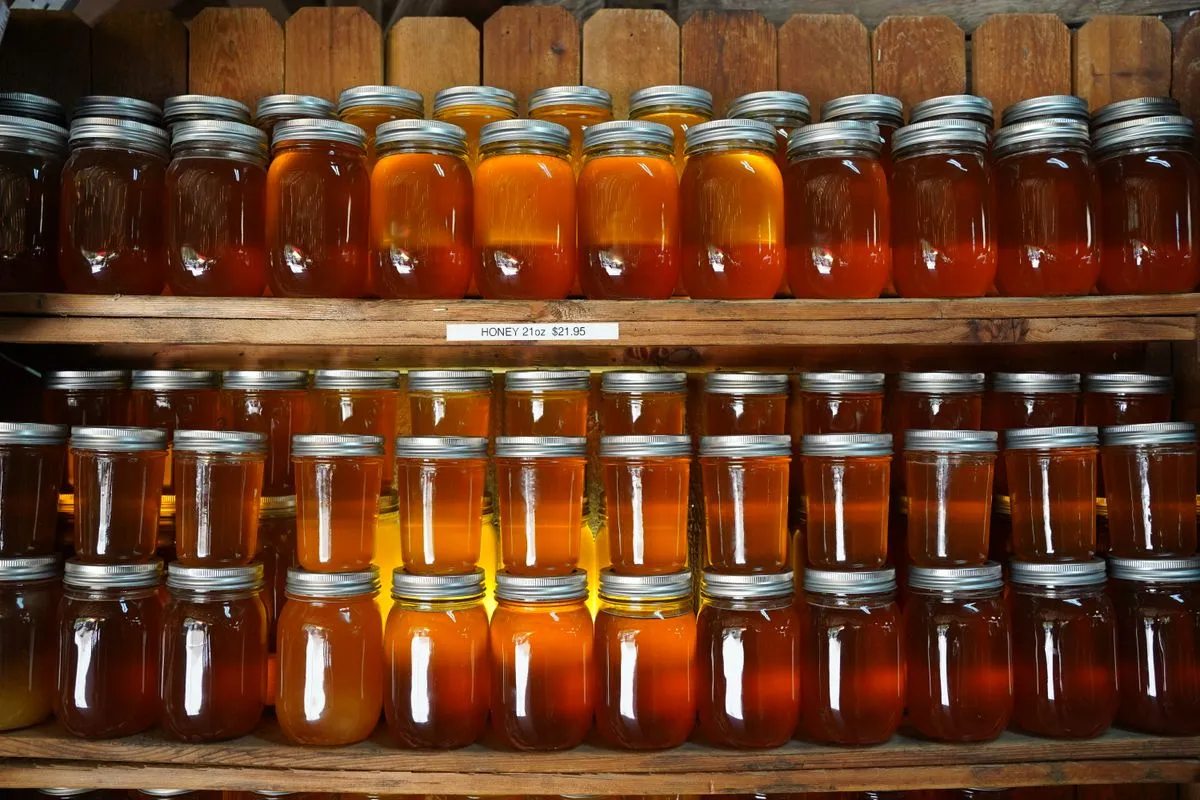
To assign lot numbers to honey, give every extraction a three-part code like 260714-HR-2 (date, yard, bucket), write it on every jar from that bucket, and keep one record row per code. In the next five minutes you will have that code, and a rule for which jars to pull if one harvest goes wrong.
Here is the problem it solves. A customer brings back a jar that has started to ferment. If your jars carry no code, you cannot tell which harvest it came from, so the honest answer is to pull everything on the shelf. With a code, you pull one harvest. The Beekeeper’s Hive, Harvest & Honey-Lot Logbook gives each harvest its own row as a lot, but the code format below works on paper too.
What is a honey lot number?
A honey lot number is a short code on the jar that ties it to one extraction: specific hives, harvested on a specific day, mixed in one bucket or tank. Every jar filled from that bucket shares the code. Nothing else does.
That is the whole idea. A lot is not a season, a yard, or a floral source. It is one batch of honey that was physically mixed together, because that is the unit that can go wrong together.
The FDA’s general recall guidance for industry (21 CFR 7.59) (opens in new tab) asks firms to code products well enough to identify specific lots, so a recall can find every affected lot. Honey is not on the FDA’s Food Traceability List (opens in new tab), so the heavier federal traceability records do not apply to it. What your state asks for varies, and cottage food law is where to check.
How to assign a lot number to honey: the code format
Here’s the move: date, then where, then which extraction.
| Part | Example | What it answers |
|---|---|---|
| Extraction date (YYMMDD) | 260714 | When it came off the hives: July 14, 2026 |
| Apiary or hive group | HR | Where: two letters for the yard (here, a “Hill Road” yard) |
| Extraction number that day | 2 | Which bucket, if you ran more than one |
So 260714-HR-2 reads as “the second bucket extracted at the Hill Road yard on July 14, 2026.” The code is short enough to write by hand, it sorts in date order, and it never needs a lookup table to read.
Three rules keep it honest:
- One bucket, one code. If two buckets were never mixed, they are two lots.
- A blend is a new lot. Mixing two lots makes a third. Give it its own code and note which two went in.
- Never reuse a code. The date prefix handles this almost automatically.
What to record against each lot
The code is only useful if it points to a record. Write one row per lot:
- Extraction date and lot code
- Which hives or yard the frames came from
- Frames pulled
- Gross weight, bucket weight, and net honey weight
- Moisture reading from a refractometer
- Floral source or color, as you judge it
- Jar size and number of jars filled
- Where the jars went: market, shop, wholesale account
The moisture reading matters most if a lot goes wrong later. Higher moisture raises the risk of fermentation. For a benchmark, the USDA’s voluntary U.S. Standards for Grades of Extracted Honey (opens in new tab) set Grade A at a minimum of 81.4% soluble solids, which works out to about 18.6% moisture. A reading on the record tells you whether a returned jar is a one-off or a lot-wide problem.
The last line is the easiest to skip, and it is what makes a pull small. If you know lot 260714-HR-2 went to the Saturday market and one shop, you know who to call.
Where the code goes on the jar
Put it on the bottom or the back label, never the front. A customer doesn’t need to read it. You do, in a hurry.
- A fine permanent marker on the lid or base works for small runs.
- A date-stamp label gun is faster once you fill more than a few dozen jars per lot.
- A pre-printed back label with a blank “Lot” line keeps it consistent.
Example: pulling one lot instead of the whole summer
Here’s how it plays out with illustrative numbers. Say a summer gives you three extractions: 80 jars, 100 jars, and 60 jars, 240 in all. The 60-jar lot was extracted a little early and one jar starts to ferment.
- Without lot codes: you cannot tell the jars apart, so you pull all 240.
- With lot codes: you pull 60, check the moisture on the record, and keep selling the other 180.
Bonus level: let your lots set your cost per jar
Your lot rows add up to something you need for pricing: the total pounds you harvested this year. Divide a full year of hive costs by that number and you have your true cost per pound, which is the step most honey pricing skips. The logbook’s cost-per-jar calculator runs that math, then adds the jar, lid, label and your bottling time to reach a price. For the wider pricing habit, see why handmade sellers undercharge. If you are deciding whether your honey business has outgrown your home kitchen, read should you rent a commercial kitchen or stay cottage food.
Common questions about honey lot numbers
Is a lot number legally required on honey?
It depends on where you sell. No single federal rule makes a small seller print one, so check your state’s honey and cottage food labeling rules. A wholesale buyer or market manager may require one regardless.
Do I need a new lot number if I blend two buckets?
Yes. A blend is a new lot. Give it its own code and note which two lots went into it, so either parent can still be traced.
The Beekeeper’s Hive, Harvest & Honey-Lot Logbook was built for exactly this: one row per lot, net weight and jars filled computed for you, a honey inventory tracked by lot, and a cost-per-jar calculator. It’s an Excel workbook with a Google Sheets copy, and you keep it.